Category Archives: democratic reform overseas

civics road trip: from Philadelphia to Ukraine

I’m in Philadelphia for the Action Civics Initiative Summer Convening, a gathering of students, educators, and NGO leaders who are working to make civic education more action-oriented. From the closing plenary tomorrow, I’m heading to Ukraine to participate in the third annual European Institute of Civic Studies, this year at the Chernivtsi National University. The Institute draws practitioners, scholars, and activists involved with strengthening democracy in Ukraine and its neighbors. On my way home, I’ll stop in Kiev to talk with civic educators who work at the high-school level.

I predict some consistent themes (polarized societies, fragile democratic norms, inequalities of power and agency) as well as some important differences. I plan to blog periodically as I travel, or at least on my return.

See also: action civics goes mainstream and gets controversiallessons from a large youth service program, creating good citizens, and the European Summer Institute of Civic Studies.

does the UK election show a return to two-party rule?

A May 2016 article in the Financial Times was headlined, “British politics has broken out of the two-party system.” The lead explains:

Politics has fragmented. London’s choice of Sadiq Khan as mayor grabbed the headlines — and rightly so. But the local and regional elections across the UK carried a broader message. British politics has broken out of the familiar framework of the two-party system. As in much of the rest of Europe the old rules are being discarded.

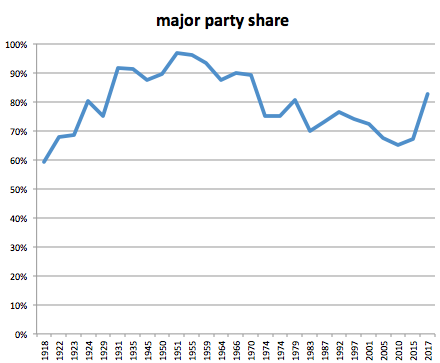
Provisionally, it seems the 2017 election results tell the opposite story. Here’s a hypothesis about what happened in Britain last week:

  1. Elections based on single-member districts tend to produce two-party systems, because votes for parties other than the top two are seen as “wasted.” The exceptions occur when regional parties are able to win majorities in their home areas.
  2. Given two parties, over time, people tend to split their votes about 50/50. If one party has a big advantage, that’s a disequilibrium; soon some demographic or identify groups migrate to the other party to even it out. Voters use party labels as heuristics and are not mainly affected by the specific policies or personalities on offer in a given campaign. That each party will get 50% of the vote is a pretty good guess.
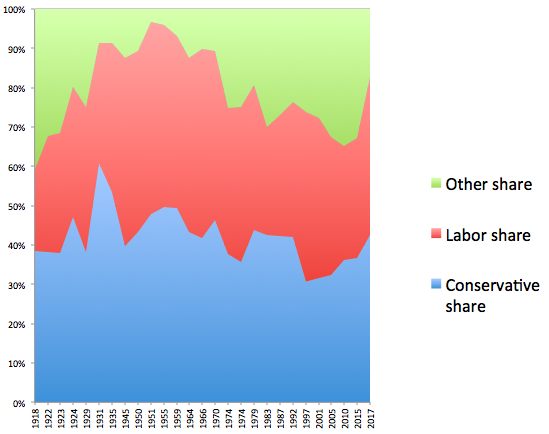
  3. Britain avoided a two-party system for parts of the 20th century, but the 2017 election saw the duopoly return. That’s why, despite May’s poor performance and Corbyn’s arguably radical views, each got closer to 50% of the vote than their predecessors had for decades.

This second graph breaks it down by party:

Sources: The Guardian for the 2017 vote tallies so far. The UK Electoral Commission for historic data. Analysis is my own.

youth don’t always tilt left

(Washington, DC) In the US since 2004, young voters have tilted moderately leftward. They gave very strong support to Barack Obama, especially in 2008. And in Britain right now, only voters under-25 favor Labour:

But young people are not consistently liberal or progressive. In 1984, US voters under 30 decisively chose Ronald Reagan, and as recently as 2000, they split their votes evenly between Bush and Gore. This is a reason, by the way, for both of our major parties to contest the US youth vote.

In 2012, a plurality of young White voters chose Donald Trump over Hillary Clinton. (Her lead among all youth was due, in large measure, to the racial diversity of the Millennial generation.) Among young Trump voters, many expressed concerns about foreign influence on US culture and political correctness.

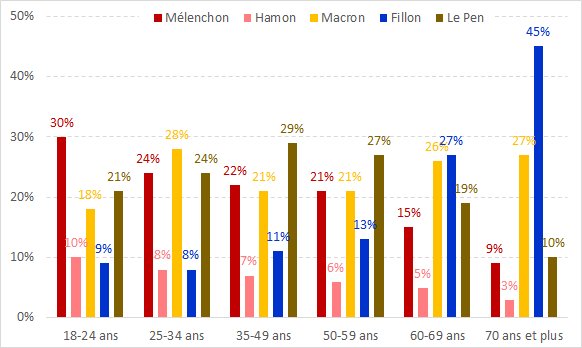
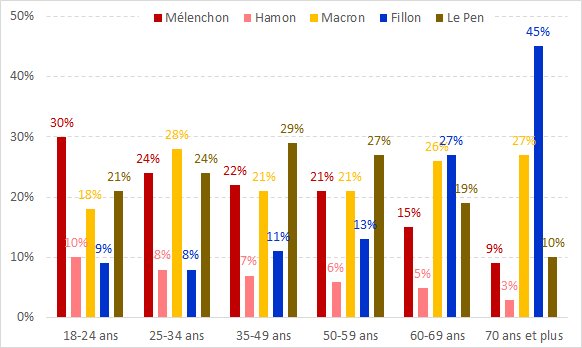
Meanwhile, Marine Le Pen did quite well among young French voters. In the second round, she seems to have drawn about one third of youth, the same proportion as in the population as a whole. For the first round, Yascha Mounk provides the chart below. A plurality of French voters under-25 chose the candidate of the left, Jean-Luc Mélenchon. However, Le Pen’s strongest support came from voters under 35, and particularly those between 25 and 34. Emmanuel Macron, the ultimate winner, performed worse among 18-24s than in any other age range.
These results do not quite match pre-election hype about Le Pen’s youth base. In a poll conducted before the first round, Ipsos had Le Pen leading the youth vote with a plurality of 35%, and reporters for Foreign Policy found many enthusiastic right-wing youth to quote:

At the [FN] conference, smartly dressed, articulate young activists were among those pushing Le Pen’s message most fervently. They hammered home the dangers of multiculturalism and Muslims who “segregate” themselves from secular French society; they pronounced themselves enthusiastically in favor of a “Frexit” from the European Union. Like Dieulafait, who joined the FN at 16, they want a government that puts French citizens’ needs before those of immigrants, and they are not ashamed to say so.

Importantly, this article noted that the National Front is way ahead of other French parties at advancing young candidates for office at all levels.

A much more extreme example: In the 1932 German election that led to Hitler’s dictatorship, the Nazi party received an essential boost from new voters, and specifically from young first-time voters. Christopher Browning writes, “The first groups to be taken over by Nazi majorities were student organizations on university campuses. In their electoral breakthrough in 1930, the Nazis won the vast majority of first-time voters, especially the youth vote.” And Dick Geary writes that Nazi Party “membership was younger than that of other parties; the average age of those joining between 1925 and 1932 was slightly under twenty-nine.”

It is always right to encourage youth engagement in democracy and to support young people to form their own view of issues and values. In a country like the US, it’s also important to boost their turnout levels because they (and their interests) are under-represented. Of course, if they prefer parties to the right of center, that is their prerogative. But progressives, liberals, mainstream conservatives, and libertarians shouldn’t romanticize youth as some kind of natural base for their movements or assume that generational change shifts the world toward democratic and cosmopolitan values. If a society harbors nationalistic, xenophobic, or downright racist views, those values will probably transmit to each new generation.

I love Hannah Arendt’s fundamental insight that only “the birth of new men and the new beginning, the action they are capable of by virtue of being born … can bestow upon human affairs faith and hope.” In other words, because new human beings are always coming into the world, we can hope that things will change for the better. But there’s certainly no reason to assume that this will happen on its own.

See also: Millennials’ political opinions: insights from the new CIRCLE pollthe Millennials and politicsin what ways are Millennials distinctive?; and the Millennials’ political values in context.
Habermas on the French election

Here are Jürgen Habermas’ recent remarks on “the future of Europe” at an event with President-elect Emmanuel Macron and German Foreign Minister Sigmar Gabriel. They spoke in March, before the election, but Habermas credits Macron with courage in “a challenging situation.”

Habermas calls for broad public deliberation about the basic values of the European Union, in contrast to a technical negotiation among elites.

European unification has remained an elite project to the present day because the political elites did not dare to involve the general public in an informed debate about alternative future scenarios. National populations will be able to recognize and decide what is in their own respective interest in the long run only when discussion of the momentous alternatives is no longer confined to academic journals – e.g. the alternatives of dismantling the euro or of returning to a currency system with restricted margins of fluctuation, or of opting for closer cooperation after all.

This has been a consistent theme for Habermas for more than seven decades as a public intellectual. In the 1950s, he argued against counting on the German Constitutional Court to define and protect the Federal Republic that had been designed by the Western allies. Instead, the German people must hold a democratic conversation that led to democratic institutions. Likewise, when East Germany fell, Habermas argued that its political institutions were worthless, but that the peoples of East and West should come together to design a new constitution for a unified Germany. (Instead, the GDR was simply absorbed into the post-War Federal Republic.)

Habermas names a list of crises that he thinks are forcing a broader and deeper conversation: Syria, terrorism, and (in a word) Trump.

Nationalist, racist, anti-Islamic, and anti-Semitic tendencies that have acquired political weight with the program and style of the new US administration are combining with authoritarian developments in Russia, Turkey, Egypt, and other countries to pose an unexpected challenge for the political and cultural self-understanding of the West. Suddenly Europe finds itself thrown back upon its own resources in the role of a defensive custodian of liberal principles (providing support to a majority of the American electorate that has been pushed to the margins).

Habermas has always been friendly to the American people and culture, which is a noteworthy stance for the head of the Frankfurt School. He seems to have been a fan of Barack Obama. I appreciate his support for the liberal part of our electorate.

Finally, Habermas calls for an expansion of democratic public spheres beyond the nation-state, in response to the globalization of public problems.

The institutionalization of closer cooperation is what first makes it possible to exert democratic influence on the spontaneous proliferation of global networks in all directions, because politics is the only medium through which we can take deliberate measures to shape the foundations of our social life. Contrary to what the Brexit slogan suggests, we will not regain control over these foundations by retreating into national fortresses. On the contrary, politics must keep pace with the globalization that it set in motion. In view of the systemic constraints of unregulated markets and the increasing functional interdependence of a more and more integrated world society, but also in view of the spectacular options we have created – for example, of a still unmastered digital communication or of new procedures for optimizing the human organism – we must expand the spaces for possible democratic will-formation, for political action, and for legal regulation beyond national borders.

See also: Ostrom, Habermas, and Gandhi are all we needMatthew G. Specter, Habermas: An Intellectual Biography and Habermas and critical theory (a primer)

two cheers for the West

The defeat of Marianne Le Pen is a victory for the European Union; and the EU is one of the structures built in the wake of World War II either directly or indirectly by the Western Allies in that war. In that sense, the EU is part of a project called “the West” that also includes at least the Marshall Plan and NATO–and arguably institutions that span the globe, like the IMF and the UN. These institutions are now beset by critics from Putin and Orban to Trump.

One reason to call these institutions “Western” is that Washington, New York, and Brussels lie to the west of, say, Moscow and Beijing. But at least some people believe that these institutions reflect a perspective, value-system, or set of ideals that can be usefully named “the West.” When I took a “Western civilization” course in the 1980s, it was colloquially called “Plato to NATO.”

One of the deepest ideological fault-lines of our time is how to assess this thing called “the West.” Imperialistic? Reactionary? Liberatory? Ethnocentric? Universalist? Inclusive? Greedy? Humane? A threat to US (or French) sovereignty, or an imposition of US (or French) power on others?

This debate seems intractable because institutions like the EU and NATO (not to mention the UN) have been involved in so many episodes and policies and have had so many effects on nations around the world. And if the West means a perspective or value-system, it is fatally vague. Anything we could define as “the West” in that sense encompasses too much diversity and overlaps too much with other cultural traditions to be meaningful.* For instance, Plato actually has almost nothing in common with NATO, but was an explicit influence on the Islamic Republic of Iran.

On the other hand, most large, co-constructed projects offer resources and inspirations for the present. Even if the first thing that comes to mind when you think of the EU or NATO is the exploitation of the Global South, these institutions also reflect other traditions. They were built on FDR’s Four Freedoms, the UN Declaration, and the promise of economic and social integration to prevent war. A set of states whose domestic arrangements range from democratic socialism to untrammeled capitalism have cooperated to advance international law, human rights, democratic institutions, and robust and interconnected cultures. I don’t deny that these states have done other things as well, but their achievements have been remarkable. Just compare continental Europe in 1945 and 2017.

I’m not sure we have conveyed the grandeur of this achievement–or its vulnerability. The EU is not just an economic zone with high GDP and a lot of bureaucrats in Brussels. It is part of a project that reflects high ideals for humanity. Stopping Le Pen has saved the EU to fight another day, but it doesn’t automatically convey the institution’s ideals. To make the European project inspiring again will require not only beating off its explicit enemies but also reforming “Western” institutions so that they again advance their best values.

*See my posts on the West and the restavoiding the labels of East and Westwhen East and West were one; and on modernity and the distinction between East and West.