social movements depend on social capital (but you can make your own)

The Montgomery Bus Boycott was the glorious chapter in the American Civil Rights Movement that began when Rosa Parks refused to give up her seat on the segregated bus. This story is usually misrepresented in ways that hide Parks’ planning, leadership, skill, and feminist radicalism (see the real Rosa Parks). In any case, at least 99 percent of the city’s African Americans quickly started boycotting the bus company. That meant that 17,500 workers needed a different way to get to work.

At first, Black-owned taxi companies carried them for the price of a bus ticket, but then the city threatened to enforce a minimum-fare law. Next, more than 150 people volunteered to drive boycotters to work in their own cars. These volunteers “responded immediately,” Martin Luther King recalls in Stride Toward Freedom, but “they started out simply cruising the streets of Montgomery with no particular system.” That must have meant that many workers missed getting available rides. Ministers responded by calling for new volunteers from their pulpits, and even more drivers came out, but that meant (King writes) that “the real job was just beginning–that of working out some system for these three hundred-odd automobiles, to replace their haphazard movement around the city.”

Committees were formed and roles were assigned. It was easy to identify [morning] pickup locations, because African Americans lived in dense urban neighborhoods. But “we discovered that we were at a loss in selecting [afternoon] pick-up stations,” because domestic workers were employed all over the White neighborhoods. Two Black postal workers helped design regular routes. King recalls all this organizational work with evident pride, and concludes, “Altogether the operation of the motor pool represented organization and coordination at their best. Reporters and visitors from all over the country looked upon the system as a unique accomplishment.”

I’d like to draw two theoretical implications from this story.

First, we tend to think of social movements as examples of contentious politics, along with protests, strikes, and even revolutions. Contentious politics has a substantial literature. A separate literature concerns how communities organize themselves to provide services and manage common resources over the long term. For the most part, these two discussions are rather separate. They draw on different disciplines and have different dominant rhetorical styles. But actual social movements rely heavily on what could be called “common pool resource management.”

The two postal workers who designed routes exemplify lessons from the research of Elinor Ostrom and her colleagues: local people tend to have the most detailed relevant information; clear rules enable coordination; and public goods can be rotated geographically to serve many people. I’ve been arguing that we should combine the political-economy of Elinor Ostrom with the insights of Gandhi and King for a more complete civic theory.

The practical implication is that people who want to confront power often benefit from learning how to organize systems and processes that look like nonprofit enterprises.

Second, it’s commonplace to note the dependence of the civil rights movement on “social capital,” especially in the form of churches and unions. Both institutions play explicit roles in Dr. King’s narrative of Montgomery. But this analysis can leave you at a loss if you’re part of a community that doesn’t happen to have much social capital. And social capital can be mysterious, for it is invisible, and its connections to tangible outcomes seem obscure.

Indeed, social capital is a metaphor: Montgomery’s African Americans did not have a literal deposit of social capital in the bank. When social capital is measured by asking individuals about their tendency to join groups and to trust one another, it’s hard to see how we could boost these assets or why they would be important politically.

A different way of looking at social capital is as a concrete capacity to solve collective-action problems, such as providing free rides to 17,500 people every day. That may have been easier in Montgomery because so many people were already organized in other successful, functioning groups, such as the Black churches. “Labor, civic, and social groups were our staunch supporters,” King writes, “and in many communities new organizations were founded just to support the protest.” Like other forms of capital, social capital can be built up in one place and used in another. But what mattered was actually organizing the carpools to sustain the boycott. Skillful citizens can pull off such successes even in the absence of existing high levels of social capital, when they design good structures.

In short, social capital is a metaphor for self-organization, and people can self-organize.

See also what is a social movement?Ostrom, Habermas, and Gandhi are all we need; and Habermas, Ostrom, Gandhi (II).

youth don’t always tilt left

(Washington, DC) In the US since 2004, young voters have tilted moderately leftward. They gave very strong support to Barack Obama, especially in 2008. And in Britain right now, only voters under-25 favor Labour:

But young people are not consistently liberal or progressive. In 1984, US voters under 30 decisively chose Ronald Reagan, and as recently as 2000, they split their votes evenly between Bush and Gore. This is a reason, by the way, for both of our major parties to contest the US youth vote.

In 2012, a plurality of young White voters chose Donald Trump over Hillary Clinton. (Her lead among all youth was due, in large measure, to the racial diversity of the Millennial generation.) Among young Trump voters, many expressed concerns about foreign influence on US culture and political correctness.

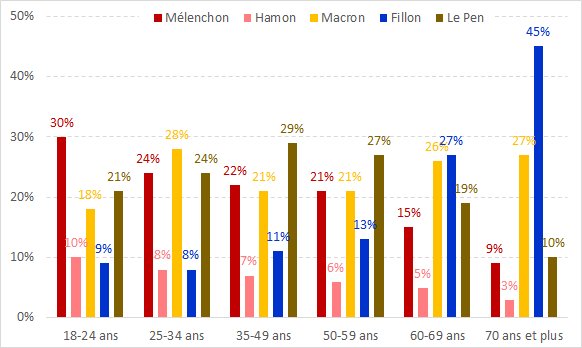
Meanwhile, Marine Le Pen did quite well among young French voters. In the second round, she seems to have drawn about one third of youth, the same proportion as in the population as a whole. For the first round, Yascha Mounk provides the chart below. A plurality of French voters under-25 chose the candidate of the left, Jean-Luc Mélenchon. However, Le Pen’s strongest support came from voters under 35, and particularly those between 25 and 34. Emmanuel Macron, the ultimate winner, performed worse among 18-24s than in any other age range.

These results do not quite match pre-election hype about Le Pen’s youth base. In a poll conducted before the first round, Ipsos had Le Pen leading the youth vote with a plurality of 35%, and reporters for Foreign Policy found many enthusiastic right-wing youth to quote:

At the [FN] conference, smartly dressed, articulate young activists were among those pushing Le Pen’s message most fervently. They hammered home the dangers of multiculturalism and Muslims who “segregate” themselves from secular French society; they pronounced themselves enthusiastically in favor of a “Frexit” from the European Union. Like Dieulafait, who joined the FN at 16, they want a government that puts French citizens’ needs before those of immigrants, and they are not ashamed to say so.

Importantly, this article noted that the National Front is way ahead of other French parties at advancing young candidates for office at all levels.

A much more extreme example: In the 1932 German election that led to Hitler’s dictatorship, the Nazi party received an essential boost from new voters, and specifically from young first-time voters. Christopher Browning writes, “The first groups to be taken over by Nazi majorities were student organizations on university campuses. In their electoral breakthrough in 1930, the Nazis won the vast majority of first-time voters, especially the youth vote.” And Dick Geary writes that Nazi Party “membership was younger than that of other parties; the average age of those joining between 1925 and 1932 was slightly under twenty-nine.”

It is always right to encourage youth engagement in democracy and to support young people to form their own view of issues and values. In a country like the US, it’s also important to boost their turnout levels because they (and their interests) are under-represented. Of course, if they prefer parties to the right of center, that is their prerogative. But progressives, liberals, mainstream conservatives, and libertarians shouldn’t romanticize youth as some kind of natural base for their movements or assume that generational change shifts the world toward democratic and cosmopolitan values. If a society harbors nationalistic, xenophobic, or downright racist views, those values will probably transmit to each new generation.

I love Hannah Arendt’s fundamental insight that only “the birth of new men and the new beginning, the action they are capable of by virtue of being born … can bestow upon human affairs faith and hope.” In other words, because new human beings are always coming into the world, we can hope that things will change for the better. But there’s certainly no reason to assume that this will happen on its own.

See also: Millennials’ political opinions: insights from the new CIRCLE pollthe Millennials and politicsin what ways are Millennials distinctive?; and the Millennials’ political values in context.

is everyone religious?

In the perennial debate about the place of religion in politics and public life, one available stance is: “Everyone is religious.” This position has weaknesses, which I will mention below, but here are three points in its favor:

  1. Ethical people hold beliefs that are hard, if not impossible, to justify with empirical evidence. For example, I believe that all human beings are equal. That is not a scientifically demonstrable claim. Science finds all kinds of inequalities of capacity, potential, and importance among actual human beings, who include speechless infants and late-stage Alzheimer’s patients. Equality is instead a moral premise. I don’t happen to take it directly from an overtly religious source, but it could be viewed as similar to a religious statement, such as “God loves the world.”
  2. Everyone should recognize that the universe exceeds our capacity to understand it, even by means of cumulative empirical research. I know things that our dog just can’t. I know, for example, that he and I live in the United States, which is a republic. Perhaps he knows some things that I can’t. With appropriate tools, I could collect the same information that he takes in with his remarkable nose, but I wouldn’t know what it feels like to sense that a cat crossed “his” yard five hours ago. A creature with a much different brain from either my dog’s or mine could know things that neither of us can. One needn’t believe in God, then, to acknowledge the likelihood that the universe is permanently unknowable by us and a place of mystery.
  3. Religions do not have foundational articles of faith from which all their other beliefs flow. Sometimes they present themselves that way. Some Jews say that the whole Law follows logically from the revelation on Sinai; some Christians, that everything is implied by God’s sacrifice of His Son on the cross; some Muslims, that everything results inevitably from believing in God and His last prophet. But I don’t think these claims do justice to their respective traditions. Religions are actually large webs of metaphysical beliefs, stories, characters, rules, examples, traditions, rituals, and hopes. Everyone has such a web, whether we see ourselves as religious or not. In fact, many items in the idea-network of a religious person are also present in my network.

In the end, it’s probably a mistake to lose the category of religion or to view religious worldviews as completely parallel to secular ones. The main reason is sociological. Since (I think) the Babylonian Captivity, the Abrahamic religions have organized themselves in a certain way within larger societies. They treat membership in the religious community as an identity: something you are, not just a set of ideas you endorse. They view certain texts as canonical. They emphasize beliefs that are matters of faith (“things hoped for, evidence of things not seen”) over memories or observations. And they gather their believers in groups that form larger networks or structures. The original meaning of the words “congregation,” “synagogue,” and ecclesia (Greek for “church”) is coming-together, a tangible social act. I think the great Asian traditions have been influenced by these sociological forms and have begun to look somewhat like Abrahamic faiths, as a result of isomorphism.

Such religions operate as identity groups and convene in organized structures. They can thus be oppressed and persecuted but can also dictate to others when they control power. That means that a liberal state is wise to identify religions for protection but also to make the government and law neutral among religions. The reason is not metaphysical or epistemological–it’s not that religious people fundamentally believe in different kinds of truths or think in different ways from secular people–but sociological. Religions function differently from other clusters of beliefs and practices.

However, if we adopt this position, then we should at least inquire into whether certain secular belief-communities have also taken forms parallel to those of the Abrahamic faiths, again perhaps due to isomorphism. Doesn’t, for instance, medical science offer its own bounded identities, canonical texts, hierarchies, moral premises, rituals, heroes, and exemplary cases? If it does, then possibly it should be viewed as similar to a religion–which is an idea as old as Durkheim.

I would be reluctant to draw radical implications for US constitutional law. Our traditional ways of defining and protecting religions reflect some pragmatic experience and help to constitute our political culture. I wouldn’t necessarily rock that boat. But if the question is not “How should the Supreme Court interpret the Establishment Clause?” but rather, “What distinguishes religious thinking?” then I am inclined to suspect that everyone is religious and that religion is everywhere.

See also a typology of denominationsare religions comprehensive doctrines? and is all truth scientific truth?

the Hollowing Out of US Democracy

In lieu of an original post here today, I’ll link to a new post of mine on The Evidence Base, a group blog from CESR, the Center for Economic and Social Research at University of Southern California.  I argue that the decline of certain types of associations has left many Americans, especially White working-class citizens, in what my colleagues at the Tisch College of Civic Life and I call “Civic Deserts.” This trend does not explain why a Republican president won in 2016 or why he has taken certain views of policy and ideology. But it does explain the appeal of his leadership style. Citizens who have never belonged to everyday local associations with responsible and accountable leaders do not expect such leadership from their president.

I also explain my SPUD framework, which stands for Scale, Pluralism, Unity, and Depth. SPUD, I propose, is the recipe for effective civic and political organizations, but it is difficult to achieve and is much scarcer today than decades ago.

mini-conference on Facts, Values, and Strategies

We are about to begin discussions of the papers listed below, in draft form. They are destined for The Good Society journal. The conversations are at the Tisch College of Civic Life at Tufts

For me, the underlying rationale goes like this. A good person is always asking “What should I do?” That question must become plural–“What should we do?”–for two reasons: we cannot accomplish enough alone, and we must reason together to improve our opinions. Both questions integrate facts and values. Something that works but isn’t good is not what we should do. Likewise, we want to avoid something that is good but doesn’t fit the circumstances of the time and place.

The structure of intellectual life in modernity frustrates asking these questions, for several reasons. One major reason is that matters of value are assigned to certain disciplines in the humanities, while matters of fact go to disciplines that widely imitate science and present themselves as value-free.

It’s easy to call for a reintegration of facts and values (and strategy), but very hard to pull that off. Fortunately, we have traditions of thought–always contributed by many thinkers and practitioners rather than a single luminary–that do reintegrate facts, values, and strategies. Names that stand for these traditions include Gandhi, Pope Francis, Hannah Arendt, William James, Amartya Sen, Elinor Ostrom, and Jurgen Habermas. These names recur in interesting combinations in the following papers. So do certain themes: the limitations of human cognitive abilities and the positive potential of certain kinds of affect; the value of institutions for structuring deliberation; the link between work and reflection; and the value of deep, responsive uncertainty–wonder.

“Public Entrepreneurship, Civic Competence, and Voluntary Association: Self-Governance Through the Ostroms’ Political Economy Lenses” — Paul Dragos Aligica, George Mason University

“Giving Birth in the Public Square: Dialogue as a Maieutic Practice” — Lauren Swayne Barthold, Endicott College and Essential Partners

“William James’s Psychology of Philosophizing: Selective Attention, Intellectual Diversity, and the Sentiments in Our Rationalities” — Paul Croce, Stetson University

“Democracy as Group Discussion and Collective Action:Facts, Values, and Strategies in Rural Landscapes” — Timothy J. Shaffer, Kansas State University

“Social Media, Dismantling Racism and Mystical Knowing: What White Catholics are Learning from #BlackLivesMatter” — Mary E. Hess, University of Toronto

“Institutions, Capabilities, Citizens” — James Johnson, University of Rochester, and Susan Orr, SUNY College at Brockport

“Forgiveness After Charleston: The Ethics of an Unlikely Act” — Larry M. Jorgensen, Skidmore College

“Facts, Values, and Democracy Worth Wanting: Public Deliberation in the Era of Trump” — David Eric Meens, University of Colorado Boulder

“The Praxis of Amartya Sen and the Promotion of Democratic Capability” — Anthony DeCesare, St. Louis University

“A Civic Account of Justice” — Karol Edward Soltan, University of Maryland