notes on cultural appropriation after the royal wedding

In the current debate about “cultural appropriation,” I would offer these premises: everything is mixed, mixing is good, having your culture borrowed can give you more power, and demands for authenticity are problematic. Although I recognize exceptions and complications, we should start by welcoming “appropriation.”

I have not seen anyone complain that the recent royal wedding was an example of appropriation, and I’m interested in why not. After all, very rich white people incorporated African American culture into their ceremony, literally bringing it into their castle. It seems evident that Black American Christianity arrived in strength and confidence and made the whole ensemble much better than it would otherwise have been. That shows that you can’t judge an act of borrowing without looking closely; and often you will find it admirable.

The wedding was a mashup of English or British traditions with African American culture, the latter in the form of Bishop Michael Curry’s magnificent  sermon and the music (“Stand By Me” and “This Little Light of Mine”). But, like everything human beings do, it’s much more mixed than that. When Rev. Curry read, “Set me as a seal upon your heart, / as a seal upon your arm,” he was sharing his patrimony, a great text of his tradition. He chose the New Revised Standard translation, which subtly echoes the King James Version (particularly prized by African American preachers), which was commissioned by Prince Harry’s eponymous ancestor, James I of England. That Bible was basically an appropriation of the translation by the heretic/martyr William Tyndale, who knew Greek and Hebrew but seems to have read the Song of Songs in the Latin translation by St. Jerome (an Illyrian), who had translated the Greek Septuagint version (made in Egypt), which–in turn–translated the Hebrew original songs, which have parallels with Mesopotamian and Egyptian love poetry of the same era. The songs are attributed to Solomon, who loved the daughter of Pharaoh and “women of the Moabites, Ammonites, Edomites, Zidonians, and Hittites” (1 Kings 11). Solomon sang for all these nations. 

In other words, it’s all borrowing, as far as the eye can see. And not just on Rev. Curry’s side. Prince Harry is a British royal. If you trace his paternal line back a millennium, you reach Elimar I (1040-1112), the Count of Oldenburg in Saxony, from whom also descend the royal families of Russia, Greece, and Denmark, among others. Windsor Chapel was founded by a King of England of Viking descent whose motto was the Middle French phrase Honi soit qui mal y pense

I can’t resist noting that if you discuss “appropriation,” you are using a word derived from the Latin appropriare, which is first attested in the medical work of Caelius Aurelianus, who was an African man, a subject of Rome, best known from translating from Greek.

But doesn’t borrowing a cultural product mean taking it from the people who rightly hold it? Isn’t it therefore an act of power that benefits the taker?

Not necessarily, because culture isn’t zero-sum. Everyone can draw from the cultural commons. Jefferson said, “He who receives an idea from me, receives instruction himself without lessening mine; as he who lites his taper at mine, receives light without darkening me.”

Power is relevant, and it’s not OK to steal other people’s patrimony, like Napoleon carting off 695 Roman sculptures to fill the Louvre. But culture has power of its own, even when it’s set against guns and money.

Again, consider the juxtaposition of English aristocrats and African Americans at the recent wedding. There is no doubt that Black Americans face structural as well as intentional racism, in a pattern that extends across the Atlantic; Britain is implicated in it. White English people who are invited to a royal wedding are far more privileged than Americans of African descent.

But not more culturally powerful. Surely in our world of 7.6 billion, the 40 million Black Americans have some of the most “soft power.” Influence is currently flowing from Black America to places like Windsor Castle in a mighty stream.

One of the reasons is sheer excellence. I don’t think you can properly assess cultural transfer unless you are attuned to quality. Perhaps we should appreciate all the cultural traditions of the world for what they are, but there are great peaks as well as modest hills. The African American church is one of the mightiest ranges. It contributes theology, rhetoric, music, a political repertoire, and a distinctive moral vision to the whole world. Of course, it is made from a mixture of elements: so is everything human. But this mixture is particularly powerful. In the exquisite setting of a late-Gothic royal chapel, representatives of the traditions of the Black church added their unique voices and made the whole greater than the sum of its parts. There are excellent reasons not to call such moments “appropriation.”

See also: what is cultural appropriation?when is cultural appropriation good or bad?cultural mixing and powerMaoist chic as Orientalismeveryone unique, all connectedJesus was a person of color.

Bologna, Santiago de Cali, and Tulsa win Cities of Service’ first Engaged Cities Award

I enjoyed serving on the selection committee for Cities of Service’s inaugural Engaged Cities Award and reading many superb applications. The winners were announced today. From the announcement:

  • Bologna, Italy: Realizing that bureaucracy was hindering citizens’ ability to improve their city, Bologna adopted new regulations allowing residents to partner with the city to revitalize public spaces. The new regulations spurred the city to establish district laboratories, where city staff connected with residents to develop their ideas and co-design initiatives. The labs engaged thousands of residents and resulted in more than 400 citizen-led initiatives, including turning an abandoned market into a concert hall for hundreds of local musicians to play and converting a former parking garage into a full-service bike station run by a resident cooperative.
  • Santiago de Cali, Colombia: To combat a high level of violence, especially between neighbors, Santiago de Cali created local councils, made up of citizens in 15 city districts. The councils designed and implemented more than 200 community initiatives, including the rehabilitation of a number of public spaces that had been used for drug activity, dance classes for at-risk youth, and soccer tournaments involving local youth and former gang members. The citizen-led initiatives benefitted more than 15,000 residents, building trust and reducing conflict in their communities.
  • Tulsa, Oklahoma: Tulsa had hundreds of data sets that could help them grow per capita income, increase population, reduce violent crime, and address other challenges. But they did not have the capacity to analyze the data for insights it might provide. The city created teams of city staff, citizens, and nonprofit partners to examine city data and help the city address more than a dozen public problems. The teams have proposed a number of solutions, including a better method for prioritizing street repairs, a tool for citizens to collect much-needed blight data, and more.

Even as national politics is dysfunctional or repugnant in many countries, cities are hotbeds of innovation and are often simply well governed. This is a truth increasingly acknowledged–most recently by Jim and Deb Fallows in Our Towns–but it is both encouraging and interesting.

See also: engaging citizens in cities“A Tale of Two Cities”: comparing the best and worst cities for civic engagementthe rise of urban citizenship; and A New Model for Citizen Engagement.

support civics in Massachusetts #CivicsforMA #MAcivicsforall

Right now is a “virtual advocacy day” for Massachusetts S.2375, “an act to promote and enhance civic engagement. I’m doing my bit by blogging in support of the law–which will also need an adequate appropriation. The bill would:

  • Require that all public schools teach American history and civics education in accordance with the History and Social Science Curriculum Framework.
  •  Establish a “Civics Project Fund,” which shall be used by the Department of Elementary and Secondary Education (DESE) to implement the various requirements of the bill (including offering professional development and developing model curriculum). The fund will consist of appropriations and donated funds.
  • Mandate that every student in the Massachusetts public school system have the
    opportunity to participate in at least 2 student-led civics projects, at least one of which
    would be completed after 8th grade and would be a graduation requirement. Projects may be individual, small group, class-wide, or as part of required coursework.
  • Allow DESE, subject to resources, to establish regional civics councils to monitor and
    provide resources for civics education implementation throughout the commonwealth.
    DESE may also hold annual conventions for such regional councils to meet and assess
    the state of civics education, share best practices, and make recommendations to the
    Board of Elementary and Secondary Education (BESE).
  • Require DESE, subject to resources, to create tools aligned with the History and Social
    Sciences Curriculum Framework to support districts in implementation .
  • Require DESE, subject to resources, to establish the “Edward Moore Kennedy and Edward William Brooke III Civics Challenge,” which shall be available to all eighth-grade public school students. Student participants will present civics projects for evaluation and recognition.
  • Direct the Secretary of the Commonwealth to establish a “High School Voter Challenge” in which every public high school may nominate one or more students to serve as voter outreach coordinators. Designated “high school voter challenge weeks” will be used to hold voter registration drives for students who are eligible to register or pre-register to vote. The Secretary will also be responsible for disseminating information to cities and towns to promote youth membership on municipal boards, committees and commissions.
  • Require BESE to provide opportunities for educators to receive professional development.
  • Require DESE to convene a commission to develop a proposal for the establishment of a civic education and public service program for Massachusetts youth.
  • Require DESE to conduct a study on the implementation of the act.

See also: the first “civic ed” bill: 1642my exchange with Beth Rubin about policy for civics; and new overview of civic education

where youth stand on the 2018 election

On April 30, Reuters drew attention with the headline, “Exclusive: Democrats lose ground with millennials – Reuters/Ipsos poll.” The basis was a pair of online surveys of more than 16,000 registered voters under age 35 conducted in 2016 and 2018. In the 2016 survey, a generic Democratic House candidate beat a generic Republican by 28 points (55%-27%). In the 2018 survey, the lead had narrowed to 18 points (46%-28%). Among White men under 35, the generic Democrat lost 11 points between these surveys, and the generic Republican gained 10 points, putting the Republican ahead among this demographic group.

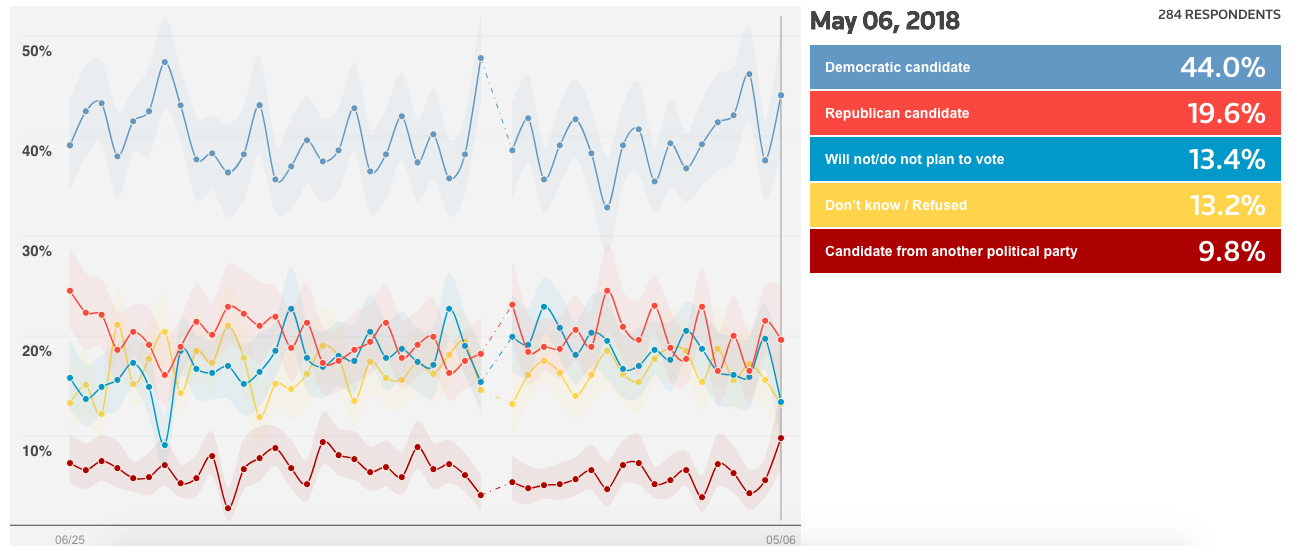
It is important not to overstate the decline based on this single comparison. Democrats have held a consistent and substantial lead in generic House candidate surveys since 2017. According to Reuters’ own tracking poll, in the week ending May 6, 2018, a Democratic generic House candidate led a generic Republican by 24 points (44%-19.6%) among 18-29s. In contrast, Reuters is currently showing a Democratic lead of only 6.3 points for all adults.

Over the whole period since June 2017, the Democratic ticket has always led the Republican ticket among 18-29s, and there is no sign of decline. Among age groups, under-30s have been by far the most favorable to Democrats.

On the other hand, there is no question that young Americans view the Democratic Party brand with some skepticism, and this creates headwinds for candidates in 2018. Reuters reports that 34% of under-25s think that the Democrats have a better plan for the economy, but 32% prefer the Republicans’ plan–basically a tie. Even as surveys show young people becoming more likely to identify as “liberal,” they also show declining willingness to identify as Democrats (with most shifting to Independents).

Millennials first entered the electorate in significant numbers in 2008, and, despite the recession, a majority felt they were middle class that year. But the proportion who identified with the middle class slipped a bit in 2009 and then slumped dramatically in 2010, not yet to recover. In 2016 General Social Survey, just one third of Millennials placed themselves in the middle class. And according to CIRCLE’s survey conducted around that year, only 17 percent of Millennials felt that the “economic system in this country is basically fair to all Americans.”

Thus, even while the nation saw a long (if slow) economic recovery under President Obama, Millennials were experiencing a rapid drop out of the middle class and drawing negative conclusions about the economic system. Since 2017, unemployment has fallen, and it’s possible that surveys would show some improvement in Millennials’ sense of their own economic circumstances under President Trump.

I conclude:

  • Democrats must reach out to youth to capture the support of this constituency, which leans their way.
  • Republicans can reasonably expect to contest the youth vote, if they try.
  • Candidates should address a wide range of economic concerns, including but extending beyond college affordability.
  • Antipathy to Donald Trump is real, but Millennials need other reasons to support Democrats.

See also: the politics of student debtthe weakening bond between millennials and the middle classnew CIRCLE report on Millennials’ ideologyhow Millennials split on some key issues; and how talking about Millennials obscures injustice.

take a survey on civic education in the US

Would you be willing to take a survey that will help a new coalition expand and improve civic education in the USA? This coalition is led by iCivics, and many leaders in the field have already joined. I am part of this coalition.

The online survey will take less than 15 minutes to complete. It will ask you a few questions about who you are, how you personally relate to civic education, and what you think about the state of civic education today.

The survey will also lead you through an exercise called the “Five Whys.” You’ll be asked whether you think that we provide good enough civic education in the USA today. If you don’t think so, you’ll be asked “What is one reason that civic education is not good enough today?” You’ll suggest a reason, and then you’ll be asked why you think that reason exists. Next, you’ll be asked for a reason for that reason. This activity will continue until you have had a chance to offer a chain of five reasons.

This brainstorming exercise will allow a broad range of people to suggest underlying causes of unsatisfactory civic education. (Or you may argue that civic education is fine as it is.) Some people who take this survey will also be invited to take a second survey later on. The second survey will help us to organize and prioritize the causes.

If you wish to take the survey, this is the link:

https://tufts.qualtrics.com/jfe/form/SV_3Cbxqjvq3Cgm1KJ

It can be taken on a computer or a smartphone.

The survey begins with more information about the research and requests your consent to proceed. If you are under 18 years old, you must ask a parent or guardian also to give permission by typing his or her name in the form.