two dimensions of debate about civics

It is good that Americans disagree about civic education. We are a free and diverse people who care about youth and the future of our republic. Agreement is not to be expected and could even be problematic. The question is whether we can disagree well while also giving our students an appropriate array of choices that they can assess for themselves.

I think there are almost as many ideas about the ideal approach to civics as there are people in the debate, and it is a mistake to assume that the field has polarized into just two or a few camps. Many individuals hold nuanced and complex views.

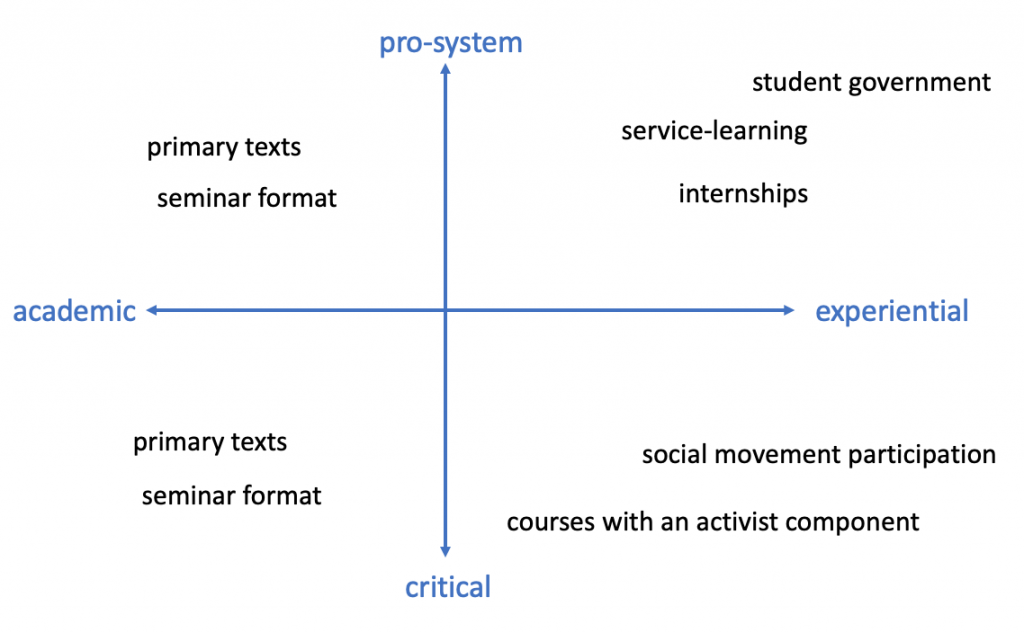
If I had to try to categorize views, I definitely would not use one continuum from left to right. I see two different axes that may help to organize the debate–as long as one remembers that hardly anyone chooses an extreme point on either continuum, and many see value across the whole map.

The vertical axis runs from favorable to critical of the US political system and society. Tennessee Gov. Bill Lee recently tweeted that his state’s schools will teach “unapologetic American exceptionalism.” In this context, “exceptional” doesn’t usually mean atypical; it means better. That places Gov. Lee pretty close to the top of my graph. Someone who wants students to focus on historical and current injustices would fall near the bottom.

The horizontal axis runs from classroom-based work (reading, discussing, and writing about texts) to experiential learning. It may also reflect a debate about whether knowledge or skills are the most important outcomes. Lee added, “By prioritizing civics education in TN schools, we are raising a generation of young people who are knowledgeable in American history and confident in navigating their civic responsibilities.” He seems to be open to engagement as an outcome, so maybe he would support the whole top half of my graph.

These two axes are distinct and orthogonal. The most common forms of experiential civics–approaches like service-learning and student government–are often pro-system. They belong above the middle of the chart. In the Positive Youth Development field, service-learning is understood as “contributing positively to self, family, community, and, ultimately, civil society” (Chung & McBride 2015). Service-learning may also encompass critical reflection about systems (Mitchell 2008), but I think the critical aspect has been rare and often superficial.

On the other hand, if you really want to teach some version of critical theory in a K-12 classroom, you are probably interested in assigning and discussing texts. (That is why it is called “theory.”) So you likely fall the left of the middle of my chart–on the same side as the people who want to assign classical texts that they appreciate. The pedagogy is similar; the debate is about which texts to assign, which topics to discuss, and which interpretive lenses to use. Meanwhile, many of us strive to assign texts with diverse perspectives and cultivate a robust discussion within the classroom.

For what it’s worth, my own emphasis is on learning how to build and manage associations. I’d use an academic pedagogy (reading, writing, and discussing texts, data, and models) for a pragmatic purpose: making civil society work. I’d let the students decide the ultimate objectives of their own associations. This approach implies a canon of texts (Alexis de Tocqueville, Gandhi, Robert Michels, Jane Addams, Mary Parker Follett, Saul Alinsky, Bayard Rustin, Ella Baker, Jenny Mansbridge, Elinor Ostrom …) that is neither pro- nor anti-system, as a whole.

I would never claim that this is the only important approach, but I think it is undersupplied.

See also: NAEd Report on Educating for Civic Reasoning and Discourse; an overview of civic education in the USA and Germany; The Educating for American Democracy Roadmap; etc.

mixed thoughts about the status of science

Science is at the heart of several of our hardest issues, including COVID-19 and global warming. (And even race and policing.) While some Americans display “Science is real” yard signs on their front lawns, Dr. Fauci is the face of oppression for others.

The question of science is not simple.

On one hand …

What individuals think about matters like vaccination and climate change has consequences for everyone else. It can be hard to coexist with people whose beliefs seem fundamentally, even willfully, false.

Some findings are well-substantiated, e.g., that vaccines work and that human beings are causing the climate to heat up dangerously.

For any given question, there are better and worse methods of inquiry. If you want to know whether a vaccine works, a randomized, double-blind, controlled experiment is an excellent method. Google-searching to see what various “influencers” say … is not.

Science is a process of inquiry, not a set of truths. When scientific consensus shifts, that is a sign of learning, not an embarrassment.

The process of learning about COVID-19 has been extraordinarily fast and impressive. It is harder to assess the pace of learning about climate change, but we have learned how to learn a lot better than our ancestors could have done three or four centuries ago.

On the other hand …

No one obtains complex knowledge directly or alone. Science is a collective enterprise, deeply dependent on interpersonal trust. Even if you are an epidemiologist or a virologist, you can’t directly observe truths about COVID-19. You must trust data, instruments, protocols, metrics, and theoretical models that come from other people. For instance, you can only know what you’re seeing through an electron microscope because you trust that device and all the previous science that yielded it.

Science is a set of human institutions that confer power and status on some, while excluding others. Anyone with a doctorate has received a graduate education that cost someone hundreds of thousands of dollars. Americans rank physicians highest in status (7.6) out of hundreds of jobs. Physics professors and college presidents come next. Environmental scientists also rank high (6.5). But many Americans are in no position to obtain these jobs, and many may not want them. By the way, just 5 percent of physicians are Black, and 0.3 percent are Native American.

It is all very well to say “Trust the experts.” But the experts in foreign and defense policy bear responsibility for two disastrous wars since 2001. Experts in urban policy wrecked our cities’ cores by slicing highways through them and forcing people into segregated public housing. Medical experts described homosexuality as a pathology in the DSM until 1973. Some influential nutrition experts insisted that fats were bad and sugar was safe while being financed by the sugar industry.

People like me have deep personal reasons to give scientific institutions the benefit of the doubt. One of these institutions literally pays my comfortable salary. My parents, spouse, sibling, and children have been admitted, supported, and (in many cases) paid by universities. I live in a neighborhood dominated by people who have benefitted from the same institutions; it has good public schools, safe streets, and high property values. Many other people could not get into any of these institutions, or don’t want to get into them, or would not feel comfortable in them, or would not be valued by them. Trusting science comes naturally to me but has no natural appeal for many other human beings.

Partisan and ideological heuristics affect all of us. I find it very comfortable to decry Ron DeSantis’ handling of COVID-19 and to blame him for Florida’s current wave. That fits with what I want to think about Republicans, conservatives, etc. It is a lot less comfortable for me to consider why the highest cumulative per capita COVID rates are in New Jersey, New York, and Massachusetts, while Florida ranks 26th and has (to date) just 62% the cumulative case rate of New Jersey. I don’t think the takeaway is that liberal policies have worsened COVID-19. (For one thing, Mississippi is close behind Massachusetts, and Vermont and Hawaii have done best of all.) But it is no more valid to infer that conservative policies are to blame.

As the last point suggests, there is much that we really do not understand, such as the reasons for the variation in COVID-19 outcomes by state or nation. If we knew the answer to that, it might help us to assess overall social systems. We are deeply divided about what kind of society we should live in, and science has not answered that question. It is not as useful as it could be for public debates, yet it should never provide the solutions, since we must reason about values as well as facts.

There is no such thing as value-neutral data. People always decide what to observe and measure and what to call the results. When I search Google Scholar for “school social distancing COVID,” I see the following keywords in the top results: school closure, workplace non-attendance, school lockdown, mental health, weight gain, nonessential workers, nonessential businesses, epidemic control, and mitigation strategies. Whether these are the most important topics, what is missing (race, for instance), and whether these factors are rightly named–these are value questions, not scientific ones. Besides, in many cases, the data come from mandatory reports, and what we require people to report is a value-judgment.

Finally, the methods that work best for evaluating the effects of a mass-produced chemical compounds, such as vaccines, may not work best for assessing many social, cultural, and moral issues. In many domains, positivist methods are too influential and not enough credibility is accorded to laypeople’s knowledge.

I agree with Jonathan Badger that the most prominent critics of science are not raising subtle points about the soft despotism of scientific institutions or the tension between expertise and democracy. Instead, they are making false statements with great certainty. That is a disgrace, but it doesn’t negate real questions about the role of science.

See also methods for engaged research; we should be debating the big social and political paradigms; what is Civic Science?; “Just teach the facts”; notes on the social role of science; etc.

civically engaged research in political science

Amy Cabrera Rasmussen, Valeria Sinclair-Chapman, and I co-direct the American Political Science Association’s Institute for Civically Engaged Research (ICER). The 2021 Institute took place online, and Political Science Now has published an article about it.

The first cohort assembled in 2019, and members of that group have since edited a symposium on civically engaged research for PS. Some of the symposium articles are starting to appear in “first look” format and will be published together soon. The preface to the symposium is online and open access: Rasmussen, A., Levine, P., Lieberman, R., Sinclair-Chapman, V., & Smith, R. (2021). Preface. PS: Political Science & Politics, 1-4.

Please watch PS for more ambitious articles from the symposium. They review definitions of civically engaged research, critically analyze various motivations for undertaking it, connect engaged research to teaching, and so on.

See also: how to keep political science in touch with politics; methods for engaged research; what must we believe?; civically engaged research in political science; etc.

the new elite is like the old elite

There is much writing–from a variety of ideological perspectives–about a new elite that is said to dominate culture, politics, and the economy. This group obviously bears a resemblance to previous elites (and disproportionately descends from parents who were wealthy and powerful), but perhaps it demonstrates some new features.

Among the novel characteristics could be: high education and technical skills (as opposed to deriving wealth from physical property), a meritocratic ideology, competitiveness and addiction to work, a tendency to cluster together in specific neighborhoods of selected cities and to marry only people of the same group, and a tilt toward center-left parties, which are said to be losing their working-class base in reaction to the dominance of meritocratic elites.

For instance, David Brooks writes:

The class structure of Western society has gotten scrambled over the past few decades. It used to be straightforward: You had the rich, who joined country clubs and voted Republican; the working class, who toiled in the factories and voted Democratic; and, in between, the mass suburban middle class. … But somehow when the class conflict came, in 2015 and 2016, it didn’t look anything like that. Suddenly, conservative parties across the West—the former champions of the landed aristocracy—portrayed themselves as the warriors for the working class. And left-wing parties—once vehicles for proletarian revolt—were attacked as captives of the super-educated urban elite. These days, your education level and political values are as important in defining your class status as your income is.

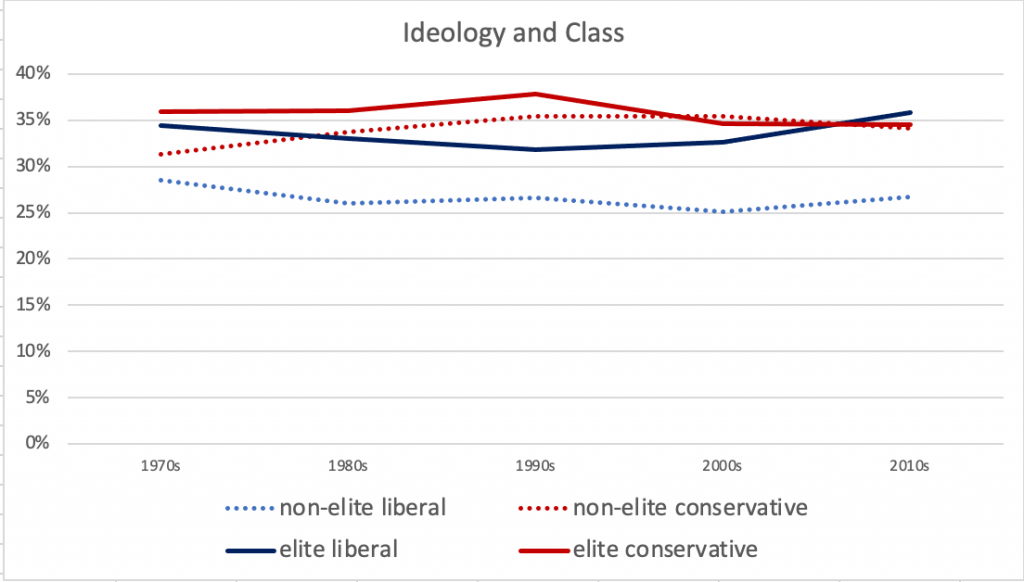
I found this story perfectly plausible but wanted to examine it empirically. Therefore, I explored it using data from the General Social Survey (GSS). In brief, I do not see evidence that today’s elite have different ideological or partisan leanings from their predecessors nearly fifty years ago, nor have they diverged from non-elites in terms of work hours, religion, or geographical mobility. They are more educated and more racially diverse than elites were in the 1970s, but overall, they look very much like their predecessors. That means that we are not experiencing a scrambling or a situation that has “suddenly” developed. Rather, critiques of a liberal-leaning, highly educated elite have been pretty consistent since the days of Richard Nixon, Spiro Agnew, George Wallace, and Pat Buchanan.

Method: The GSS categorizes jobs by prestige, based on a survey of representative Americans. In 2012, respondents rated a street corner drug dealer and a panhandler lowest (at 1.9 and 2.1, respectively) and a college or university president and a physics professor highest (at 7.1 and 7.2). [Correction: physicians are highest, at 7.6] A lawyer was rated 6.4; a mechanical engineer, 6.6; and a board member of a large company, 6.8 (Smith & Son 2014).

I isolated people who either held jobs in the top tenth of the prestige scale or else were married to people in the top tenth. Although it matters whether one is the worker or the spouse, I was interested in high-status households and wanted to include partners, especially in the 1970s.

I could have defined the “elite” in different ways. Trying various definitions would be valuable. However, it is important not to select on the dependent variable. In this case, one could define the elite as people who are liberal, live in major metro areas, hold advanced degrees, and meet other criteria assumed by commentators like Brooks. But then the conclusion would be foreordained. With equal validity, one could identify survey respondents who are conservative, religious, and powerful and tell a story about them. To avoid this form of bias, I pre-selected a definition of “elite” and then examined this group empirically. To be honest, I was surprised by how little change I observed.

Here are some comparisons and contrasts between the most-prestigious households in the 1970s and the 2010s.

Education: Today’s elite (as defined above) is more educated. Seventy-two percent hold at least a bachelor’s degree, up from 58% in the 1970s. Less than one percent don’t have a high school diploma, down from 6% in the 1970s. The non-elite also have more education than they did in the 1970s; however, just 24% hold a bachelor’s degree or more.

At the same time, a graduate degree certainly does not guarantee admission to the elite. Sixty-four percent of people with graduate degrees are not in the top tenth by occupational prestige.

Demographics: The elite was 93% white in 1970, six points whiter than the non-elite at the time. Both groups are now more diverse, but the change has been faster among the elite (who started at a very white baseline). In the 2010s, 80% of the elite was white, 8% was African America, and 12% belonged to other racial groups.

Party and ideology: Elites have not moved toward the Democrats. Including independents who lean toward either party, the elite has gone from 47% Democrat and 39% Republican in the 1970s to 47% Democrat and 37% Republican in the 2010s. They already leaned Democratic in the days of Richard Nixon, and still do by an almost identical margin.

However, non-elites are considerably less Democratic, down from 56% to 45% between the 1970s and 2010s, with most of that change happening during the 1980s. This trend may reflect Southern realignment more than ideology. The graph below shows ideological trends for elites and non-elites. It is true that elites have become somewhat more liberal since 2000, but the changes are small. Overall, elites were more liberal than non-elites in the 1970s and still are today. (To be sure, what it means to be “liberal” has changed, but this is still a reason to doubt a story of ideological realignment.)

Work-week: The elite worked a mean of 41.5 hours in a typical week in the 2010s– essentially the same as the 41.2 hours their predecessors had worked in the 1970s. The non-elite are down about two hours/week to 37.4 hours.

Geography: The elite have not diverged from the non-elite in geographic mobility. Both groups have become about 3-4 percentage points less likely to live in the same city where they lived when they were 16 years old. In each decade, the elites have lived in places with larger average populations than the non-elites, but community size has shrunk for both groups–presumably, as a result of movement to the suburbs and exurbs.

Marriage: Most non-elite adults (72%) were married in the 1970s. That proportion fell to just over half (54%) by the 2010s. Most of this large shift was to the “never married” category. Elites were less likely than non-elites to be married in the 1970s, and even less so in the late 1900s, dropping to 35% married by the 1990s. However, the marriage rates among the elite has risen to 46% in the 2010s, approaching the rate of the non-elites. A consistent one in four elites reports never being married in each decade.

Religion: In each decade, elites have attended religious services a bit more often than non-elites (on average), but religious attendance has fallen for both groups.

Sources: General Social Survey; Tom W. Smith & Jaesok Son, “Measuring Occupational Prestige on the 2012 General Social Survey,” NORC at the University of Chicago GSS Methodological Report No. 122, 2014. See also: why the white working class must organize; the Left between Obama and Hillary Clinton.

Buddhism as philosophy

Let’s say that a religion consists of beliefs–and, often, practices–that many people consider deeply important and that unite them as a community.

By this definition (derived from Durkheim), communism and some forms of patriotism may be religions, but there is no such thing as a solitaire religion. For one thing, most believers value unity and belonging. In the Abrahamic faiths, professions of faith are singular (“I accept Jesus as my personal savior …”), and an adherent could prefer–or be forced–to worship alone. Nevertheless, the basis of an Abrahamic religion is a revelation made to a group of people who formed a community when they accepted the revealed truths. To believe is to join that community. In other traditions, it may make even less sense to be a solo believer.

Finally, many religions claim–to various degrees–to be comprehensive and final. They offer conclusive answers to all the most important questions. This feature helps them to unify their believers and to occupy a major portion of their adherents’ inner lives.

In contrast, let’s call a philosophy a list of beliefs–and the relations among them–that a person arrives at by reflection. One’s reflection need not be rational as opposed to emotional, but it is personal. Everyone can arrive at a different philosophy. If we are wise, we assume that the beliefs on our own list are provisional and incomplete. When we bring our ideas into a public space, we expect disagreement, which may sometimes cause us to adjust our ideas.

By these definitions, a specific belief may play an important role within one or more religions and also one or many philosophies. The belief has the same content but a different function.

Over its long history, Buddhism has been a philosophy for many and a religion for many more. Ideas attributed to the Buddha and his influential followers have served to define and unite believers and have been deeply interwoven with other aspects of the believers’ shared cultures, such as their art, music, and ritual. In that sense, we can talk about Tibetan Buddhism or Buddhist architecture–cultural categories.

Meanwhile, individuals from diverse backgrounds have sometimes assessed ideas from Buddhism and have adopted one or more of them into their own thinking, often in an eclectic fashion, without considering them complete or final, and without necessarily feeling any sense of belonging. The latter is Buddhism as philosophy.

The philosophical approach involves assessing each belief associated with Buddhism, asking whether it coheres with your own experience and your previous reflections and with the other ideas on the list of Buddhist beliefs. This process actually requires a prior step: deciding which ideas are important to Buddhism–a sensitive task, given the variety of views held over more than two millennia of development. The outcome is a list of zero or more ideas that you feel you should provisionally endorse, along with any the other ideas from any other sources that you also hold. For example, I would ask whether each Buddhist idea coheres with major findings of 21st century natural science.

By the way, there is some textual evidence that this is how the Buddha wanted to be received, although I don’t know whether that evidence is historically valid. In any case, I would start the philosophical analysis with the Four Noble Truths, which are fundamental across the whole tradition.

The first is the truth of suffering. It is not wrong to try to phrase this as a proposition, in which case some candidates might be: “Suffering is inevitable,” or “Suffering is universal,” or “Suffering is intrinsic to life.” You can also consider which propositions are incompatible with it, such as “Everything happens for a good reason and works out well in the end,” or “Only people who deserve to suffer ultimately experience suffering.” Buddhism rejects such claims.

But there is a good reason that the noble truths are not usually presented as propositions. To endorse the first noble truth is to feel the significance and ubiquity of suffering: not only one’s own but also everyone else’s. The truth is closely connected to the mental state of compassion. To endorse it is to be compassionate, and vice-versa. The philosophical question, then, is whether such universal compassion is virtuous and valid.

The second noble truth is the truth of the origin of suffering. Spelled out in propositional form, the origin is said to be craving, desire, or attachment (tanha). This is certainly a claim that one can reason about. Does desire inevitably yield suffering? If so, why? Is the reason metaphysical, or is it a feature of human psychology? What kind of emotion (or action?) qualifies as tanha? These are issues within Buddhist philosophy and worthy of inquiry. But, again, the second truth is not typically phrased as a proposition because it is equally important to try it out. Does it seem right that craving, or clinging, or some such emotional state is involved (often or always) in the suffering that one feels and observes?

The third truth is the truth of the cessation of suffering. Removing the cause, which is craving, will remove the suffering itself. This claim is philosophically contestable. Assuming that craving does cause suffering, are we confident that ceasing to crave will remedy the damage already done? Is a life without craving and without suffering a good life? Is it the best life? Again, I think these are questions within Buddhism, not critical of the tradition.

The fourth truth is the path to the cessation of suffering. In medical terms, we have already explored the condition (suffering), the diagnosis (craving), and the cure (ceasing to crave). We need a prescription to accomplish the cure. The prescription is a set of right actions and right thoughts, often spelled out in detail. The specific content is contested and has varied within the tradition, but we can identify some typical elements.

First, right action is moderate. It is the Buddha’s “middle way” between asceticism and self-indulgence. You can’t remove the cause of suffering either by rejecting all pleasurable experiences or by filling your stream of experience with pleasure. You are wiser to put temporary pleasures in their proper place within a life that is ordered and responsible and attainable by actual human beings. By filling your life with this kind of moderation, you occupy time that would otherwise be colonized by immoderate will, which would worsen suffering.

Second, right action helps other sentient beings but without ignoring the actor’s condition. In Owen Flanagan’s phrase, the ideal is “equanimity-in-community.” By being a helpful part of a community while also tending to one’s own mental equilibrium, one fills the time that would otherwise be occupied with indulgence or asceticism, which would worsen suffering. This balance between individual and community complements the moderation of the middle way.

Third, right thinking (and right action) must be consistent with the noble truths. To start with, the first truth implies–or actually is–compassion; therefore, good thought and action must be compassionate. The more mental space we occupy with compassion, the less will fill with craving. The desire that others escape suffering has the unique feature of not causing the desirer to suffer. And if we are truly compassionate, we must act in others’ benefit. Emotion and action come together.

Fourth, right thinking reflects correct metaphysics, which has at least two important features.

The doctrine of no-self holds that there is no autonomous, durable (let alone immortal) self, the kind of thing that might be labeled a “soul” in other traditions. Introspection identifies many specific thoughts and experiences that arrive in a rapid flow. It does not ever identify the self that “has” these experiences, because there is no such thing. Per the second noble truth, the impulse to find a self and to preserve it amid the flux is a form of craving that inevitably yields suffering. Really believing the doctrine of no-self helps to accomplish the cure promised in the fourth truth. Apart from anything else, it makes one much less concerned about oneself, thus leaving more space for compassion.

The doctrine of dependent origination holds that everything happens as the inevitable outcome of the conditions that were in place before it. This is very much like a core metaphysical assumption of modern science. It rejects the notion of a “final” cause (in Aristotle’s sense). Things do not happen because of some independent end or purpose. For instance, I may believe I am raising my hand in order to get attention, but the real cause is the firing of neurons, which happens because of prior neurons’ firing and other physical circumstances. A related doctrine is impermanence: everything inevitably changes.

We should believe in dependent origination and impermanence because they are true and also because they help us on the path from suffering. Believing in final causes–that things happen for good reasons–and in permanent objects of value causes frustration because we constantly observe bad outcomes and change. Instead, we should acknowledge that things just happen. That includes suffering, which arises because of prior conditions, but especially because of prior expressions of craving. Compassionate action interrupts that causal cycle.

What about two famous doctrines that seem much less compatible with modern science and with the moral experiences of modernity: reincarnation and karma?

One way to interpret these ideas would be as background assumptions from the cultural milieu of the Buddha and his South Asian followers. Other Indian traditions also teach karma and reincarnation. In the Mediterranean region, the comparable background assumptions were the survival of the soul after bodily death and the existence of an afterlife. We don’t find it especially interesting when an ancient Mediterranean thinker assumes that souls go to the underworld. We could likewise attribute karma and reincarnation to the cultural milieu and not take these ideas seriously as core ideas of Buddhism–much as we might dismiss the classical Buddhist list of four elements (earth, air, fire, and water), which they shared with Mediterranean peoples. To be a Buddhist today does not imply belief in the four elements, and maybe it doesn’t imply karma and reincarnation.

A different response has the advantage of being more interesting. After all, the popular summaries of both karma and reincarnation contradict major points summarized earlier in this post. If there is no-self, how can the soul transmigrate to a different body after death? And if everything happens through dependent origination, why should good actions always yield benefits to the person who acts well? Why would the universe be set up so nicely?

Perhaps we should revise these doctrines to make them more compatible with the rest of Buddhist thought. In fact, the best any of us can do is to adopt the background material of a culture and revise it in the light of our own best thinking to create a framework that illuminates something about the reality of an existence that is too complex for human beings to grasp in full. In that spirit, let’s reconstruct what a believer in the four noble truths, no-self, and dependent origination would make of reincarnation and karma.

I think reincarnation becomes a doctrine of continuous rebirth. There is no self, just a stream of experiences. In that sense, the self is constantly being reincarnated. Furthermore, most of our experiences are not original to us. We feel things that others have felt before and that still others will feel after we are gone. Even the words we inwardly use to name these experiences belong to languages spoken before and after our time. Thus the components of our experience travel from organism to organism, and the process of rebirth outlasts the natural lives of individuals. This theory is but crudely expressed by the literal idea of reincarnation.

And I think karma gains an ethical gloss. It is not that some cosmic scorekeeper gives us positive points for good behavior and demerit points for bad behavior and calibrates our suffering accordingly (in our current and future lives). We are not literally paying the price for bad actions that we performed in past lives, for there is no self that carries over from yesterday to today, let alone from one death to another. Rather, there is a tendency for craving to cause suffering and for compassionate thoughts and acts to reduce it. Craving is like any other factor in a deterministic world of cause-and-effect: its influence tends to ripple out and affect other people. The best way to block it is to exercise compassion instead. Ideally, that will radiate out positively. In this sense, each of us experiences the total of the good and bad karma of many past lives. There is, however, no one-to-one correspondence between a specific past life and a specific current one.

If these glosses are correct, why are they not communicated more clearly and prominently, at the expense of the literal versions of karma and reincarnation? Here the “three vehicles” idea from Mahayana Buddhism is helpful. We can reduce suffering in several different ways, and any way that works is valuable. If it helps to believe that every bad action accrues to the actor and causes suffering later on–in the next life if not in this life–then that is a welcome result. One who believes this theory will strive to be compassionate and will thus tend to suffer less. However, this theory isn’t Really True. You might instead believe that everyone should be compassionate for its own sake even though the outcomes are uncontrollable and determined. This theory has the advantage of being more philosophically defensible, but it is not very inspiring–except for the wisest among us. So people need a choice of vehicles that they can ride on the path away from suffering.

None of this is meant to be original–it just represents my personal effort to explore some aspects of Buddhism as philosophy. If it has any value, it is as an example of a worthwhile exercise. [Feb. 1. 2022: I wrote this post without citations, but I was certainly aware that every idea expressed here has been stated before, including by Buddhist monks. One example is “Heart-wood from the Bo Tree” by the Venerable Ajaan Buddhadasa, 1961. Or see the 40 Tenets of Plum Village, especially #24, “We can only understand the real teaching of rebirth (sams?ra) in the light of impermanence, no-self and interbeing”; and #40, on science.]

It is not final. I assent to several of the Buddhist theories because of my other experiences and my commitment to contemporary science, but experiences and scientific findings change. Also, I did not discuss in any detail my skepticism about some of the theories.

It is not comprehensive. What I have written here says nothing about political institutions or social justice, epistemology, or aesthetics. It is all about ethics and metaphysics (and incomplete on those topics). Of course, thinkers who identify as Buddhists have developed political, epistemological, and aesthetic ideas, but that doesn’t mean that their ideas are implied by the core tenets of Buddhism. If we treat Buddhist ideas as philosophical, we would expect any list to be incomplete and for specific ideas to appear in various philosophical structures that also draw on other sources. Comprehensiveness is impossible.

Finally, the result is not redemptive or salvific. The advice may be good, and you may tend to benefit if you follow it, but you will not be able to honor it completely enough to banish suffering. (It is said that the Buddha experienced headaches even after his enlightenment.) On the other hand, it is possible to envision a person who has followed these principles thoroughly enough to have overcome existential dread. That requires no suspension of the usual physical or metaphysical rules. It is a psychological accomplishment, and it offers as much consolation as one would derive from the news that there was a life after death.

See also: the grammar of the four Noble Truths; freedom of the will or freedom from the will? (comparing Harry Frankfurt and Buddhism); how to think about other people’s interests: Rawls, Buddhism, and empathy; Owen Flanagan, The Bodhisattva’s Brain: Buddhism Naturalized; scholasticism in global context; what secular people can get out of theology; how to think about the self (Buddhist and Kantian perspectives); rebirth without metaphysics; is everyone religious?, three truths and a question about happiness; etc.