Category Archives: Uncategorized

the European country that spoke Esperanto

Did you know that there used to be a quasi-autonomous European jurisdiction with a land area of 3.5 km and a population as large as 3,500 that used Esperanto as its official language?

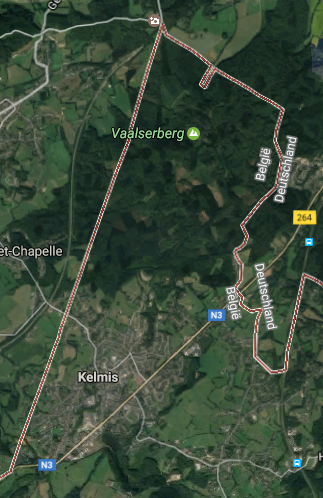
Moresnet (Esperanto: Amikejo, or “friendship place”) lay among Belgium, Prussia/Germany and the Netherlands in roughly the location shown on this Google Map. It was established in 1816 and absorbed into Belgium in 1920. I exaggerate by calling it a “country,” but it was an international condominium with sovereignty shared by Prussia (later, Germany) and Belgium, official neutrality, its own tricolor flag, and a high degree of self-rule. In 1918, a project began to make it Esperanto-speaking; many residents learned the language, and the World Congress of Esperanto named it the capital of the global Esperanto community.

I learned this after reading about Alexander Dubcek, the face of Socialism with a Human Face and a Czechoslovak leader during both the Prague Spring and the Velvet Revolution. Dubcek was conceived in Chicago but born in what’s now Slovakia. He and his family moved to what’s now Kyrgyzstan at age 3. There he and his family lived in an experimental co-op called Interhelpo, where first Esperanto and then Ido (Esperanto for “offspring,” meaning a kind of Esperanto 2.0) was spoken as the main language. In 1943, Stalin liquidated Interhelpo and shot many of its crunchy residents, but by then Dubcek was back in Czechoslovakia, flighting the Nazis. He survived to be a thorn in the side of totalitarian communism, but not–as far as I know–a dedicated Esperantist.

Any dreams of uniting Moresnet and Interhelpo into a confederation of Esperanto states proved (shall we say) utopian.

we are hiring: Tufts CTSI Director of Stakeholder and Community Engagement / Tisch College Director of Civic Learning for the Health Professions

Tufts CTSI Director of Stakeholder and Community Engagement / Tisch College Director of Civic Learning for the Health Professions

The Tufts Clinical and Translational Science Institute (CTSI) (www.tuftsctsi.org/), one of 64 organizations supported by the National Institutes of Health (NIH) Clinical and Translational Science Awards (CTSA), was established in 2008 to transform the biomedical research process through education, promoting collaboration, and the provision of research infrastructure and support services. Tufts CTSI accelerates the translation of laboratory research into clinical use, medical practice, and health policy. In addition to its work with Tufts University, Tufts Medical Center, and other partner organizations, Tufts CTSI contributes to the national CTSA Consortium.

Tufts CTSI is a leader nationally in the development of frameworks and methods for stakeholder and community engagement in translational research. Most recently, Tufts CTSI enlisted experts from the fields of civic engagement, stakeholder engagement, and participatory research to establish a broad set of resources and training programs to help researchers, communities and partnerships improve the relevance and transparency of research.

The Jonathan M. Tisch College of Civic Life (http://activecitizen.tufts.edu/) prepares Tufts University students to become active citizens and community leaders. The only university-wide college of its kind, Tisch engages Tufts students in meaningful community building, public service experiences, and transformational learning. It also conducts and supports groundbreaking research on civic and political participation and forges innovative community partnerships.

Tufts CTSI and Tisch College of Civic Life seek a faculty member to split his or her time between leading the Stakeholder and Community Engagement (SCE) Program [Tufts CTSI] and directing Civic Learning for the Health Professions at Tufts [Tisch College]:

More details: https://apply.interfolio.com/41316.

what is a social movement?

Social movements are at the heart of politics right now. Drawing loosely on work by Charles Tilly, Doug McAdam, Sidney Tarrow, Frencesca Polletta, Jennifer Earl, and others, I would define a social movement using five criteria (listed below). Note that this is a value-neutral definition. It could fit a fascist movement as well as a progressive one, and it doesn’t imply that social movements are preferable to other phenomena, such as political parties. It is merely intended to categorize a set of phenomena so that we can study them.

1. A social movement consists of many autonomous groups and individuals

Movements are polycentric rather than hierarchical or centralized. A single organization can adopt the feel and spirit of a movement by empowering separate groups internally, but it is only an actual movement if those groups are autonomous and collaborate voluntarily.

2. It persists over numerous episodes and campaigns

The marches over the Edmund Pettus Bridge were episodes. The struggle for the Voting Rights Act was a campaign. The Civil Rights Movement consisted of thousands of episodes and several campaigns.

3. It makes demands on holders of power

The power-holders may be governments, firms, media entities, universities, or any other institutions. If people make no demands on any institutions, I wouldn’t define them as participants in a social movement. They might form an important grouping, such as a spiritual revival or a self-help network, but it would not be a social movement.

Just as important, a social movement makes demands on holders of power rather than trying to supplant them. A political party seeks offices. A revolutionary cadre strives to overthrow and replace the state. An established labor union negotiates contracts with a firm. None of these meet the definition of a social movement, which stands apart from the institution and makes demands on it. I acknowledge that a broad-based social movement can encompass elements that act like parties, revolutionary cadres, or collective bargainers. The Civil Rights Movement encompassed the Mississippi Freedom Democratic Party (MFDP), the Black Panther Party, and the Brotherhood of Sleeping Car Porters; but it was a movement because it wasn’t defined by any of those groups.

4. It supports its demands by displaying WUNC

Tilly observes that social movements don’t just express demands; they back them up with four assets that command attention: worthiness, unity, numbers, and commitment. For example, the women’s marches after Trump’s Inauguration demonstrated that millions of people cared (numbers), that they were willing to travel to Washington or stand outside in the streets of their hometowns (commitment), that they were unified (pink pussycat hats, marching on the same day), and that they were worthy. Worthiness can mean respectability: for instance, “We are middle-class women (with some men) who are pillars of our communities, not the kinds of people who usually make trouble.” But worthiness need not mean respectability. Sometimes, highly oppressed groups claim the worthiness that comes from suffering.

WUNC serves as a standard for evaluating the credibility of would-be movements. For example, does holding a sign on the Boston Common demonstrate enough commitment?

5. It imposes limits on itself

Social movements often adopt and attempt to enforce limits on themselves: “We will not run for office or endorse any parties.” “We will negotiate with companies but not form our own businesses.” “We denounce terrorism.” “We call for a new nation but will not commit treason against the existing state.”

No particular form of self-limitation is definitive of social movements. For instance, there are violent and even terroristic social movements; thus nonviolence is not a condition. But it is highly characteristic–perhaps even definitive–of social movements that they choose some limitations that they enforce on their own members. I would propose a functional explanation of this tendency. Coordinating the behavior of many autonomous groups and individuals is extraordinarily difficult. Movements are easily destroyed by internal disagreements or by escalation to a point where they lose their support. Successful movements avoid escalation by choosing limits and economize on the topics that are open to discussion. For instance, if the movement eschews electoral politics, then it needn’t decide who should run for which office. If it renounces violence, it needn’t debate which targets to hit with which weapons.

Thus a social movement can say: “We are [a set of groups] who want [demands] from [institutions], who demonstrate WUNC [in particular ways] and who eschew [certain tactics or ends.]”
how Millennials split on some key issues

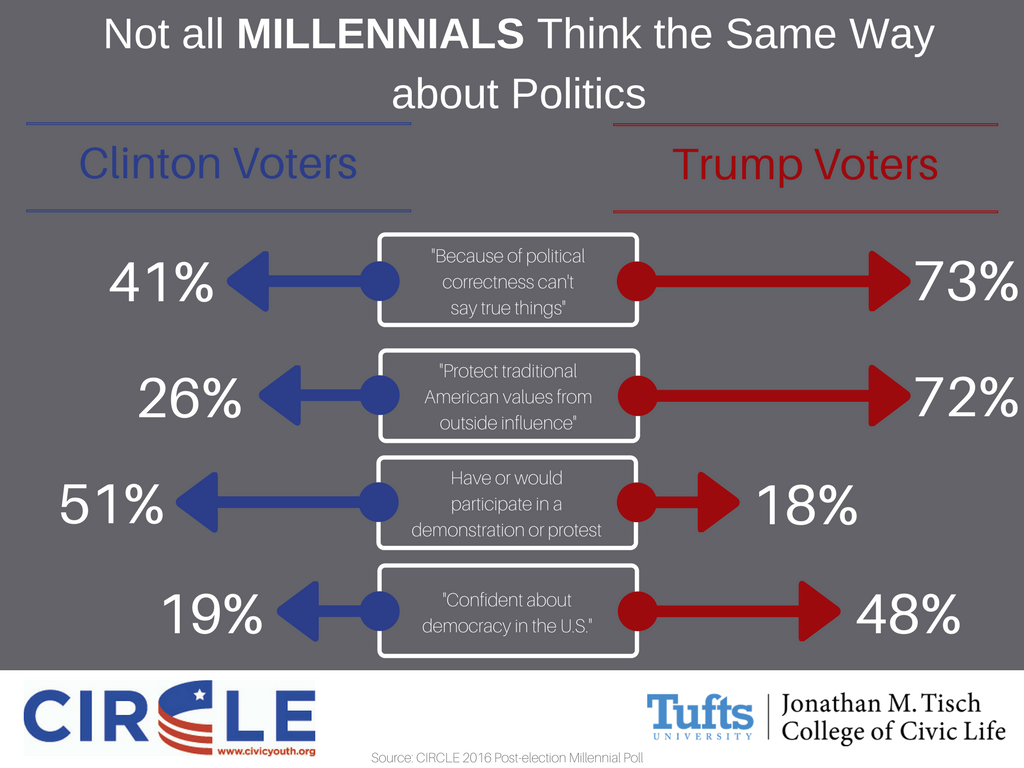
Here are some tidbits from CIRCLE’s analysis of its Millennial youth survey, the second wave of which was conducted in January. A substantial proportion of all Millennials believe that “political correctness” prevents people from saying things that are true, but that opinion is much more common among young people who voted for Trump. Three quarters of pro-Trump Millennials (who were 37% of all the youth who voted) want to protect traditional American values against influences from the outside, compared to one in four of those who voted for Clinton. Clinton voters are much more likely to be ready to participate in demonstrations and protests, and seriously lack confidence in US democracy. Much more at the link.

Simon Denny: turning the NSA into art

(Waterville, ME) Last week I saw a display that is exemplary of Simon Denny’s work. Inside a case made of server racks and glass panes are three-dimensional versions of the NSA graphics displayed in the PowerPoint presentations that Edward Snowden leaked. For instance, a slide depicting military vehicles crossing barriers has been turned into a diorama made in part of hobbyist models. A slide showing “The 5 Team Dysfunctions” has been turned into a three-dimensional pyramid with levels labeled with phrases like “Lack of Accountability” and “Lack of Results.” For another installation that I didn’t see, Denny actually used a stuffed eagle that he bought from a taxidermist to illustrate the eagle on the NSA’s shield. Lights flicker on the servers. The whole object is neat, shiny, hermetic, and strange.

For the Venice Biennale, Denny’s NSA displays were exhibited in the Renaissance Library of St. Mark (the Biblioteca Marciana), which was originally a storehouse of global knowledge and information for what was then a great mercantile power. The Marciana has held–although not currently–the finest medieval world-map, the Fra Mauro Map (ca. 1450) which compiled intelligence from such emissaries as Marco Polo. Venice sent these feelers into the world and compiled their data for the benefit of her navy and traders.

Here is Denny’s work as displayed in Venice–one empire echoing another across the centuries. Those are portraits of philosophers on the walls, sources of wisdom that might be compared to the gnomic utterances in the NSA slides, such as “Role of the Team Member: Focusing on Collective Impact.”

I, however, saw the same display at MOMA, the high-rise museum in the heart of Manhattan’s Midtown that Rockefellers founded to collect the best art of the world for the most powerful commercial city of its time.

Like much conceptual art, this display poses questions. I value that function, although I also think the appropriate response to a question is an answer. So, standing before Denny’s display and thinking about my own responses, I believe I’d say: As an organization, the NSA resembles a large bureaucratic for-profit firm, at least in its internal rhetoric. Its rhetoric is banal. A highly self-conscious, polished, ironic representation of that banality is art.

ThE NSA collects lots of information without people’s permission. It is part of the United States government, which is owned by the American people. The Agency also affects people around the world. The people who own it and the people whom it affects have a right to understand how it works. Understanding it includes having some kind of grasp of its internal culture, including its banality.

Then again, it is probably both necessary and even valuable for a nation to spy, so long as its foreign policy is reasonably just. To spy in the modern world is going to require an organization that resembles a large bureaucratic for-profit firm, and running such an operation reasonably efficiently may require banal slogans. (I’m not sure about that.)

By the way, the original artist who created many of the NSA’s graphics is David Darchicourt. He gets an odd sort of billing in Denny’s subversive Art-World response. Fortunately, Darchicourt seems good-humored about the whole thing. Ryan Gallagher reports:

Now he is the unwitting central character in a new exhibition that puts the spotlight on the spy agency’s imagery. … He admits he finds it interesting to see his designs in the Renaissance setting. “It’s kind of flattering, but it’s also kind of creepy,” Darchicourt says, adding that he’s now considering deleting some pictures from his online portfolios to prevent them from being used by anyone else in the future. “Anything that has to do with the NSA will be removed; it’s old and I don’t really identify with that organization anymore.”

See also: on the moral peril of cliche; cultural mixing and power; on the deep state