Europa was an Asian woman, and other thoughts on the definition of Europe

Europa was Phoenician. She was a princess of Tyre, now in Lebanon, which is in Asia. If we take the myth literally, her native tongue would have been Semitic, part of the Afroasiatic language family. Zeus, disguised as a bull, carried her off to Crete, where she bore him three sons who ruled domains from Anatolia to the Cyclades. She gave her name to the continent where she landed.

That is one story about Europe and its neighbors. Here’s a more influential one. Long ago, Spain was populated by people who were Christian and European and whose language and culture derived from ancient Rome. A conquering army arrived from Africa, bringing a foreign religion and language (an Afroasiatic one, in fact). Their advance was checked by a European army at the Battle of Tours. Then, gradually, the surviving Christian leaders “reconquered” the peninsula and drove the foreigners away.

Now here are some problems with that story. Both Christianity and Islam (and Judaism) began in the same region of western Asia. Many people in both northwest Africa and the Iberian peninsula converted to one of those religions, or to one and then another. Members of the same families belonged to both. ‘Abd al-Rahman III, the powerful monarch who founded the Caliphate of Cordoba, had a Christian grandmother, Princess Onneca of Pamplona, and a Christian slave mother, Muzna. He dyed his fair beard dark to look more like one of his very distant patrilineal ancestors from the Arabian peninsula (Brian Catlos, Kingdoms of Faith, p. 130).

Although the origins of the peoples of both modern Spain and Morocco are unclear, there’s at least some evidence that they descended from a common “Ibero-maurusian” culture that spanned the straits. The invaders in 711 included many Christians as well as Muslims. Some people whose ancestors had lived in Spain before 711 thoroughly acculturated to Arab language and customs while remaining Catholic. However, it was largely because of the influence of the Muslim and Arabic-speaking Abassid Caliphate far to the east that texts, ideas, and aesthetic values that had been important in ancient Rome spread into the Iberian peninsula, and from there into northern Europe.

It is hard to shake an equation of European with Christian, Latinate, and white. But this is a misleading mental model, as well as often a racially prejudiced one. The Spanish story of “reconquest” is one of its sources.

We can trace the model one step back from Spain to the court of Charlemagne, where Alcuin of York (c. 735–804) used the word “Europe” for the region where he lived. For instance, Alcuin wrote, “Almost the whole of Europe was destroyed by the fire and the sword of the Goths or the Huns. But now, by the mercy of God, as the sky shines bright with stars, so Europe shines with the ornament of churches, and in them the offices of the Christian religion flourish and increase.”

Alcuin wanted to differentiate Charlemagne’s empire (headquartered in what is now the French/German border) from its pagan Nordic enemies, the Slavic peoples whom Charlemagne raided for slaves, the Iberian Arabs whom Charlemagne’s grandfather had fought at Tours, and especially the Greek-speaking Christians based in Constantinople. Hence Alcuin defined a continent that encompassed Charlemagne’s possessions while excluding all other lands, including the empire of the Greeks.

Alcuin didn’t invent the word “Europe”; he reformulated ancient precedents. For Herodotus (485-425 BCE) the line between Asian and Europe ran through the Kerch Strait (the site of Putin’s bridge today), the Bosphorus and Sea of Marmara, and then between the coast of Asia Minor and the Aegean islands. Herodotus described many closely associated cities and people on both sides of this line. Meanwhile, he defined the border between Asia and Africa as the River Nile, which split the Kingdom of Egypt between two continents:

I cannot guess for what reason the earth, which is one, has three names, all women’s, and why the boundary lines set for it are the Egyptian Nile river and the Colchian Phasis River [now in Georgia] … ; and I cannot learn the names of those who divided the world, or where they got the names which they used. For Libya is said by most Greeks to be named after a native woman of that name, and Asia after the wife of Prometheus … But as for Europe, no men have any knowledge whether it is bounded by seas or not, or where it got its name, nor is it clear who gave the name, unless we say that the land took its name from the Tyrian Europa, having been (it would seem) before then nameless like the rest. But it is plain that this woman was of Asiatic birth, and never came to this land which the Greeks now call Europe, but only from Phoenicia to Crete and from Crete to Lycia. Thus much I have said of these matters, and let it suffice; we will use the names established by custom.

Herodotus, The Histories (trans. A. D. Godley) 4:45

Thus, for Herodotus, the distinctions among continents were arbitrary (there was one connected “earth”) and did not mark cultural boundaries. These distinctions were basically local, because he admitted that he did not know how far the continents extended. He did not intend to contrast people from China, Scotland, and Nigeria, but rather those from Lycia and Lesbos, which lie a few miles apart. (One of Europa’s sons by Zeus, Sarpedon, was the mythical founder of Lycia, which Herodotus counted as Asian. Another son was Minos, the mythical king of Crete, which he considered Greek.)

However, Herodotus begins his histories with a strong binary opposition between the “Hellenes” and the “barbarians” (Hdt. 1.1.0). He retells a series of mythical tit-for-tat abductions or rapes–from Europa to Helen–and then blames the Greeks for escalating these conflicts into full-scale war by invading and destroying Troy. He offers what he calls the Persian take on this matter:

“From then, we have always held the Greeks to be our enemies.” For the Persians claim Asia and all the barbarian peoples who live there as theirs, and they consider Europe and the Greeks to be separate.

(Hdt. 1.4.4, my trans.)

Thus, for Herodotus, the Europe/Asia distinction is really a Persian construction–but it matters deeply to him because he sees the Persian Empire of his time as the chief threat to Greek liberty.

Thucydides may obliquely criticize Herodotus when he notes that Homer never named Agamemnon’s forces as “Hellenes,” nor did Homer use the word “barbarian” at all. Thucydides argues that the concept of Greekness arose long after the Trojan War, once the city states centered in Greece had developed sufficient wealth and power that they could act in concert (Thucy. 1.3). In other words, for Thucydides, Greek identity and opposition to Persian power were political accomplishments, not natural facts.

Twenty-five centuries later, these distinctions–much evolved and redefined–still influence us. Herodotus would be perplexed to hear barbarians from the distant west define themselves as Europeans, yet a long thread connects him to them.

The idea of “Europe” can be inspiring. I was exposed to benign propaganda in favor of European integration when I was a child in London in the 1970s, and for me, the EU still invokes cosmopolitan, peaceful, and democratic values. I was moved to see EU flags on many private buildings in Lviv and Chernivtsi in 2015. On the other hand, “Europe” can also be an exclusionary idea, a boundary. In the case of Brexit, it even serves as a way of turning very close neighbors into foreigners. It’s always worth recalling the arbitrary origins of the concept and remembering Herodotus’ point that the earth is really one.

See also: the history of the phrase “the West”; don’t name things Western but call out imperialism; to whom do the ancient Greeks belong?Jesus was a person of color; Brexit: a personal reflection; etc.
Civic Engagement in American Climate Policy:
Collaborative Models

Newly published on Tisch College’s CivicGreen website is “Civic Engagement in American Climate Policy: Collaborative Models,” a report from CivicGreen in cooperation with the Center for Communities by Design, the American Institute of Architects, and the Kettering Foundation. Carmen Sirianni has been a key organizer of this work, along with Ann Ward and others.

The report is a detailed guide to incorporating public engagement and public work in addressing the climate crisis. It’s not about public advocacy or popular pressure to enact environmental policies, but rather the public’s role in implementing policies–from local planning to paid service jobs that offer pathways to green careers. It draws on extensive experience with:

  • sustainable cities and local climate planning
  • collaborative environmental justice and the EPA’s CARE program
  • community design and public interest design
  • urban and community forestry
  • collaborative community conservation and ecosystem management
  • environmental education
  • coastal management and sea level rise
  • civilian conservation and climate corps
  • citizen science
  • digital and geospatial mapping tools
  • climate and science communication
  • civic professional practice and training

I observe some environmentalists framing public engagement as basically a barrier to efficient climate policy. They fear that NIMBY citizen organizations may block green projects or divert funds that were intended for climate to other purposes, thus weakening their impact.

I also see some progressives trying to redefine environmental policies to accomplish other social-justice goals using money that was earmarked for climate. I get their motivations, but diverting funds threatens climate outcomes.

In my view, public engagement is essential for making green investments actually work for their intended purposes. For instance, funds for public transportation will only cut carbon emissions if people ride the new trains and buses–and communities know what transit is needed. If more people are paid to address climate problems in their daily work, the constituency for environmental reform will grow, especially if these workers are organized, not only to advocate for wages (which is good) but also to address environmental issues. Public engagement must go well, which is by no means inevitable. This new report offers detailed, experienced-based recommendations.

See also: the major shift in climate strategy;  A Civic Green New Deal; and the Green New Deal and civic renewal

trying Mastodon

As of today, I am @peterlevine@mastodon.sdf.org on the decentralized Mastodon network (https://mastodon.social/).

I would report good experiences with Twitter (as @peterlevine). I never attract enough attention there to be targeted by malicious or mean users. I don’t see fake news. (Of course, everyone thinks that’s true of themselves; maybe I’m naive.) I do enjoy following 750 accounts that tend to be specialized and rigorous in their respective domains. I read an ideologically diverse array of tweets and benefit from conservative, left-radical, religious, and culturally distant perspectives that I would otherwise miss–yet I curate my list for quality and don’t follow anyone unless I find the content useful. A bit of levity is also appreciated.

Notwithstanding my own positive experiences, I understand that Twitter does damage. At best, it’s far from optimal as a major instantiation of the global public sphere. We’d all be better off engaging somewhere else that was better designed and managed.

However, making the transition is a collective-action problem. Networks are valuable in proportion to the square of the number of users (Metcalfe’s Law). Twitter has been helpful to me because so many people are also on it, from defense logistics nerds posting about Ukrainian drones to election nerds tweeting about early ballots to political-economy nerds writing about Elinor Ostrom. For everyone to switch platforms at the same time and end up in the same place is a classic coordination dilemma.

Elon Musk may provide the solution by encouraging enough Twitter users to try the same alternative platform simultaneously. I perceive that a migration to Mastodon is underway. Joining Mastodon may offer positive externalities by helping to make it a competitive alternative. Starting anew is also pretty fun, even though the Mastodon interface isn’t too intuitive. So far, I have four followers, and the future is promising.

class inversion as an alternative to the polarization thesis

One deep story that’s being told about our current political crisis invokes polarization: two “poles” or ends of the spectrum are seen as moving apart and growing mutually hostile. That is a symmetrical metaphor. A different deep story emphasizes the anti-democratic and anti-constitutional turn of MAGA-style Republicans. I would add a third model that involves both parties, but not in a symmetrical way. It is also less about ideas and policies than interests and identities. It’s a story of inverted partisanship.

Envision a democracy with two main parties or coalitions. The left party favors more taxing, spending, and regulation and draws most of its votes from the lower half of the economic scale. The right party opposes government economic intervention and draws its support from the upper half.

This kind of system can be frustrating, since the median voter (who probably comes from the middle of the economic scale) often wields the deciding vote. Both socialist and libertarian principles are somewhat disfavored. However, if you are a socialist or a libertarian, you should believe that you can convince the median voter of your ideas. Meanwhile, the debate is a good one, because citizens can determine the role of government. And both sides are constrained. The left may want lots of government, but as taxes and regulation rise, so will resistance. The right may love markets, but cutting government deeply also creates opposition. The whole system is pretty stable–for better and worse–and it tends to reward ideas that benefit most people.

Now switch the demographics of the parties, so that the rich vote for the left and the poor vote for the right. In that situation, the left will not really do anything substantial to promote equity, because that would cost its affluent voters. You will see lots of virtue-signaling; superficial policies, hypocritically applied; and odd priorities, such as forgiving college debt but not medical debt. Meanwhile, the right will not get far by cutting taxes, since low-income people pay little or no income tax. The right will look for other ways to benefit its constituency, probably including appeals to racial, national, and/or religious identity.

In this situation, the path to ambitious progressive policies is blocked by the left party itself, while the right party is prone to dangerous escalation. You’ll see statements like John Daniel Davidson’s “We Need To Stop Calling Ourselves Conservatives” in The Federalist (Oct 22). Davidson floats adopting a “pro-worker, even pro-union political agenda that once belonged to the left” and displaying “a willingness to embrace government power.” But to what end? “Drag Queen Story Hour should be outlawed,” “parents who take their kids to drag shows should be arrested and charged with child abuse” and “teachers who expose their students to sexually explicit material should not just be fired but be criminally prosecuted.”

Davidson is not a political strategist, and many of his ideas would poll very poorly. In that sense, his own agenda would be constrained by voters. However, partisan political entrepreneurs on the right can develop cannier agendas that win Republican primary elections and legislative majorities in selected states and give them substantial power. They will not arrest parents for attending constitutionally protected public events, but they will arrest Black men for registering to vote in good faith or transport asylum-seekers to Martha’s Vineyard.

I think a model of a class inversion is more informative than one of “polarization,” which assumes that two durable coalitions have moved apart. In contrast, the inversion model presumes that some people have changed their parties–like the Obama-Trump voters of Luzerne County, PA.

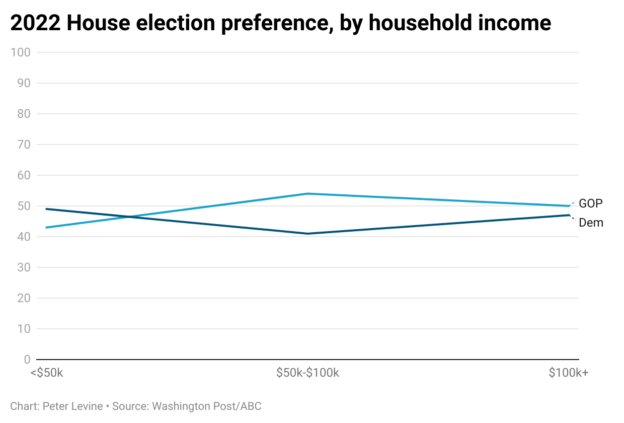
There are signs of this class inversion in many democracies today. However, the picture in the USA is mixed, because wealth, race, and education don’t push in the same directions. Right now, according to the Washington Post-ABC poll, household income does not predict people’s opinion of the 2022 election very well. Democrats perform just a touch better among households earning less than $50,000 per year, and Republicans do better above that threshold, but the whole graph (see above) is pretty flat. That’s because income and being white correlate with support for Republicans, whereas education and being black correlate with Democratic support. The result is our somewhat mixed situation, in which the parties fumble between their traditional roles and inverted ones.

I am fully aware that race is at the heart of the issue in the United States–as it has been all along in this country. However, that observation should be the beginning of the conversation, not the conclusion. If the parties invert their class positions because of white racism, then the whole system is in trouble. Socialists, moderates, libertarians, and constitutionalists should all be alarmed. Again, this is not a new threat today; the end of Reconstruction offers a frightening precedent. But it will be a tough trap for our republic to escape.

Real constitutionalist conservatives have critical work to do on their side of the aisle. Meanwhile, Democrats need to win the votes of more low-income whites, whether that means taking Heather McGee’s advice to explain how racial injustice also harms whites, or taking Ruy Teixeira’s advice to reclaim patriotism and certain traditional values, or running campaigns like Tim Ryan’s in Ohio, or simply doing more to benefit low-income communities that include a lot of white voters.

See also the social class inversion as a threat to democracy; social class in the French election; why the white working class must organize etc.

Mapping Ideologies as Networks of Ideas

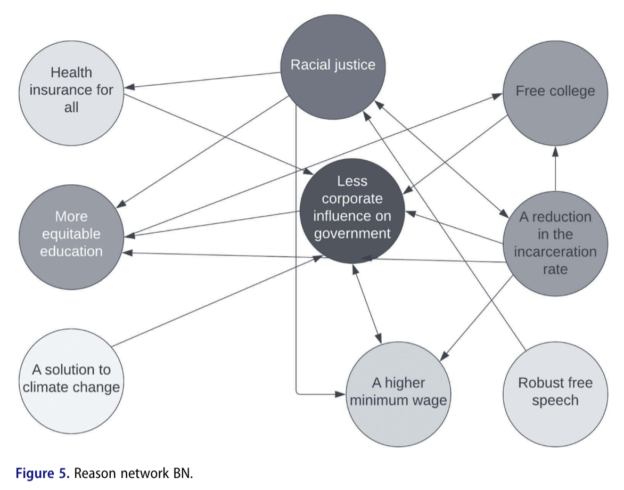
Newly published (behind a firewall): Peter Levine (2022) Mapping ideologies as networks of ideas, Journal of Political Ideologies, DOI: 10.1080/13569317.2022.2138293.

This is an early publication from my main current scholarly project. I am concerned that several streams of research and intellectual conversations are converging on the same conclusion: people just aren’t very thoughtful or rational about politics. This stance discourages efforts to enhance democracy and the public sphere. However, the most prevalent measurement tools–standard opinion surveys–are systematically biased against detecting the complexity and individuality of individuals’ political views. Various colleagues and I are experimenting with alternative quantitative methods that involve directly asking people about the connections among their distinct beliefs and analyzing the results as networks. This sole-authored article is a pilot study aimed at validating the method.

Abstract:

Individuals in a non-representative sample of 93 US progressives were asked which social outcomes they valued and then asked about the relationships among these opinions. Did each outcome provide a reason for a different one? Would each outcome cause a different one? If each outcome came to pass, would it make them more likely to support another outcome? Network diagrams derived from these responses represent portions of these individuals’ ideologies, understood as structures of political thought. Scrutiny of the network diagrams and analysis of the aggregate data suggest that most respondents carefully and reasonably identified relationships among their own ideas. Features of their networks predicted their assessments of five prominent politicians. This exploratory study paints a strikingly different picture of the sample than what would emerge from more conventional methods, such as factor analysis. Instead of a group that looks ideologically homogeneous on a unidimensional scale or that exhibits a low level of ideological coherence (because very few of their ideas are correlated), this method displays a collection of people who hold diverse and complex structures of thought. The method should be replicated with representative samples to explore the variation and significance of such structures.

See also: what if people’s political opinions are very heterogeneous?;  individuals in cultures: the concept of an idiodictuonideologies and complex systemsdon’t let the behavioral revolution make you fatalistic, etc.