My employer and primary community, Tufts University, appears (along with virtually all US colleges and universities) in two massive studies by Raj Chetty and colleagues. I will use Tufts’ statistics to offer some general observations about the relationships between capital and education in our economic order. Tufts represents one type of institution that plays a significant economic role in the US and even globally.
According to his study of economic mobility, 62% of Tufts students who arrive from the bottom fifth of the income distribution attain the top fifth, which ranks Tufts #7 among “elite” institutions for upward mobility. However, students from the bottom of the income distribution are relatively scarce at Tufts (due, I believe, to our relatively small endowment), ranking us 40th in accessibility out of 65 elite colleges. Putting those two facts together generates a rank of 30th out of 65 for what Chetty et al. call “overall mobility.”
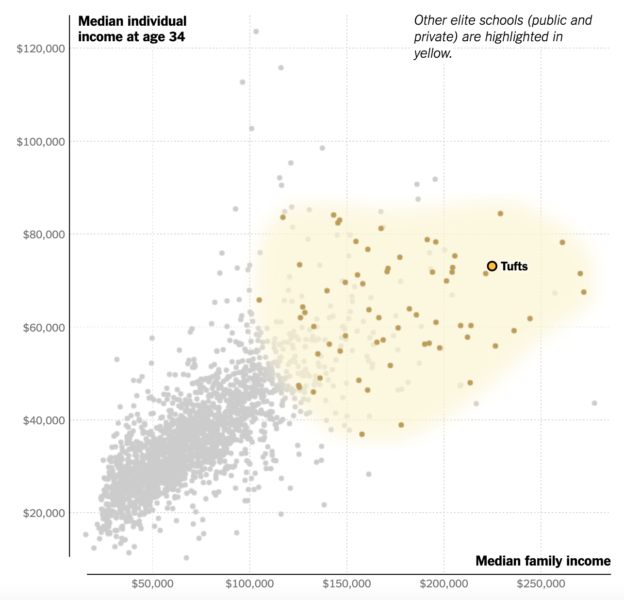
Basically, Tufts students tend to be economically advantaged, but their median income at age 34 is much higher than their family income was at age 18. This is typical of the institutions Chetty et al. call “elite.” (See the graphic with this post, which shows Tufts right in the midst of the elite schools.)
Meanwhile, according to Chetty and colleagues’ analysis of Facebook data, 94.4% of low-income Tufts students’ Facebook “friends” have high incomes, ranking Tufts in the 100th percentile among all US institutions on that measure. Tufts demonstrates relatively low “clustering,” meaning that Tufts students’ Facebook-friend networks are relatively cliquey. But these cliques do not seem to be economically homogeneous (Chetty et al 2022). In short, because Tufts is somewhat diverse and fairly cohesive but also predominantly affluent, students who are admitted from the lower economic strata obtain economically valuable connections while in college.
Chetty follows James Coleman (1988, cited 61,000 times), Robert Putnam (2001), and other authors, mostly Americans, in finding that social capital boosts educational success and upward economic mobility. The argument is basically that individuals–especially children and youth–are more likely to succeed if other people voluntarily support them and if many people support their schools and colleges, thereby making these institutions work better. If we define “social capital” as such networks of voluntary engagement, then having social capital benefits the individual and has positive externalities for the society. It is win/win.
A different literature is equally influential but has a different audience. Pierre Bourdieu sees education primarily as a way of reproducing economic stratification. His most famous idea is that educational institutions mark their graduates as members a specific social class by teaching them how to talk and act (Bourdieu 1983, cited 61,000 times). Members of the current ruling class dominate the institutions that mark people as upper class, ensuring that their children obtain “cultural capital.” Bourdieu also uses the phrase “social capital,” referring to the network-ties that further stratify a society. For instance, if a rich and powerful person knows and likes you, you have social capital. For Bourdieu, social capital is zero-sum, a means of gaining relative advantage over others.
To make these theories vivid, image two concrete stories.
First, imagine a US teenager who has only decent odds of completing high school, obtaining an associate’s degree, and getting a job that pays as much as her parents did when they started out. She will be more likely to succeed at these goals if her family members and other adults and peers offer emotional support, occasional financial support, and connections, and if many people support the local schools, sports leagues, and other community-based settings where she spends her time.
Second, imagine a teenager (we will call him “Brett”) who attends a selective private school in the Washington suburbs with a future Supreme Court justice, goes on to Yale, where his grandfather had studied before him, and then to Yale Law School, where he rooms with a future federal judge and plays basketball with the Yale professor who leads the Federalist Society chapter. He gets clerkships, jobs, and appointments that culminate in a seat on the Supreme Court along with his former schoolmate, two other Yale Law graduates, and five other former members of the Federalist Society. Brett was more likely to succeed at reaching his goal–the nation’s highest court–because well-placed friends looked out for him and supported the institutions where he studied.
Both of these theories could be true. They might name dynamics that apply for different segments of our population. I am not aware of empirical studies that explicitly juxtapose them in ways that would allow them to be compared and, perhaps, combined. Chetty’s work hints at some combinations. If he and his colleagues only studied institutions like Tufts, the main findings would be consistent with Bourdieu. But Chetty offers data for all colleges, universities, school systems, and neighborhoods, and often it appears that social capital benefits everyone, as in Coleman and Putnam.
I would also cite the tremendously ambitious Chicago study by Sampson, Raudenbush, and Earls (1997). As Sampson presents the results, this study finds very little evidence of economic mobility in Chicago. The vast majority of Chicagoans retain their class position as they move through life (Sampson 2012, Kindle loc. 5138). Nevertheless, individuals are much safer and healthier if their neighborhoods are more socially cohesive. In this model, social capital–which Sampson et al. re-conceive as “collective efficacy”–improves one’s quality of life without challenging the class structure. This is a way of synthesizing Bourdieu and Coleman.
I cannot offer additional empirical evidence, but I would like to suggest some conceptual clarifications. Basically, I believe that the categories in this debate are complicated and that neither Bourdieu’s Marxism nor neoliberal economics offers sufficient nuance on its own.
Capital takes many forms. Let’s define capital most abstractly as a stock that produces some kind of flow. This stock can be land (with our without natural endowments that benefit people), raw materials, equipment, organizational structure, know-how, basic knowledge, specific knowledge, network ties, and/or influence or even control over other people. Depending on the type of stock, it may or may not belong to groups, as opposed to individuals. Depending on the laws and economic system, it actually belongs to some entities and not others. Likewise, capital can have many flows, from money to happiness to prestige, and those outputs either benefit or harm different people or groups. Some flows accumulate while others dissipate. It may be possible to purchase one kind of capital with another. A classic example is the lucky nouveau-riche who buys cultural capital in the form of a fancy educations for his kids. But such exchanges face barriers and inefficiencies.
People want a variety of things: not only concrete goods for themselves but also relative status vis-a-vis other people, feelings of belonging, freedom, and various other people’s welfare.
Education has many aspects. It can mean practical knowledge with social or economic value for the individual, the community, or both; intrinsically valuable knowledge that may not be socially valued; an indication of relative talent and/or ambition; an indication of membership in a specific social category (e.g., the social elite, a religious group, the military); a process of accommodating individuals to current authority and prevailing norms; or a liberation from those norms. People may consciously seek various combinations of these outcomes for themselves or their children and may experience outcomes that they did not intend. For instance, think of parents who believe they are purchasing economic advancement and good behavior, yet they watch their children turn into subversive radicals–or the reverse.
The socioeconomic distribution can be characterized in various ways. Chetty and colleagues write a lot about mobility, which means movement from one income or wealth percentile to a different one. It is important to remember that upward mobility must be exactly matched by downward mobility, holding other factors constant. For every first-gen. student who attends college, one college graduate’s child must not go to higher education, unless total enrollments rise (which will cheapen the relative advantage of college). This explains why the upper strata are so fierce about preventing mobility. Studies like Sampson et al. are focused on absolute levels of human welfare, such as victimization by violent crime. It would be possible for everyone to rise above reasonable levels. Bourdieu might be interested in the ratio of the top to the bottom, although his relatively classical Marxism is more about power than income. (And France, which he studied, is unusual in its combination of economic equality with political and cultural elitism).
There are many kind of relevant institutions, from neighborhood public schools that appear open to all but may be deeply exclusive because of residential patterns, to public universities that are genuinely accessible yet internally segregated and stratified, to well-endowed private institutions that heavily subsidize a minority of their students in the interests of “diversity,” which may primarily benefit the best off, and more.
There are many policy options. As I understand it, the elite of Mexico congregate at the Universidad Nacional Autonoma de Mexico, UNAM, which enrolls 356,530 students, admitting just 10% of its applicants, and charges $900 for tuition thanks to federal support and a limited budget. About half of UNAM students graduate. A considerable number of affluent but less ambitious Mexican students opt for private institutions in Mexico or US colleges that offer more individual services at higher cost but with less distinction. In contrast, many EU countries do not allow their universities to differ much in reputation or selectivity, and they typically serve students from their local areas, again, offering limited services. Even relative inexpensive and more accessible US public institutions usually provide many more services, beyond classroom instruction, compared to European universities. One would expect different results in terms of mobility, stratification, minimum welfare, median welfare, and equality–which are different measures.
Here are some possible takeaways for different kinds of people:
- If you’re prone to admire selective (Akil Bellow calls them “highly rejective”) institutions because many of their less advantaged students move upward on the socioeconomic scale, focus less on those few students and more on the vast numbers who aren’t admitted. Furthermore, if selective institutions offer exclusive social capital, their impact on mobility could not be expanded. Making them bigger would dilute their benefits for their own students.
- If you view selective institutions as merely exclusive and all about preserving social advantage, you have a valid perspective. However, you might consider the public goods that these institutions produce (from highly trained physicians to translations from Sanskrit) and ask how we else we might generate those goods.
- If you want to promote mobility by giving money to selective institutions, you should at least Google their per-student endowments. Some US universities (but not including Tufts) could already offer completely free tuition for all their students below a high income threshold. You might ask what they are doing with your fungible contributions.
- If you think that universities should invest more in services and quality of life to promote their own students’ equitable well-being, you might consider evidence that such investments also make those institutions more selective and less accessible (Bulman 2022). Institutions could instead expand the number and/or diversity of the students they admit, but that means serving a hypothetical constituency instead of an actual one, and it rarely happens.
Citations: Bourdieu, Pierre. Forms of Capital: General Sociology, Volume 3: Lectures at the College de France 1983-84. United Kingdom: Wiley, 2021; G. Bulman, “The Effect of College and University Endowments on Financial Aid, Admissions, and Student Composition,” NBER Working Paper 30404 (2022) http://www.nber.org/papers/w30404; Chetty, Raj, Matthew O. Jackson, Theresa Kuchler, Johannes Stroebel, Nathaniel Hendren, Robert B. Fluegge, Sara Gong et al. “Social capital I: measurement and associations with economic mobility.” Nature 608, no. 7921 (2022): 108-121; Coleman, James S. “Social capital in the creation of human capital.” American journal of sociology 94 (1988): S95-S120; Putnam, Robert D. 2001. “Community Based Social Capital and Educational Performance.” In Making Good Citizens: Education and Civil Society, edited by Diane Ravitch and Joseph P. Viteritti, 58–95. New Haven, CT: Yale University Press; Sampson, Robert J.. Great American City: Chicago and the Enduring Neighborhood Effect. University of Chicago Press 2012; Sampson, Robert J., Stephen W. Raudenbush, and Felton Earls. “Neighborhoods and Violent Crime: A Multilevel Study of Collective Efficacy.” Science 277, no. 5328 (1997): 918–24. http://www.jstor.org/stable/2892902.
See also why don’t colleges allocate more resources to access?; four perspectives on student debt forgiveness; the weirdness of the higher ed marketplace; two approaches to social capital: Bourdieu vs. the American literature; Bourdieu in the college admissions office; the ROI for philosophy, etc.