there are tears of things

One of the most famous–and notoriously ambiguous–phrases in all of Latin literature is Virgil’s “sunt lacrimae rerum” (Aeneid 1, 462). In his response to the Covid pandemic, Pope Francis interprets the phrase in an environmentalist spirit:

If everything is connected, it is hard to imagine that this global disaster is unrelated to our way of approaching reality, our claim to be absolute masters of our own lives and of all that exists. I do not want to speak of divine retribution, nor would it be sufficient to say that the harm we do to nature is itself the punishment for our offences. The world is itself crying out in rebellion. We are reminded of the well-known verse of the poet Virgil that evokes the “tears of things”, the misfortunes of life and history

(Pope Francis, 2020, 33)

Others have equated the phrase with the Japanese motto mono no aware, which Dennis Washburn defines as “an intuitive sensitivity toward the sublime, sad beauty that inheres in mutable nature and transitory human existence” (Washburn, 2016). In turn, mono no aware can express the First Noble Truth of Buddhism–the essential pervasiveness of suffering (Saito 1997)–or it can be an alternative to that view, a way of collecting and relishing representations of impermanence and loss.

Very literally, Virgil’s three words mean “there are tears of things,” but that statement makes little sense in English and requires expansion–using other meanings of the Latin nouns and/or additional connectives. English translators have proposed phrases as various as “The world is a world of tears (Fagles) or “They weep here / For how the world goes” (Fitzgerald), or even “The universe has sympathy for us” (Stewart, 1971, p. 119).

Gawin Douglas was the first to translate The Aeneid into a relative of modern English (Renaissance Scots), producing a version that Ezra Pound particularly appreciated. Douglas wrote:

Thir lamentabyll takynnys [condition] passit befor
Our mortal myndis aucht to compassioun steir.

The context is important for understanding these words’ sense. The Aeneid begins in medias res with Aeneas, the sole important survivor of defeated Troy, trying to sail from there to Italy. The goddess Juno, who hates him and all Trojans, arranges for a terrible storm to scatter his ships and maroon him on the coast of Libya. Aeneas’ mother, Minerva, appears in the guise of a hunter and directs him to Carthage, which is under construction. He wanders into a temple of Juno, where the art illustrates the Trojan War, depicting Aeneas’ comrades, his enemies, and even himself in battle. Since this is Juno’s temple, we might guess that the paintings are supposed to celebrate Aeneas’ defeat. However, the sight gives him hope–the text says–and he blurts out:

"Sunt hic etiam sua praemia laudi;
sunt lacrimae rerum et mentem mortalia tangunt.
Solve metus; feret haec aliquam tibi fama salutem." 

"Even here praiseworthy deeds have their rewards;
There are tears of things, and mortal matters impress the mind.
Let fear go; this fame will also bring you some benefit." 

Aeneas sees his own story as depicted by human artists, provoking thoughts of loss and sorrow but also pride. He utters a concise but mystifying phrase that pairs the words for “tears” and “things.” I imagine a companion following up with questions:

Do you mean that things are intrinsically or fundamentally sad?

– Yes, that is what I feel right now.

Or that these paintings are objects that make people cry?

– That too.

Are you somehow happy to see these sad events depicted?

– I suppose so.

Yet they make you sad?

– That is what I am happy about.

Do you want people who hear about your suffering to be sad?

– Yes, but I want them to relish that sadness.

In the end, I don’t think the original poem really provides a basis for interpreting the phrase as a statement of existential wisdom, comparable to mono no aware or to modern environmentalism. I suspect Aeneas is mostly interested in being depicted heroically in art. “This fame will bring you benefit” is his main point. However, the words “sunt lacrimae rerum” jump out of their context and can translate ideas from remote traditions.

Sources: Pope Francis, Fratelli Tutti: Encyclical Letter on Fraternity and Social Friendship, English version (Libreria Editrice Vaticana, 2020); Dennis Washburn, introduction to Murasaki Shikibu, The Tale of Genji (W. W. Norton & Company, 2016); Saito, Yuriko. “The Japanese Aesthetics of Imperfection and Insufficiency.” The Journal of Aesthetics and Art Criticism, vol. 55, no. 4, 1997, pp. 377–85; Douglas J. Stewart, “Sunt Lacrimae Rerum.” The Classical Journal, vol. 67, no. 2, 1971, pp. 116–22; Gawin Douglas, The Aeneid translated into Scottish Verse. See also David Wharton, “Sunt lacrimae rerum: an exploration in meaning.” Classical Journal 103.3 (2008): 259-279. And see: Nostalgia for Now; Arachne; The Wedding of Peleus and Thetis; The Laughter of the Gods; and compassion, not sympathy (on Seneca).

The Sum of Ostrom, Common Pots, and Persistence

I’ve deeply been deeply influenced by Elinor Ostrom (1933-2012). This is my brief introduction to her work, with links to two lectures that I’ve recorded about her, drawing on chapter 4 of my book What Should We Do? A Theory of Civic Life.

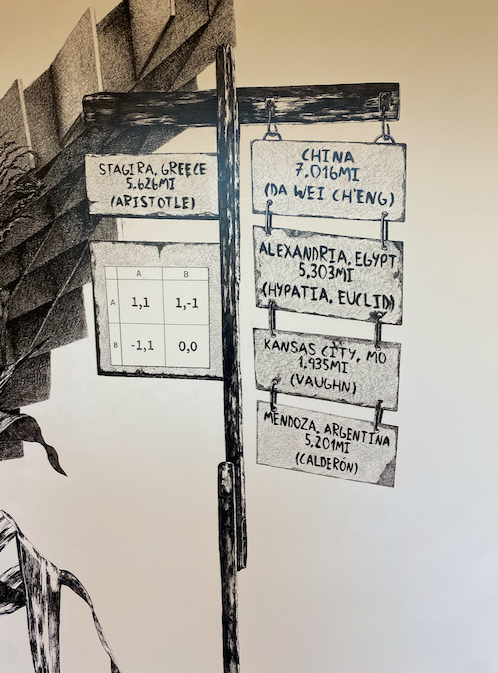
Lin Ostrom had many fans, including several of my colleagues at Tufts. Nevertheless, I see myself as her most enthusiastic champion here. Therefore, imagine my delight when a student told me about “The Sum of Ostrom, Common Pots, and Persistence,” a two-story mural by Jamal Thorne in Tufts’ new Joyce Cummings Center. At the time, I was co-teaching a course in the same building in which we discussed how Ostrom’s model applies to religious organizations.

According to the catalogue, “Thorne evokes a seeming past made present through the reclamation of iconic symbols, such as a walnut tree, native flora, a standing clock, lanterns, and a quilt. These variously denote the setting’s connections with the Mashpee Wampanoag tribe, the Underground Railroad, and George L. Stearns, a Boston merchant and abolitionist whose estate was acquired by Tufts in 1920. Furthermore, the inclusion of an abstracted road sign alludes to Thorne’s collaboration with the Math and Economics departments, the varied fields and perspectives represented among faculty, and an appreciation for how the wonders and theorems of abstract thought connect with human behavior.”

One of the murals shows a mathematical representation of the Prisoner’s Dilemma (which, Ostrom argued, people can solve), plus directional signs that point to Aristotle, Da Wei Cheng (1533–1606), who wrote Suanfa Tongzong (General Source of Computational Methods), Hypatia and Euclid (Greek mathematicians), Dorothy Vaughn (one of the Black women mathematicians and computer pioneers who contributed to the Pentagon and NASA), and the Argentine-US mathematician Alberto Pedro Calderon (1920-1998).

Ostrom is all about emergent systems in which people voluntarily contribute and create common goods. Some of these systems are natural: environments in which human beings play positive roles. Some of them are intellectual: Ostrom understood knowledge as a commons that is generated by people in institutions like Tufts. Often commons have cultural dimensions, incorporating the cultural products of the past. Some are indigenous and threatened by modernist schemes. Some, however, are global. Thorne eloquently combines these aspects in an installation for our newest major building.

See also: 142 previous posts on this blog about Ostrom.

Montaigne the bodhisattva?

Several influential philosophical traditions assert that everyone is equally important. Since other people outnumber each of us–by billions–we should count ourselves and our interests for almost nothing.

That is a direct implication of classical utilitarianism. Sam Bankman-Fried endorsed it in an interview with Adam Fisher, conducted while he was actually stealing money for himself. (But hypocrisy does not invalidate a moral principle.) Another crisp statement comes in Shantideva’s classical summary of Buddhist ethics, probably written in the 700s CE. Shantideva recommends that we

meditate intently on the equality of oneself and others as follows: ‘All equally experience suffering and happiness. I should look after them as I do myself. … When happiness is liked by me and others equally, what is so special about me that I strive after happiness only for myself … Without exception, no sufferings belong to anyone. They must be warded off simply because they are suffering. Why is any limitation placed on this? If one asks why suffering should be prevented, no one disputes that! If it must be prevented, then all of it must be. If not, this goes for oneself as for anyone … This is why Supushpacandra, although undergoing torture at the hands of the king, did nothing to prevent his own suffering out of sacrifice for many sufferers. … Those who have developed the continuum of their mind in this way, to whom the suffering of others is as important as the things they themselves hold dear, plunge down into the Avici hell as geese into a cluster of lotus blossoms [to save the souls condemned there.]

Shantideva, 8.90, 8.95, 8.102-3, 8.106-7.

Michel de Montaigne acknowledges that “most of the world’s rules and precepts do adopt such an attitude, driving us outside ourselves and hounding us into the forum in the interests of the public weal.” These philosophies advise “that one should forget oneself on behalf of one’s neighbour and that, compared to the general, the individual is of no importance” (Montaigne, “On Restraining Your Will,” 1580, III, 10, p. 1137). Montaigne even says that his father held this view, and it motivated the elder Montaigne to be a devoted public servant.

Nevertheless, Montaigne dissents. He acknowledges one good thing about trying to treat every other person as just as important as ourselves. It teaches us not to be overly attached to our private interests, just as a “bowman, … to hit his target, raises his sights way above it”–or just as “to straighten a piece of bent wood we bend it right over backwards” (p. 1138).

In other words, striving to count ourselves for almost nothing counters the fault of caring for ourselves alone. But our real target should lie between the extremes of self-negation and self-love. For …

the true degree of love which each man owes to himself is … not false love which makes us embrace glory, knowledge, riches and such-like with an immoderate primary passion, as though they were members of our being, nor a love which is easy-going and random, acting like ivy which cracks and destroys the wall which it clings to, but a healthy, measured love, as useful as it is pleasant. Whoever knows its duties and practises them is truly in the treasure-house of the Muses: he has reached the pinnacle of human happiness and of man’s joy. Such a man, knowing precisely what is due to himself, finds that his role includes frequenting men and the world; to do this he must contribute to society the offices and duties which concern him. [C] He who does not live a little for others hardly lives at all for himself: ‘Qui sibi amicus est, scito hunc amicum omnibus esse.’ [Know that a man who feels loving-friendship for himself does so for all men – Seneca] The chief charge laid upon each one of us is his own conduct: that is why we are here. For example, any man who forgot to live a good and holy life himself, but who thought that he had fulfilled his duties by guiding and training others to do so, would be stupid: in exactly the same way, any man who gives up a sane and happy life in order to provide one for others makes (in my opinion) a bad and unnatural decision.

Montaigne 1580, p. 1138.

Montaigne’s position requires a defense. After all, every person is equally valuable, in an objective sense, so why shouldn’t we act accordingly?

First, Montaigne argues that to promote everyone else’s welfare requires ambition. It means climbing the ladder of authority in order to influence the social order. Montaigne is highly skeptical of ambition, seeing it as a snare. Most people who attain high office are actually unable to accomplish much, yet they are quick to take themselves far too seriously:

Most of our occupations are farcical: ‘Mundus universus exercet histrionem.’ [Everybody in the entire world is acting a part — Petronius]. We should play our role properly, but as the role of a character which we have adopted. … I know some who transubstantiate and metamorphose themselves into as many new beings and forms as the dignities which they assume: they are prelates down to their guts and livers and uphold their offices on their lavatory-seat.

Montaigne, 1580, pp. 1143-4.

Those who enter the fray to improve the world also become partisans for particular positions. They take views about how things should be and are prone to disparage their opponents. Montaigne, on the other hand, strives for intellectual humility and uncertainty, and he looks for value in all views. “I am firmly attached to the sanest of the parties but I do not desire to be particularly known as an enemy of the others beyond what is generally reasonable” (p. 1145). After all, “A good book does not lose its beauty because it argues against my cause” (p. 1144).

But why do we need authority or ideology to improve the world? Why not humbly give away most of what we possess? Perhaps Montaigne should have done that–and perhaps I should now. Although he doesn’t directly address this issue, he does argue that wealth is unrelated to happiness. “Metrodorus lived on twelve ounces a day, Epicurus on less; Metrocles slept among his sheep in the winter and, in summer, in the temple porticos; ‘Sufficit ad id natura, quod poscit.’ [What nature demands, she supplies –Seneca.] (p. 1141).

Montaigne acknowledges that people want more than the bare minimum of worldly goods, but that is because we have become habituated to surplus and are averse to losing it to other people. “If I lack anything which I have become used to, I [foolishly] hold that I truly lack it” (p. 1142). Better not to obtain it in the first place. That implies that sharing one’s surplus with others would do them little good.

But Montaigne’s main point–throughout his work–is that happiness is hard to accomplish. Fear of death and other human frailties beset us, regardless of our social circumstances. “We are never ‘at home’: we are always outside ourselves. Fear, desire, hope, impel us towards the future; they rob us of feelings and concern for what now is, in order to spend time over what will be – even when we ourselves shall be no more” (Montaigne, I:3, p, 11). We can address such faults, but to do so requires introspection and self-care. If everyone devoted themselves to helping everyone else, no one would accomplish happiness.

Since I began this post with Shantideva, I should present his probable rejoinder. He would agree with Montaigne that suffering is universal, and the only solution is inward. “Since I cannot control external events, I will control my own mind” (5.14). However, this Buddhist monk would recommend a different path from Montaigne’s. The more we fully grasp the suffering of the vast number of other sentient beings, the less space we have left to care about our own private interests. Caring about our interests–experiencing desire or craving–is the source of all unhappiness. Therefore, setting one’s aim, like an archer, at the good of all sentient beings is actually the best way to liberate oneself from suffering. “Whosoever longs to rescue quickly both himself and others should practice the supreme mystery: exchange of self and other” (8:120)

This doesn’t sound exactly like Montaigne. As I have noted, he rejects the advice to “forget oneself on behalf of one’s neighbour.” He famously retreated from the world’s struggle to read and write in his private tower, making himself his only topic. “My business, my art, is to live my life” (p. 425, from “On Practice”). Also, Montaigne claims modestly that he has not achieved “noble Stoic impassibility” (p. 1153), because he hasn’t accomplished his inner peace by exercising any kind of discipline. Instead, he just happens to be easy-going by temperament.

Still, Montaigne’s writing radiates curiosity and empathy for the vast variety of human beings whom he has encountered in books and life. He abhors cruelty. He offers gentle advice aimed at liberating us from attachment. For instance: “There are so many awkward passages that the surest way is to glide rather lightly over the surface of this world. We should slide over it, not get bogged down in it. Pleasure itself is painful in its deeper reaches” (p. 1136).

And perhaps his essays are a gift. “Here you have not my teaching but my study: the lesson is not for others; it is for me. Yet, for all of that, you should not be ungrateful to me for publishing it. What helps me can perhaps help somebody else” (p. 423, from “On Practice”). This is Montaigne’s way of plunging into hell as a cluster of lotus blossoms.

Sources: Michel Montaigne, The Complete Essays (1580), translated by M.A. Screech (Penguin Books Ltd. Kindle Edition); Shantideva, The Bodhiicaryacatara, trans. by Kate Crosby and Andrew Skilton (Oxford University Press, 1995). See also: compassion, not sympathy; two criticisms of Effective Altruism; “you should be the pupil of everyone all the time”; was Montaigne a relativist?; John Stuart Mill, Stoic; introspect to reenchant the inner life; Emerson’s mistake; the sublime is social; Buddhism as philosophy; etc.


using federal spending to strengthen democracy

The federal government is authorized to spend an additional $2 trillion over the next 10 years through the Bipartisan Infrastructure Law, the CHIPS and Science Act, and the Inflation Reduction Act. I support many of the priorities in these laws.

But government spending should be democratic–at several levels. Operating in a democratic way is consistent with justice and is most likely to be sustainable, because people will feel relatively supportive of government programs that engage them. This is the version of social democracy or Great Society liberalism that I can get behind.

What does spending money democratically mean? First, a fairly elected, deliberative legislature should allocate the funds into large categories. That pretty much happened with these bills (acknowledging many imperfections).

Then the federal agencies and state and local governments that administer the funds should engage relevant communities in deciding how to spend the money in detail and should form partnerships with groups (which may not be federal grantees) to accomplish the intended outcomes of the spending. Finally, the funds should allow many people to be hired and given a voice in the programs–including those who do the blue-collar work.

Spending on public transportation is a good example. The White House says there will be “$89.9 billion in guaranteed funding for public transit over the next five years — the largest Federal investment in public transit in history.” This investment has potential benefits for climate, racial equity, and convenience and quality of life.

States and cities will receive portions of this money. They should give their communities appropriate voice in deciding what and where to build. They should form partnerships with community groups whose goals align (e.g., community development corporations that can build dense housing near the transit). And they should employ workers–often via contracts with businesses–who have a say and who see pathways to influential Green careers.

This approach is inconsistent with libertarian conservatism, which opposes the spending in the first place. It is also inconsistent with technocratic progressivism, which views community engagement with deep skepticism. Doesn’t “engagement” mean NIMBY groups that block valuable projects in their neighborhoods, well-resourced companies that grab government contracts, and process-driven delays that dilute the benefits for both environment and racial equity?

The truth is, public engagement must be done well. A one-time public meeting in which citizens line up at the microphone to yell at public officials–that is a recipe for disaster. A worthwhile process takes planning and money. It requires training and technical support for the federal civil servants, local public employees, and activists who are involved. Since no single training program can accomplish very much, success requires building experienced bodies of employees who have run processes before and have learned to do them better.

We have not tried this approach for many decades in the USA–not since the Great Society, which tried various experiments in community engagement under the heading of “Maximum Feasible Participation” (with mixed success).

Reagan depicted government as the problem, although federal outlays per capita, adjusted for inflation, rose rapidly during Reagan’s term and only stabilized under Clinton. Also, despite a rhetorical commitment to hiring contractors instead of career civil servants, the civil service actually grew in that era. However, I think that federal capacity for public engagement shrank, outside of certain notable programs. More importantly, Congress launched or redesigned very few social programs after the late 1960s. That means that most federal money has flowed into well worn channels, offering limited opportunities for deliberation about what and how to spend.

Then, when the Obama Administration got a chance to allocate a substantial amount of new money in the 2009 stimulus, the progressive technocratic approach clearly won out. Efficiency was the by-word. Funds went to “shovel-ready” projects that were seen as offering the quickest return, or to initiatives informed by behavioral economics that were supposed to “nudge” people without them even being aware, or to competitions (like “Race to the Top”) that were meant to leverage non-federal funds. There was no sense that the public would be involved in defining and solving national problems along with the federal government.

Democratic spending is the path not taken, at least not since ca. 1965. We should find out whether it can produce sustainable, popular, and fair social outcomes in ways that we have not seen in my lifetime. That requires:

  • Setting aside tiny but real percentages of the federal funds for democratic and deliberative processes and for the training and technical assistance that they require. I am not sure to what extent those purposes are authorized under current law. If it is impossible to spend federal funds this way, then philanthropy should step up.
  • Considering new rules, such as offering special grants to communities that can demonstrate that they have reached agreement about priorities across traditional lines of difference, such as race, partisanship, or urban/suburban/rural divides. I’d be especially interested in agreements that bridge distant communities, such as coal towns and East Coast cities.
  • Intellectual leadership: influential people should articulate the value of public engagement. In the Obama Administration, the president did that, albeit somewhat vaguely. No members of his cabinet and hardly any liberal public intellectuals backed him up. The stimulus package and Obamacare came across as strictly technocratic and were assessed only for their outcomes (while democratic culture waned). We need more effective voices to defend democracy this time.

When David Meyers of The Fulcrum asked me yesterday to comment on the fact that the public identifies “the government” as the biggest problem facing us today, I replied that the most promising solution is to spend money democratically. My reply was rooted in the best traditions of the New Deal and Great Society (as I see them), but it’s a fairly marginal view today. It’s an alternative to three prevalent assumptions: that democracy is mostly a matter of fair electoral processes, that activated citizens are often a nuisance, and that protecting democracy means uplifting some kind of political center. I think we must exercise power to improve the world, but do so in ways that empower our full diversity of people in their roles as citizens.

See also: the Green New Deal and civic renewal; the new manipulative politics: behavioral economics, microtargeting, and the choice confronting Organizing for Action; Democrats as technocrats; Hillary Clinton on spending for infrastructure; the long march through institutions–for civic renewal; the big lessons of Obamacare; empowering citizens to make sure the stimulus is well spent; etc.

call for papers: Teaching Ethics in Data Science

The 1st Annual Workshop on Methods for Teaching Ethics in Data Science (MTEDS 23) will take place virtually and on the campus of Tufts University on Tuesday, May 2, 2023. 

Submission Guidelines

All papers must be original and not simultaneously submitted to another journal or conference. The following paper categories are welcome:

  • Short papers (1-5 pages) related to the topic of the workshop; accepted short papers will be given a 20 minute presentation slot in the conference. 
  • Undergraduate Ethics Case Studies for the Tripods Undergraduate Ethics Case Studies Project (see more details at https://sites.tufts.edu/mteds23/samplecase) 

Program Committee

  • Peter Levine (co-chair), Tufts University
  • Benedetta Giovanola (co-chair), University of Macerata, Italy
  • H. V. Jagadish, University of Michigan
  • Andreia Martinho, Tufts University 
  • Karl Schmitt, Trinity Christian College
  • more PC members TBA 

Organizing committee

  • Peter Levine, Tufts University
  • Lenore Cowen, Tufts University

Here is the call for papers: https://easychair.org/cfp/mteds23. The deadline is January 10, 2023