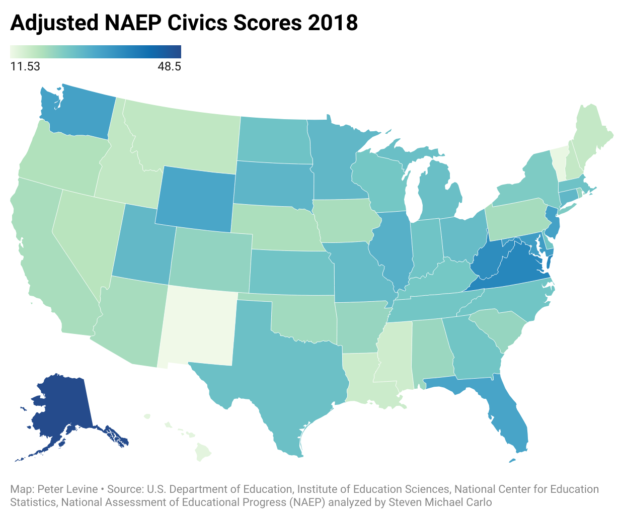
NAEP civic scores 2018 adjusted by demographics

civics test scores by state

The National Assessment of Educational Progress (NAEP) periodically measures US students’ knowledge of civics with an instrument that looks like a test, although it has no stakes for the students or teachers. I have served on the design committee for that instrument for many years. I don’t love the framework, which is dominated by the formal structure of the federal government. However, the NAEP is a carefully constructed assessment with a large, representative sample, so the data are certainly worth using.

Because states adopt their own standards, course requirements, and other policies for civics, we would like to understand which state policies are most effective. In a recent paper, Steven Michael Carlo presents mean NAEP civics scores for each state for 2014-18. Importantly, he adjusts these scores for other factors that might affect the results, namely: individual students’ race/ethnicity and gender, whether their school is public or private, the party of the state’s governor and legislature, the state’s adult and student demographics, state per-pupil expenditures on k-12 schools, and the state’s percentage of private school students.*

Of course, one could add more variables of interest, including various state policies. However, Carlo has presented a plausible answer to the question: Which states do better at civics?

I thought it might be useful to display two columns of data from Carlo’s paper in the form of maps, because a visual display can help to suggest hypotheses. At a minimum, states like Louisiana, New Mexico, Mississippi, and Vermont that have low adjusted scores should investigate possible causes. States like Virginia, West Virginia, Washington and Florida that have high scores may provide models.

First, here are the adjusted NAEP civics scores from the most recent year (2018).

And here are changes in those scores from 2014-18.

Another research step would be to add state civics policies (such as course and test requirements) to the model.

*Carlo, Steven Michael. (2024). The State of State Civics Scores: An Application of Multilevel Regression with Post-Stratification using NAEP Test Scores. (EdWorkingPaper: 24-954). Retrieved from Annenberg Institute at Brown University: https://doi.org/10.26300/rn72-q717. See also: the new NAEP civics results; some surprising results from the 2010 NAEP Civics assessment; CIRCLE’s release on today’s Civics results etc.

An Association as a Belief Network and Social Network

This is a paper that I presented at the Midwest Political Science Association on April 6, 2024. I hope to reproduce this study with another organization before publishing the results as a comparison. I am open to investigating groups that you may be involved with–a Rotary Club like the one in this study, a religious congregation, or something else. Please contact me if you are interested in exploring such a study.

Abstract

A social network is composed of individuals who may have various relationships with one another. Each member of such a network may hold relevant beliefs and may connect each belief to other beliefs. A connection between two beliefs is a reason. Each member’s beliefs and reasons form a more-or-less connected network. As members of a group interact, they share some of their respective beliefs and reasons with peers and form a belief-network that represents their common view. However, either the social network or the belief network can be disconnected if the group is divided.

This study mapped both the social network and the belief-network of a Rotary Club in the US Midwest. The Club’s leadership found the results useful for diagnostic and planning purposes. This study also piloted a methodology that may be useful for social scientists who analyze organizations and associations of various kinds.

simulating the French Revolution

In The Fall of Robespierre: 24 Hours in Revolutionary Paris, Colin Jones offers so much vivid detail about the events that unfolded within a single day that I realized it would be possible to base a simulation on his work. I have not been involved in role-playing games since I was a kid, but I do use light simulations in teaching and believe in their pedagogical value. Therefore, I wrote the rules for an educational simulation/game called Thermidor. It could contribute to a history course or a more abstract course about politics and decision-making. Someone would have to write private objectives for each character, and perhaps my rules should be improved before they are used. In any case, I am making the draft available for anyone who wants to use it.

Blurb:

When the sun rises on July 27, 1794, Maximilien Robespierre is the most powerful man in France. Under the official policy of “Terror,” the revolutionary government has executed at least 16,000 people since June alone, including many politicians. France is at war with implacable foreign enemies and struggles to suppress an insurgency in the countryside. Inflation is severe despite laws limiting prices and wages. Rumors of plots and purges abound. 

By the end of this fateful day, Robespierre is under arrest and on his way to the guillotine, and a period of political reaction is about to begin.

What would have happened if you had been involved?

See also: the role of communications in the French Revolution; why learn game theory? (a lesson plan that includes a game); and a simulation to teach civic theory and practice

tracking the Biden climate investments

The United States began a major experiment in 2022. After decades without an intentional industrial policy and not much action on the climate crisis, the federal government decided to spend something on the order of a trillion dollars over a decade to subsidize green industries.

I interpret this decision not only as a way to purchase lower emissions by (for example) buying solar panels, but also as a strategy for changing the power-base of the economy. As long as the livelihoods of many voters are tied to carbon, it’s very hard to regulate emissions. But once many people are involved with green technologies–as producers and/or consumers–they will demand green policies. This is also a competitive move, challenging other countries to subsidize their green sectors.

I believe this experiment should be on almost everyone’s minds. Conservatives and libertarians should acknowledge that it’s underway–because that’s the truth–and criticize it on its merits. Center-left people should defend it and also think hard about what comes next–whether Trump is elected and tries to undo it all or Biden gets another four years to build on it. Economic and environmentalist radicals are free to criticize the Biden strategy or to vote based on other issues, including the Mideast, but they should at least discuss the opportunities that a green industrial policy creates.

Instead, many conservatives seem locked into the idea that Biden is feckless and has done nothing. At least some on the center-left want to base the 2024 election entirely on Trump and abortion. And most radicals seem uninterested. For every thousand articles about Israel-Palestine debates on elite college campuses, I think I see less than one about the progress of the Inflation Reduction Act–which, by the way, was given a blatantly misleading name on the assumption that voters care about inflation, not climate. I am alarmed at how this whole topic is submerged.

As a very minor and amateurish effort to direct attention to the Biden climate policy, I recommend that people check out the official page for Clean Jobs America. Some points that strike me:

  • About $150 billion has been committed so far to concrete projects. For reference, that’s about the same as the annual budget of the Commonwealth of Virginia. It’s somewhat less than the annual cost of the US Navy (about $200 billion).
  • On a per capita basis, the largest investments are in South Carolina ($2,800 per resident), Arkansas (almost $2,000 per resident), and North Carolina ($1,800 per resident). Eleven states and DC have no specific projects yet.
  • South Carolina got $14 billion in investments. The same state sends $28 billion to the federal government in tax revenues annually. Basically, South Carolina is getting half its federal taxes back to fund green industry. On the other hand, Washington State sends $100 billion to DC each year and has received no clean energy support.
  • If you think of this as a jobs program, it is expensive. I calculate that about one job is created for every $1.2 million spent. On the other hand, the impact is not only on direct employment but also on carbon emissions, and there may be long-term positive effects on employment.
  • The cost of the jobs created varies a lot by sector. Only 200 jobs have been created so far in energy efficiency, but those were cheap at $30,000 per job. (If you want to accomplish something important, and it only costs you $30k to create a new position to do it, that’s a bargain.) On the other hand, the electric vehicle sector has seen more than 60,000 new jobs at $1.3 million per job.

The Biden Administration has also taken regulatory actions regarding hydrofluorocarbons and electric vehicles–see the tracker from the World Resources Institute. But I would regard the industrial policy as much more innovative and significant–for better or worse.

See also: a trillion here, a trillion there, and pretty soon, you’re talking real money; a different way in which the 2024 election is a failure for democracyfederal spending for both climate and democracythe major shift in climate strategy

read slowly, read aloud

It feels hard to read deeply these days. Our devices distract us constantly, the world is frenetic, and we have developed habits–as well as tools–for scanning and searching instead of following someone else’s thought across many pages. I find that some students are concerned about these trends and are striving to focus more on their own reading. Yet I also perceive a decline in many students’ attention (as well as my own) during the short period since the pandemic.

Meanwhile, Alexandra Moe recently wrote a piece in The Atlantic that reports extensive research on the benefits of reading aloud–even privately. Compared to silent reading, giving voice to written words involves different regions of the brain and has documented benefits, including helping people to manage chronic pain. It sounds like a form of meditation. Indeed, in his book about Tibetan Buddhist monks, Georges Dreyfus writes:

Reading or reciting aloud is considered virtuous for several reasons. Vocalizing a text in a rhythmic pattern helps it penetrate one’s mind, where it starts to take on a life of its own. One finds oneself spontaneously repeating the words. Such absorption of religious texts is thought to have soteriological value. The virtuous nature of recitation is also tied to a view of the world as alive with a number of invisible entities [who can hear the spoken words and benefit from them].

Dreyfus, The Sound of Two Hands Clapping: The Education of a Tibetan Buddhist Monk (Kindle Locations 1212-1215).

However, in the Tibetan monasteries where Dreyfus studied,

Reading aloud was used for liturgy or by beginners, not by seasoned scholars. As scholastics, Tibetan intellectuals had to consult a vast literature, and they thus read intensively and swiftly… . Tibetan scholars often practice comparative reading, matching the opinions of several texts point by point; this practice, too, requires speed and is incompatible with vocalization. [Scholars] read silently even in their daily recitations.

Ibid., Kindle Locations 2125-2129)

It is a familiar pattern that professionals read silently to find things, thus perhaps missing the spiritual benefits of reading aloud. Declaiming written words slows us down and forces us to think about how each syllable and sentence should sound. It’s an activity for amateurs, in the best sense of that word.

With those points in mind, you might try reading Keats’ “Ode to Autumn” aloud. I’ll paste the text below.

This work has generated a large and learned literature with unresolved questions. For instance, is it about endings alone or also about rebirth? Is it apolitical or a subtle response to the dramatic political events of 1819? Is it patriotic–about a specifically English fall? Why is the narrative “I” missing?

These questions are good, but for the moment, I’d recommend simply hearing the sounds of Keats’ words in your own mouth; asking yourself where the stresses and pauses belong; visualizing, as concretely as you can, his sequence of images; and following the trajectories–as I read the poem–from September to November and from feeling through sight to sound.

Season of mists and mellow fruitfulness,
Close bosom-friend of the maturing sun;
Conspiring with him how to load and bless
With fruit the vines that round the thatch-eves run;
To bend with apples the moss'd cottage-trees,
And fill all fruit with ripeness to the core;
To swell the gourd, and plump the hazel shells
With a sweet kernel; to set budding more,
And still more, later flowers for the bees,
Until they think warm days will never cease,
For summer has o'er-brimm'd their clammy cells.

Who hath not seen thee oft amid thy store?
Sometimes whoever seeks abroad may find
Thee sitting careless on a granary floor,
Thy hair soft-lifted by the winnowing wind;
Or on a half-reap'd furrow sound asleep,
Drows'd with the fume of poppies, while thy hook
Spares the next swath and all its twined flowers:
And sometimes like a gleaner thou dost keep
Steady thy laden head across a brook;
Or by a cyder-press, with patient look,
Thou watchest the last oozings hours by hours.

Where are the songs of spring? Ay, Where are they?
Think not of them, thou hast thy music too,—
While barred clouds bloom the soft-dying day,
And touch the stubble-plains with rosy hue;
Then in a wailful choir the small gnats mourn
Among the river sallows, borne aloft
Or sinking as the light wind lives or dies;
And full-grown lambs loud bleat from hilly bourn;
Hedge-crickets sing; and now with treble soft
The red-breast whistles from a garden-croft;
And gathering swallows twitter in the skies.

I also found my way to images of John Constable’s “The Hay Wain,” painted just two years after Keats wrote this Ode and a frequent object of comparison.

See also: reading for personal interest: trends since 2003; are we forgetting how to read?; when you know, but cannot feel, beauty;