would Americans be better off if they used ideology as a heuristic?

(Washington DC) News stories abound these days about Trump voters who are surprised that the president and his party may cut their benefits. For instance, Mae Bilodeau says she voted for Trump “precisely because she thought he would help the poor people of America who need services like [the local Legal Advice and Referral Center]. ‘He seems to be taking away from them more than helping them at this point,’ Bilodeau said.”

A good number of Trump voters even spontaneously announce a preference for a Canadian-style single payer system.

I learned a long time ago to think of US politics on a left/right continuum: pro-state on the left, anti-state on the right. Using that framework, I regarded Obamacare as a modest shift leftward. I assumed that President Obama would wish to move further left but had compromised (wisely, I think; others would say unnecessarily) by enacting the ACA. If I were enrolled in an Obamacare exchange, I would expect a Democrat to reduce my premiums or increase my benefits, simply by spending more money on the program. I would expect a Republican president to do the opposite: defund or repeal the law. My opinion of their positions would depend on my view of the government and the market.

But the Trump supporters quoted in these recent news reports do not use the left/right continuum as a heuristic. And that shouldn’t surprise us.  “Despite the centrality of philosophical concepts like liberalism and conservatism to mainstream political discourse, modern public opinion research has generally concluded that most citizens are unable to effectively use these concepts when making political judgments” (Frederico & Hunt 2013). Instead, at least some of Trump’s voters simply see him as standing on their side, and liberals as their enemies. I overheard two working-class white New England guys recently. One said, “The problem with liberals is they just hate people.” The other laughed. Many seem to have assumed that Trump would lower their premiums or improve their benefits. If Obama wasn’t doing either, that showed that he was a people-hating liberal, or perhaps just less competent than business-wizard Donald J. Trump would be.

This post could end with me tsk-tsking my fellow citizens for not using the ideological heuristic that I learned long ago to decide for whom to vote. And in fact, I believe Americans would be better off (overall) if they at least understood how to think in pro-state versus pro-market terms. That would certainly be far preferable to using race as a heuristic, as some may do.

Yet they may also be right to downplay the left/right spectrum. Consider the Kentuckian whom Sarak Kliff interviewed last December. She is reliant on the ACA, yet she had voted for Trump. She explained, “I guess I thought that, you know, he would not do this, he would not take health insurance away knowing it would affect so many peoples lives. … I mean, what are you to do then if you cannot pay for insurance?”

At the time, I tsk-tsked. But, to my surprise, it now looks fairly unlikely that the Republicans will repeal the ACA. This voter was right, and I was wrong. She saw herself as part of a coalition that won the election and would serve her interests. Ultimately, I believe that heuristic misled her, because she threw her support to anti-government conservatives who want to cut her benefits for ideological reasons, and she joined a coalition dominated by wealthy people who mainly want their taxes cut. But again, I am the one who was surprised to see ACA repeal in such trouble; her prediction was more accurate than mine.

Republicans tend to think that they have an anti-government or pro-market movement behind them. They are likely wrong. (CIRCLE’s research reveals a substantial shift of young white men who define themselves as “moderates,” not “conservatives,” to Trump in 2016.) The Alt-Right believes there’s a majority that is pro-welfare and also white-supremacist. I doubt that constituency is huge. But liberals should also doubt that they can win votes mainly by finding the right point on the left/right spectrum. Their main challenge is trust. As for voters, they may use a range of heuristics to assess candidates, but they would be wise not to ignore left/right ideology completely, because it explains why the GOP is trying to cut their benefits.
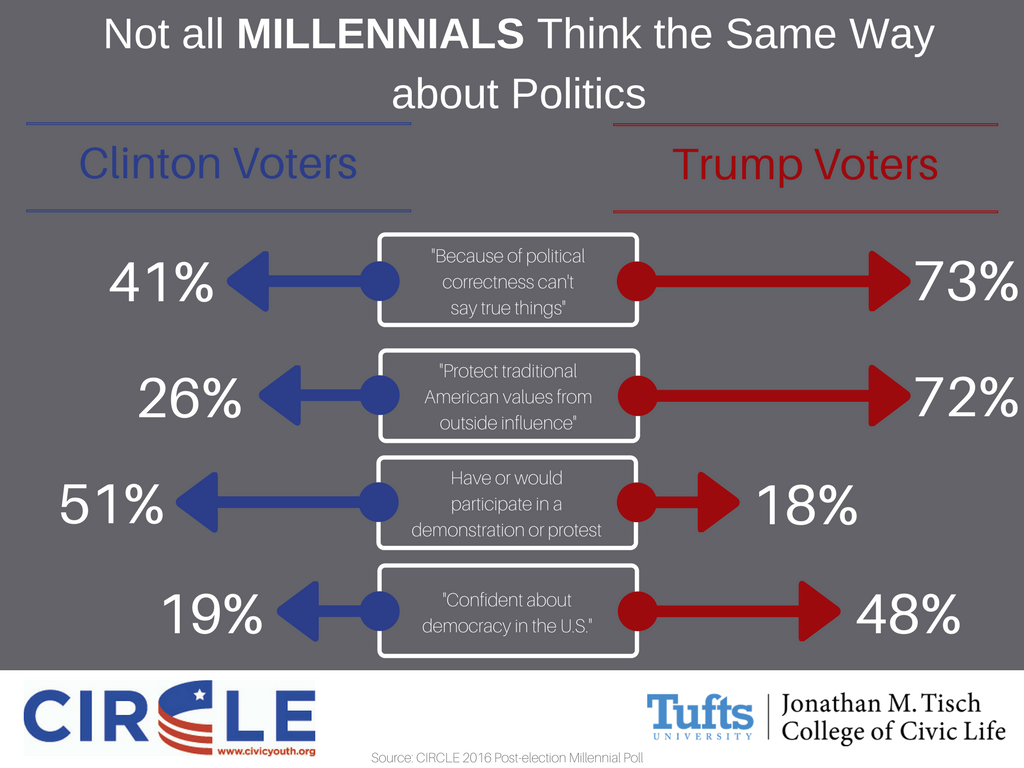
how Millennials split on some key issues

Here are some tidbits from CIRCLE’s analysis of its Millennial youth survey, the second wave of which was conducted in January. A substantial proportion of all Millennials believe that “political correctness” prevents people from saying things that are true, but that opinion is much more common among young people who voted for Trump. Three quarters of pro-Trump Millennials (who were 37% of all the youth who voted) want to protect traditional American values against influences from the outside, compared to one in four of those who voted for Clinton. Clinton voters are much more likely to be ready to participate in demonstrations and protests, and seriously lack confidence in US democracy. Much more at the link.

Millennial women in the 2016 election

A new paper by CIRCLE Director Kei Kawashima-Ginsberg investigates Millennial women’s participation in the 2016 election, their views of democracy, and their own political engagement in the Trump era. It was published as part of a symposium on gender and Millennials convened by the Council on Contemporary Families and is cited today in a New York Times op-ed.

According to the paper, 50 percent of young white women voted for Clinton; 41 percent, for Trump. Young women of color preferred Clinton by wider margins. Only 25% of Millennial women identified as feminists, and less than 15% say that the possibility of electing the first woman president informed their vote choice. Young women were more likely than young men to be inspired by Clinton, but only 23 percent reported that feeling. After the election, they are more concerned about the future of democracy than their male peers are, but not more likely than Millennial men to be interested in political engagement.

to whom it may concern

It has come to my attention that the level of my age
Is now set to fifty, with more movement on the gauge.
Who authorized this increase? Who consented to the change?
The alternative is worse, you say, but we’ve breached my chosen range.
I’ve searched my files for decades past and found most data gone.
Records labeled thirties, forties seem to be withdrawn.
Those phases passed much faster than I’d been led to understand;
I can’t recall what happened then or whether it was planned.
I’m writing to request a reset, please: thirty-five and hold it there.
Oh, and reset all my family, too; just me would be unfair.
Once I see the options back, and the meter’s restored to high,
I’ll retract the review I’ve given you–but I await your prompt reply.

Simon Denny: turning the NSA into art

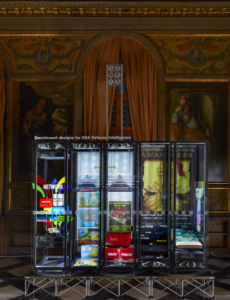
(Waterville, ME) Last week I saw a display that is exemplary of Simon Denny’s work. Inside a case made of server racks and glass panes are three-dimensional versions of the NSA graphics displayed in the PowerPoint presentations that Edward Snowden leaked. For instance, a slide depicting military vehicles crossing barriers has been turned into a diorama made in part of hobbyist models. A slide showing “The 5 Team Dysfunctions” has been turned into a three-dimensional pyramid with levels labeled with phrases like “Lack of Accountability” and “Lack of Results.” For another installation that I didn’t see, Denny actually used a stuffed eagle that he bought from a taxidermist to illustrate the eagle on the NSA’s shield. Lights flicker on the servers. The whole object is neat, shiny, hermetic, and strange.

For the Venice Biennale, Denny’s NSA displays were exhibited in the Renaissance Library of St. Mark (the Biblioteca Marciana), which was originally a storehouse of global knowledge and information for what was then a great mercantile power. The Marciana has held–although not currently–the finest medieval world-map, the Fra Mauro Map (ca. 1450) which compiled intelligence from such emissaries as Marco Polo. Venice sent these feelers into the world and compiled their data for the benefit of her navy and traders.

Here is Denny’s work as displayed in Venice–one empire echoing another across the centuries. Those are portraits of philosophers on the walls, sources of wisdom that might be compared to the gnomic utterances in the NSA slides, such as “Role of the Team Member: Focusing on Collective Impact.”

I, however, saw the same display at MOMA, the high-rise museum in the heart of Manhattan’s Midtown that Rockefellers founded to collect the best art of the world for the most powerful commercial city of its time.

Like much conceptual art, this display poses questions. I value that function, although I also think the appropriate response to a question is an answer. So, standing before Denny’s display and thinking about my own responses, I believe I’d say: As an organization, the NSA resembles a large bureaucratic for-profit firm, at least in its internal rhetoric. Its rhetoric is banal. A highly self-conscious, polished, ironic representation of that banality is art.

ThE NSA collects lots of information without people’s permission. It is part of the United States government, which is owned by the American people. The Agency also affects people around the world. The people who own it and the people whom it affects have a right to understand how it works. Understanding it includes having some kind of grasp of its internal culture, including its banality.

Then again, it is probably both necessary and even valuable for a nation to spy, so long as its foreign policy is reasonably just. To spy in the modern world is going to require an organization that resembles a large bureaucratic for-profit firm, and running such an operation reasonably efficiently may require banal slogans. (I’m not sure about that.)

By the way, the original artist who created many of the NSA’s graphics is David Darchicourt. He gets an odd sort of billing in Denny’s subversive Art-World response. Fortunately, Darchicourt seems good-humored about the whole thing. Ryan Gallagher reports:

Now he is the unwitting central character in a new exhibition that puts the spotlight on the spy agency’s imagery. … He admits he finds it interesting to see his designs in the Renaissance setting. “It’s kind of flattering, but it’s also kind of creepy,” Darchicourt says, adding that he’s now considering deleting some pictures from his online portfolios to prevent them from being used by anyone else in the future. “Anything that has to do with the NSA will be removed; it’s old and I don’t really identify with that organization anymore.”

See also: on the moral peril of cliche; cultural mixing and power; on the deep state