Hannah Arendt and Lin-Manuel Miranda

Hannah Arendt’s interpretation of the American Revolution may not be accurate history, but it is valuable political theory, and it finds an eloquent echo in Lin-Manuel Miranda’s Hamilton.

Arendt argues that the American revolutionaries began by seeking liberty, which they didn’t define sharply but which mainly meant negative individual freedom (On Revolution, p 20). (On this point, Phillip Pettit disagrees, arguing that the founders were motivated by opposition to “domination,” or subjugation to another person’s discretion.) In creating new institutions that would protect negative freedom, the revolutionaries discovered “public freedom”—the freedom to create together. And they found that this was a source of happiness for them. “They were enjoying what they were doing far beyond the call of duty” (p. 24).

Freedom, for Arendt, is in no tension with equality, because political equality can only exist among equals, free people who decide together what to do. She writes, “Freedom was understood as being manifest in certain, by no means all, human activities, and that these activities could appear and be real only when others saw them, judged them, remembered them. The life of a free man required the presence of others. Freedom itself therefore needed a place where people could come together—the agora, the market-place, or the polis, the political space proper” (p. 21). Equality is not natural but is created by people who decide to govern themselves on terms of freedom (pp. 30-1). Aristotle calls equals who govern together political friends.

A strong word for the kind of excellence and flourishing that the founders discovered in revolutionary action was “glory” (p. 196). Arendt is not a deliberative democrat who understands public discussion as a quest for consensus about the right thing to do. She is more of a performative democrat who sees politics as a place for demonstrating excellence to friends and to posterity.

In retrospect, we can explain the founding of the American republic in terms of contingent causes: France and Spain gave military support to defeat Britain, Parliament was divided, the size of the colonies made them ungovernable, etc. That is the perspective of a spectator. But the founders saw themselves as agents (p. 52), initiators of a story whose end was not determined.

The hard question posed by the Revolution was how to make the “public happiness” enjoyed by the founders in Philadelphia in 1776 or 1788 available to all Americans across time: the question of scale and sustainability.

In Miranda’s Hamilton, these themes are pervasive. The whole story is about Hamilton’s quest for glory and his discovery of freedom among friends (and Burr’s exclusion from the “rooms where it happens”). The themes of freedom, equality, friendship, glory, story-making, and expanding the scale of the revolution come together neatly in the the tavern scene where Hamilton and his friends sing “The Story of Tonight”:

[HAMILTON]
I may not live to see our glory!
[LAFAYETTE/MULLIGAN/LAURENS]
I may not live to see our glory!
[HAMILTON]
But I will gladly join the fight!
[LAFAYETTE/MULLIGAN/LAURENS]
But I will gladly join the fight!
[HAMILTON]
And when our children tell our story…
[LAFAYETTE/MULLIGAN/LAURENS]
And when our children tell our story…
[HAMILTON]
They’ll tell the story of tonight
[MULLIGAN]
Let’s have another round tonight
[etc]
[LAURENS]
Raise a glass to freedom
Something they can never take away
No matter what they tell you
Raise a glass to the four of us
[LAURENS/MULLIGAN]
Tomorrow there’ll be more of us
[MULLIGAN/LAFAYETTE/LAURENS]
Telling the story of tonight
[HAMILTON]
They’ll tell the story of tonight
[LAURENS/MULLIGAN/LAFAYETTE]
Raise a glass to freedom
Something they can never take away
[etc.]
CQ article on civic education

There’s always a steady trickle of articles about civic education, and I don’t post most of them, but I do recommend “Misinformed and Unschooled, Young People Are Failing in Civics” by Emily Watkins for CQ/Roll Call. Actually, the headline is a little too dire, since most kids face some kind of required course on civics that is graded, and most pass. But the content of the article is good. In particular, it highlights news media literacy as an objective, focuses on a real decline (class time devoted to social studies k-8), and gives an overview of the policy landscape, including the positive news of a current federal appropriation for civics.

saving Habermas from the deliberative democrats

“God save me from the Marxists”–attributed to Karl Marx

Jürgen Habermas is often presented as the master theorist of deliberative democracy, the author who believes that a society should approximate an “ideal speech situation” in which “the only force is the force of the better argument.” People apply his theory by creating deliberative fora, such as citizen’s juries or Participatory Budgeting processes, that approach an ideal speech situation. People criticize him for being utopian or overly rationalistic.

There is some basis for this interpretation of Habermas, but it overlooks that he is a sociologist with an abiding interest in the big Systems of a modern polity: markets, firms, legislatures, courts, unions, and the like. He understands modernity as a process of differentiation in which institutions that have diverse organizational logics and incentives arise and interrelate. I haven’t encountered a point at which he advocates creating ideal participatory fora and adding them to the mix of social institutions (although he may have done so somewhere in his voluminous works). What he does advocate is social movements, especially the “New” movements that have arisen since the 1970s, which he understands as efforts to resist the encroachment of the state and the market on everyday life. He names, as examples, squatter movements that occupy houses in German cities, and anti-tax protests. He argues that these movements revivify the public sphere by forcing the public to debate the proper role of state and market in relation to private life. A better speech situation results as a byproduct of contentious politics.

The New Social Movements are not deliberative fora to which representative citizens are invited to discuss public issues and reach agreement on policies. Instead, they combine “discourse” with a whiff of tear gas. I think they are needed for a full appreciation of Habermas.

See also: Ostrom, Habermas, and Gandhi are all we needHabermas and critical theory (a primer)the New Social Movements of the seventies, eighties, and today

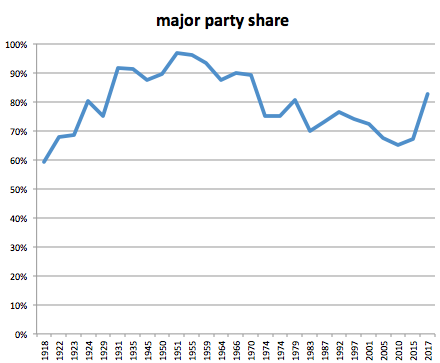
does the UK election show a return to two-party rule?

A May 2016 article in the Financial Times was headlined, “British politics has broken out of the two-party system.” The lead explains:

Politics has fragmented. London’s choice of Sadiq Khan as mayor grabbed the headlines — and rightly so. But the local and regional elections across the UK carried a broader message. British politics has broken out of the familiar framework of the two-party system. As in much of the rest of Europe the old rules are being discarded.

Provisionally, it seems the 2017 election results tell the opposite story. Here’s a hypothesis about what happened in Britain last week:

  1. Elections based on single-member districts tend to produce two-party systems, because votes for parties other than the top two are seen as “wasted.” The exceptions occur when regional parties are able to win majorities in their home areas.
  2. Given two parties, over time, people tend to split their votes about 50/50. If one party has a big advantage, that’s a disequilibrium; soon some demographic or identify groups migrate to the other party to even it out. Voters use party labels as heuristics and are not mainly affected by the specific policies or personalities on offer in a given campaign. That each party will get 50% of the vote is a pretty good guess.
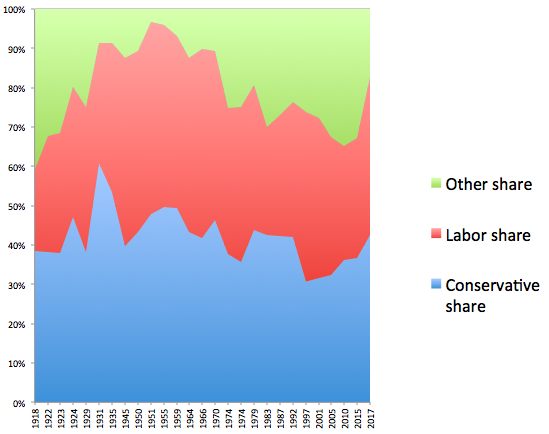
  3. Britain avoided a two-party system for parts of the 20th century, but the 2017 election saw the duopoly return. That’s why, despite May’s poor performance and Corbyn’s arguably radical views, each got closer to 50% of the vote than their predecessors had for decades.

This second graph breaks it down by party:

Sources: The Guardian for the 2017 vote tallies so far. The UK Electoral Commission for historic data. Analysis is my own.

starting the 9th annual Summer Institute of Civic Studies

The 9th annual Summer Institute of Civic Studies begins this morning and continues for two weeks, with 6½ hours of seminar discussion daily.  This year’s participants hold degrees in religion and literature, social policy, social welfare, international relations, political theory, philosophy, management, education, public administration, communications, geography, and sociology. They come from Liberia, the Philippines, Latvia,  Colombia, Nigeria, China, and the US. And they come from graduate programs, faculty positions, or staff roles at Brandeis, Harvard, North Carolina Agricultural and Technical University, Penn State, Sheffield, Syracuse, University of Colorado, University of Ottawa, University of the Philippines-Los Banos, University of South Florida, Vanderbilt, the UN mission in Liberia, the US Embassy in Brazil, the Chicago Community Trusts, and the private sector.

One of our inspirations is this “Framing Statement” by Harry Boyte, Stephen Elkin, Jane Mansbridge, Elinor Ostrom, Karol Soltan, Rogers Smith, and me.  At one point in the Statement, the “civic ideal” is defined (in part) as “Public spiritedness, or the commitment to the public good, the res publica (to make explicit the republican roots of this idea in the Western tradition), a certain form of patriotism, a loyalty directed toward political communities.”

I like to present the ideal of public spiritedness in this way. If you look around a university, you will see lots of people asking the following questions:

  • What is going on? For instance, who is in poverty? How is the global climate changing?
  • What causes these patterns and what would change them? For example, would a global carbon tax reduce emissions?
  • How should things be? (What is justice?)
  • What should be done–for example, by the government?

But if you’re public-spirited, your question is different. As a public-spirited citizen, you ask:

  • “What should we do?”

A “Copernican turn” is a terrible cliché and sounds arrogant. But it works as a metaphor for what the authors on our syllabus have tried to accomplish. Copernicus kept all the planets and other heavenly models from the old system; he just moved the sun to the center. Civic Studies retains all the components (governments, markets, etc.) of standard social science and political theory, but it moves the citizen to the center. It’s an effort to theorize rigorously from the perspective of “we.”