new survey on Americans’ views of democracy

(Salt Lake City, Utah) Freedom House, the George W. Bush Institute, and the Penn Biden Center for Diplomacy and Global Engagement have released a new national survey on Americans’ attitudes toward democracy.

The headline finding is that Americans value democratic norms–regardless of party–and they worry that those norms are weakening. Almost exactly the same proportion of Democrats and Republicans (63% and 65%) say that it is “absolutely important” to live in a democracy.

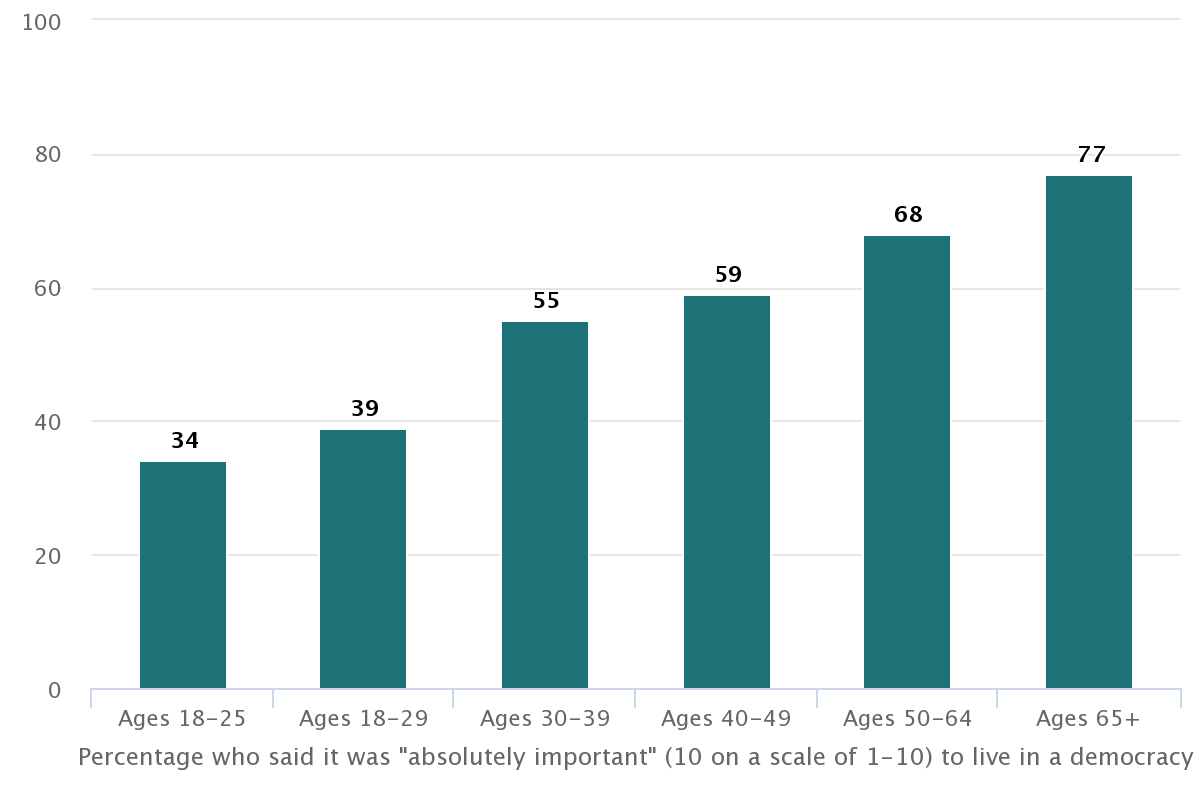
But only one in three young adults think it’s “very important” to live in a democracy. The perceived importance of living in a democracy rises steadily and steeply by age. This trend could be generational, in which case democracy is in trouble as we face a century dominated by people who aren’t committed to democracy. Or it could be a life-cycle effect: perhaps people gradually develop more commitment as they grow older.

This graph is an argument for better civics. Almost 90 percent of poll respondents want to “ensure that schools make civic education a bigger part of the curriculum.”

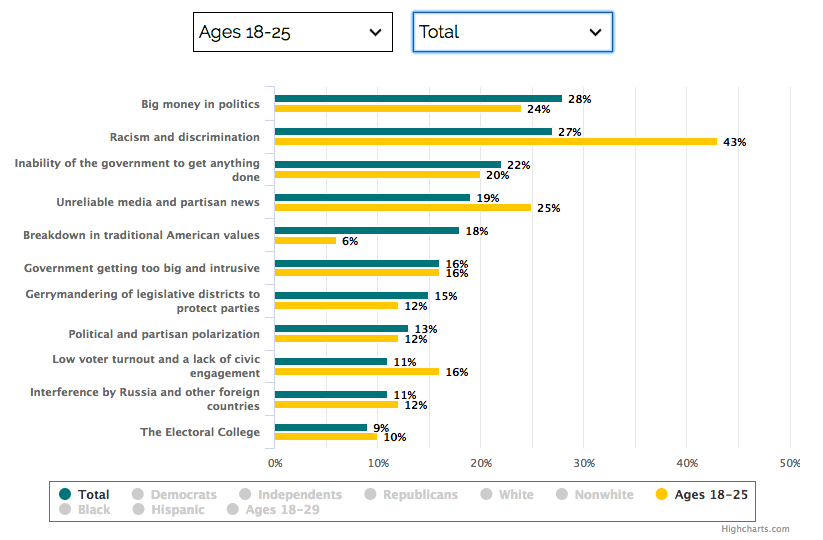
Respondents were asked what is wrong with our democracy today. Youth are much more likely that other groups to point to racism and discrimination. They are somewhat less likely to condemn unreliable media and partisan news. Hardly any youth are concerned about a “breakdown in traditional American values.” But partisan news and a breakdown of traditional values are the two most serious problems according to Republicans.

convicted by their conscience: the rule of law, judgment, and writing in The New Testament

John 8:3-11:

And the scribes and Pharisees brought unto him a woman taken in adultery; and when they had set her in the midst,

The “scribes and Pharisees” arrive as an undifferentiated group. They act in concert. No names or adjectives distinguish them, but they share a social role as experts on the law and as men of writing.

The one person who stands out is the woman. She comes passively (presumably compelled). She is the sole female character and the only one who is never described in this passage as either reading or writing.

They say unto him, Master, this woman was taken in adultery, in the very act.

The Gospels are written in the past tense, but here the Greek (like the English) is suddenly in the present: “they say.” I think the speakers are living completely in the present moment–so forcefully that it flows into the narration as an example of “implied indirect discourse.” The scribes’ and Pharisees’ mode is to ask what the abstract categories of the written law mean for what is to be done now. They don’t reflect on their pasts, nor on the woman’s future, for she has none in the minds.

Now Moses in the law commanded us, that such should be stoned: but what sayest thou?

Here they invoke the written law, the commandment that comes to us from an author (notably, Moses rather than God) through his writing. The text is meant to determine our judgment, speech, and decision.

This they said, tempting him, that they might have to accuse him. But Jesus stooped down, and with his finger wrote on the ground, as though he heard them not.
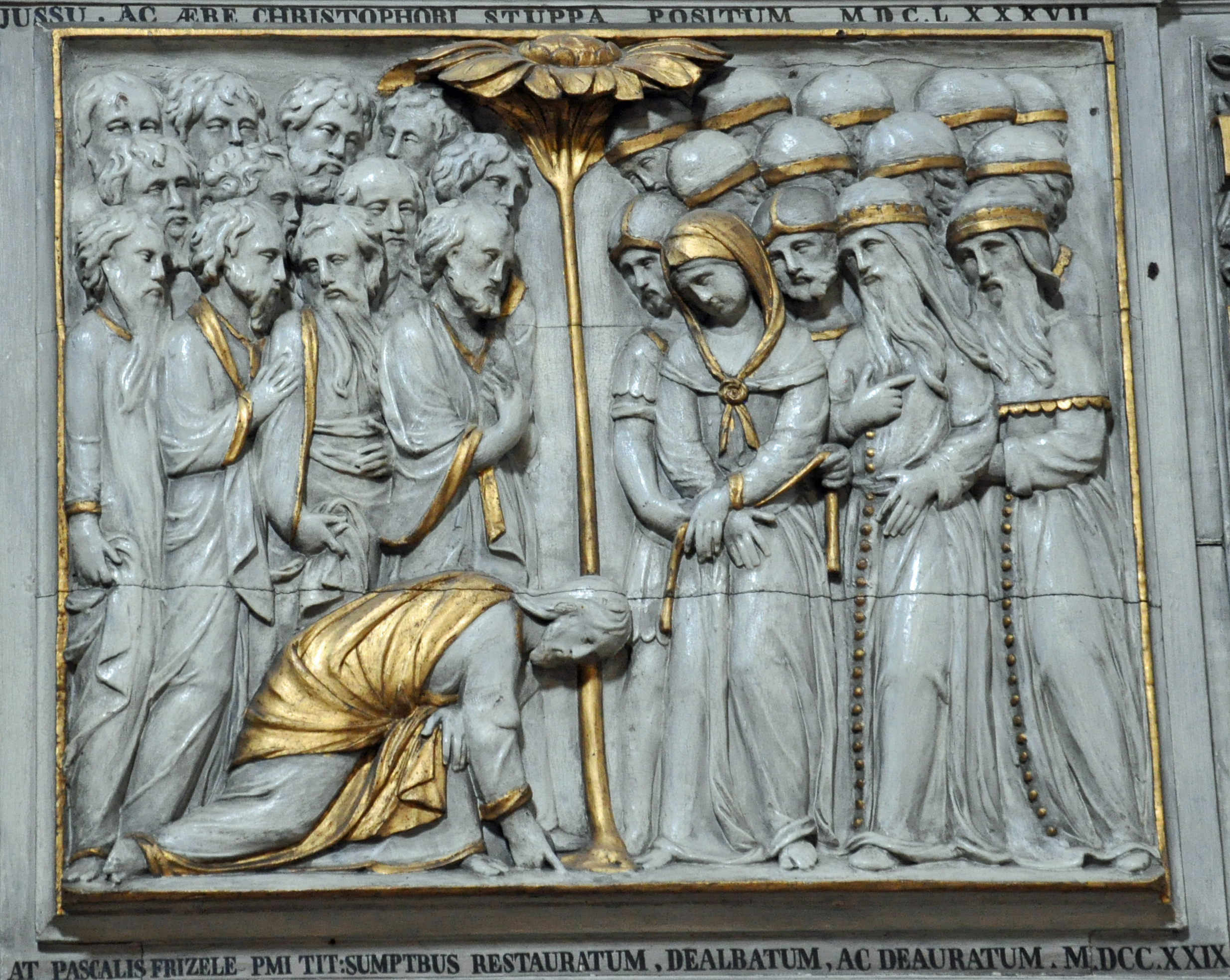
The Woman Taken in Adultery, Church of the Angel Raphael, Venice, 1677

They have set a trap for Jesus. He must either blatantly violate the rule of law or else abandon his message of love. If he does the former, they “might have to accuse him.” In their minds, this would not be a choice. It would be determined by the application of the law, which (again) is an artifact of writing.

So Jesus also writes. Since he stoops down, we cannot see the text that flows. Indeed, it might not be text: the Greek verb katagraphein is unusual (appearing just here in the whole New Testament). It can mean “to scratch,” so Jesus might be making a wordless shape in the dust. Euclid uses katagraphein 40 times in his Elements, as a verb for drawing shapes. It can also mean to “write against,” as in framing an indictment.

Jesus’ act is mysterious. He is literally in touch with the earth. His act is public in the sense that he performs katagraphein as his response to the scribes and Pharisees. It’s private in the sense that we cannot know what he writes; and probably they cannot either, since he “stoops down.”

So when they continued asking him, he lifted up himself, and said unto them, He that is without sin among you, let him first cast a stone at her.

They keep asking him, he keeps writing, and then he stands to address them face-to-face (leaving his writing behind) and gives his famous verbal response: “He that is without sin among you, let him first cast a stone at her.”

And again he stooped down, and wrote on the ground.

He then goes back down to the earth, to his private stance, and writes. This time the verb is graphein, the ordinary word for writing.

In these verses, the woman is invisible to us. She neither speaks nor writes nor acts.

And they which heard it, being convicted by their own conscience, went out one by one, beginning at the eldest, even unto the last: and Jesus was left alone, and the woman standing in the midst.

The scribes and Pharisees are no longer an undifferentiated group, acting in concert and in unison. Each has turned his own mind toward his own past. They exit one by one, making individual choices to break with the group. The one with the longest record of conscience, the eldest, is the first to break.

Jacopo Tintoretto - Christ and the Woman Taken in Adultery - WGA22436

Jacopo Tintoretto – Christ and the Woman Taken in Adultery

Now Jesus is alone, and the woman is “in the midst” (more literally, “being in the middle,” or “being in the center”). It’s just the two of them, quiet. Jesus is still stooped down and does not look at her.

10 When Jesus had lifted up himself, and saw none but the woman, he said unto her, Woman, where are those thine accusers? hath no man condemned thee?

Now he makes eye-contact, as he did earlier with the scribes and the Pharisees, and he asks her what happened, although he must know it already. “Woman, where are those thine accusers? hath no man condemned thee?”

11 She said, No man, Lord. And Jesus said unto her, Neither do I condemn thee: go, and sin no more.

At last she speaks, addressing Jesus as her lord. He speaks in the first person, placing himself in the same position as the Scribes and Pharisees who have chosen individually not to accuse her. And he sends her away from the center, on her own.

Questions

What did Jesus write? There is obviously no way to know, but here are some possibilities: 1) He listed the sins of each of the scribes and Pharisees. 2) He noted his own judgment of the Woman, privately. 3) He described the specific situation concretely–in contrast to the abstractions of the categorical law. 4) He drew an abstract image.

Why can’t we know what he wrote?

Why did his act change the situation?

When does private–or public–writing liberate? What about the text of the Gospel of John?

See also: Sessions and the fate of Herodthe Gospels on two hot-button issues; and the prospects for an evangelical turn against Trump.
why autocrats are winning (right now) #DemFront #DemFront18

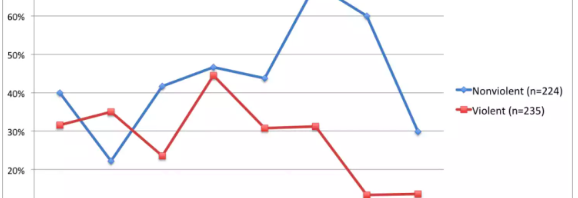
During the opening session of Frontiers of Democracy last night, Hardy Merriman from the International Center on Nonviolent Conflict showed this graph from Erica Chenoweth and Maria J. Stephan. It shows that nonviolent social movements were strikingly successful at achieving their own stated objectives during the 1990s, but their success rate has fallen sharply since.

A full explanation would have to consider many variables–geopolitics, technology, changes in ideologies and issues. I suspect (as Chenoweth and Stephan do) that one factor is the skill and sophistication of both democrats and autocrats. For a sustained argument about the importance of skill in social movements, see Marshall Ganz, Why David Sometimes Wins: Leadership, Organization, and Strategy in the California Farm Worker Movement

To explain the graph above, we could first argue that nonviolent movements and bottom-up pro-democracy movements developed an impressive repertoire of strategies, thanks to the experience of anti-colonial struggles in the Global South, social movements in the West, dissident movements in the Soviet Bloc, and hacker cultures online. At the same time, the traditional toolkit of the autocrat–centrally managed economies, mass incarceration and terror, secret police bureaucracies, etc.–was failing.

On both sides, actors always learn from their peers. Solidarity invited Bayard Rustin to Poland to teach nonviolent strategies–and that’s just one of countless examples on the nonviolent side. On the other side, Saddam imitated Stalin. But Rustin and Solidarity had the newer and and more successful ideas; Saddam and his ilk were losing.

Then the surviving older autocrats, and the new generation of authoritarians, began to innovate. Chenoweth & Stephan write:

State opponents may be learning and adapting to challenges from below. Although several decades ago, they may have underestimated the potential of people power to pose significant threats to their rule, they may now see mass nonviolent campaigns as truly threatening, devoting more resources to preventing them — perhaps following the implications of Bruce Bueno de Mesquita and Alastair Smith’s “Dictator’s Handbook” — or deploying “smart repression” to subvert them when they arise. This phenomenon of learned adaptation, or what Steven Heydemann, the Ketcham Chair in Middle East Studies at Smith College, calls “authoritarianism 2.0,” is a central focus of the “Future of Authoritarianism” project at the Atlantic Council.

In a recent Bloomberg column, Tyler Cowan argues that “the governance technologies and strategies of authoritarian regimes have become much more efficient.” One-party states and oligarchs are better at managing economies and thereby delivering economic growth.

They have also developed more sophisticated ways of dealing with criticism:

Authoritarian leaders realized that absolute prohibitions on free speech were counterproductive, and they learned how to manage an intermediate solution.  Allowing partial speech rights is useful as a safety valve, it allows major dissidents to be identified and monitored, and absolute speech prohibitions tended to wreck the economy and discourage foreign investment, leading to unpopularity of the government. At the same time, an autocratic government could come down hard on the truly threatening ideas when needed.

Authoritarian states have begun collecting valid data about what the people want through reliable opinion polling. As Cowan notes, Mao got only indications of popular support from his terrified underlings, but today’s Communist Party really knows what the Chinese people think and can respond strategically.

Also in the modern autocrat’s toolkit are increasingly sophisticated surveillance strategies, state control of media that is actually popular (rather than drab and overtly propagandistic), and the use of digital technologies to corrupt the public sphere.

The graph is alarming, but the game isn’t over yet. Autocrats and democrats play an endless cat-and-mouse game. There was nothing inevitable about the triumph of nonviolent social resistance, but neither is it doomed today. Strategies that worked in 1995 are not likely to work in 2020, and we should always expect effective counter-strategies to develop. As Merriman said last night, this pattern underlines the importance of innovation, analysis, training, and networking.

See also Why Civil Resistance Workspeople trust authoritarian governments mostwhy the global turn to authoritarian ethnonationalism?what does it mean to say democracy is in retreat?watching democratic cultures decline; and was the Civil Rights Movement successful because of the Cold War?

civic education that is less about the state

We are completing the tenth (!) annual Summer Institute of Civic Studies, which revolves around the three schools of civic theory outlined below. (Each “school” encompasses diverse views and criticisms.) Today we talked about what these theories would mean for civic education at various levels and in several nations.

I certainly don’t advocate assigning The Theory of Communicative Action vols. 1-2Governing the Commons, or Hind Swaraj in an 8th grade civics class. But we might involve 8th graders in managing common resources, incorporate them in the public sphere by inviting them to join public deliberations, and ask them to develop strategies for addressing power disparities at the human level. Indeed, we do all these things, but they tend to be somewhat marginal in civics curricula around the world, which focus much more on the state, the law, and the citizen in relation to those.

The Bloomington School of Political Economy (Elinor Ostrom et al) The Frankfurt School in its second generation (Jurgen Habermas et al) Nonviolent social movements (Gandhi/King)
Fundamental problem People fail to achieve what would be good for them collectively People manipulate other people by influencing their opinions and goals People fail to view others (or themselves) as fully human
Characteristic starting point People know what they want but can’t get it People don’t know what they want or want the wrong things Some people won’t recognize other people as fellow citizens
Prominent example of failure We destroy an environmental asset by failing to work together Government or corporate propaganda distorts our authentic values One national or ethnic group exploits another
Essential behavior of a citizen Working together to make or preserve something. Talking and listening about controversial values. Using nonviolent sacrifice to compel change
Keyword Collaboration Deliberation Relationships
Instead of homo economicus (the individual who maximizes material self-interest) we need … Homo faber (the person as a maker) Homo sapiens (the person as a reasoner) or homo politicus (the participant in public assemblies) A satyagrahi (the person as a bearer of soul force)
Role of the state A set of nested and overlapping associations, not fundamentally different from other associations (firms, nonprofits, etc.) Citizens form public opinion, which should guide the state, which makes law. The state should be radically distinct from other sectors A target of demands
Modernity is … A threat to local and traditional ways of cooperating, but we can use science to assist people in solving their own problems A process of enlightenment that liberates people, but it goes wrong when states and markets “colonize” the private domain For Gandhi: An imperialist imposition, undermining swaraj
How facts and values are combined Not explicitly. Implicitly by using research on collective action to liberate people for reflective self-government By proposing counterfactual ideals such as “the ideal speech situation” and diagnosing the reasons these are not met Through “experiments in living”

In a prophetic mode

Main interdisciplinary combination Game theory plus observations of indigenous problem-solving Normative philosophy (mainly achieved through critical readings of past philosophers) plus system-level sociology Critical theology plus military strategy

the prospects for an evangelical turn against Trump

Not long after Donald Trump’s inauguration, I met with a conservative evangelical pastor near his church in a small city in one of the most conservative of the Southern states. He told me how deeply he despised and feared the new president as a threat to his values and his community. Some of his concerns were moral, involving Trump’s sexual behavior. Some were pastoral–he worried that young people would be alienated from Christianity as the faith came to be associated with Trump. And some concerns involved leadership. He felt that he struggled to be a good leader of his church community: accountable, inclusive, a peacemaker. Trump modeled the very opposite style.

I often recall this conversation as I read about White evangelical support for Trump and the criticism he’s now receiving from some evangelical clergy.

That first spring of the Trump era, I formed an empirical hypothesis. I thought that many evangelicals might vote for Trump because of abortion and a few other issues, and I could understand that. However, I thought that admiring him as a leader would correlate negatively with actual participation in a Christian community, once you controlled for demographics. In the back of my mind was the theory that being Christian can have three meanings:

  1. A set of theological beliefs that may have moral and political implications. These vary enormously. Some Christians see Jesus as a pacifist socialist; others think he would endorse capitalism and national sovereignty. But if you take theology seriously, you will assess a politician in its terms, and not just do what he says.
  2. Membership and participation in a community of believers, which may extend from a concrete local church to a denomination or even an ecumenical network of denominations. Churches vary from congregationalist to hierarchical (the word means “holy order or structure”), from traditionalist to innovative, and from homogeneous to diverse; and we would expect these differences to matter politically.
  3. An identity, something you are as well as (or even instead of) something you believe or do. It’s possible to identify as a White Christian man without believing in God or going to church, if you think of Christianity as pure identity, akin to an ethnicity.

I would expect #1 to inform attitudes toward Donald Trump, but in a complex way. Assessments would depend on the theological commitments of the specific believer and the policies of the administration. Theological seriousness would make people into critical thinkers about any politician.

I would expect #2 to teach people lessons about what kind of leadership to expect and admire. In a megachurch dominated by a charismatic and wealthy preacher, people might learn to expect leaders who act at least roughly like Trump. In a congregationalist church or a Catholic parish with empowered laity, people would learn to expect accountability and inclusivity, not to mention skills like listening and mediation; and they would despise Trump’s leadership style in contrast.

I would expect #3 to predict support for Trump because that’s what he offers. He gives no indication of actual belief but looks for all opportunities to say: This is a white Christian nation, and everyone must acknowledge that. I haven’t yet read Janelle Wong’s new book, but this seems to be her finding. It would be consistent with the theory that “Fox News evangelicals” (or “coach-potato evangelicals”)–rather than deeply committed Christians–are Trump’s base.

We had the opportunity to ask about all these topics in one survey. We asked about policy opinions, demographics, admiration for Trump as a leader, and experiences of participation in religious and secular communities. I don’t want to “publish” our findings here, because I worked with several colleagues who aren’t co-authors of this blog, and the statistical issues were somewhat complex. Our work is yet unpublished. But I will say there was no clear evidence that I was correct. The outcome was something like a null result. Once you know that someone is a White evangelical who favors abortion rights, you don’t learn anything new by asking about her personal involvement in a church community.

This is disappointing, but it may not be the end of the story. Assume that you are a serious Christian with conservative politics who actually cares about theology and the community of the living church. Christianity as an ethnic identity is a threat to everything you deeply believe in. Right now, you’re losing the struggle for your faith. It’s becoming an ethnic identity with a dangerous level of resentment, not a belief system. But you have resources to struggle back. You have moral legitimacy, cultural depth, diversity, youth support, and grassroots institutions that are shrunken but still vital. I would expect to see more and more anti-Trump organizing from the evangelical pulpit, and a widening gap between White identity “Christianity” and actual Christian faith.

See also why Trump fans aren’t holding him accountable (yet)Civic Deserts and our present crisisthe Democrats and religious Americans and the political advantages of organized religion