conservatism as gratitude or humility?

(DCA) Yuval Levin offers this definition (h/t Robert Pondiscio):

To my mind, conservatism is gratitude. Conservatives tend to begin from gratitude for what is good and what works in our society and then strive to build on it, while liberals tend to begin from outrage at what is bad and broken and seek to uproot it.

You need both, because some of what is good about our world is irreplaceable and has to be guarded, while some of what is bad is unacceptable and has to be changed. 

This is a thoughtful effort to describe left and right evenhandedly, but I don’t think it is the best way to define or defend conservatism.

The problem is that people differ greatly in the degree to which they can reasonably be grateful to any particular polity. Consider, as one of several extreme examples, Native Americans. They can adopt any view of the USA that they want, but they have much less objective reason to be grateful to this republic than I have. They may well feel deep gratitude to their own communities. That gratitude is particularistic. Conservatism would then imply a particularistic ideal: a commitment to the specific communities that deserve each person’s gratitude. Some versions of conservatism have in fact been particularistic–but not Levin’s. He wants Americans (all Americans, I presume) to feel grateful to the nation-state:

But we can also never forget what moves us to gratitude, and so what we stand for and defend: the extraordinary cultural inheritance we have; the amazing country built for us by others and defended by our best and bravest; America’s unmatched potential for lifting the poor and the weak; the legacy of freedom—of ordered liberty—built up over centuries of hard work.

In the same essay, Levin suggests a more secure and persuasive core principle for conservatism—humility:

Conservatives often begin from gratitude because we start from modest expectations of human affairs—we know that people are imperfect, and fallen, and weak; that human knowledge and power are not all they’re cracked up to be; and we’re enormously impressed by the institutions that have managed to make something great of this imperfect raw material. So we want to build on them because we don’t imagine we could do better starting from scratch.

This reminder of “modest expectations” is what conservatism valuably contributes to public debates. Because people are “imperfect, and fallen, and weak”–or, we could say, cognitively and motivationally limited and biased–we should always be somewhat skeptical of ambitious reform proposals, of original designs for complex things (cities, welfare programs, markets), and of the likelihood that any person can dramatically improve things for any other person.

Humility, in this sense, is the common thread that unites libertarians (skeptical of central planning), religious conservatives (skeptical of human reason and motivation), and communitarians (skeptical of formal institutions). It also encourages all three types of conservatives to admire complex phenomena that have emerged and that seem to function well enough–“that have managed to make something great of this imperfect raw material.”

Levin argues that humility implies gratitude, but that connection is contingent. It depends on whether what has emerged so far is good enough for you and the people you care most about. Answers to that question will reasonably differ. Humility is the premise; gratitude is a consequent that depends on the circumstances. Humility is something that everyone has a reason to endorse, although everyone should also be open to the possibility of change.

See also: what defines conservatism?; a plea to conservatives; and from classical liberalism to a civic perspective
“Empathy” is a new word. Do we need it?

According to the OED, “empathy” entered the English language in 1895 to mean “a physiological brain-function”–specifically, “a form of psychophysical energy” in the nervous system–that correlated with a feeling.

This meaning is now obsolete, because the underlying theory is. A somewhat more familiar meaning appeared in 1909: “Not only do I see gravity and modesty and pride … but I feel or act them in the mind’s muscles. This is, I suppose, a simple case of empathy, if we may coin that term as a rendering of Einfühlung.” E. B. Titchener Lect. Exper. Psychol. Thought-processes i. 21  (1909).

But this meaning is now also “rare,” says the OED. The word “empathy” gained its mainstream current meaning only in 1946 (in a professional psychology journal):

[Meaning 2b] orig. Psychology. The ability to understand and appreciate another person’s feelings, experience, etc.

1946 Jrnl. Clin. Psychol.2 61/1   A ‘man-to-man’ regard for the client, characterized (ideally) by the understanding of empathy without the erratic quality of identification or the supportiveness of sympathy.

You might think it’s a Greek word, and it parses in Greek: en- (“of the state or condition of”) plus pathos (“an incident, accident; suffering”) = “the state of someone’s [else’s] suffering.” But no such word is listed in my Liddell & Scott Greek-English Lexicon. It is a modern English word built of ancient Greek components. If anything, the origin is the German word Einfühlung (coined in 1873), which needed an English equivalent.

While noting the recent origins of the English word, Emily McRae also argues that it has no direct translation in Sanskrit or other languages that have been used to express the Indo-Tibetan Buddhist tradition. Key words from that tradition are better translated as “compassion” and “sympathetic joy.” McRae derives a theory of empathy from Buddhist texts, but she interprets phrases like “exchanging self and other” rather than any single word that corresponds to “empathy.”*

Since the word “empathy” is recent, and many wise thinkers have done without it, we might ask whether adding it to our vocabulary has done us good. It would be possible to carve up the conceptual space so that “empathy” vanished and we used only “compassion,” “beneficence,” “good will,” “forgiveness,” “responsiveness,” “mirroring,” and other related words.

I am a little worried that “empathy” confuses matters by combining an empirical concept–empathy exists when person A feels an emotion, which causes person B to feel some of that same emotion–with a positive moral valence (it is good to be empathetic). Yet it is not always good to feel the same emotion as someone else in response to that person.

*“Empathy, Compassion, and ‘Exchanging Self and Other’ in Indo-Tibetan Buddhist Ethics” for Handbook of Philosophy of Empathy (Routledge), edited by Heidi Maibom, 2017. See also: empathy, sympathy, compassion, justice; empathy: good or bad?; and my self, your self, ourselves

tangled beauty

Let us be glad for tangled things--
   For soiled fingers raking thick-stemmed grass;
     For matted fur on long, warm ears;
Or child's hair idly twisted in rings.
   A thatch of ganglia fires in the brain's wet mass:
     A thought--electric--splits, connects, adheres.

All things rooted, snarled, or tensed,
   Whatever needs some mesh to form its mass,
With loops, forks; twists, knots; ends, tears.
   Let's give thanks for things that are soft and dense. 

See also: for Gerard Manley Hopkins; and Pied Beauty, illustrated.

a better approach to coalition politics

Sometimes people view coalitions instrumentally and transactionally. You know what you believe, but unfortunately you don’t (yet) have enough support, or seats, or votes, or dollars to get what you want, so you must join with other people who either share roughly similar beliefs–close enough to settle for–or who will support your agenda in return for your help with theirs.

We see this approach most clearly in parliamentary systems, when parties come together to form majorities. The center-left party will form a government with the Greens if they need the Greens’ votes, but will drop them if they don’t. We also see it in US logrolling politics: Democrats from rural districts vote for HUD; urban Democrats vote for the Farm Bill. And we see it in social movements, when participants advocate for a “big tent” or invoke a “bird that flies with two wings”–clichés that usually mean: “Include me in your coalition or you won’t win.”

Some circumstances–such as parliamentary votes of confidence–require a transactional approach to putting together coalitions of 50% plus one. But it is possible to view a coalition in a different way: as a network of valuable relationships among people who trust and respect one another.

Brad DeLong, a self-proclaimed “neoliberal” and “[Robert] Rubin Democrat,” recently announced his support for a coalition led by people to his left. Speaking of his own faction within the Democratic Party, he wrote:

Over the past 25 years, we failed to attract Republican coalition partners, we failed to energize our own base, and we failed to produce enough large-scale obvious policy wins to cement the center into a durable governing coalition. We blame cynical Republican politicians. We blame corrupt and craven media bosses and princelings. We are right to blame them, but shared responsibility is not diminished responsibility. And so the baton rightly passes to our colleagues on our left. We are still here, but it is not our time to lead.

Note that DeLong is not renouncing his own beliefs or exiting public life in defeat. Instead, has has reached an all-things-considered judgment that people who disagree with him on some important matters should lead a coalition that he will support. It’s their time.

In a Vox interview, he adds:

while I would like to be part of a political coalition in the cat seat, able to call for bids from the left and the right about who wants to be part of the governing coalition to actually get things done, that’s simply not possible as of now.

We shouldn’t pretend that it is, or that it’s going to be. We need to find ways to improve left-wing initiatives, rather than demand that they start from our basic position and do minor tweaks to make them more acceptable to their underlying position.

DeLong wants to contribute, but he thinks the left should lead. His role is non-coercive persuasion: offering market-based suggestions that the left can accept or not. He doesn’t suggest that his support will be conditional on their agreement. He is in, but he wants to retain his voice. His explicit renunciation of a claim to lead should engender some trust from the left. It’s an example of the general principle that Danielle Allen defends in Talking to Strangers. Our task is to become “political friends” who demonstrate “reciprocal goodwill”; and to get there, often the first step is to make an explicit sacrifice.

In turn, if the left were to lead the Democratic Party, it would become the main source of energy and ideas. Progressives would earn the voluntary support of a broader spectrum. They would not view leftover neoliberals as enemies to be rooted out but as fellow members of the coalition who can be inspired and persuaded. They would take seriously their own capacity, opportunity, and moment to lead. They would see themselves as better leaders if people like Brad DeLong continued to follow them. They would value not only the votes of such moderates but their insights.

They would also care about the condition of the coalition. Is it sufficiently attractive to a broad range of people? Does it offer entry-points for newbies and youth while also honoring the folks who have been working hard for a long time? Is it nimble but also principled? Can it manage dissent? How does it handle disagreement? You can’t answer those questions well if you are always thinking about whether your own policy goals will prevail. You must also care about the coalition as a community.

I am not saying that the currently insurgent left is failing to act this way. So far, so good. I am just offering a way to conceptualize leadership that doesn’t reduce a coalition to a pure means for accomplishing the leaders’ goals. I’d argue that valuing the coalition is a path to wiser strategies and more influence.

See also: we need SPUD (scale, pluralism, unity, depth); saving relational politics; and the value of diversity and discussion within social movements.

will the Democrats keep talking to their young voters?

According to CIRCLE’s latest analysis of its own survey data, young people who were contacted by candidates and parties in the 2018 election cycle were much more likely to vote. Some of this is probably selection-bias: campaigns try to contact the most likely voters. But there is also accumulated evidence that contact is effective: it boosts turnout, even for low-propensity voters.

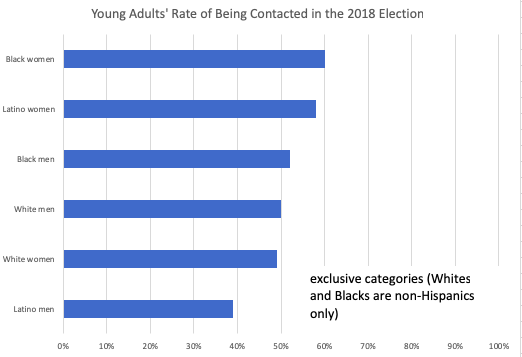
Democrats contacted substantially more youth than Republicans did in 2018. Demographics influenced who received the most contact:

based on CIRCLE data

These differences do not track disparities in political power and SES. On the contrary, young Black women generally face compounded disadvantages in America, yet 60% were contacted in 2018 (presumably by Democrats, for the most part). They top the list. Meanwhile, young white men were ten points less likely to be contacted.

What does this mean? It all depends on the nature of the contact and the follow-up. If Democratic candidates were simply trying to mobilize a reliable segment of their base by sending one-way messages before the election, and if African American women don’t hear from politicians again until October 2020, then the graph demonstrates political opportunism.

On the other hand, if the contact involved some listening and learning by campaigns, and if elected officials now recognize their debt to Black women and continue to engage them between elections, then the graph offers grounds for optimism.

I wouldn’t bet on the more optimistic interpretation, but it’s something to work for.

It’s also worth focusing on young Latino men, who really are left behind. I think this is partly because they are (for the most part) less involved in conventional organizations where people can be found and reached. In social science jargon, they have less “social capital” than the other categories of young Americans.

Finally, I don’t think it’s good news that’s young white men were contacted at low rates. From a partisan Democratic perspective, it could be a reasonably good sign. Democrats, who did most of the outreach to youth in 2018, directed their resources to people of color for a mix of tactical and principled reasons. But we also know that many young white men live in “civic deserts,” where they are generally disconnected from civic and political institutions. That can reinforce combustible forms of alienation. If the low contact rate reflects low levels of membership and belonging, it is evidence of a problem.

See also: Civic Deserts and our present crisis; new research on “civic deserts”; and democracy is coming to the USA.