work and play and civic life

(My notes for a talk this evening at a Ludics Seminar at Harvard’s Mahindra Center on “The Role of Play in Human Evolution and Public Life: Work, or Play?”)

It is very common to distinguish politics or civic life from both work and play. (The words “politics” and “civic” have overlapping meanings, coming respectively from Greek and Latin, and I’ll use them interchangeably here.)

Aristotle provides an early example of the distinction between work and politics. He begins with the premise that “the citizen’s function” is “deliberating and judging (whether on all issues or only a few).” In other words, to act as a citizen means to talk, to listen, and to vote. It is discursive and cognitive. Citizens, understood as deliberators and judges, must be free from doing the necessary tasks of life, which are done by slaves (who work for individuals) and by mechanics and laborers (who work for the community). Aristotle advises: “The best form of city will not make the mechanic a citizen.” Note that the mechanic or laborer is not defined by poverty, for some are very rich, but by participation in the marketplace. Working distorts people’s values and goals and makes them bad at deliberation about the public good, perhaps because they focus on their economic interests. Governance is best reserved for a class that has enough wealth not to work.

I cannot think of anyone today who would openly disenfranchise workers for the reasons that Aristotle cites. However, the same distinction between work and politics is evident in several political traditions that make the opposite value-judgment from Aristotle’s. Like him, they presume that politics is about talking, listening, and deciding, and it’s done outside of work. But unlike Aristotle, they think that only those who work are worthy of politics, because they alone have the appropriate values or because their productive labor gives them the right to rule.

One version holds that people of industry and thrift are worthy of governing a republic. This idea is familiar from the English Revolution, the Dutch Republic, and Colonial New England. It associates the bourgeois work ethic with republican virtues.

A different version is agrarian populism, which sees the stalwart farmer as the most legitimate citizen. Like Cincinnatus, a republican farmer puts down his plow to govern and fight, but he hastens back to his fields when his civic duty is done. Jeffersonian American populism and Russian Narodnism are examples.

A third version is Marxist. The workers form a class, distinguished from the bourgeoisie, who merely claim a “work ethic” while they exploit the actual laborers. The working class should rule. Marx offers the resonant ideal of unifying work with Aristotelian politics, removing the alienation between ruling and making. But my impression is that Marxist reforms–from mild democratic socialism all the way to Maoism–have hardly ever realized that ideal. Instead, they have tended to distinguish–just as Aristotle did–between work and governance, but they make the workers into the governors. You work in the factory by day, and after the whistle blows, you attend a workers’ council meeting to make decisions. In fact, the problem with socialism, according to Oscar Wilde, is that it occupies too many evenings.

Two additional strands of reform have developed since the Industrial Revolution. I endorse both, but they are not my main subject here. One aims to democratize the workplace by creating co-ops and other alternative enterprises that are governed on the basis of one-worker, one-vote. The other puts democratic pressure on the workforce by forming an independent association of workers than can negotiate and strike–a union. Both reforms narrow the gap between work and politics, but not in the way that I will describe.

My friend Harry Boyte advocates a different ideal, which he calls Public Work. He has uncovered many precedents for it from around the world.

Continue reading


gratitude

(Provo, UT) I am at Brigham Young University, discussing civic engagement with insightful faculty and students, against a background of cold, clear mountains. Within the past two weeks, I have had somewhat similar conversations inside the classroom of a Massachusetts medium security prison, a Tufts classroom with 50 talented 18-20-year-olds, a glittering living room in Boston’s Louisburg Square (at a political fundraiser), and in various coffee shops around Cambridge, MA. I’ve also heard a lecture on Tagore and the Upanishads and chatted with colleagues scattered across the country.

I just want to express my gratitude for these opportunities. To some extent, they come with being an academic, which is a privilege in itself. But my particular role and institution make such experiences especially frequent, diverse, and rewarding.

See also: at BYU; and teaching about institutions, in a prison

MassForward event: Advancing Democratic Innovation and Electoral Reform in Massachusetts

Please Join MassForward for “Advancing Democratic Innovation and Electoral Reform in Massachusetts” (Register Here)

Wednesday, November 13, 2019

8:30 to 10:30 a.m. Continental breakfast will be available at 8:00 a.m.

The Edgerley Center for Civic Leadership at the Boston Foundation 75 Arlington Street, 3rd Floor, Boston

Please join the Boston Foundation for the release of new research by MassINC and Tufts’ Tisch College of Civic Life that examines the health of our Commonwealth’s democratic processes and institutions. From increasingly strong one-party rule to lack of representation for communities of color, this report new provides data to illuminate acute challenges and presents a comprehensive set of reforms and innovations to fortify our democracy at the state and local level. This opening presentation will be followed by a panel conversation with leaders who can offer a wide-range of perspectives on workable solutions to these pressing challenges.

Welcome & Opening Remarks

Paul S. Grogan, President & CEO, The Boston Foundation

Presentation of Report

Peter Levine, Associate Dean of Academic Affairs & Lincoln Filene Professor of Citizenship & Public Affairs, Tisch College of Civic Life at Tufts University

Panel Discussion
Jay R. Kaufman, Retired State Representative (D), 15th Middlesex District, Commonwealth of Massachusetts; Founder & President, Beacon Leadership Collaborative
Beth Lindstrom, Former Executive Director, Massachusetts Republican Party
Keith Mahoney, Vice President, Communications & Public Affairs, The Boston Foundation (Moderator)
Laurie Nsiah-Jefferson, PhD, Interim Director, Center for Women in Politics & Public Policy; Interim Director, Gender, Leadership, and Public Policy Graduate Certificate Program at UMass Boston Pavel Payano, Councilor-at Large, City of Lawrence

Closing Remarks
Juana Matias, Chief Operating Officer, MassINC

For additional information, please contact Michelle Hinkle at 617-338-4268 or michelle.hinkle@tbf.org

By working in collaboration with a wide range of partners, the Boston Foundation provides opportunities for people to come together to explore challenges facing our constantly changing community and to develop an informed civic agenda. All of the Boston Foundation’s civic leadership activities are supported by our annual campaign for Civic Leadership. Visit www.tbf.org/civicleadership to learn more about this important campaign. Visit www.tbf.org to learn more about the Boston Foundation and its activities.

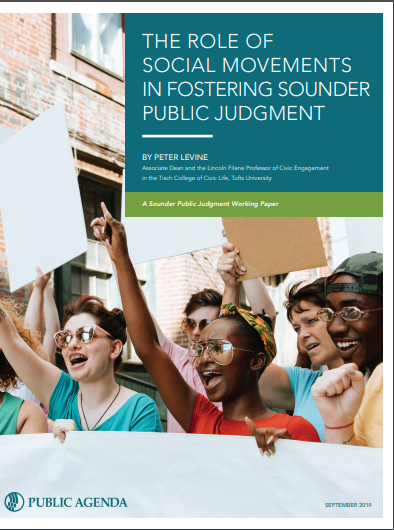
The Role of Social Movements in Fostering Sounder Public Judgment

Public Agenda has released the first papers in their series on “Sounder Public Judgment.” Among them is my paper on “The Role of Social Movements in Fostering Sounder Public Judgment.” It’s a short essay but it has several objectives:

  1. To encourage people who sit within formal institutions, such as my own university, to analyze and respond to social movements better. Movements are not just bunches of protesters; they have structures and norms that can be admirable or problematic and that deserve attention.
  2. To encourage proponents of deliberation (or, more generally, good discourse and conversation) to see social movements–including radical movements–as essential components of a deliberative society. There may be a tension between cause-driven movements and the institutions (such as newspapers and universities) that pursue impartiality; but a deliberative society needs both.
  3. To encourage social-movement participants to understand the value of deliberation within their movements and in the broader society, and to take advantage of the expertise and techniques of the people and organizations that directly promote deliberation.

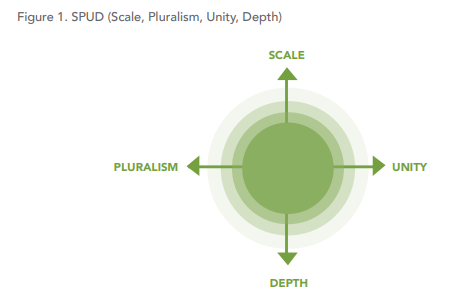
I also took the opportunity to put my SPUD framework in print again:

See also: the value of diversity and discussion within social movements; social movements of the sixties, seventies, and today; deliberation depends on social movements; a sketch of a theory of social movements; What is the appropriate role for higher education at a time of social activism?; pay attention to movements, not just activists and events; Habermas with a Whiff of Tear Gas: Nonviolent Campaigns and Deliberation in an Era of Authoritarianism; we need SPUD (scale, pluralism, unity, depth)

teaching about institutions, in a prison

The Tufts University Prison Initiative of the Tisch College of Civic Life (TUPIT) is my institution’s contribution to the national movement for prison education. Colleges and universities are offering classes, degree programs, and special events for people in prisons or for incarcerated people along with students who come from “outside.” Sometimes, corrections staff and scholars of criminal justice also participate in these programs as learners, educators, or both.

In the era of mass incarceration–and in the wake of massive cuts to prison education programs–these efforts are far too small to fill the need, but they offer valuable opportunities and potential models for broader reform. Some of my favorite colleagues are deeply involved in prison education, and that includes the Founding Director of TUPIT, Prof. Hilary Binda, and her colleagues here at Tufts.

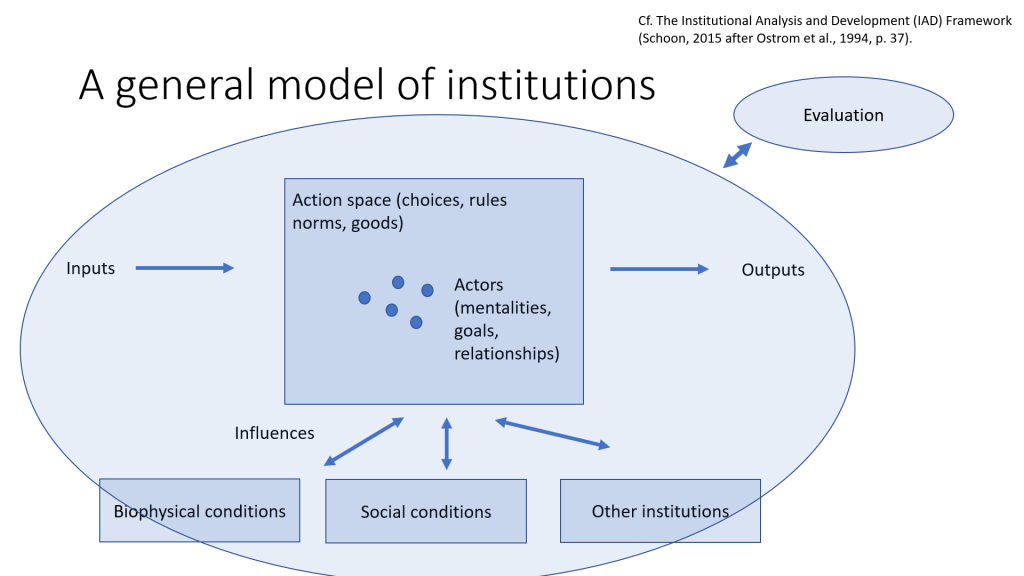
Thanks to TUPIT, I got to guest-teach a class at MCI-Concord last week. The class consisted of about 25 incarcerated men who are working on associates degrees. I presented my current working model for institutions, which I had also presented a few days earlier in the very different environment of a Tufts brown-bag series.

I told the students at MCI Concord that they should decide whether we’d focus on the prison as an institution, or spend more time on other examples. I’d say that we talked about prisons about half the time during the 2-hour conversation, but we also discussed families, gangs, schools, businesses, the foster-care system, and even biological systems such as forests. At least one student was interested in understanding the self as an “institution” that could fit the model. At Tufts, in contrast, the main institution that we’d discussed was “science”—mainly because that was the topic of the brown bag series in which I presented. Science and a prison make a pretty sharp contrast, but the model covers both.

For me, a goal was to test the validity of the model with this particular group. I think it largely passed muster, although many classes are too polite to share their reservations, and this was an exceptionally polite class, by any standard.

Certain aspects of the model seemed illuminating for at least some students. For example, the diagram shows a two-way arrow between biophysical conditions and the action space, which is composed of rules, norms, etc. Students at MCI-Concord generated the insight that the walls and barbed wire around the prison are biophysical conditions that both shape, and are shaped by, the rules and norms on the inside.

Among the interesting topics that arose was the distinction between a rule and a norm. Which is the right word for “Don’t snitch” within MCI-Concord? It is not an official rule; in fact, it violates the official rules. But it may be more than a norm, since it is enforced by the community, with clear consequences. Maybe it is a community-imposed rule.

I took one major challenge away from the conversation. The model that I presented is static or cross-sectional. It analyzes how an institution functions at a given time. The students wanted to know how people develop and change as they pass into, out of, and through multiple institutions. I suggested to them that they might be thinking that way because they’re taking a course that is all about personal transformation, but I also acknowledged that personal change is a concern for everyone, everywhere. So I came away feeling that the model of institutions should somehow connect to a model of personal development.

Finally, a word about the origins of this model. Where did I get this diagram, and why do I claim it might be valid? Essentially, it is my simplification of the Institutional Analysis and Design Model developed by Elinor Ostrom and her colleagues, which she presented in her Nobel Lecture. That is a pretty strong pedigree. I have simplified it in order to make it more general. The kinds of cases that Ostrom investigated are well modeled by game theory. They involve actors with fairly fixed goals who interact by bargaining. But human beings also interact in other kinds of situations, e.g., when we don’t know what we want and we are open to discussing it, or when our interests fuse due to very strong emotional attachments. My more general model is meant to cover bargaining situations, deliberative situations, loving relationships, and more. I am also interested in explicitly analyzing the role of power in institutions—not that Ostrom was blind to power, but I think she interpreted it too narrowly. I have claimed that power operates on every element of this model.