MassForward event: Advancing Democratic Innovation and Electoral Reform in Massachusetts

Please Join MassForward for “Advancing Democratic Innovation and Electoral Reform in Massachusetts” (Register Here)

Wednesday, November 13, 2019

8:30 to 10:30 a.m. Continental breakfast will be available at 8:00 a.m.

The Edgerley Center for Civic Leadership at the Boston Foundation 75 Arlington Street, 3rd Floor, Boston

Please join the Boston Foundation for the release of new research by MassINC and Tufts’ Tisch College of Civic Life that examines the health of our Commonwealth’s democratic processes and institutions. From increasingly strong one-party rule to lack of representation for communities of color, this report new provides data to illuminate acute challenges and presents a comprehensive set of reforms and innovations to fortify our democracy at the state and local level. This opening presentation will be followed by a panel conversation with leaders who can offer a wide-range of perspectives on workable solutions to these pressing challenges.

Welcome & Opening Remarks

Paul S. Grogan, President & CEO, The Boston Foundation

Presentation of Report

Peter Levine, Associate Dean of Academic Affairs & Lincoln Filene Professor of Citizenship & Public Affairs, Tisch College of Civic Life at Tufts University

Panel Discussion
Jay R. Kaufman, Retired State Representative (D), 15th Middlesex District, Commonwealth of Massachusetts; Founder & President, Beacon Leadership Collaborative
Beth Lindstrom, Former Executive Director, Massachusetts Republican Party
Keith Mahoney, Vice President, Communications & Public Affairs, The Boston Foundation (Moderator)
Laurie Nsiah-Jefferson, PhD, Interim Director, Center for Women in Politics & Public Policy; Interim Director, Gender, Leadership, and Public Policy Graduate Certificate Program at UMass Boston Pavel Payano, Councilor-at Large, City of Lawrence

Closing Remarks
Juana Matias, Chief Operating Officer, MassINC

For additional information, please contact Michelle Hinkle at 617-338-4268 or michelle.hinkle@tbf.org

By working in collaboration with a wide range of partners, the Boston Foundation provides opportunities for people to come together to explore challenges facing our constantly changing community and to develop an informed civic agenda. All of the Boston Foundation’s civic leadership activities are supported by our annual campaign for Civic Leadership. Visit www.tbf.org/civicleadership to learn more about this important campaign. Visit www.tbf.org to learn more about the Boston Foundation and its activities.
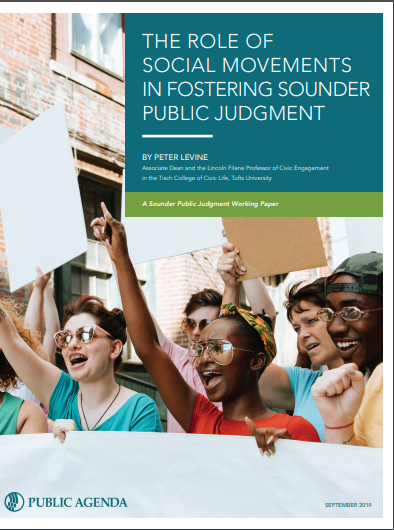
The Role of Social Movements in Fostering Sounder Public Judgment

Public Agenda has released the first papers in their series on “Sounder Public Judgment.” Among them is my paper on “The Role of Social Movements in Fostering Sounder Public Judgment.” It’s a short essay but it has several objectives:

  1. To encourage people who sit within formal institutions, such as my own university, to analyze and respond to social movements better. Movements are not just bunches of protesters; they have structures and norms that can be admirable or problematic and that deserve attention.
  2. To encourage proponents of deliberation (or, more generally, good discourse and conversation) to see social movements–including radical movements–as essential components of a deliberative society. There may be a tension between cause-driven movements and the institutions (such as newspapers and universities) that pursue impartiality; but a deliberative society needs both.
  3. To encourage social-movement participants to understand the value of deliberation within their movements and in the broader society, and to take advantage of the expertise and techniques of the people and organizations that directly promote deliberation.

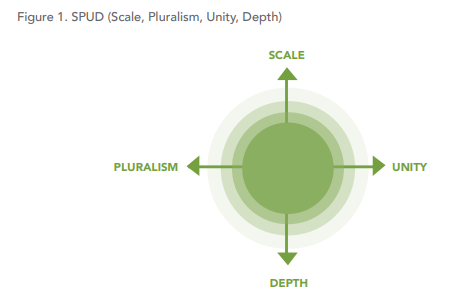
I also took the opportunity to put my SPUD framework in print again:

See also: the value of diversity and discussion within social movements; social movements of the sixties, seventies, and today; deliberation depends on social movements; a sketch of a theory of social movements; What is the appropriate role for higher education at a time of social activism?; pay attention to movements, not just activists and events; Habermas with a Whiff of Tear Gas: Nonviolent Campaigns and Deliberation in an Era of Authoritarianism; we need SPUD (scale, pluralism, unity, depth)

teaching about institutions, in a prison

The Tufts University Prison Initiative of the Tisch College of Civic Life (TUPIT) is my institution’s contribution to the national movement for prison education. Colleges and universities are offering classes, degree programs, and special events for people in prisons or for incarcerated people along with students who come from “outside.” Sometimes, corrections staff and scholars of criminal justice also participate in these programs as learners, educators, or both.

In the era of mass incarceration–and in the wake of massive cuts to prison education programs–these efforts are far too small to fill the need, but they offer valuable opportunities and potential models for broader reform. Some of my favorite colleagues are deeply involved in prison education, and that includes the Founding Director of TUPIT, Prof. Hilary Binda, and her colleagues here at Tufts.

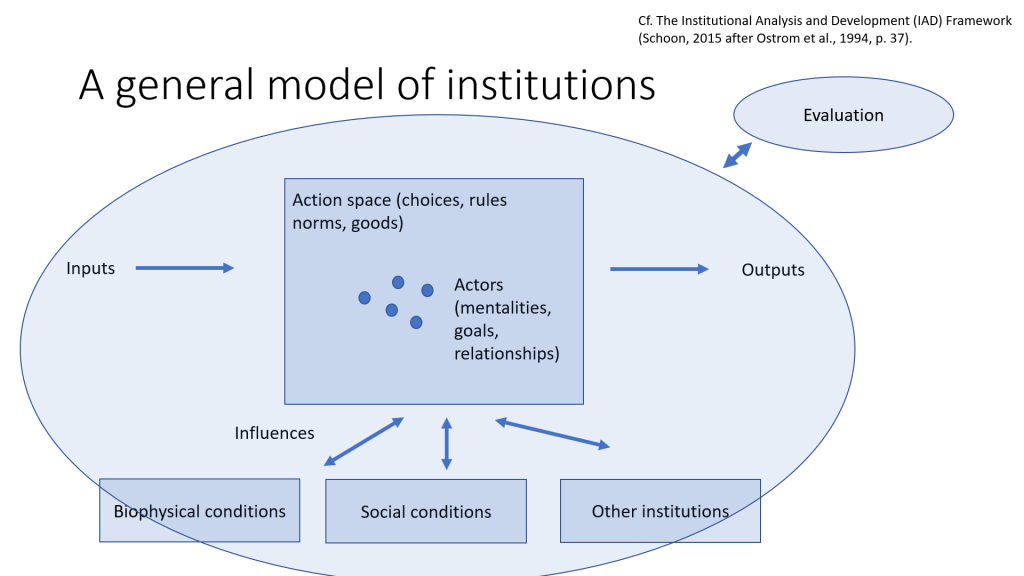
Thanks to TUPIT, I got to guest-teach a class at MCI-Concord last week. The class consisted of about 25 incarcerated men who are working on associates degrees. I presented my current working model for institutions, which I had also presented a few days earlier in the very different environment of a Tufts brown-bag series.

I told the students at MCI Concord that they should decide whether we’d focus on the prison as an institution, or spend more time on other examples. I’d say that we talked about prisons about half the time during the 2-hour conversation, but we also discussed families, gangs, schools, businesses, the foster-care system, and even biological systems such as forests. At least one student was interested in understanding the self as an “institution” that could fit the model. At Tufts, in contrast, the main institution that we’d discussed was “science”—mainly because that was the topic of the brown bag series in which I presented. Science and a prison make a pretty sharp contrast, but the model covers both.

For me, a goal was to test the validity of the model with this particular group. I think it largely passed muster, although many classes are too polite to share their reservations, and this was an exceptionally polite class, by any standard.

Certain aspects of the model seemed illuminating for at least some students. For example, the diagram shows a two-way arrow between biophysical conditions and the action space, which is composed of rules, norms, etc. Students at MCI-Concord generated the insight that the walls and barbed wire around the prison are biophysical conditions that both shape, and are shaped by, the rules and norms on the inside.

Among the interesting topics that arose was the distinction between a rule and a norm. Which is the right word for “Don’t snitch” within MCI-Concord? It is not an official rule; in fact, it violates the official rules. But it may be more than a norm, since it is enforced by the community, with clear consequences. Maybe it is a community-imposed rule.

I took one major challenge away from the conversation. The model that I presented is static or cross-sectional. It analyzes how an institution functions at a given time. The students wanted to know how people develop and change as they pass into, out of, and through multiple institutions. I suggested to them that they might be thinking that way because they’re taking a course that is all about personal transformation, but I also acknowledged that personal change is a concern for everyone, everywhere. So I came away feeling that the model of institutions should somehow connect to a model of personal development.

Finally, a word about the origins of this model. Where did I get this diagram, and why do I claim it might be valid? Essentially, it is my simplification of the Institutional Analysis and Design Model developed by Elinor Ostrom and her colleagues, which she presented in her Nobel Lecture. That is a pretty strong pedigree. I have simplified it in order to make it more general. The kinds of cases that Ostrom investigated are well modeled by game theory. They involve actors with fairly fixed goals who interact by bargaining. But human beings also interact in other kinds of situations, e.g., when we don’t know what we want and we are open to discussing it, or when our interests fuse due to very strong emotional attachments. My more general model is meant to cover bargaining situations, deliberative situations, loving relationships, and more. I am also interested in explicitly analyzing the role of power in institutions—not that Ostrom was blind to power, but I think she interpreted it too narrowly. I have claimed that power operates on every element of this model.

how to assess candidates in a presidential primary

Voters in a primary are a bit like members of a hiring committee. They have a batch of eager candidates and must choose one to represent their party and–they hope–hold the office.

I have served on dozens of hiring committees, including some for nonprofit CEOs and senior university administrators. Head-hunters give consistent advice about how to assess candidates. They advise committees not to ask how a candidate will or would address issues in the future. Candidates don’t really know, because their strategies will depend on the details of the issue and the other stakeholders’ actions. They almost inevitably give platitudinous responses: “I will bring people together, build consensus, and then move decisively.” “I will identify the ineffective programs and phase them out.” Such responses have zero informational and predictive value. Instead, committees should ask candidates how they actually addressed challenges in their previous work, and what they learned from that experience. This is more informative.

I don’t think that advice applies to voters in legislative elections. A legislator faces decisions about whether to vote yea or nay on bills. Newly elected legislators–back-benchers–do little else than vote yea or nay. It makes sense to ask legislative candidates (especially newcomers) how they would vote.

I realize that voters around the world are cynical about politicians’ promises. But I think cynicism should be reserved for their very general rhetoric about outcomes. “I will bring the country together” or “I will generate 5% growth” — these are promises waiting to be broken. (If they come to pass, it’s mostly good luck.) On the other hand, when candidates say, “I will support HR 1234,” that is quite predictive. It’s good to ask them how they will vote.

But presidents are more like CEOs than legislators. To be sure, they face decisions about whether to sign or veto bills, but those are rarely their decisive actions. Most of their impact results from hiring, firing, and guiding subordinates and jawboning all kinds of independent actors: 535 members of Congress, foreign heads of state, civil society actors and corporate leaders. (They also have the bully pulpit to address the nation, but the impact of that is somewhat overrated.)

We’d like to know how well they’ll do in those conversations and what their (precise) objectives will be. But what they say how they will deal with other people has limited value. It’s currently fashionable to place Democratic candidates on a scale from accommodating to tough, where the question is how they will handle their relationship with Republicans. I don’t think how they present themselves on the campaign trail predicts that very well at all.

Candidates should publish policy briefs, and we should read them. The main reason is that a campaign is a precious opportunity for a national debate about issues, influencing citizens’ knowledge and values. But policy briefs are not very informative about a candidate’s actual performance as president.

A brief may tell you something about the candidate’s goals and values. A Democratic candidate who says “Medicaid for all,” is conveying more progressive ideals that a candidate who asks, “How will we pay for that?” But an actual Democratic president will not choose between those two policy positions. She or he will: (1) choose one or two issues to emphasize at key moments, (2) deal with members of Congress across the spectrum about those issues and the many issues that arise for other reasons; and (3) decide whether to sign or veto the actual bills that emerge from Congress–if any do. Asking candidates how they will perform those tasks is not terribly informative, because the question yields platitudes of the form, “I will bring people together and move forward together” or “I will rally the troops and drive change through.” (Those sound different, but neither describes what they will actually do.)

The 2020 Democratic Primary has generated an especially large number of interesting policy proposals. The Warren campaign, in particular, has made a meta-issue of having detailed policy briefs. (“I have a plan for that.”) I like the message that Warren is detail-oriented and interested in policy, a major contrast to the incumbent and probably predictive of how she would govern. I like the ethic of presenting specific ideas to the voters: it takes people seriously as thinkers. I also think the policy debate among candidates may have some influence on other actors–Members of Congress, interest groups, and the public–which is beneficial. But I would still take the headhunters’ advice and focus more on how candidates have actually dealt with challenges than on what they say they would do if they were president.

Deliberative Democracy Consortium conference on whether deliberation is feasible

From this official registration page:

On October 30 and 31, the Deliberative Democracy Consortium is convening researchers, scholars, and deliberative democracy practitioners in Washington, D.C., to explore the intersection of deliberative democracy with human cognition, social and emotional intelligence, and moral decision making.

We will explore questions such as:

1) Given what we know about human cognition and moral development, is deliberative democracy feasible?

2) At what scale?

3) Under what conditions?

This meeting will give scholars, practitioners, funders, and others an opportunity to explore both the promise and the limitations of deliberative democracy in the context of human behavior and development. The meeting may result in an edited volume; future convenings; an action plan; a statement of shared values; promising partnerships; etc.

Agenda

Evening of Wednesday, October 30 – 5:00pm – Reception with no host bar and heavy hors d’oeuvres

Thursday, October 31 – 9:00am – 4:00pm – All day meeting – Continental breakfast (8:30am) and lunch included

I’ll be moderating a panel. Part of our session description (still under construction) says:

The traditional “civics class” description of democracy assumes that citizens reason independently about issues, listen to and learn from each other, and then select leaders or policies that represent their views. It is consistent with liberal democratic tenets of individual and minority rights, free speech and the rule of law. 

The Behavioral Revolution presents a very different premise: human beings are deeply biased, and the reasons we express are mainly justifications for opinions we already held without conscious choice. Meanwhile, New Institutionalism suggests that even when individuals reason well, the processes that yield decisions in groups add arbitrariness and bias. These are two of the most influential currents in the study of human beings, and both tend to support arguments for expertise and unregulated markets, technocracy, or authoritarianism. Specifically, right-wing authoritarian populism is on the rise.  …

How can deliberative democracy address these problems of citizen capacity and the consequent vulnerability of liberal democracy?

Please join us.