the Coronavirus information commons

In Wired, Natalie Chyi offers an excellent list of ways that people are fighting misinformation–and promoting reliable and useful information–during the pandemic:

Neighborhoods are creating Slack groups and communities are coming up with mutual aid spreadsheets to coordinate aid and support each other. … Local geographies have been reconstructed in online spaces, most notably as students are rebuilding their universities within Minecraft. … . Volunteers on Wikipedia have been working tirelessly to ensure that the site serves reliable and up-to-date information, especially surrounding the virus. Students are compiling master lists of summer internship updates, cancellations, and opportunities across various industries. Groups are creating crowdsourced libraries of resources tailored to the unique needs of everyone from mourners to remote workers to policymakers. New online platforms have been created for specialists like doctors, engineers, and scientists to find and contribute their expertise to ongoing relief projects. Thousands of Covid-19 related open-source projects are popping up, with the source code and documentation freely available to enable their use. Some focus on software, like code for a hospital impact model developed by the University of Pennsylvania; others on hardware, like instructions for 3D printing medically-approved masks and other critical supplies.

Finally, knowledge previously locked behind paywalls or intellectual property protections has been made available to the public for the purposes of fighting the pandemic.

Chyi credits Elinor Ostrom and Charlotte Hess for the idea of an information commons (itself an application of Lin Ostrom’s ideas to the special case of information), and she cites me to the effect that “this form of collective action and participation of place-based knowledge strengthens communities by giving them a shared sense of identity, understanding, and trust.” Incidentally, the whole book by Ostrom and Hess, Understanding Knowledge as a Commons (2007) in which my chapter appears is–fittingly–online and free.

See also my new chapter on Elinor Ostrom and Civic Studies; the legacy of Elinor Ostrom and the Bloomington School; Elinor Ostrom, 1933-2012; understanding knowledge as a commons.

Navigating the Pandemic webinar series

Tisch College of Civic Life is launching an eight-part weekly webinar series this summer aimed at supporting students, including the Class of 2020—and the Tufts community generally—during the COVID-19 pandemic.

Navigating the Pandemic: Knowledge, Resilience, Civic Purpose and Engagement will be offered on Wednesdays, 11 a.m. to 12:30 p.m. ET, starting June 10. It draws on the expertise of Tisch College faculty and staff, Tufts faculty in a variety of academic disciplines, and experts from Boston-area universities, hospitals, and community nonprofit organizations.

“We have developed this webinar series to help mitigate the sense of isolation and unsettledness many students are experiencing,” said Deborah Donahue-Keegan, Tisch College senior fellow and Department of Education faculty member. She is leading the effort with Tisch associate dean Peter Levine.

“We are offering a way for students to stay connected to the university community and to each other over the summer,” she said. “We also want to help students acquire more knowledge and skills in order to navigate conflicting information and misinformation regarding COVID-19.”

“The pandemic is confusing and unpredictable,” said Levine. “For some, it can be isolating, damaging, and even tragic. As a major research university, Tufts offers a wealth of resources to learn about the disease and its social impact and how to take care of ourselves, help others, and be civically engaged during the pandemic.”

Webinar topics will include:

  • emotional resilience in the face of trauma and uncertainty
  • civic engagement and voting
  • dispelling COVID-19 misinformation with science
  • the public policy and economic implications of the pandemic
  • physical health and nutrition
  • building and maintaining connections

The weekly seminars for undergraduate and graduate students are free. Those who attend at least six of the sessions and submit responses to questions at the end of each session attended will qualify for a certificate of completion. The panel discussions will be broadcast via Tisch College’s YouTube channel and will be recorded to ensure access for the entire Tufts community.

“This effort reflects Tufts’ commitment to promote social emotional resilience and well-being skills across the university,” said Donahue-Keegan. “This webinar series is one of many ways we strive to foster the development of such skills in service of fostering civic purpose, agency, and ethical civic engagement.”

For more information and to sign up, go to https://tischcollege.tufts.edu/navigating-pandemic-knowledge-resilience-civic-purpose-and-engagement.

the pivotal significance of reparations for the American left

About one in four Americans supports reparations for slavery. There is a racial split on that question, with up to three in four African Americans–but only 15% of whites–in favor.

If you think that justice demands reparations, you should support them. You might not make reparations your main criterion for choosing candidates in a given political contest, because you might vote on other grounds, but you should endorse proposals that you believe are just.

Here I want to address a different issue. I’ll offer an explanation (not a justification or a critique) of the importance of reparations in the mentality of left-leaning Americans.

I think that many Americans on the left are torn between two political positions, each coherent on its own but in tension with the other:

1. A strong version of New Deal/Great Society liberalism and/or social democracy, in which the nation-state intervenes assertively in the economy to promote equity and environmental sustainability. This stance is compatible with enthusiastic support for voting and democratic processes. It requires a lot of trust in the state and a willingness to entrust state actors with the ability to, for example, investigate how much wealth (not just annual income) you have, which schools your kids will attend, and which health treatments will be paid for, given data about your body.

Martin Luther King, Jr., provides a classic statement of this view when he recalls the launch of the Great Society: “A few years ago there was a shining moment in that struggle. It seemed as if there was a real promise of hope for the poor — both black and white — through the poverty program. There were experiments, hopes, new beginnings.”

2. A deep suspicion of the United States government as white-supremacist, patriarchal, and colonialist: as a continuous entity that has played a leading role in genocide, enslavement, and apartheid, in part because those policies have sometimes been popular among the white majority of the country.

It’s debatable what positive program follows from the second position, but in practice, it can mean support for local initiatives, nonprofits, women- and minority-owned businesses, and autonomy at the neighborhood level. Malcolm X provides a classic text for this view:

The white man, the white man is too intelligent to let someone else come and gain control of the economy of his community. But you will let anybody come in and control the economy of your community, control the housing, control the education, control the jobs, control the businesses, under the pretext that you want to integrate. 

… we haven’t had sense enough to set up stores and control the businesses of our community. … But the political and economic philosophy of black nationalism…the economic philosophy of black nationalism shows our people the importance of setting up these little stores, and developing them and expanding them into larger operations. Woolworth didn’t start out big like they are today; they started out with a dime store, and expanded, and expanded, and expanded until today they are all over the country and all over the world and they getting some of everybody’s money. …

So our people not only have to be reeducated to the importance of supporting black business, but the black man himself has to be made aware of the importance of going into business. And once you and I go into business, we own and operate at least the businesses in our community. 

Note that this position is compatible with certain forms of libertarian thought but not with social democracy.

It is not embarrassing to be drawn to two incompatible views. The social world is complicated, and there are good reasons in favor of many positions. However, when you feel the pull of two incompatible ideas, a deciding factor becomes very important.

Reparations play that role for the American left. If the United States government were to pay reparations, that would tilt many left-leaning people from the second position to the first: from Malcolm to Martin, if those labels are helpful. The impact would be especially strong if Congress and the president decided to pay reparations of their own volition–not by grudgingly negotiating with a social movement–and if the payment were substantial.

The underlying theory here is similar to Homer-Dixon et al (2020). An ideology is a complex system that consists of numerous ideas with logical links among them. It cannot be described adequately by placing it on one left/right spectrum, nor even several such continua at once. It is not a point in logical space but a structure of ideas.

In complex systems, we frequently see multiple equilibria, and specific nodes have surprisingly large impact because of their location. A single node can tilt the system from one equilibrium to another.

My conjecture is that reparations plays such a role in the system of the ideology of the American left. Left-leaning people may not rate it as the most important issue. They may not even endorse it whole-heartedly. But it (perhaps uniquely) can tilt them from a libertarian equilibrium to a social-democratic equilibrium.

This is an empirical conjecture for which I do not have data. To test it, we would have to explore the epistemic network of left-leaning Americans, either by analyzing large bodies of text or by surveying individuals about their ideas and perceived connections among their ideas.

See also: on Hillary Clinton and Julius Jones of #blacklivesmatter; ideologies and complex systems; and unveiling a systems map for k-12 civic education (for a methodological analog).
the Biden-Trump polling gap

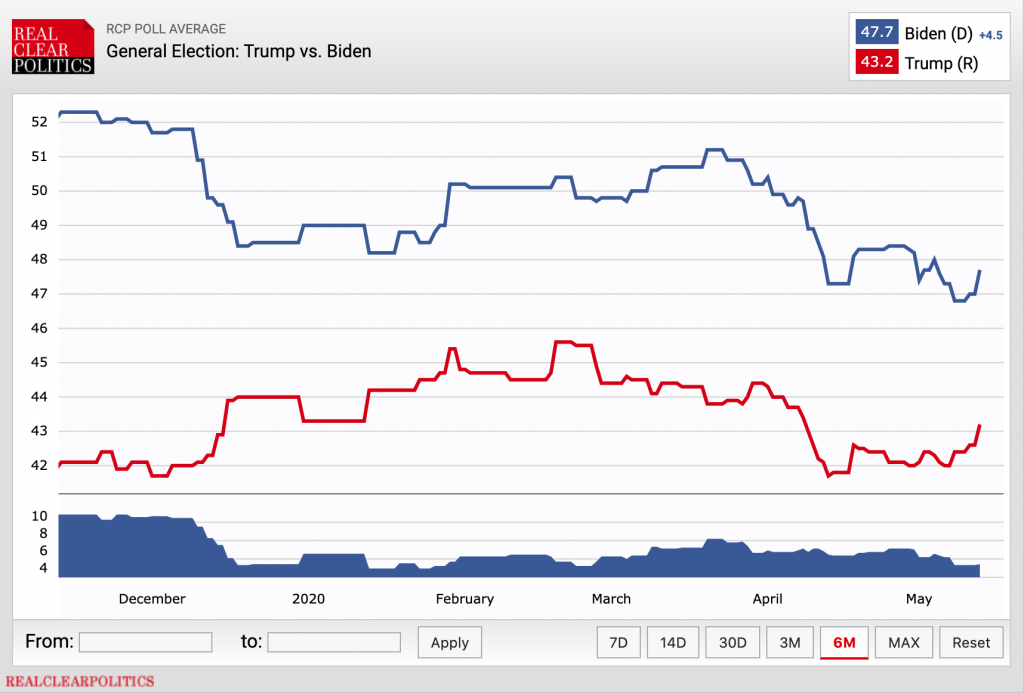
I have been watching these lines for months:

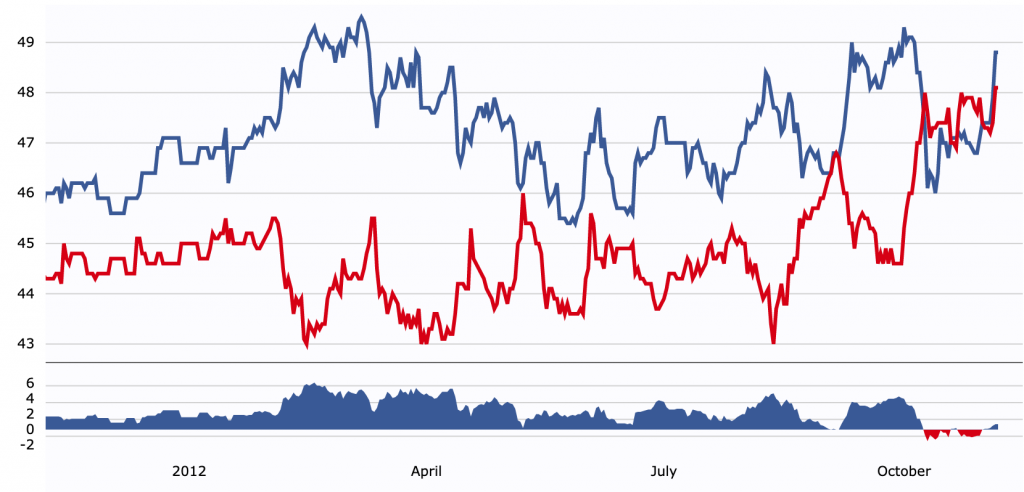
The gap is very steady, which means that every time Trump moves up, so does Biden–at the expense of undecideds–and vice-versa. By way of contrast, this is how the 2012 election looked:

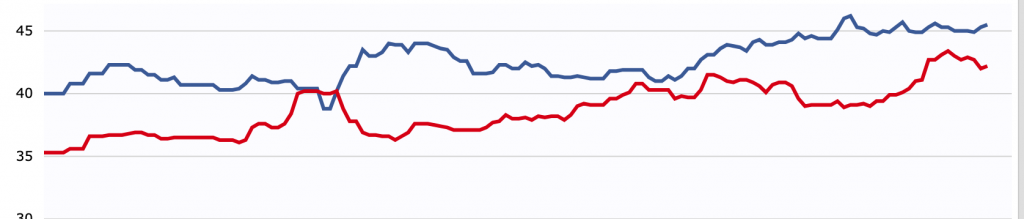
Granted, the scale is even tighter in the 2012 graph than in 2020, and the length of the trend is longer. Still, we saw points when the lines converged, crossed, or moved apart.

Likewise in 2016:

Or 2008, according to Gallup’s polling:

Henry Enten does better and compares Biden/Trump 2020 polling to historical trends going back to the beginning of polling. He says, “The steadiness in the polls is record breaking. Biden’s advantage is the steadiest in a race with an incumbent running since at least 1944.” Enten adds: “all the [national] polls taken since the beginning of 2019 have [Biden] up 6 points.” He means an average of six points, but that has a small standard deviation. The Real Clear Politics chart, reproduced above, suggests that the full range has been 4-10 points.

The consistency of this gap is noteworthy in an extraordinarily tumultuous period, marked by impeachment, a competitive Democratic primary campaign, a global pandemic, and the worst economic decline since 1929. Donald Trump’s own support has risen and fallen–although only within a five-point range. Biden has had his own ups and downs: near defeat in the primary, a serious accusation of sexual impropriety. Yet the gap between the candidates has been virtually unchanged since December.

Polls this far out are not necessarily very predictive. National polls don’t map exactly onto Electoral College outcomes. Polls conducted now include all adults or self-described “registered voters”; actual voters will be a subset of those. Turnout in 2020 is particularly hard to predict given the practicalities of voting in what may still be a pandemic.

But all these caveats are about whether the graph foretells the result in November 2020. Even if it doesn’t, it tells a very interesting story about now. As Matthew Continetti writes

It is not foolish to suppose that these world-shaking events would affect the presidential election. On the contrary: One would expect a dramatic swing toward either the incumbent or the challenger. But look at the polls. Not only has there been no big shift. There has been no shift. … Neither good nor bad news has an effect.

I think that almost all Americans have formed such firm and well-anchored beliefs about both Trump and Biden that even epoch-making events don’t shift us. We already have enough information to judge these men, whatever the news throws at us. By six percentage points, we like Biden more than Trump.

(By the way, Biden also leads in battleground states’ averages: by 3 points in WI and NC, by 4 in NV and FL, by 7 in PA and NH, and by 8 in Michigan. That would bode well for an Electoral College win, if we want to get into forecasting November.)