the Dutch secret

I have been offline because we’d been enjoying a lovely vacation in Amsterdam. While there, I read James C. Kennedy’s A Concise History of the Netherlands. His argument has general implications.

It’s an argument about why the Netherlands has been so successful–even an “enviable” country. Before addressing that question, we should acknowledge, as Kennedy does, that the Dutch participated actively and influentially in European imperialism, including the transatlantic slave trade. So their story is not entirely admirable–perhaps not mainly so. It is nevertheless an interesting question why the Dutch have frequently been more tolerant, free, equitable, and prosperous at home than their neighbors have been.

It’s common to claim that a long tradition of commercial acumen and mercantile values made the Dutch tolerant. They have been too busy to hate. But this is not really an explanation. For one thing, why were they often so good at commerce? Besides, are we sure that the causal arrow points from commercial interests to tolerance? Couldn’t a tolerant culture be good for business?

Kennedy offers a different explanation. He notes that it has typically been impossible for anyone to dominate the Low Countries. In the middle ages, the region was divided into many counties that fell within different duchies and kingdoms. It also developed many prosperous towns, which were profitable for their various feudal lords but hard to control. Later, the Reformation added several religious sects (Calvinists, Mennonites, Moravians, Anabaptists, Jews, and others, plus the many Catholics). The land has always been carved up by water, creating quite disparate regions. And after industrialization, the society split into multiple “pillars” (traditionalist Calvinist, Catholic, socialist), each with its own parties, schools, unions, and press–none strong enough to dominate the rest.

Yet the Netherlands has frequently faced grave threats: the French, the Hapsburgs, the English, and–always–the ocean. Thus the Dutch have been forced to coordinate or perish. Seeking a central authority to lead them, they broadly backed Philip the Good, the Duke of Burgundy, to acquire titles to their whole region. But Philip had to negotiate with the cities to rule, and his descendants, the Habsburg emperors, faced a successful revolt. Later, the Orangist faction favored rule by the House of Orange as a means to centralize, but they always faced effective opposition. Voluntary association has been more common.

What were the odds that the Dutch would survive as an independent country? Things looked bad in 1421, 1672, 1795, 1940, 1953. It is risky to generalize from one case that turned out successfully. Maybe other people did the same things but failed.

However, it looks as if voluntary coordination has been a learned skill in the Netherlands. The Dutch already founded an extraordinary array of philanthropic and municipal associations, guilds, almshouses, beguine-houses, etc., during late medieval times, to which they subsequently added the world’s first true corporation, a complex republican confederal government, councils of church elders and synods, and many other innovations in self-governance. In this context, tolerance can be seen as a mode of relating to other people when you need their cooperation but you cannot dominate them. Tolerance results from polycentricism. It comes with skills of self-governance and an ability to invent new mechanisms for cooperation.

See also: polycentricity: the case for a (very) mixed economy; the UK in a polycentric Europe; modus vivendi theory; how a mixed economy shapes our mentalities; what sustains free speech?; China teaches the value of political pluralism etc.
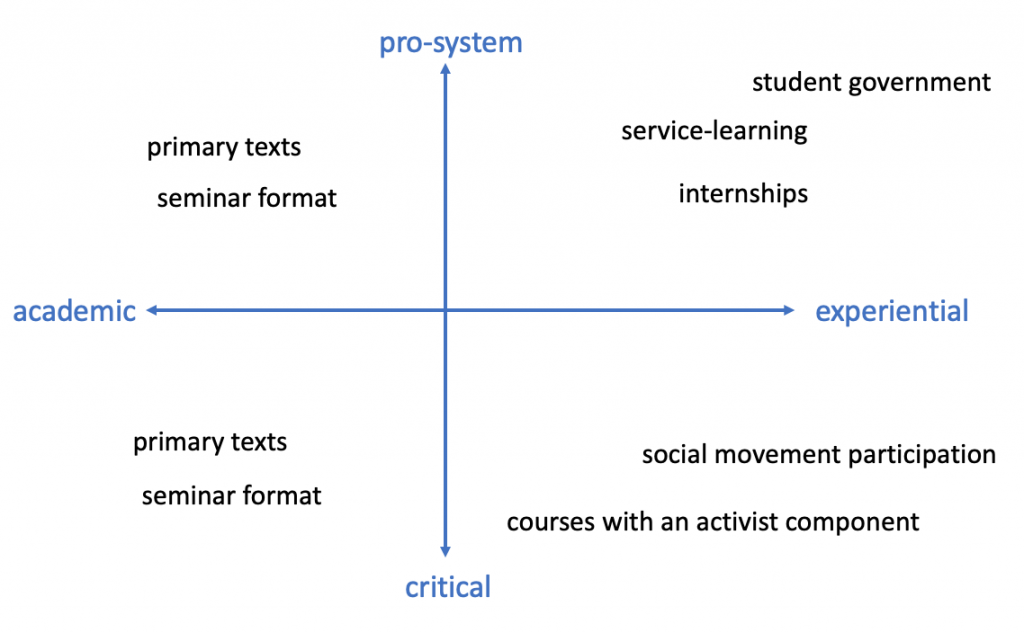
two dimensions of debate about civics

It is good that Americans disagree about civic education. We are a free and diverse people who care about youth and the future of our republic. Agreement is not to be expected and could even be problematic. The question is whether we can disagree well while also giving our students an appropriate array of choices that they can assess for themselves.

I think there are almost as many ideas about the ideal approach to civics as there are people in the debate, and it is a mistake to assume that the field has polarized into just two or a few camps. Many individuals hold nuanced and complex views.

If I had to try to categorize views, I definitely would not use one continuum from left to right. I see two different axes that may help to organize the debate–as long as one remembers that hardly anyone chooses an extreme point on either continuum, and many see value across the whole map.

The vertical axis runs from favorable to critical of the US political system and society. Tennessee Gov. Bill Lee recently tweeted that his state’s schools will teach “unapologetic American exceptionalism.” In this context, “exceptional” doesn’t usually mean atypical; it means better. That places Gov. Lee pretty close to the top of my graph. Someone who wants students to focus on historical and current injustices would fall near the bottom.

The horizontal axis runs from classroom-based work (reading, discussing, and writing about texts) to experiential learning. It may also reflect a debate about whether knowledge or skills are the most important outcomes. Lee added, “By prioritizing civics education in TN schools, we are raising a generation of young people who are knowledgeable in American history and confident in navigating their civic responsibilities.” He seems to be open to engagement as an outcome, so maybe he would support the whole top half of my graph.

These two axes are distinct and orthogonal. The most common forms of experiential civics–approaches like service-learning and student government–are often pro-system. They belong above the middle of the chart. In the Positive Youth Development field, service-learning is understood as “contributing positively to self, family, community, and, ultimately, civil society” (Chung & McBride 2015). Service-learning may also encompass critical reflection about systems (Mitchell 2008), but I think the critical aspect has been rare and often superficial.

On the other hand, if you really want to teach some version of critical theory in a K-12 classroom, you are probably interested in assigning and discussing texts. (That is why it is called “theory.”) So you likely fall the left of the middle of my chart–on the same side as the people who want to assign classical texts that they appreciate. The pedagogy is similar; the debate is about which texts to assign, which topics to discuss, and which interpretive lenses to use. Meanwhile, many of us strive to assign texts with diverse perspectives and cultivate a robust discussion within the classroom.

For what it’s worth, my own emphasis is on learning how to build and manage associations. I’d use an academic pedagogy (reading, writing, and discussing texts, data, and models) for a pragmatic purpose: making civil society work. I’d let the students decide the ultimate objectives of their own associations. This approach implies a canon of texts (Alexis de Tocqueville, Gandhi, Robert Michels, Jane Addams, Mary Parker Follett, Saul Alinsky, Bayard Rustin, Ella Baker, Jenny Mansbridge, Elinor Ostrom …) that is neither pro- nor anti-system, as a whole.

I would never claim that this is the only important approach, but I think it is undersupplied.

See also: NAEd Report on Educating for Civic Reasoning and Discourse; an overview of civic education in the USA and Germany; The Educating for American Democracy Roadmap; etc.

mixed thoughts about the status of science

Science is at the heart of several of our hardest issues, including COVID-19 and global warming. (And even race and policing.) While some Americans display “Science is real” yard signs on their front lawns, Dr. Fauci is the face of oppression for others.

The question of science is not simple.

On one hand …

What individuals think about matters like vaccination and climate change has consequences for everyone else. It can be hard to coexist with people whose beliefs seem fundamentally, even willfully, false.

Some findings are well-substantiated, e.g., that vaccines work and that human beings are causing the climate to heat up dangerously.

For any given question, there are better and worse methods of inquiry. If you want to know whether a vaccine works, a randomized, double-blind, controlled experiment is an excellent method. Google-searching to see what various “influencers” say … is not.

Science is a process of inquiry, not a set of truths. When scientific consensus shifts, that is a sign of learning, not an embarrassment.

The process of learning about COVID-19 has been extraordinarily fast and impressive. It is harder to assess the pace of learning about climate change, but we have learned how to learn a lot better than our ancestors could have done three or four centuries ago.

On the other hand …

No one obtains complex knowledge directly or alone. Science is a collective enterprise, deeply dependent on interpersonal trust. Even if you are an epidemiologist or a virologist, you can’t directly observe truths about COVID-19. You must trust data, instruments, protocols, metrics, and theoretical models that come from other people. For instance, you can only know what you’re seeing through an electron microscope because you trust that device and all the previous science that yielded it.

Science is a set of human institutions that confer power and status on some, while excluding others. Anyone with a doctorate has received a graduate education that cost someone hundreds of thousands of dollars. Americans rank physicians highest in status (7.6) out of hundreds of jobs. Physics professors and college presidents come next. Environmental scientists also rank high (6.5). But many Americans are in no position to obtain these jobs, and many may not want them. By the way, just 5 percent of physicians are Black, and 0.3 percent are Native American.

It is all very well to say “Trust the experts.” But the experts in foreign and defense policy bear responsibility for two disastrous wars since 2001. Experts in urban policy wrecked our cities’ cores by slicing highways through them and forcing people into segregated public housing. Medical experts described homosexuality as a pathology in the DSM until 1973. Some influential nutrition experts insisted that fats were bad and sugar was safe while being financed by the sugar industry.

People like me have deep personal reasons to give scientific institutions the benefit of the doubt. One of these institutions literally pays my comfortable salary. My parents, spouse, sibling, and children have been admitted, supported, and (in many cases) paid by universities. I live in a neighborhood dominated by people who have benefitted from the same institutions; it has good public schools, safe streets, and high property values. Many other people could not get into any of these institutions, or don’t want to get into them, or would not feel comfortable in them, or would not be valued by them. Trusting science comes naturally to me but has no natural appeal for many other human beings.

Partisan and ideological heuristics affect all of us. I find it very comfortable to decry Ron DeSantis’ handling of COVID-19 and to blame him for Florida’s current wave. That fits with what I want to think about Republicans, conservatives, etc. It is a lot less comfortable for me to consider why the highest cumulative per capita COVID rates are in New Jersey, New York, and Massachusetts, while Florida ranks 26th and has (to date) just 62% the cumulative case rate of New Jersey. I don’t think the takeaway is that liberal policies have worsened COVID-19. (For one thing, Mississippi is close behind Massachusetts, and Vermont and Hawaii have done best of all.) But it is no more valid to infer that conservative policies are to blame.

As the last point suggests, there is much that we really do not understand, such as the reasons for the variation in COVID-19 outcomes by state or nation. If we knew the answer to that, it might help us to assess overall social systems. We are deeply divided about what kind of society we should live in, and science has not answered that question. It is not as useful as it could be for public debates, yet it should never provide the solutions, since we must reason about values as well as facts.

There is no such thing as value-neutral data. People always decide what to observe and measure and what to call the results. When I search Google Scholar for “school social distancing COVID,” I see the following keywords in the top results: school closure, workplace non-attendance, school lockdown, mental health, weight gain, nonessential workers, nonessential businesses, epidemic control, and mitigation strategies. Whether these are the most important topics, what is missing (race, for instance), and whether these factors are rightly named–these are value questions, not scientific ones. Besides, in many cases, the data come from mandatory reports, and what we require people to report is a value-judgment.

Finally, the methods that work best for evaluating the effects of a mass-produced chemical compounds, such as vaccines, may not work best for assessing many social, cultural, and moral issues. In many domains, positivist methods are too influential and not enough credibility is accorded to laypeople’s knowledge.

I agree with Jonathan Badger that the most prominent critics of science are not raising subtle points about the soft despotism of scientific institutions or the tension between expertise and democracy. Instead, they are making false statements with great certainty. That is a disgrace, but it doesn’t negate real questions about the role of science.

See also methods for engaged research; we should be debating the big social and political paradigms; what is Civic Science?; “Just teach the facts”; notes on the social role of science; etc.

civically engaged research in political science

Amy Cabrera Rasmussen, Valeria Sinclair-Chapman, and I co-direct the American Political Science Association’s Institute for Civically Engaged Research (ICER). The 2021 Institute took place online, and Political Science Now has published an article about it.

The first cohort assembled in 2019, and members of that group have since edited a symposium on civically engaged research for PS. Some of the symposium articles are starting to appear in “first look” format and will be published together soon. The preface to the symposium is online and open access: Rasmussen, A., Levine, P., Lieberman, R., Sinclair-Chapman, V., & Smith, R. (2021). Preface. PS: Political Science & Politics, 1-4.

Please watch PS for more ambitious articles from the symposium. They review definitions of civically engaged research, critically analyze various motivations for undertaking it, connect engaged research to teaching, and so on.

See also: how to keep political science in touch with politics; methods for engaged research; what must we believe?; civically engaged research in political science; etc.

the new elite is like the old elite

There is much writing–from a variety of ideological perspectives–about a new elite that is said to dominate culture, politics, and the economy. This group obviously bears a resemblance to previous elites (and disproportionately descends from parents who were wealthy and powerful), but perhaps it demonstrates some new features.

Among the novel characteristics could be: high education and technical skills (as opposed to deriving wealth from physical property), a meritocratic ideology, competitiveness and addiction to work, a tendency to cluster together in specific neighborhoods of selected cities and to marry only people of the same group, and a tilt toward center-left parties, which are said to be losing their working-class base in reaction to the dominance of meritocratic elites.

For instance, David Brooks writes:

The class structure of Western society has gotten scrambled over the past few decades. It used to be straightforward: You had the rich, who joined country clubs and voted Republican; the working class, who toiled in the factories and voted Democratic; and, in between, the mass suburban middle class. … But somehow when the class conflict came, in 2015 and 2016, it didn’t look anything like that. Suddenly, conservative parties across the West—the former champions of the landed aristocracy—portrayed themselves as the warriors for the working class. And left-wing parties—once vehicles for proletarian revolt—were attacked as captives of the super-educated urban elite. These days, your education level and political values are as important in defining your class status as your income is.

I found this story perfectly plausible but wanted to examine it empirically. Therefore, I explored it using data from the General Social Survey (GSS). In brief, I do not see evidence that today’s elite have different ideological or partisan leanings from their predecessors nearly fifty years ago, nor have they diverged from non-elites in terms of work hours, religion, or geographical mobility. They are more educated and more racially diverse than elites were in the 1970s, but overall, they look very much like their predecessors. That means that we are not experiencing a scrambling or a situation that has “suddenly” developed. Rather, critiques of a liberal-leaning, highly educated elite have been pretty consistent since the days of Richard Nixon, Spiro Agnew, George Wallace, and Pat Buchanan.

Method: The GSS categorizes jobs by prestige, based on a survey of representative Americans. In 2012, respondents rated a street corner drug dealer and a panhandler lowest (at 1.9 and 2.1, respectively) and a college or university president and a physics professor highest (at 7.1 and 7.2). [Correction: physicians are highest, at 7.6] A lawyer was rated 6.4; a mechanical engineer, 6.6; and a board member of a large company, 6.8 (Smith & Son 2014).

I isolated people who either held jobs in the top tenth of the prestige scale or else were married to people in the top tenth. Although it matters whether one is the worker or the spouse, I was interested in high-status households and wanted to include partners, especially in the 1970s.

I could have defined the “elite” in different ways. Trying various definitions would be valuable. However, it is important not to select on the dependent variable. In this case, one could define the elite as people who are liberal, live in major metro areas, hold advanced degrees, and meet other criteria assumed by commentators like Brooks. But then the conclusion would be foreordained. With equal validity, one could identify survey respondents who are conservative, religious, and powerful and tell a story about them. To avoid this form of bias, I pre-selected a definition of “elite” and then examined this group empirically. To be honest, I was surprised by how little change I observed.

Here are some comparisons and contrasts between the most-prestigious households in the 1970s and the 2010s.

Education: Today’s elite (as defined above) is more educated. Seventy-two percent hold at least a bachelor’s degree, up from 58% in the 1970s. Less than one percent don’t have a high school diploma, down from 6% in the 1970s. The non-elite also have more education than they did in the 1970s; however, just 24% hold a bachelor’s degree or more.

At the same time, a graduate degree certainly does not guarantee admission to the elite. Sixty-four percent of people with graduate degrees are not in the top tenth by occupational prestige.

Demographics: The elite was 93% white in 1970, six points whiter than the non-elite at the time. Both groups are now more diverse, but the change has been faster among the elite (who started at a very white baseline). In the 2010s, 80% of the elite was white, 8% was African America, and 12% belonged to other racial groups.

Party and ideology: Elites have not moved toward the Democrats. Including independents who lean toward either party, the elite has gone from 47% Democrat and 39% Republican in the 1970s to 47% Democrat and 37% Republican in the 2010s. They already leaned Democratic in the days of Richard Nixon, and still do by an almost identical margin.

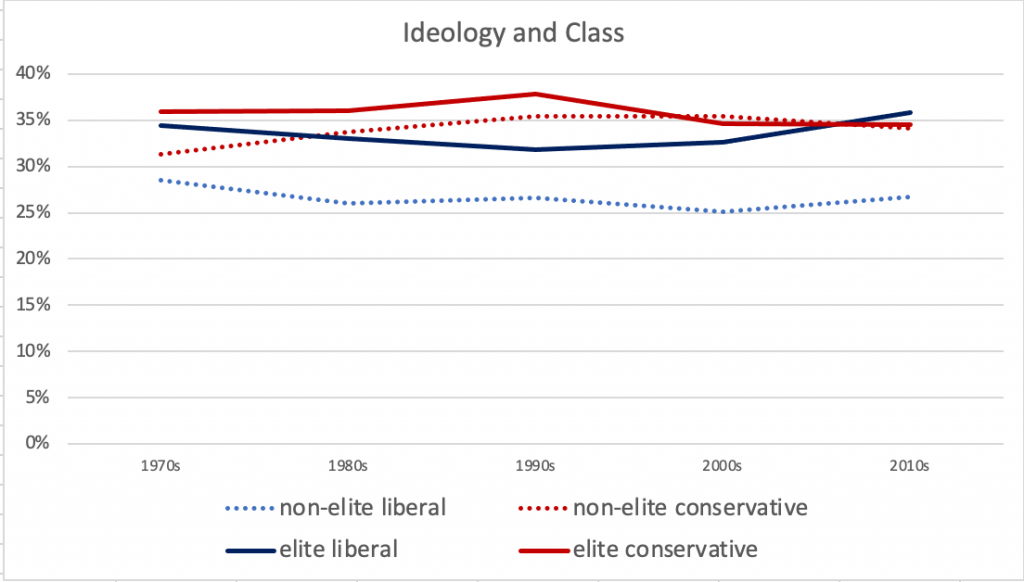
However, non-elites are considerably less Democratic, down from 56% to 45% between the 1970s and 2010s, with most of that change happening during the 1980s. This trend may reflect Southern realignment more than ideology. The graph below shows ideological trends for elites and non-elites. It is true that elites have become somewhat more liberal since 2000, but the changes are small. Overall, elites were more liberal than non-elites in the 1970s and still are today. (To be sure, what it means to be “liberal” has changed, but this is still a reason to doubt a story of ideological realignment.)

Work-week: The elite worked a mean of 41.5 hours in a typical week in the 2010s– essentially the same as the 41.2 hours their predecessors had worked in the 1970s. The non-elite are down about two hours/week to 37.4 hours.

Geography: The elite have not diverged from the non-elite in geographic mobility. Both groups have become about 3-4 percentage points less likely to live in the same city where they lived when they were 16 years old. In each decade, the elites have lived in places with larger average populations than the non-elites, but community size has shrunk for both groups–presumably, as a result of movement to the suburbs and exurbs.

Marriage: Most non-elite adults (72%) were married in the 1970s. That proportion fell to just over half (54%) by the 2010s. Most of this large shift was to the “never married” category. Elites were less likely than non-elites to be married in the 1970s, and even less so in the late 1900s, dropping to 35% married by the 1990s. However, the marriage rates among the elite has risen to 46% in the 2010s, approaching the rate of the non-elites. A consistent one in four elites reports never being married in each decade.

Religion: In each decade, elites have attended religious services a bit more often than non-elites (on average), but religious attendance has fallen for both groups.

Sources: General Social Survey; Tom W. Smith & Jaesok Son, “Measuring Occupational Prestige on the 2012 General Social Survey,” NORC at the University of Chicago GSS Methodological Report No. 122, 2014. See also: why the white working class must organize; the Left between Obama and Hillary Clinton.