Tufts receives grant from the Arthur Vining Davis Foundations to launch new curricular track in interfaith civics studies

Wednesday, September 1, 2021

FOR IMMEDIATE RELEASE: September 1, 2021
CONTACT: Jen McAndrew
jennifer.mcandrew@tufts.edu | 617.627.2029

Tufts University students will soon have more opportunities to explore the complex relationships between faith and civic life in a religiously diverse world, thanks to a grant from the Arthur Vining Davis Foundations (AVDF). Building on its undergraduate Civic Studies major, the only one of its kind, Tufts University will launch a new interdisciplinary curriculum track in interfaith civic studies.  This two-year project represents an innovative collaboration between the Jonathan M. Tisch College of Civic Life, Tufts’ School of Arts & Sciences Department of Religion, and the Tufts University Chaplaincy.

The AVDF grant will catalyze the development of a 6-course sequence in interfaith civic studies at Tufts, provide opportunities for faculty professional development and course design, support a cadre of new “student interfaith ambassadors,” and support a Resident Fellow to facilitate interdisciplinary, interfaith discussions at Tufts.

Peter Levine, Tisch College Associate Dean of Academic Affairs and Lincoln Filene Professor of Citizenship & Public Affairs, who is the lead principal investigator, notes, “Religious traditions, identities, institutions, and conflicts are central to civic life. This generous grant will allow Tufts to develop new insights about the relationships between faith and civic life and to educate students to be effective and ethical contributors in a religiously diverse world.”

Co-principal investigator Brian Hatcher, former Chair of the Department of Religion, adds, “The Department of Religion is excited to join with the Tufts Chaplaincy and Tisch College to develop this new initiative to promote Interfaith Studies at Tufts and Beyond. Thanks to the generous support of the Arthur Vining Davis Foundations, we hope to explore new avenues for integrating the academic study of religion with lived, practical approaches for promoting awareness, knowledge, and engagement among faith communities. Our aim is to help prepare students to address the challenges of interfaith collaboration and religious contestation and to find ways to foster reflection on the role of religion in civic life.”

University Chaplain and co-principal investigator Elyse Nelson Winger is committed to centering student voices in all phases of the initiative. She says, “I am thrilled that our students and University Chaplaincy team are a vital part of this new initiative.  Through experiential learning, community-building, and co-curricular programming, the Interfaith Ambassador Program will equip students from different religious, spiritual, and philosophical backgrounds to ‘live the questions’ most pertinent to interfaith engagement.” 

Jennifer Howe Peace, Senior Researcher at Tisch College and co-founder of the Interreligious/Interfaith Studies Program Unit at the American Academy of Religions, will work with colleagues across departments to design an introduction to interfaith civic studies course and coordinate the grant.  Peace comments, “Young people are eager to creatively tackle the dilemmas and opportunities of living in religiously diverse societies. This grant gives us an opportunity to harness the expertise already at Tufts to educate a new generation of civically-minded leaders with a nuanced understanding of interfaith relations.”
the Dutch secret

I have been offline because we’d been enjoying a lovely vacation in Amsterdam. While there, I read James C. Kennedy’s A Concise History of the Netherlands. His argument has general implications.

It’s an argument about why the Netherlands has been so successful–even an “enviable” country. Before addressing that question, we should acknowledge, as Kennedy does, that the Dutch participated actively and influentially in European imperialism, including the transatlantic slave trade. So their story is not entirely admirable–perhaps not mainly so. It is nevertheless an interesting question why the Dutch have frequently been more tolerant, free, equitable, and prosperous at home than their neighbors have been.

It’s common to claim that a long tradition of commercial acumen and mercantile values made the Dutch tolerant. They have been too busy to hate. But this is not really an explanation. For one thing, why were they often so good at commerce? Besides, are we sure that the causal arrow points from commercial interests to tolerance? Couldn’t a tolerant culture be good for business?

Kennedy offers a different explanation. He notes that it has typically been impossible for anyone to dominate the Low Countries. In the middle ages, the region was divided into many counties that fell within different duchies and kingdoms. It also developed many prosperous towns, which were profitable for their various feudal lords but hard to control. Later, the Reformation added several religious sects (Calvinists, Mennonites, Moravians, Anabaptists, Jews, and others, plus the many Catholics). The land has always been carved up by water, creating quite disparate regions. And after industrialization, the society split into multiple “pillars” (traditionalist Calvinist, Catholic, socialist), each with its own parties, schools, unions, and press–none strong enough to dominate the rest.

Yet the Netherlands has frequently faced grave threats: the French, the Hapsburgs, the English, and–always–the ocean. Thus the Dutch have been forced to coordinate or perish. Seeking a central authority to lead them, they broadly backed Philip the Good, the Duke of Burgundy, to acquire titles to their whole region. But Philip had to negotiate with the cities to rule, and his descendants, the Habsburg emperors, faced a successful revolt. Later, the Orangist faction favored rule by the House of Orange as a means to centralize, but they always faced effective opposition. Voluntary association has been more common.

What were the odds that the Dutch would survive as an independent country? Things looked bad in 1421, 1672, 1795, 1940, 1953. It is risky to generalize from one case that turned out successfully. Maybe other people did the same things but failed.

However, it looks as if voluntary coordination has been a learned skill in the Netherlands. The Dutch already founded an extraordinary array of philanthropic and municipal associations, guilds, almshouses, beguine-houses, etc., during late medieval times, to which they subsequently added the world’s first true corporation, a complex republican confederal government, councils of church elders and synods, and many other innovations in self-governance. In this context, tolerance can be seen as a mode of relating to other people when you need their cooperation but you cannot dominate them. Tolerance results from polycentricism. It comes with skills of self-governance and an ability to invent new mechanisms for cooperation.

See also: polycentricity: the case for a (very) mixed economy; the UK in a polycentric Europe; modus vivendi theory; how a mixed economy shapes our mentalities; what sustains free speech?; China teaches the value of political pluralism etc.

two dimensions of debate about civics

It is good that Americans disagree about civic education. We are a free and diverse people who care about youth and the future of our republic. Agreement is not to be expected and could even be problematic. The question is whether we can disagree well while also giving our students an appropriate array of choices that they can assess for themselves.

I think there are almost as many ideas about the ideal approach to civics as there are people in the debate, and it is a mistake to assume that the field has polarized into just two or a few camps. Many individuals hold nuanced and complex views.

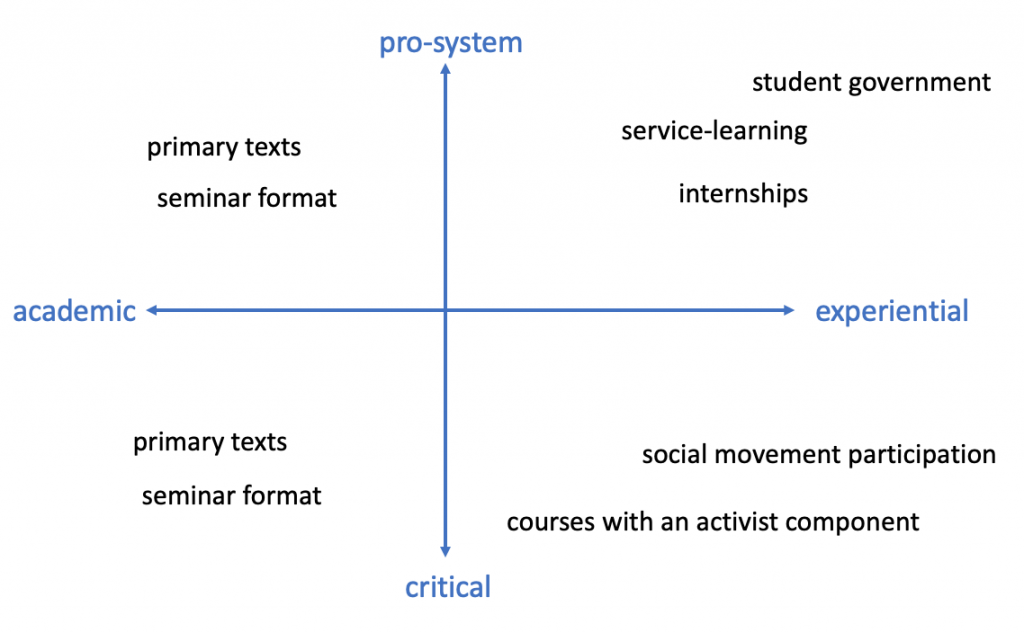
If I had to try to categorize views, I definitely would not use one continuum from left to right. I see two different axes that may help to organize the debate–as long as one remembers that hardly anyone chooses an extreme point on either continuum, and many see value across the whole map.

The vertical axis runs from favorable to critical of the US political system and society. Tennessee Gov. Bill Lee recently tweeted that his state’s schools will teach “unapologetic American exceptionalism.” In this context, “exceptional” doesn’t usually mean atypical; it means better. That places Gov. Lee pretty close to the top of my graph. Someone who wants students to focus on historical and current injustices would fall near the bottom.

The horizontal axis runs from classroom-based work (reading, discussing, and writing about texts) to experiential learning. It may also reflect a debate about whether knowledge or skills are the most important outcomes. Lee added, “By prioritizing civics education in TN schools, we are raising a generation of young people who are knowledgeable in American history and confident in navigating their civic responsibilities.” He seems to be open to engagement as an outcome, so maybe he would support the whole top half of my graph.

These two axes are distinct and orthogonal. The most common forms of experiential civics–approaches like service-learning and student government–are often pro-system. They belong above the middle of the chart. In the Positive Youth Development field, service-learning is understood as “contributing positively to self, family, community, and, ultimately, civil society” (Chung & McBride 2015). Service-learning may also encompass critical reflection about systems (Mitchell 2008), but I think the critical aspect has been rare and often superficial.

On the other hand, if you really want to teach some version of critical theory in a K-12 classroom, you are probably interested in assigning and discussing texts. (That is why it is called “theory.”) So you likely fall the left of the middle of my chart–on the same side as the people who want to assign classical texts that they appreciate. The pedagogy is similar; the debate is about which texts to assign, which topics to discuss, and which interpretive lenses to use. Meanwhile, many of us strive to assign texts with diverse perspectives and cultivate a robust discussion within the classroom.

For what it’s worth, my own emphasis is on learning how to build and manage associations. I’d use an academic pedagogy (reading, writing, and discussing texts, data, and models) for a pragmatic purpose: making civil society work. I’d let the students decide the ultimate objectives of their own associations. This approach implies a canon of texts (Alexis de Tocqueville, Gandhi, Robert Michels, Jane Addams, Mary Parker Follett, Saul Alinsky, Bayard Rustin, Ella Baker, Jenny Mansbridge, Elinor Ostrom …) that is neither pro- nor anti-system, as a whole.

I would never claim that this is the only important approach, but I think it is undersupplied.

See also: NAEd Report on Educating for Civic Reasoning and Discourse; an overview of civic education in the USA and Germany; The Educating for American Democracy Roadmap; etc.

mixed thoughts about the status of science

Science is at the heart of several of our hardest issues, including COVID-19 and global warming. (And even race and policing.) While some Americans display “Science is real” yard signs on their front lawns, Dr. Fauci is the face of oppression for others.

The question of science is not simple.

On one hand …

What individuals think about matters like vaccination and climate change has consequences for everyone else. It can be hard to coexist with people whose beliefs seem fundamentally, even willfully, false.

Some findings are well-substantiated, e.g., that vaccines work and that human beings are causing the climate to heat up dangerously.

For any given question, there are better and worse methods of inquiry. If you want to know whether a vaccine works, a randomized, double-blind, controlled experiment is an excellent method. Google-searching to see what various “influencers” say … is not.

Science is a process of inquiry, not a set of truths. When scientific consensus shifts, that is a sign of learning, not an embarrassment.

The process of learning about COVID-19 has been extraordinarily fast and impressive. It is harder to assess the pace of learning about climate change, but we have learned how to learn a lot better than our ancestors could have done three or four centuries ago.

On the other hand …

No one obtains complex knowledge directly or alone. Science is a collective enterprise, deeply dependent on interpersonal trust. Even if you are an epidemiologist or a virologist, you can’t directly observe truths about COVID-19. You must trust data, instruments, protocols, metrics, and theoretical models that come from other people. For instance, you can only know what you’re seeing through an electron microscope because you trust that device and all the previous science that yielded it.

Science is a set of human institutions that confer power and status on some, while excluding others. Anyone with a doctorate has received a graduate education that cost someone hundreds of thousands of dollars. Americans rank physicians highest in status (7.6) out of hundreds of jobs. Physics professors and college presidents come next. Environmental scientists also rank high (6.5). But many Americans are in no position to obtain these jobs, and many may not want them. By the way, just 5 percent of physicians are Black, and 0.3 percent are Native American.

It is all very well to say “Trust the experts.” But the experts in foreign and defense policy bear responsibility for two disastrous wars since 2001. Experts in urban policy wrecked our cities’ cores by slicing highways through them and forcing people into segregated public housing. Medical experts described homosexuality as a pathology in the DSM until 1973. Some influential nutrition experts insisted that fats were bad and sugar was safe while being financed by the sugar industry.

People like me have deep personal reasons to give scientific institutions the benefit of the doubt. One of these institutions literally pays my comfortable salary. My parents, spouse, sibling, and children have been admitted, supported, and (in many cases) paid by universities. I live in a neighborhood dominated by people who have benefitted from the same institutions; it has good public schools, safe streets, and high property values. Many other people could not get into any of these institutions, or don’t want to get into them, or would not feel comfortable in them, or would not be valued by them. Trusting science comes naturally to me but has no natural appeal for many other human beings.

Partisan and ideological heuristics affect all of us. I find it very comfortable to decry Ron DeSantis’ handling of COVID-19 and to blame him for Florida’s current wave. That fits with what I want to think about Republicans, conservatives, etc. It is a lot less comfortable for me to consider why the highest cumulative per capita COVID rates are in New Jersey, New York, and Massachusetts, while Florida ranks 26th and has (to date) just 62% the cumulative case rate of New Jersey. I don’t think the takeaway is that liberal policies have worsened COVID-19. (For one thing, Mississippi is close behind Massachusetts, and Vermont and Hawaii have done best of all.) But it is no more valid to infer that conservative policies are to blame.

As the last point suggests, there is much that we really do not understand, such as the reasons for the variation in COVID-19 outcomes by state or nation. If we knew the answer to that, it might help us to assess overall social systems. We are deeply divided about what kind of society we should live in, and science has not answered that question. It is not as useful as it could be for public debates, yet it should never provide the solutions, since we must reason about values as well as facts.

There is no such thing as value-neutral data. People always decide what to observe and measure and what to call the results. When I search Google Scholar for “school social distancing COVID,” I see the following keywords in the top results: school closure, workplace non-attendance, school lockdown, mental health, weight gain, nonessential workers, nonessential businesses, epidemic control, and mitigation strategies. Whether these are the most important topics, what is missing (race, for instance), and whether these factors are rightly named–these are value questions, not scientific ones. Besides, in many cases, the data come from mandatory reports, and what we require people to report is a value-judgment.

Finally, the methods that work best for evaluating the effects of a mass-produced chemical compounds, such as vaccines, may not work best for assessing many social, cultural, and moral issues. In many domains, positivist methods are too influential and not enough credibility is accorded to laypeople’s knowledge.

I agree with Jonathan Badger that the most prominent critics of science are not raising subtle points about the soft despotism of scientific institutions or the tension between expertise and democracy. Instead, they are making false statements with great certainty. That is a disgrace, but it doesn’t negate real questions about the role of science.

See also methods for engaged research; we should be debating the big social and political paradigms; what is Civic Science?; “Just teach the facts”; notes on the social role of science; etc.

civically engaged research in political science

Amy Cabrera Rasmussen, Valeria Sinclair-Chapman, and I co-direct the American Political Science Association’s Institute for Civically Engaged Research (ICER). The 2021 Institute took place online, and Political Science Now has published an article about it.

The first cohort assembled in 2019, and members of that group have since edited a symposium on civically engaged research for PS. Some of the symposium articles are starting to appear in “first look” format and will be published together soon. The preface to the symposium is online and open access: Rasmussen, A., Levine, P., Lieberman, R., Sinclair-Chapman, V., & Smith, R. (2021). Preface. PS: Political Science & Politics, 1-4.

Please watch PS for more ambitious articles from the symposium. They review definitions of civically engaged research, critically analyze various motivations for undertaking it, connect engaged research to teaching, and so on.

See also: how to keep political science in touch with politics; methods for engaged research; what must we believe?; civically engaged research in political science; etc.