three big questions relating to knowledge

I know that the sky is dark and wet today because of input from my senses to my brain. But I know that the earth moves around the sun and that the earth is warming because people have taught me. My sources didn’t use their own senses to learn these things by themselves; they, too, were taught by people–usually mediated via texts or images. This communication often takes places in organized venues like classrooms, books, and newspaper articles. In short, most knowledge is the output of institutions. In turn, institutions are organized, funded, led, regulated, rewarded, interconnected, and governed or self-governed in various specific ways.

I am interested in the following big questions about the social aspect of knowledge:

  1. Knowledge/Power: Because knowledge comes out of institutions, it is naive to think that we can know important truths without the influence of power. At the same time, it is possible to learn truths that are inconvenient to the powerful. Discoveries sometimes alter the distribution of power. And power is not necessarily bad: a democratic people exercises appropriate power when it decides to pour resources into a particular kind of medical research. We should be glad we have capacity to understand our world, and “capacity” is almost synonymous with power. Yet power is not innocent. How does it structure knowledge, and how should it be configured?
  2. Facts/Values: The Logical Positivists held that there were facts, which could be demonstrated; and there were values, which were mere matters of opinion. This distinction is still widely taught and believed, even though it has been shredded by a century of criticism from various angles. The facts we know result from our choices about what to study, which are based in values. It is very hard even to state a factual claim without also making value-claims, if only because the names we use are often loaded. The domains of fact and value are so interconnected that it may be impossible to distinguish them, yet people mix them up in harmful ways, e.g., by claiming that pro- and anti-vaccination positions are equally valid (because they both reflect values), or that police shootings do not exhibit racism because Blacks are not more likely to be shot. What are good ways to bring facts and values together?
  3. General/Particular: We cannot truly grasp the idea that the earth is warming without understanding abstract ideas like the carbon cycle and the greenhouse effect, not to mention more fundamental abstractions like temperature, change, and the idea that the earth is a sphere in space. At the same time, we cannot develop abstractions like the carbon cycle without lots of concrete data. Especially when we are studying human beings, generalities are problematic because they cover up individuality and particularity. But there are no particular facts without more general frameworks. How can we wisely combine the general and the particular?

See also: the progress of science; vaccination, masking, political polarization, and the authority of science; mixed thoughts about the status of science; what must we believe?; new special issue of The Good Society on reintegrating facts, values, and strategies; etc
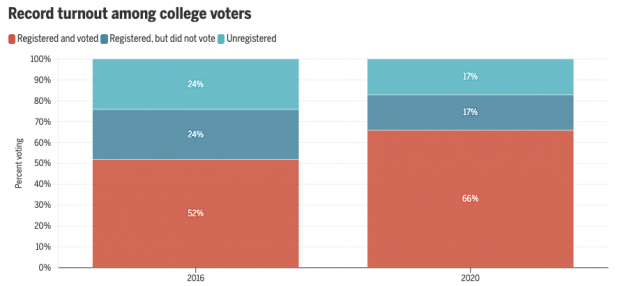
college student voting up 14 points in 2020

My colleagues at Tisch College’s Institute for Democracy and Higher Education have released their national report on the 2020 election, which is based on voting records of students enrolled at about 1,050 colleges and universities in the United States. As IDHE director Nancy Thomas says in the front-page Boston Globe feature, the turnout increase was “quite stunning.” It was also quite consistent across different types of institutions, fields of study, and demographic groups. For instance, white men, black men, social science or history majors, business majors, students at private liberal arts colleges, and students at public PhD-granting universities all showed increases of between 14 points and 17 points.

The whole report is here.

a conversation with Farah Stockman about American Made: What Happens to People When Work Disappears

I really enjoyed my conversation yesterday with Farah Stockman, whose new book is moving, insightful, and even suspenseful. She tells the life stories of three workers who were laid off when the Rexnord factory in Indianapolis was shut down, just as Donald Trump was winning the 2016 election.

I asked her versions of these questions:

You recall that your parents used to argue about race. When a waitress was rude, your Black mother would suspect she was being racist; your white father “thought she must be cranky after a long day on her feet.” You say, “I always wondered which one was right. That is why I became a journalist, to talk to the waitress.” I read that sentence as a metaphor for the whole book, and especially for sections like the one where you have a four-hour conversation about race with John—the Trump-voting union guy–after you learn that he displays a Confederate flag in his garage. Can you say more about your impulse to talk to people like the waitress and John? What are you trying to accomplish?

John sees the world in terms of workers vs capitalists. He hates talk of white privilege because he feels oppressed as a worker. He works to make the union fight the company, and he votes for Trump. His wife is more favorable to management. On that basis, he describes her as a “liberal.” He is also surprised when a Republican politician doesn’t seem to favor US workers. Does he see today’s capitalists as the liberals? What is making him feel that way?

Wally is a black man. You say that the first time he gave a “structural” explanation for injustice was when he criticized how the city condemned houses owned by Black people and sold them to white developers. Otherwise, instead of giving structural explanations, he talks about his own responsibility and how he’ll benefit from a positive personality and hard work. I believe in structural explanations, but I can see how they don’t offer much to Wally. He doesn’t have many ways to address structural problems in the society, but he sometimes benefits–precariously — from his own hard work and niceness. Am I understanding him right? And do you think he would have been better off if he had thought more politically and structurally?

College really doesn’t seem to benefit anyone in the book. Several people enroll and rack up debt without getting degrees, or earn degrees that don’t lead to good jobs. They resent college-educated people who are set over them. Shannon says, “I am not a Democrat or a Republican. I’m for the one who will keep good-paying jobs here for us un-educated people that build the parts that make them rich.” Is college good? How could it work better for all?

The book is full of moving moments of solidarity, like when a Mexican worker who will take Shannon’s job pulls her aside and apologizes (233), or when John worries that he might be taking a position away from a Black co-worker, Marlon (289), or when Wally physically embraces a man he has caught sabotaging equipment (214), or—most moving to me—when Wally and his new girlfriend Stacie pray and weep together over his challenges. Factory work can offer solidarity. Unemployment destroys it. Do you see ways to build solidarity, especially across race?

You explore the differences among Shannon, John, and Wally, but also their shared circumstances and culture. And you depict how different their culture is from that of a Harvard-grad reporter who lives in Cambridge, Mass. You are critical of your group (which is also mine) for being out of touch, pretentious, and soft. What should highly educated elites learn from working class Americans?

Dr. Kenann McKenzie to lead the Generous Listening and Dialogue (GLAD) Center at Tisch College

Happy news, per our official release:

Tufts University’s Jonathan M. Tisch College of Civic Life today announced that Dr. Kenann McKenzie, an accomplished educator, researcher and civic leader, will direct the newly created Generous Listening and Dialogue (GLAD) Center.

Designed to be a global center of excellence to promote authentic dialogue and generous listening across differences, the GLAD Center will serve as an educational resource for Tufts and beyond. The Center defines generous listening broadly, encompassing the art of listening to ourselves, to nature, and to others—especially when people disagree or when they confront differences of power and status.

Dr. McKenzie, who will join Tufts on November 1, 2021, has worked for two decades in the higher education sector as an academic counselor, researcher, lecturer, policy analyst and administrator. She currently serves as Director of the Aspire Institute, which supports the preK-12 educational sector with professional development based in a social justice framework and community engagement. In addition, she currently teaches at Wheelock College and serve d as the Educational Leadership & Policy Studies’ faculty representative to the college’s Equity, Diversity & Inclusion Committee.

“Working with Tufts students—the next generation of civic leaders—is a wonderful opportunity, and I’m thrilled to join Tisch College in building and sustaining a community of robust dialogue and truly generous listening,” said Dr. McKenzie. “This work challenges us to hear each other and ourselves, and to commit to considering big questions and big issues together.”

Housed at the Tisch College of Civic Life, the GLAD Center will collaborate with schools and departments across the university and with external partners, building on the expertise of Tufts’ faculty, research centers and civic engagement programs. Its programming, research, and interdisciplinary initiatives will help people at Tufts and beyond to develop skills and awareness, address hard issues, and generate new knowledge. The GLAD Center was launched in the spring of 2021 in collaboration with the Vuslat Foundation. Dr. McKenzie will be joined on the Center’s leadership team by Dr. Deborah Donahue-Keegan, Associate Director, Tisch College Senior Fellow and Lecturer in the Tufts University Department of Education.

“We look forward to welcoming Dr. McKenzie to Tufts and Tisch College,” said Dayna Cunningham, the Pierre and Pamela Omidyar Dean of the Tisch College of Civic Life. “Her leadership of the GLAD Center could not come at a better time. To grapple with the challenges that confront our students, our university and the world—from systemic racial injustice to the existential threat of global climate change—we need to flex every civic muscle we have, including the skills of listening and dialogue.”

Dr. McKenzie has a BA in Africana Studies from Cornell University, M.Ed. from the University of Virginia in Social Foundations of Education, and a Ph.D. in Politics and Education from Teachers College, Columbia University. In her civic life, she serves on the Beverly, Massachusetts School Committee and as VP III and education chair of the North Shore Branch of the NAACP. She is most proud of being a mother to amazing children who inspire her work everyday.

Newhouse endowment for the CIRCLE directorship

The Samuel I. Newhouse Foundation has made a $1.5 million gift to endow the directorship of the Center for Information & Research on Civic Learning and Engagement (CIRCLE), the leading research center on youth civic education and engagement at Tufts University’s Jonathan M. Tisch College of Civic Life.

This endowment is the most recent gift from Elyse Newhouse, J82, and her husband Michael Newhouse, A82, who have long been generous supporters of Tisch College and Tufts University. The gift will advance CIRCLE’s mission to understand and eradicate the barriers that keep some young people from participating in civic life. It will ensure that CIRCLE, a consequential anchor institution in the fields of civic education and engagement, will continue to have extraordinary impact on diverse young people’s ability to have a voice in our democracy.

[See the whole press release here.]

This announcement is doubly meaningful for me. First, the director is my close colleague and successor Kei Kawashima-Ginsberg, who richly merits an endowed position as a national leader in the field of youth civic engagement. CIRCLE is intensely collaborative, and the whole team deserves credit for all of its work, yet this is a moment to celebrate Kei. The gift reflects her accomplishments and excellence.

Second, the endowment vindicates our initial vision for CIRCLE. Founded in July 2001, CIRCLE began as strictly grant-funded project, albeit with the ambition of becoming a permanent institution that would help create a new field of research and practice. We moved from University of Maryland to Tufts in 2008 because of Tufts’ commitment to civic engagement and research. I proudly turned over the leadership to Kei in 2015. Tufts has supported CIRCLE in many ways, of which the Newhouse endowment is the newest–and one of the most significant–examples. We can now be sure that CIRCLE will be active and influential for a long time to come.