This is the video of yesterday’s conversation with Peter Beinart at Tufts:
I asked him:
What do you think is the relationship (if any) between rising anti-Semitism and rising criticism of Israel?
When is criticism of Israel anti-Semitic, and when isn’t it?
Is it important that we have dialogue about Israel/Palestine in places like Tufts? Why? What would be trying to accomplish?
In Jewish Currents in July, you wrote, “In mainstream American discourse, the word ‘anti-Palestinian’ barely exists. It is absent not because anti-Palestinian bigotry is rare but because it is ubiquitous. It is absent precisely because, if the concept existed, almost everyone in Congress would be guilty of it, except for a tiny minority of renegade progressives who are regularly denounced as antisemites.” Can you expand on that statement and talk a little more about why you focus on anti-Palestinian prejudice here, apart from Islamophobia or anti-Arab prejudice?
What should non-Jews know about Judaism to engage appropriately in civic life?
What is your own position on Israel/Palestine now, and how did you get there?
What would a one state solution look like? How would the state be organized?
The Atlantic’s Emma Green begins her interview with Princeton president Christopher Eisgruber by asking, “Why should Princeton exist?” He answers by talking about “talent.” He says, “the idea of a place like Princeton is that you can identify young people who have extraordinary talent and will benefit from an intensive academic experience. Over the space of years and decades, they will blossom in ways we can’t even predict, and they will be able to address problems that matter.”
In order to accept this rationale, you would have to accept some version of four controversial premises: 1) Princeton attracts talent, as opposed to various forms of capital (financial, social, cultural). 2) Talented people learn more at Princeton than they would at less selective institutions; they do not merely receive credentials with high market value. 3) Graduates of Princeton are trustworthy and accountable to other human beings. And 4) Social change depends on small numbers of talented people.
Persuasive evidence for these claims cannot be anecdotal. Eisgruber cites Justice Sotomayor, who is genuinely talented, probably learned a lot at Princeton (she talked about it when she visited Tufts), serves the public good, and wields influence as a Supreme Court justice. But one example does not make the case. What is the net impact of Princeton on society? (For instance, what is the impact of one Sonia Sotomayor minus one Ted Cruz?)
I would offer a different justification, cautiously because I think it only goes so far. You could call it “one cheer for Princeton.”
Justice is extraordinarily important. It is a contestable concept and it should be complex, encompassing various values that may not fit together comfortably. For instance, it should probably encompass both individual freedom of choice and also equity. Regardless of how you define justice, highly selective and fabulously endowed US universities are not likely to be consistent with it. That is why they should face constant pressure from democratic institutions as well as competition from public higher education and from other entities here and abroad.
But I don’t think that justice is the only good. Here I would also mention truth and beauty. Highly selective and well-funded universities generate a lot of those goods–and not only for their own members. As Eisgruber notes, five of this year’s Nobelists have Princeton connections, and their research is in the public domain. David Card’s work on the minimum wage is research that should promote both truth and justice. He conducted it with Alan Krueger while they were both at Princeton, which is a good example of the benefits of concentrating expertise. Princeton also produces beauty in the form of natural science and scholarship. At Tufts, we add a school of fine arts.
Although highly selective private institutions generate truth and beauty, they don’t–and shouldn’t–monopolize those functions. For one thing, public universities produce a vast amount of the same goods. (But US public universities are often effectively private institutions.) More importantly, truth must come from beyond the academy.
Indeed, universities have weaknesses as producers of knowledge and beauty (apart from their questionable impact on justice). They are not particularly good at valuing the ideas and insights that come from the margins of society. My job is to try to address that problem at Tufts and in some national networks. Whether I succeed is a different question, but I work on it every day. I think my underlying motivation is the belief that by combining the kinds of knowledge that come from places like Tufts and Princeton with very different kinds of knowledge, we might be able to enlighten and empower people beyond our walls.
Tyler Cowen recently posed the “mystifying question: Why has our advanced, modern and wealthy world ceased building beautiful neighborhoods?” He notes that the “modern world has produced striking individual buildings, such as Guggenheim Bilbao or the Seattle Public Library, among many others.” But “modern residential neighborhoods are not very aesthetically appealing.” He adds, “This is not a purely subjective judgment (though it is my personal subjective judgment).” Instead, it is a fact that people “pay money to see … older neighborhoods, dating as far back as medieval times but pretty much never after 1940. Tysons Corner just isn’t as charming as Old Town Alexandria.”
As in the good old days of the blogosphere, his article has generated in-depth replies, e.g., from Scott Alexander and Scott Sumner. You can find some disagreement about Cowen’s premise, plus a range of explanations, especially economic ones.
I would offer a different type of explanation. For a millennium, European architecture unfolded as a series of styles: romanesque, gothic, renaissance, baroque, neoclassical, rococo. During transitional periods, more than one style could be found in a given place, but usually a single style prevailed.
This situation had three major advantages. First, everyone from stonemasons to famous architects acquired complementary training and experience. If a certain kind of ornament was part of the style, architects knew how to sketch it; masons knew how to carve it. Second, architects could work from templates and models: they didn’t face a blank sheet of paper. They weren’t expected to be creative geniuses. Third, each style had a powerful justification. It was loaded with cultural significance. Just for example, renaissance architecture was a deliberate movement to restore the ethos of late-Roman Christianity, seen as the best era in history. It is inspiring to use an architectural repertoire if you are convinced that it is the best possible one.
Beginning in the late 1700s, Europeans learned much more about–and became more appreciative of–the history of culture and the many styles that has unfolded over time. Simultaneously, they became more conscious and somewhat more respectful of styles from the Middle East and Asia. They began to see cultures as plural and styles as aesthetic choices. “All artistic styles [are] bound in place and time,” wrote Nietzsche.
That recognition ended the procession of period styles. In the 1800s, almost all architecture by Europeans and European settlers on other continents was revivalist. Buildings were self-consciously gothic, or renaissance, or “Moorish” or “Mogul.” I have learned to appreciate this work, especially when it merges new technologies and social needs with revived styles. A 20-story cast-iron gothic building is an impressive innovation. Nevertheless, few 19th-century buildings meet Cowen’s test of drawing tourists for their architecture, as older buildings do. Certainly, people travel to see the neo-gothic Big Ben or the neo-classical US Capitol Building, but not specifically for their architecture.
Modernists decried revivalism as fake and bourgeois. They proposed an alternative: functionalism or minimalism. Modernists argued that architecture could transcend style permanently by expressing a building’s true function. Gropius wrote:
We have had enough and to spare of the arbitrary reproduction of historical styles … The modern building should derive its architectural significance solely from the vigour and consequence of its own organic proportions. It must be true to itself … A breach has been made with the past. … The morphology of dead styles has been destroyed; we are returning to honesty of thought and feeling.
Modernism produced many masterpieces and even whole impressive neighborhoods of ordinary buildings, as in Miami or Tel Aviv. But soon it was obvious that modernism, too, was a style. In theory, you can do all sorts of things with basic elements like flat walls and windows. In practice, a modernist building looked a certain way. Postmodernism then emerged as a critique of modernism’s pretense to have escaped style. A perfect example is Philip Johnson AT&S Building, a minimalist box with a “Chippendale” baroque roof tacked on the top.
The resulting crisis explains why everyday architecture is not as good as it was until ca. 1800. We still see new works of architectural genius–often buildings that work like original sculptures and that take full advantage of technology. In the absence of a prevailing style, a great artist can invent something personal and original. But that solution cannot work for whole neighborhoods.
We also have plenty of revivalism, with imitations of mid-century modernism now joining neo-Palladian and even neo-Gothic homes. I think it is a fair generalization that most of this is worse than the revivalism of the 19th century, partly for economic reasons (like the Baumol effect), and partly because we instinctively share the modernists’ resistance to imitating past styles. New styles also pop up periodically, like the one I tried to describe here and that others have amusingly named “Simcityism,” “McUrbanism,” “blandmarks,” “LoMo”, or “Spongebuild Squareparts.” Vernaculars like this one don’t last or spread widely, because they quickly look dated.
It is important for left and center-left political parties to rely on lower-income voters, who–nowadays–are also people with less educational attainment. Then the left’s political leadership will be accountable to disadvantaged people. Since they identify with the left, they will try to serve their core voters by promising more funds and more regulation. I generally favor such policies, but even if you do not, you should acknowledge that taxing, spending, and regulating are compatible with a constitutional democracy. If you want to oppose the left, you can vote for the right.
It is equally important for center-right parties to depend on people with higher incomes (which generally means more education), because then they will have incentives to advocate lower taxes and less regulation. I tend to oppose such policies, but I would acknowledge–and urge others on the left to accept–that trying to shrink the size of government is compatible with constitutional democracy. People who have reasons to shrink government need a political outlet. Again, the way to oppose their position is to vote for the other side. This debate is a good one.
As long as the parties split the electorate this way, they will have incentives to act reasonably on matters outside their core interests. A pro-business party rooted in the upper stratum of society can easily support civil liberties and a safety net. A left party dependent on working class voters will want to protect economic growth. Both should defend the basic constitutional order.
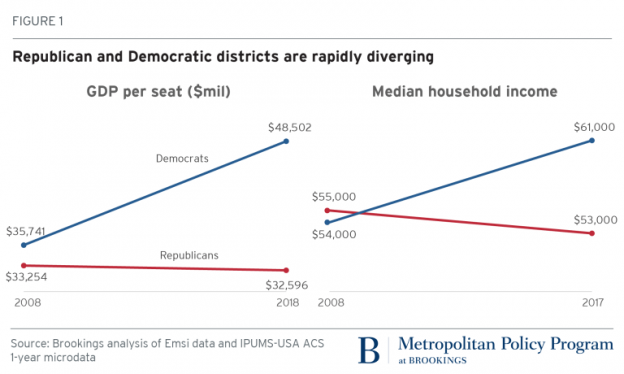
Unfortunately, this neat arrangement has been scrambled in many developed, democratic countries. Considerable numbers of highly educated people vote left, even forming the base of the center-left parties, while many working-class people have shifted to the right. Democrats now represent the 17 richest congressional districts and most of the richest 50. In the aggregate, Democratic districts are wealthier than Republican ones. (Race is certainly relevant in the USA, and I will say more about that later.)
This situation is dangerous because of the incentives it creates. A center-left party that relies on highly educated people will want to preserve the society’s most advantaged institutions: its most dynamic industries, thriving communities, and elite universities. Since it’s on the left, it won’t explicitly defend inequality, but it won’t really undermine it, either. It will prefer symbolic gestures of inclusion and equity that don’t shake the social foundations. Basically, advantaged individuals will assume that they can retain their own nice neighborhoods, good schools, and satisfying jobs while allowing some newcomers to join them. If such voters represent the main force on the left, social transformation becomes impossible.
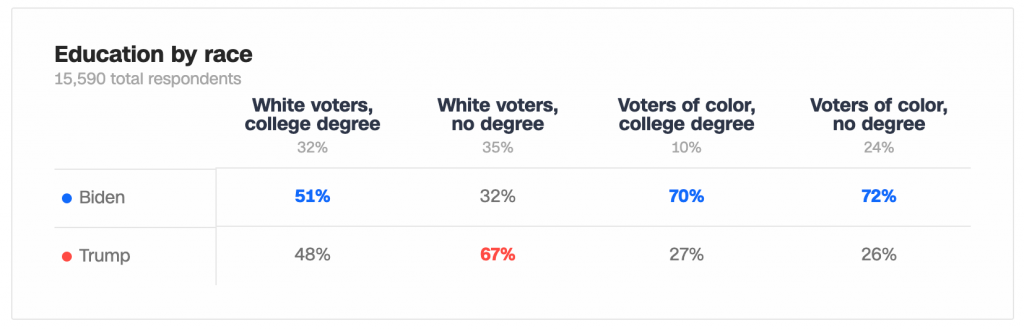
Nevertheless, the center-left party will offer the least-bad option for people of color, since diversity and inclusion are better than outright exclusion. Thus Biden drew 70% of voters of color along with a majority of college-educated white voters.
National Exit Polls 2020 (CNN)
For their part, right parties that are based in working-class, low-income communities will have incentives to turn ethno-nationalist, xenophobic, and authoritarian. Being on the right, they cannot embrace social democracy. They could offer libertarian alternatives: getting the state off people’s backs. Unlike authoritarianism, libertarianism is compatible with constitutional democracy. However, surveys never show much support for truly libertarian policies–and less so today, after the neoliberal revolution has played out. Ethno-nationalism has much wider support.
When the parties invert in this way, the left tends to become moderate–excessively so, in my view–but it also generates a critical flank. Right now, the Democrats’ critical flank is led by younger politicians of color who represent urban communities with many lower-income voters of color. They have incentives, as well as genuine commitments, that anchor them on the left. But they are outnumbered within their own party by politicians who represent and reflect high-income communities. If we had a multi-party system, these factions would split and then negotiate about whether to form a coalition in Congress. In our duopoly, the strife occurs within the party and is constrained by difficult calculations.
Meanwhile, the Republicans have strong and palpable incentives to move in a racist and authoritarian direction, jettisoning their libertarian impulses. Debate is less evident on their side of the aisle, since Trump supporters truly dominate the GOP’s elected ranks. Only a significant electoral defeat can re-empower the traditional conservatives, and that seems unlikely.
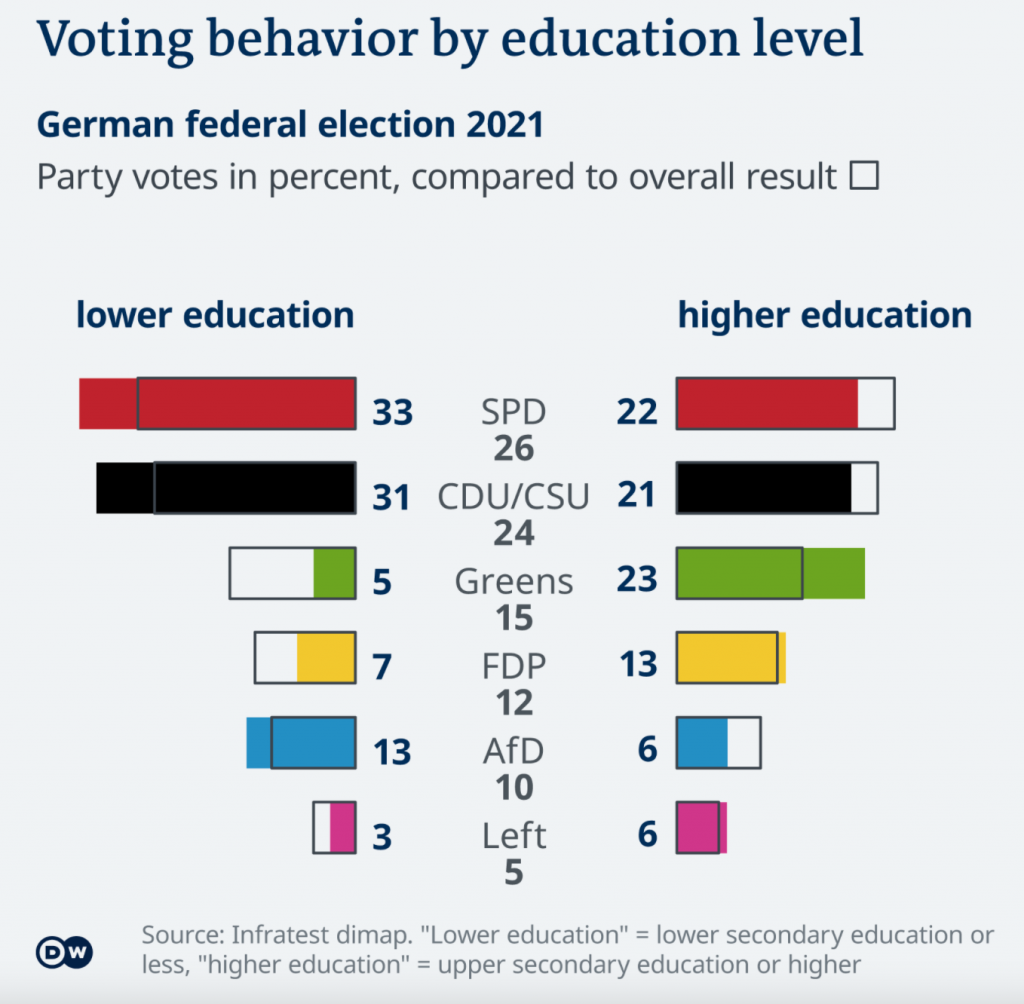
A similar inversion has been evident in several other countries, including Germany, where the Social Democrats (SPD) now attract highly educated knowledge-workers, while many blue-collar workers have moved right. (I graphed some historical trends here.) One election does not make a trend, but the results from the recent German election are somewhat encouraging. The SPD performed best among people with lower education: the working class. That is how a social-democratic party should perform. The Greens drew almost entirely from the top educational stratum. A red/green coalition would combine working class voters with the liberal intelligentsia, but with the working class in control because of their larger numbers. That coalition would resemble the Democrats if the Progressive Caucus were three times as big.
On the other hand, the hard right (AfD) is disproportionately working class, as is the center right (CDU). Although I do not expect the CDU and AfD to form a coalition in the near future, the temptation is real.
It will not be easy to get out of this situation. The Democrats could offer more tangible benefits to working class people of all races and ethnicities. One problem: policies that I would regard as beneficial are not always seen as such, for a variety of reasons. Besides, there is always a loose connection between policy and public opinion, given the genuine difficulty of discerning the effects of policies plus the low level of attention that most people give to public affairs.
To make matters even harder, Democrats are a loose group of entrepreneurial politicians who have their own constituencies–disproportionately wealthy ones. This means that Democratic leaders are not the best group to reach out to working-class voters, nor are their core supporters likely to support really bold policies. That is why I have been interested in tactics like investing in the Appalachian cities, whose mayors are Democrats.
My colleagues and I in Tisch College’s small but mighty Civic Science program recently read and discussed these three works together:
Arendt, Hannah. “Man’s Conquest of Space.” The American Scholar (1963): 527-540.
Kuhn, Thomas S. 1962. The structure of scientific revolutions. University of Chicago Press.
Polanyi, Michael. 1962. “The Republic of Science.” Minerva 1 (1): 54-73.
Polanyi is interested in how scientists coordinate. A “multitude of scientists, each of whom is competent to assess only a tiny fragment of current scientific work,” must collectively decide what to study next, which methods to use, what findings to publish and cite, and what the results mean. You become a scientist by joining a “network of mutual appreciation extending far beyond [your] own horizon.” This network is governed by the community of science through such means as blind peer-review and citation. These tools play the same role as prices in a market: they communicate information about what is valued without resort to a central authority, which would lack sufficient knowledge and would be untrustworthy.
Science is “an association of independent initiatives, combined towards an indeterminate achievement. It is disciplined and motivated by serving a traditional authority, but this authority is dynamic: its continued existence depends on its constant self-renewal through the originality of its followers.” Science is not exactly goal-directed, because no one knows what it will discover. But it is value-driven, because the “explorers strive toward a hidden reality, for the sake of intellectual satisfaction.”
Polanyi developed the idea of “spontaneous order,” which Hayek used to advocate for minimally regulated markets. But Polanyi distinguished himself from classical liberalism. “It appears, at first sight, that I have assimilated the pursuit of science to the market. But the emphasis should be in the opposite direction. The self-coordination of independent scientists embodies principle which is reduced to the mechanism of the market when applied to the production and distribution of material goods.” In other words, science is better than a market because the motives of all the independent but coordinated decision makers are superior to those of buyers and sellers.
Polanyi paints a comfortable picture of constant progress–the steady accumulation of knowledge. In contrast, Kuhn focuses on scientific “revolutions.” He observes that all the scientists working at a given time tend to share one overall “paradigm,” composed not only of foundational beliefs but also of methods and instruments. These paradigms “shift” occasionally when the current one ceases to explain the data. Kuhn introduces a modest kind of relativism by suggesting that scientists at any given time see the world through, or with, a paradigm that will later become obsolete. Yet nature or reality plays a substantial role in changing our paradigms. It is because the earth really moves around the sun that the Ptolemaic system falls to the Copernican system once scientists have obtained enough data to shake the former view.
Both of these theories are progressive and take an essentially benign view of science. They seek to explain the apparent fact that science is successful. Arendt’s stance is very different. She notes that “physicists split the atom without any hesitations the very moment they knew how to do it, although they realized full well the enormous destructive potentialities of their operation.” This is an example of the fundamental amorality of science. “The scientist qua scientist does not even care about the survival of the human race on earth or, for that matter, about the survival of the planet itself.”
Not only does science yield catastrophic practical results–including the possible extinction of the human race–but it also alienates us from nature and ourselves. As scientists discover aspects of reality that are deeply counter-intuitive (for instance, invisible living organisms in our noses; distant ancestors that were apes and even bacteria; light as both wave and a particle), knowledge becomes unmoored from experience. Science culminates with the figure of “the astronaut, shot into outer space and imprisoned in his instrument-ridden capsule where each actual physical encounter with his surroundings would spell immediate death.”
For Arendt, the problem is built into the logic of science and the mentality and motivation of scientists. (It is not nature’s fault that we study it as we do.) Polanyi admires scientists’ motives and defends their refusal to look at ultimate consequences. Results should be “emergent” rather than planned. The contrast between these two authors raises interesting questions about the motivations and underlying commitments of actual scientists.
But the governance of science is a different issue from the mentality of scientists. I think Polanyi errs in assuming a well-functioning system. What about bias, status hierarchies within labs, replication crises, selling out to industry? Kuhn might offer some insights about why revolutions are sometimes necessary. Meanwhile, Arendt misses the problem of collective action. An individual physicist could opt not to study atoms ca. 1935 because that research might lead to atom bombs. But this physicist would reasonably believe that other scientists–possibly Nazi scientists–would go ahead with the research anyway. To stop scientific investigation of a particular topic is a problem of governance.
Polanyi is too cheerful about the actual governance of what he calls the “republic of science,” but Arendt (despite being a great republican political theorist) strangely neglects it. I suspect this is because she views republics as autonomous political entities that have plenipotentiary power within their geographical borders. She would subsume scientists to their respective republican states. She misses the possibility that science is a republic of its own, overlapping political borders. But then the question is how that republic should be governed.