Sometimes, my dog wonders something about me. Perhaps: Will I will play with him?
He stares at my face, which means he must look quite far above his own head. His nostrils may twitch, and I guess that he is gathering as much data as he can with his nose. His head is cocked, which signals to me that he has a question. His ears (being floppy) are harder to interpret, but usually you can tell that they are tensed forward to listen.
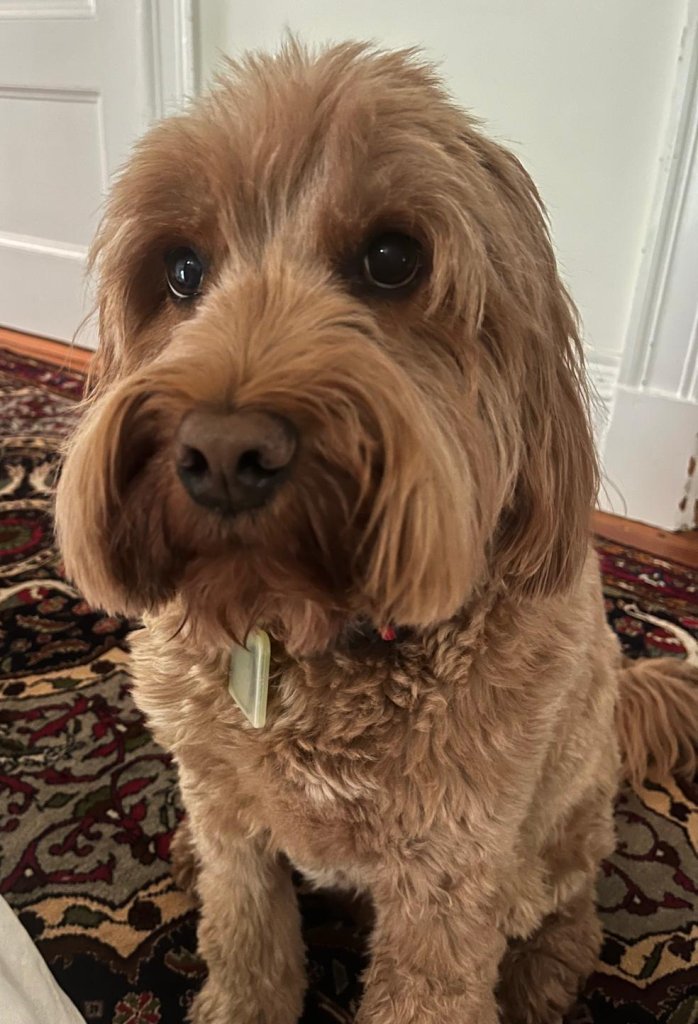
Where is he when he attends this way? One valid answer: between his nose and his tail. Or: in the space contained by his fur.
But it would be a normal use of the English language to say that his eyes–or his mind–are on me. Presumably, he is not thinking about his tail, whereas he is intentionally focused on my face. His eyesight is directed, so that he is not looking anywhere other than my face. Even the space between us and behind me is presumably blurred for him. I am the “figure,” and the rest is the “ground.”
The senses of smell and sound are less directed. Information can reach a nose and ears from any direction. But Luca is probably trying to screen out other olfactory and auditory data and lean into information about me that may be carried by smells and sounds.
He cannot feel me from a distance, and he is probably inattentive to the things that he can feel, such as the ground below him–unless it moves. He is not focused on touch because it will not tell him whether I am going to play with him.
Thus, if you ask where is he when he wonders about me, a plausible answer would be: In a zone centered on my face. But my face is merely a source of information, so another answer could be: He is in relation to me. Or: We are together. After all, the purpose of the cocked head is to tell me that he is attending to me so that I will be more likely to answer his question.
This act of attention has duration. Luca sustains his gaze, which is why I infer that he is attentive. Besides, he is interested in whether I will play with him in the future because I have played with him in the past. I don’t know whether a dog thinks about memories or plans, but humans certainly do. And neither memories nor plans are in the present.
If Luca already knew what he wanted to know, he would no longer pay attention. Nor would he attend if there were nothing present that might answer his question. Maurice Merleau-Ponty says that attention arises “in the process of learning” (1945, p. 34). He defines the “attention itself” as “circumscribed ignorance, an intention that is still ’empty’ but already determined” by what is really there.
Let’s say that any sentient being is its attention, or at least that its attention is a very significant aspect of the being. I have explored that thesis a bit here.
Our attention has a location that is related to the location of our body, but the two are not coterminous. In fact, we are rarely aware of most of our body, and we cannot become aware of some parts or aspects of it, such as the blood in our veins. Although Luca’s sensory capacity is concentrated inside his skull, he is not attentive to his skull and can never even see the back of it.
Still, the body has an important relationship to attention. If something happens to the body, we may immediately notice it and may be compelled to attend. I pulled a muscle in my back on Monday, and that certainly got my attention. If the body dies, the attention ends.
Our attention has a location in time that is related to the present hour and minute, but the two are not identical. We can be deeply engaged with a memory or a fear or hope for the future. And an instant of attention may make sense only as one part of an extended act. I may attend to one word while writing this whole post, but no word means much alone.
Two or more attentions can be connected, with each serving as the object of the other. Then it may be more meaningful to ask where we are than where I am.
Where? and When? seem to be questions about limitations. We are finite, limited creatures who cannot be everywhere or last forever. However, we are not limited in quite the way we may assume when we identify with our body at the moment that is shown on a clock. Our place and time are different from that.
Source: Maurice Merleau-Ponty, Phénoménologie de la perception (Gallimard, 1945). (“La conscience en train d’apprendre” is “cette ignorance circonscrite, de cette intention <<vide>> encore, mais déjà déterminée“). The metaphor of figure and ground also comes from this text.
See also: people as clusters of attention; paradigms of attention; effortful attention and moral responsibility; Cezanne’s portait of Gustave Geffroy; Rilke, ‘The Grownup’.