Monthly Archives: January 2024

Civic Education in a Time of Democratic Crisis

I enjoyed an online conversation yesterday with David Campbell from Notre Dame, Paul Carrese from Arizona State University, Linda Darling-Hammond from the Learning Policy Institute, Kent McGuire of the Hewlett Foundation, and Na’ilah Suad Nasir from the Spencer Foundation. We discussed research collected in the current volume of The ANNALS of the American Academy of Political and Social Science, on the topic of “Civic Education in a Time of Democratic Crisis.” Several articles in that volume feature recent insights from the National Academy of Education’s Educating for Civic Reasoning and Discourse report and the Educating for American Democracy Roadmap.

The conversation addressed such questions as these: What new understanding of civic education is presented in the ANNALS volume, and how is this vision relevant to our current political environment? What are some recent shifts in civics standards and requirements? What can we learn from the learning sciences about pedagogies for civics? What does all this mean for teacher education?

I also thought that members of the audience pushed us to consider some valuable questions, such as whether it’s right to use “crisis” language to describe democracy or civic education in our schools (or both).

introduction to public policy for undergrads

This semester, I’ll be teaching an introductory course on public policy for Tufts undergraduates. I want them to learn some of the concepts and vocabulary that are prevalent in graduate schools of public policy, government agencies, and think tanks. I’m not trying to sell them on these concepts, a few of which I personally happen to dislike. We’ll learn to use them and assess them critically.

I also want to develop the civic skill of making policy choices under conditions of uncertainty, when there is a legitimate controversy about what is best. I recognize that some students may not want to make such decisions or be complicit in the institutions that make them. For example, on the first day of class, when we discuss what the UK government should have done about national exams during COVID, students may say that they wouldn’t participate in such decisions because they wouldn’t serve in the UK Department of Education or preside over a system of high-stakes national exams. I welcome such existential reflections, but I think that examining specific policy choices can actually clarify the roles that we feel comfortable playing. (Also, people who exercise power are not the only ones who can be ethically negligent; so can people who shun power.)

Every Monday, we will discuss a published case: a true story about a decision that confronted real policymakers. I’ve taken most of these cases from the open repositories of Harvard’s Kennedy School and Syracuse’s Maxwell School, with a few from Justice in Schools, the Pluralism Project, and Johns Hopkins’ SNF Agora Institute. I like cases that pose genuine dilemmas, with conflicts among legitimate values and uncertainty about outcomes.

Every Wednesday, we will add a new concept that can enrich our understanding of such cases, such as cost/benefit analysis, equity and equality, rights, rule of law, exit/voice, public engagement in policy, policy feedback-loops, social capital, and more.

Each student will write several research papers about the same chosen topic and then use that research to write a short case that they will present for discussion at the end of the semester. Asking students to write cases is a pedagogy that I have described and recommended before.

See also: calling youth to government service; assigning students to write cases; judgment in a world of power and institutions: outline of a view; social education as learning to improve models; making our models explicit; etc.

Lea Ypi, Free: A Child and a Country at the End of History

Lea Ypi is a political theorist who has written a prize-winning memoir entitled Free: A Child and a Country at the End of History (Norton, 2021). You don’t have to be interested in political theory, philosophy–or any academic discipline–to enjoy and benefit from this book. It is an engrossing story about coming of age during an extraordinary time and in an unusual household composed of vivid characters. For the most part, the vantage point is that of a child or adolescent. The plot is compelling, and I don’t want to give that away. I was genuinely surprised by some of the twists.

It is, however, no secret that Ypi is now an influential leftwing public intellectual who was born in the extremely communist state of Albania and experienced the collapse of that regime when she was a young teenager. One might ask whether she is highly critical of capitalism today because of her formative experiences during a disastrous “transition” to a market economy. Likewise, one might ask whether other people have been anti-communist because they experienced Stalin, or Albania’s Enver Hoxha.

I think Ypi’s answer would be: Yes. Our “biographies” (a fraught word under the Albanian communist system) do shape what we think. Jailing or shooting potential critics was evil, but the Party was not foolish to distrust people whose formative experiences would lean them to anti-Communism. Our circumstances shape us.

The next question might be whether knowing that someone holds a view because of personal experiences invalidates that view. For example, should we discount Ypi’s current politics because she was influenced by extreme circumstances at a formative moment?

Here, her answer would be: No. Our fate is to live at specific times in history. The best we can do is to critically assess the world that we find and work with others to improve it. This is “politics,” in the best sense of that word. It is also “freedom.” To be free is to bring your individual experiences into a consequential public debate with other people who are different from you. That is dangerous or even impossible under a dictatorship, but it is also difficult in contexts like the contemporary European Union, where there is “no politics left, only policy” (p. 227).

If Ypi holds a general political/economic theory, it’s not in her memoir. In fact, she says that she was planning to write a “philosophical book about the overlapping ideas of freedom in the liberal and Socialist traditions” (which sounds like an attempted synthesis), but “when I started writing, ideas turned into people–the people who made me who I am.” She adds: “They loved and fought each other; they had different conceptions of themselves, and of their obligations. They were, as Marx writes, the product of social relations for which they were not responsible, but they still tried to rise above them” (p. 263).

This passage is about as abstract as this book gets. Otherwise, it is about specific people, including the narrator. But the whole memoir conveys the idea that freedom is “trying to rise above” current injustices while treating other human beings as responsible individuals with perspectives of their own.

The epigraph is a quotation from Rosa Luxemburg: “Human beings do not make history of their own free will. But they make history nevertheless.” Ypi vividly and empathetically depicts people who are not free–and who cannot see the truth objectively or independently–but who still strive to make the world better. That is her definition of freedom.

See also: Arendt, freedom, Trump; Hannah Arendt and thinking from the perspective of an agent; don’t confuse bias and judgment; some notes on identity from a civic perspective academic freedom for individuals and for groups; and a case for liberalism.
Climate stress and anxiety, environmental context, and civic engagement

Recently published: Elyssa Anneser, Peter Levine, Kevin J. Lane, and Laura Corlin, “Climate stress and anxiety, environmental context, and civic engagement: A nationally representative study,” Journal of Environmental Psychology, 2023; ISSN 0272-4944,
https://doi.org/10.1016/j.jenvp.2023.102220. Free access at this link, for a limited time.

Abstract:

There is increasing recognition that people are experiencing stress and anxiety around climate change, and that this climate stress/anxiety may be associated with more pro-environmental behavior. However, less is known about whether people’s own environmental exposures affect climate stress/anxiety or the relationship between climate stress/anxiety and civic engagement. Using three waves of survey data (2020–2022) from the nationally representative Tufts Equity in Health, Wealth, and Civic Engagement Study of US adults (n=1071), we assessed relationships among environmental exposures (county-level air pollution, greenness, number of toxic release inventory sites, and heatwaves), self-reported climate stress/anxiety, and civic engagement measures (canvasing behavior, collaborating to solve community problems, personal efficacy to solve community problems, group efficacy to solve community problems, voting behavior). Most participants reported experiencing climate stress/anxiety (61%). In general, the environmental exposures we assessed were not significantly associated with climate stress/anxiety or civic engagement metrics, but climate stress/anxiety was positively associated with most of the civic engagement outcomes (canvassing, personal efficacy, group efficacy, voter preference). Our results support the growing literature that climate stress/anxiety may spur constructive civic action, though do not suggest a consistent relationship between adverse environmental exposures and either climate stress/anxiety or civic engagement. Future research and action addressing the climate crisis should promote climate justice by ensuring mental health support for those who experience climate stress anxiety and by promoting pro-environmental civic engagement efforts.

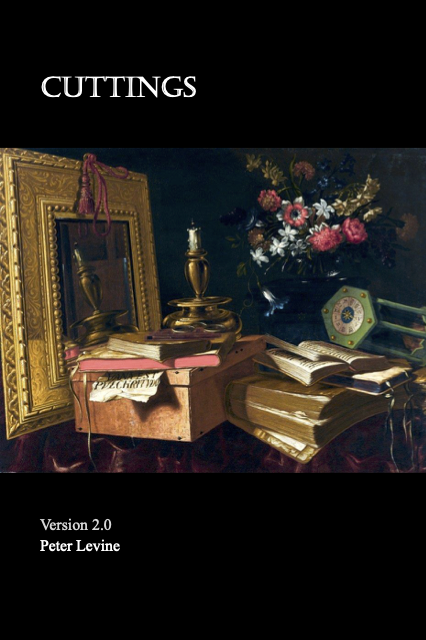
Cuttings 2.0 by Peter Levine, cover

Cuttings version 2.0: a book about happiness

Please see version 3.0 instead.

I began blogging on this site on Jan 8, 2003: 21 years ago. I’ve posted more than 4,000 times so far.

To celebrate last year’s 20th anniversary, I selected about 70 posts on a general theme: whether and how to pursue happiness. I edited and organized those posts so that the juxtapositions intrigued and pleased me.

Some entries are short philosophical essays, usually responding to a quotation from a classic work. Some respond instead to literary texts, especially poems. Some are translations; a few offer original verse. The entries are meant to relate to each other, but the transitions are loose and suggestive.

I used the Four Noble Truths of Buddhism as a scaffold for the whole work, even as some of the entries explicitly challenge some of those theses. The text is meant to represent gradually increasing wisdom and equanimity. Unfortunately, that arc does not describe the real me. I didn’t write the entries in the order they appear. Ethical or spiritual growth is a literary conceit, not an autobiographical report.

I did not seek to publish Cuttings 1.0, because I saw it as a work in progress. As planned, I am now celebrating 21 years of blogging by issuing version 2.0. I have added and subtracted substantial amounts of material and reorganized and edited the whole text to produce this new version. I plan to do the same again in the future.

You could download a PDF version of Cuttings 2.0, click to view a Google doc version, or download an .epub version, which requires an e-reader like iBook or Kindle and provides the best experience. If you want an .epub version emailed to a regular email address or directly to a Kindle, please enter that address here.

The new cover art, which is in the public domain, is a still life by the Master of the Vanitas Texts, ca. 1650. I chose it because it illustrates “cuttings” from both plants and texts. Although those snipped things are now dead, we might coax them to regenerate.

As always, comments–including critical ones–are appreciated and are really the best reward.

(By the way, this anniversary might be an appropriate moment to advertise that you can subscribe to this blog as a weekly email, just like a Substack, or follow it on Mastodon, Threads, BlueSky, or Twitter.)