Monthly Archives: January 2024

a different way in which the 2024 election is a failure for democracy

Here’s a modest and basic account of democracy: While they seek office, candidates make proposals. Voters select the politicians with the proposals they prefer. The winners try to implement their ideas. Voters observe, discuss, and evaluate what happens. In the next election, voters decide whether to stay or change the course.

In 2020, Joe Biden and congressional Democrats ran on a fairly clear platform of spending money to stimulate green manufacturing in disadvantaged places. They then managed to pass the $1.9 trillion American Rescue Plan, the $739 billion Inflation Reduction Act, and the $280+ billion CHIPS Act. The total was less than some of them had proposed, but it was more than I had expected, considering that congressional Republicans were also elected who opposed these ideas.

The net effect is not only a significant change in policy but also a turn of the steering wheel. We’re now at the beginning of a long journey toward a green industrial policy.

In 2024, the voters will–as they should–determine whether to stay on this route or hit the breaks. But they will not make a conscious decision. The federal budget will not be a decisive issue, or perhaps even a prominent one. Whether the country shifts to an industrial policy will be an unrecognized side-effect of votes cast for other reasons.

Biden does not seem likely to emphasize the federal spending because it doesn’t poll well. Perhaps that’s partly because voters (including liberal ones) do not believe what Democratic incumbents claim about their own policy successes. Instead, Biden will run on Trump’s unfitness, Jan. 6, and abortion, and he may well win on that basis.

Trump will not run against the federal spending because he has other grievances on his mind. Besides, he does not really oppose ambitious and expensive federal interventions. The rest of his party will take pot shots at the deficit but not challenge the spending because doing so would concede that the Democrats have made substantial changes. They prefer depicting Biden as feckless rather than wrong.

And the press won’t cover the spending because its results are not yet very tangible, and it no longer qualifies as a live political conflict. As a rough proxy for press attention, consider the trend in Google searches for “Inflation Reduction Act” since 2020. The current rate is one fiftieth of the brief peak that occurred while the Act was political news.
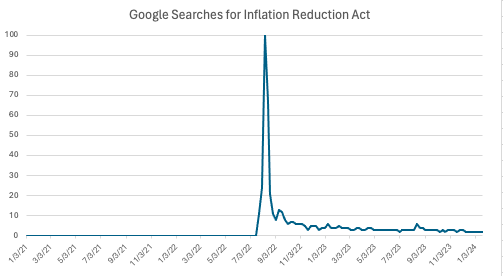
I favor the Biden-era policies. I understand principled arguments against them from several directions. We should be debating green industrial policy and deciding whether or not to continue this course.

One reason we will miss this debate is that Donald Trump has given us other grave matters to discuss. Indeed, it would be problematic if voters failed to consider the threat he poses to the constitution. But I don’t think Trump is the only reason. The failure of a major ideological change to register on the public consciousness is symptomatic of a breakdown in news, attention, and public discussion that prevents the people from controlling our government.

See also: preparing for a possible Trump victory; a presidential election with two incumbents?; 1984 all over again? The Reagan/Biden analogy; whether to make the election a referendum on MAGA

Frontiers of Democracy 2024: Violence, Nonviolence, and Robust Democracy

Dates: June 13 (5pm) until June 15 (1 pm) at Tufts University in Medford, MA

Frontiers of Democracy an annual conference at Tufts University’s Tisch College of Civic Life that convenes practitioners and scholars from across the United States and overseas. 

Please hold the dates (June 13-15), register and purchase tickets at the “early bird” discount rate until March 29, and consider proposing one or more sessions for the conference by April 16.

This year’s special theme is “Violence, Nonviolence, and Robust Democracy.” We anticipate robust conversations (and disagreements) about what defines and causes political violence and about the potential and limitations of nonviolent strategies. This year’s plenary speakers on the nonviolence theme will include Damien ConnersMaria StephanThupten Tendhar, and others to be named later.

This theme is not exclusive; we welcome sessions on other topics related to Tisch College’s “North Star”: building robust, inclusive democracy for an increasingly multiracial society. In particular, we are eager to continue last year’s rich conversations about religious pluralism and democracy and would welcome proposals in that area, whether or not they relate to violence and nonviolence. 

Although we will consider proposals for presentations or panels of presentations, we generally prefer proposals for other formats, such as moderated discussions, meetings devoted to strategy or design, trainings and workshops, case study discussions, debates, and other creative formats. 

The conference agenda will develop over the next several months.

Cost: $240 for a standard ticket with discounts for current students. This includes hors d’oeuvres on June 13, breakfast and lunch on July 14, and breakfast and lunch on June 15. Other meals and lodgings are not provided.

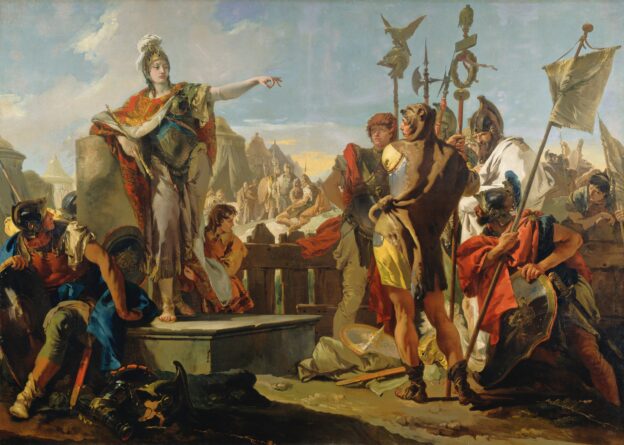
Tiepolo, Queen Zenobia Addressing her Soldiers, National Gallery Washington

Zenobia of Palmyra

Supposedly, many American men think more than once a day about the Roman empire. This seems implausible, but I must admit that Rome often comes to my mind. For instance, I recently read Zenobia; Shooting Star of Palmyra by Nathanael Andrade (Oxford University Press, 2018).

A powerful female monarch from Syria, Zenobia has been a figure of fascination for 18 centuries. She’s been a symbol for misogynists and feminists, for European imperialists, Arab nationalists, and cosmopolitan modernists. She appears in Christian histories, the Talmud, early Islamic sources, and bel canto operas.

Andrade selects and sorts the ancient written sources (all of which are biased in various ways) and relevant inscriptions, coins, and statuary. He is especially helpful at explaining the context of Palmyra, a thriving merchant city with a distinctive hybrid culture. The protagonist of his book was Septimia Zenobia (a Hellenistic monarch), Iulia Aurelia (a Roman woman of the senatorial class), and Bathzabbai (a Palmyrene clan leader), and she probably inhabited all three roles fully.

We know almost nothing about her inner life, but her story is dramatic. The 240s and 250s saw the Roman empire often at war with the nascent power of Sassanian Persia to its east. In 260, the Romans suffered a catastrophe when their emperor, Valerian, was defeated on the battlefield and taken prisoner. At the same time, the empire was beset by Germanic invasions and a rebellion in Gaul. The whole eastern Mediterranean was at risk, but it was saved by a Palmyrene leader named Odeanthus (a.k.a. Odainat), who bore Roman titles, including commander, governor, and consul. With the Empire in disarray, Odeanthus essentially ruled an important region from his capital in Palmyra, calling himself King of Kings, albeit without openly challenging Roman sovereignty.

After four years of rule, Odeanthus was murdered by assailants who remain unknown to this day. The initial propaganda from Rome implied that Odeanthus was killed because he’d become treasonous. It’s likely that a pro-Roman faction in Palmyra expected to replace him. Instead, his widow, Zenobia, quickly gained political control and reigned as a regent in the name of her minor son Wahballath, a.k.a. Septimius Vaballathus, a.k.a. Athenodorus. Now some of the Roman propaganda suggested that an evil and unnatural woman had killed her husband to gain his throne.

Zenobia seems to have led a tolerant and culturally vibrant polity that may have seen itself as Palmyrene and/or Syrian, although she presented herself and her son as Roman officials and claimed to be related to the Greek-speaking Egyptian queen Cleopatra. She ruled various kinds of pagans, Christians (both orthodox and gnostic), early rabbinic Jews, Manichaeans, Zoroastrians, and others. The Greek philosopher Longinus was a courtier and reputedly Zenobia’s personal mentor, although he was not actually the author of On the Sublime, which was attributed to him in later centuries.

Zenobia’s territory dramatically expanded when her forces captured Egypt, the breadbasket of the Roman empire and the terminus of sea routes in Asia. It’s not clear why she launched this invasion, but it could have been on behalf of Palmyrene merchants who competed with Egyptians. Zenobia was now calling herself Augusta (a title for an empress) and using the title Augustus for Wahballath. She was empress of the richest third of the Roman imperium. One can imagine a stable new entity forming in the Levant. However, In 272, the Emperor Aurelian invaded and defeated the Palymrenes, taking mother and son to Rome as prisoners. The unified Roman empire still had another century and a half to go.

Andrade deals sensitively with the horrifying events at the site of ancient Palmyra in 2015-2016. The site had been controlled by European imperialists and then by Syrian secular nationalists, each of whom had exploited Zenobia’ memory for their own purposes. ISIS destroyed the ruins and their living guardians as an attack on both Assad and the West.

Out of the countless depictions of Zenobia since her time, I’ll mention a set of paintings by Giambattista Tiepolo. These works hang in different museums and had miscellaneous titles. In 1974, Fern Rusk Shapley first noted that they all depict scenes from the life of the Queen of Palmyra. Shapley conjectured that the Zenobios, a noble Venetian family who were unrelated to Zenobia but who happened to share her name, commissioned them for one room in their palazzo. Knox (1979) accepts that they are all by Tiepolo but thinks that the artist painted them over several decades for the Zenobios.

Of course, these paintings are not realistic or consistent with modern scholarship–or even very serious–but I appreciate that Tiepolo could imagine Zenobia as a heroic soldier and as a stoic victim. The National Gallery’s Queen Zenobia Addressing Her Soldiers (1725/1730) shows her in a martial pose–see above–while the Prado’s Queen Zenobia before the Emperor Aurelian (1717) depicts her as gracious in defeat. Both look like scenes from an opera.

References: Shapley, “Tiepolo’s Zenobia Cycle,” in Robert Enggass, Hortus imaginum: essays in Western art (Lawrence: University of Kansas, 1974): George Knox, “Giambattista Tiepolo: Queen Zenobia and Ca’Zenobio: ‘una delle prime sue fatture’,” The Burlington Magazine 121.916 (1979): 409-418. See also: Velazquez, The Spinners; Goya’s Familia del infante Don Luis; and three great paintings in dialogue

apply for the 2024 Institute for Civically Engaged Research (ICER) in political science

APSA’s Institute for Civically Engaged Research (ICER) is a four-day, residential institute that provides political scientists with training to conduct ethical and rigorous civically engaged research. Up to 20 scholars will be selected as ICER Fellows and invited to attend the 2024 Summer Institute. ICER Fellows will network with other like-minded political scientists, and together, learn best practices for conducting academically robust, mutually beneficial scholarship in collaboration with communities, organizations, and agencies outside of academia.

ICER is organized in partnership with Tufts University’s Jonathan M. Tisch College of Civic Life. The 2024 Institute will be held in person at Tufts University, outside of Boston, MA, June 17-20

To apply, please complete this form. Application deadline: April 1, 2024.

What is Civically Engaged Research?

Scholars in many disciplines are grappling with how to produce rigorous scholarship that addresses significant social challenges in collaboration with communities, organizations, and agencies. They strive to learn from those working outside of academia, to benefit from the insights of all kinds of groups and institutions, and to give back to communities rather than extract value from them. Civically engaged political science research is an approach to inquiry that involves political scientists collaborating in a mutually beneficial way with people and groups beyond the academy to co-produce, share, and apply knowledge related to power or politics that contributes to self- governance. Conducting robust community and civically engaged research entails a different set of practices than other kinds of political science research,

APSA’s Institute for Civically Engaged Research

ICER trains political scientists at all career stages in best practices for conducting academically rigorous, mutually beneficial, civically engaged research. The Institute Directors are Peter Levine (Tufts University), Samantha Majic (John Jay College & The CUNY Graduate Center), and Adriano Udani (University of Missouri, St. Louis). Together with practitioner experts and scholarly guest speakers, ICER Directors and fellows will explore key topics related to civically engaged research by discussing relevant readings, by analyzing specific examples of civically engaged research from political science and cognate disciplines, and by considering the research plans and ideas of institute participants.

the Tufts prison program and Civic Studies

Rachelle Cohen writes in the Boston Globe:

As a child, Juan Pagan was physically abused by his father. By the time he was 16, his mother, who had battled mental illness all her life, was in prison, and Pagan was expelled from school and had run away from home. His only family became the Lowell gang he was a part of. In May 2006 he stabbed a member of a rival gang, Alexander Castro Santos, and was convicted the following year of first-degree murder — a charge reduced to second-degree in 2008, giving him the possibility of parole down the road.

Now 33, he’ll be awarded his bachelor’s degree from Tufts University Tuesday. He’ll collect it at a ceremony at MCI-Concord along with nine other incarcerated students in the first-ever graduating class of the Tufts University Prison Initiative of the Tisch College of Civic Life.

I’m proud of my colleagues who make this program work, and, above all, proud of the graduates.

These students are earning degrees in Civic Studies, the major that we have developed at Tufts as part of an informal, international network devoted to this emerging field. The Tufts Civic Studies students who are incarcerated often say that the major is ideal because it helps them to understand and change systems. They are part of an international community that consists of hundreds of people who have participated in Summer Institutes of Civic Studies at Tufts, in Europe, and at James Madison University since 2009, plus those who study this subject on Tufts’ main campus.

See also: teaching about institutions, in a prison; article about the Civic Studies major