Category Archives: elections

Clinton’s support in historical context

Hillary Clinton is winning the popular vote, and I am seeing commentary to the effect that she has one of the largest vote counts ever received, at nearly 64 million. It’s true that only Obama beat that number (twice, with 69 million and then 66 million votes in his two presidential races). However, the population of the US keeps growing, so one would expect the number of votes cast to rise.

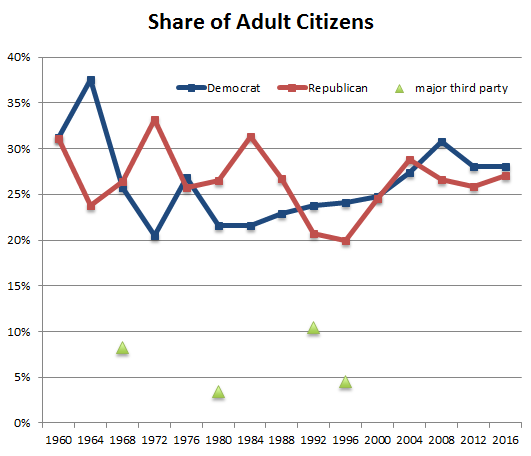
The best measure of popular support is the percentage of all adults who turn out for a given candidate. Clinton got about 28%; 27.1% voted for Trump. The 0.9% gap was one of the smallest in modern times, although 1960, 1968, and 2000 were actually closer races in these terms. Clinton’s share of all eligible voters was the same as Obama’s in 2012 (28%).

There have been thirty major party presidential nominees since 1960, and Clinton ranks seventh among all of them in votes/adult population. A few candidates drew much bigger shares back when turnout was higher and partisan swings were wider. LBJ drew the votes of 37.5% of all adults in 1964, about one third more than Clinton did–but politics has changed since then.
voteshare2

(Major third party candidates are shown for 1968, 1980, 1992, and 1996.)

CIRCLE’s full post-election analysis of the youth vote

(By the CIRCLE staff, cross-posted from civicyouth.org.) Since Election Day, CIRCLE’s analysis has focused on whom young people voted for, how many voted, and which segments of the youth population cast their ballots—placing each in historical context by examining trends from recent elections. Today’s analysis looks more deeply at the youth vote in the 2016 presidential race, offering a breakdown of young people’s support for each major candidate and for the political parties they represent. We also consider the long-term implications, for both Democrats and Republicans, of a youth electorate that is increasingly loathe to identify strongly with either major party.

READ OUR FULL ANALYSIS HERE

Major findings include:

The Youth Electorate

  • CIRCLE analysis suggests that young people voted at a similar rate than in 2012 – around 50%. In 11 battleground states, on aggregate, 55% of youth turned out to vote.
  • The racial and ethnic composition of the 2016 youth electorate closely mirrored the general population of young citizens, and remained as diverse as it has been since 2008, though this year there was a surge of young, White, male voters.
  • Young people without college experience, already historically underrepresented, made up a smaller share of the young people who cast ballots than in recent elections.
  • Less than 4 in 10 young voters identified with the Democratic Party and less than 3 in 10 identified with the Republican Party, suggesting that America’s two major parties are having trouble attracting a substantial youth base.

partyidandideology

The Youth Vote for Trump and Clinton

  • President-elect Trump lost the youth vote overall by 55% to 37%, but he garnered support from some segments of the youth electorate: Whites, evangelicals, and young people in rural areas.
  • While Secretary Clinton won by large margins among demographic groups like unmarried young women and youth of color, she lacked key support from young Whites, young men, and young White moderates.
  • President-elect Trump drew significant support from young people whose ideas and concerns tracked closely with the key themes of his campaign: the state of the country,stronger immigration controls, and a the perceived untrustworthiness of his opponent.

racegendered-graph

Implications for the Future

  • Young people are clamoring for significant change, though there are deep divisions on what that change should look like. Youth also seem increasingly skeptical of the two major political parties’ ability to bring the change they seek.
  • Moderates, Independents, and other young people who eschew the ideological extremes and strong party identification, appear to be a rising force in the youth electorate. They may also be harder to mobilize if they don’t engage with the traditional party—and partisan—organizations that for many youth provide structures and opportunities for political and broader civic engagement.
  • There’s another national election in two years! Only one in five young young people voted in the 2014 midterms, and after an election in which many youth were disappointed with both nominees (and most youth voted for the losing candidate) it may be even harder to keep youth politically motivated. Stronger civic education and strategic, intentional youth outreach remains key.

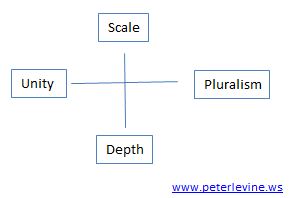
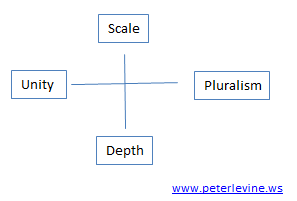
we need SPUD (scale, pluralism, unity, depth)

Whether you’re building a social movement, organization, network, or media platform, you should strive for SPUD:

Scale: You need a lot of people. For instance, if your social movement is anti-Trump, it must include 55% of all voting Americans in 2018 to have a chance of capturing the House. (Note that this is entirely possible. Joshua Spivak cites 1894 and 1994 as “among the two most important midterm elections in American history.” Both “came two years after one party won a seemingly sweeping mandate for power. Both saw historic reversals. And, perhaps more importantly, both completely reshaped the political landscape for decades to come.” Trump’s 2016 victory could be monumentally Pyrrhic–but only if the opposition attains sufficient scale to reverse it).

Pluralism: Your organization, movement, or platform must incorporate a plurality of perspectives. The criterion is not whether it represents the opinions of the American people as a whole. We are entitled to build groups that tilt one way or another; that’s what politics is about. But ideologically homogeneous groups make stupid choices. They also limit their own scale because they forget how many people disagree with their premises. Ideological homogeneity and narrowness are dangers on the left as well as on the right.

Unity: Groups are more effective when they can present a united front. We march together, sing the same anthem, or use the same hashtag to display unity. Standing together compels respect. Groups also need actual unity so that they can develop agendas and coordinate their resources and actions to accomplish their goals. Compromise is an inevitable aspect of politics, but groups that lack unity can’t negotiate effectively when it comes time to compromise.

Depth: Valuable political organizations change their participants. Truly engaged members learn skills and information, gain agency and purpose, develop allies, and (in the best cases) make their own goals more responsible and ethical by participating in groups. Both political outcomes and the quality of our civic life depend on who develops in these ways.

The SPUD values conflict. Groups with larger scale struggle to provide depth: transformative experiences for their members. But groups that really change lives struggle to reach large scale. Even more obviously, pluralism conflicts with unity. Supporters of Hillary Clinton, Bernie Sanders, Black Lives Matter, and #NeverTrump disagree about fundamental matters right now, and that is causing a lot of angst. A cheap consensus would reduce pluralism, but deep and continuous disagreements will block unity.

spud

Despite these tradeoffs and tensions, groups and movements achieve more or less SPUD. There is such a thing as populist pluralism the treats the people as highly diverse and yet united in the common interest. This is an essential antidote to Trumpian populism, which depicts the people as homogeneous and represented by a single leader. It takes work to grow large and go deep, to encourage pluralism and build unity. It would sound utopian except that it’s exactly what our best organizations and movements accomplish. And it suggests a diagnostic checklist for any group, institution, or network you’re part of. How are you doing on each dimension of SPUD?

For these distinctions, see also: Peter Levine, “Democracy in the Digital Age,” The Civic Media Reader, edited by Eric Gordon and Paul Mihailidis (Cambridge, MA: MIT Press, 2016), pp. 29-47; and Peter Levine and Eric Liu, “America’s Civic Renewal Movement: The View from Organizational Leaders” (Medford, MA: Jonathan M. Tisch College of Citizenship & Public Service, 2015).

to beat Trump, invest in organizing

To respond to Trump’s election, we must address who is organized, and how.

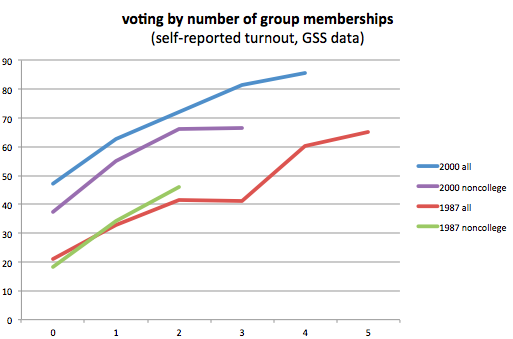
Members of organizations are more likely to vote and to take the more costly actions that will be vital during the Trump years, such as protest and resistance. As a quick-and-dirty illustration, consider the correlation between the number of groups that people belong to and the proportion who say they vote.*
screen-shot-2016-11-13-at-10-00-25-am

This graph combines all kinds of groups. When people belong to organizations that offer them voice and accountability, that address social or political issues, and that encompass at least some diversity, they are not only more likely to vote; they are also more likely to act and choose responsibly. Members of such groups learn to negotiate, to set appropriate expectations for their leaders, and to feel ownership for results.

Before the election, I proposed that Trump mainly appealed to people who lacked accountable organizations, and that’s one reason that they opted for a totally irresponsible (as well as a cruel) celebrity candidate. They behaved as alienated spectators rather than as political agents. I also expected turnout to be relatively weak among people leaning toward Trump.

Theda Skocpol finds that the rural and exurban areas where Trump performed best did have “organized networks – NRA, Christian Right, some RNC and Koch network/AFP presence – that amplified the right media attacks on HRC nonstop and persuaded many non-college women and some college women in those areas to go for Trump because of the Supreme Court.” Skocpol acknowledges that Trump himself “had no organization,” but, she says, he “made deals to get the NRA, Christian right and GOP federated operations on his side. They have real, extensive reach into nonmetro areas.” I’ve also estimated, based on Exit Poll data, that 56% of Trump voters attend church at least monthly. His turnout wasn’t great, but it was sufficient to win the Electoral College.

I was wrong in part. Trump did well because of the traditional mechanism: outreach by groups. However, I would still propose that the groups that reached Trump voters were unaccountable to them. The Koch Network, for instance, is centralized, fueled by two brothers’ money, and undemocratic and opaque in its internal organization. The relationship between such an organization and its target population is transactional and instrumental: it spends money to persuade them to vote. That is consistent with my view that Trump’s voters aren’t authentically organized. Being mobilized is not the same thing.

Meanwhile, Skocpol is definitely right about the other side:

HRC had the typical well-funded presidential-moment machine, an excellent one. We on the center left seem to treat these presidential machines as organization[s], and they are, but they are not as effective as longstanding natural organized networks. … [Off] the coasts, Democrats no longer have such reach beyond what a presidential campaign does on its own. Public sector and private sector unions have been decimated. And most of the rest of the Democratic-aligned infrastructure is metro based and focused. That infrastructure is also fragmented into hundreds of little issue and identity organizations run by professionals. HRC’s narrow loss was grounded in this absent non-metro infrastructure – and Dem Party losses in elections overall even more so.

In areas where progressive voters predominate, we need a much more authentic, democratic, and integrated base of organizations. Instead of parachuting presidential machines into diverse urban areas every four years in search of votes, the left must invest in younger and more diverse local leaders who have real authority and voice and who can work continuously. American democracy has always functioned best when organizations offer a range of goods, of which political power is just one. For instance, churches offer spirituality; unions raise salaries. Their members ultimately vote, but that’s not the main service these organizations advertise. Right now, resources should flow to multipurpose organizations and movements that will turn out voters in 2018 and 2012, but that will do much before then–starting with protecting safety and civil rights against both hateful individuals and government agencies.

The decline in votes in Wayne County (Detroit) between 2012 and 2016 (37,364) will almost certainly be larger than the final margin of victory for Michigan. Milwaukee saw a 41,000-vote decline that was bigger than the state’s margin. I suspect that scarce investment in organizing was as important in Wisconsin as voter-suppression. These statistics should ring loud alarms, if they haven’t already. How many young African American and Arab American organizers can count on paid activist jobs in Detroit in 2017 and 2018?

Meanwhile, we also need organizations in red states and red counties, in rural areas and exurbs. The point of organizing there is not to show empathy to Trump voters or to honor their concerns. The point is to win. Particularly in 2018, anti-Trump votes will be very poorly distributed–far too concentrated in the great cities to win the House and Senate back. Every extra vote in a white non-urban county will matter, and that requires organizations to change minds, to empower the disenfranchised, and to offer real benefits. By the way, although I think the Democratic Party is a necessary component of the opposition, it is not sufficient. Electing or reelecting responsible and caring Republicans in red districts is also essential.

In our October poll of Millennials, we found that just 30% of Clinton supporters had been contacted by a campaign or organization that had urged them to vote; 28% of young Trump supporters had been contacted; and 70% had not been contacted at all.  Young people who had received multiple contacts were 19 points more likely to say they’d vote than those who’d received none. That poll was a warning that young Americans across the spectrum were not being reached by organizations. Young Trump voters were almost as likely to receive outreach as Clinton voters were: another indictment of the left’s investments. The time to change this is now.

*I’m showing General Social Survey data from 1987 about whether people “always vote” and from 2000 about whether they voted in the last presidential election. Unfortunately, I can’t find more recent comparable data, but I hope the graph illustrates an important pattern. Note that the correlation applies to people who have no college experience (the working class) as well as the population as a whole.
how to respond?

I offer this flowchart in case it can help anyone to think about how to respond to the devastating results of the election. I am sure it is incomplete. Also, it doesn’t present stark alternatives: options can be combined. In fact, I suspect we need people working on each and every one of these boxes, and an individual can address more than one. However, we cannot all do everything all the time, and I’m using this flowchart to think about how to allocate my own time and attention. (Click to expand.)


For a revised version (March 22, 2017) please see how to respond, revisited.