Category Archives: elections

what it means that people prefer a businessman to a politician for president

The contrast between Donald Trump the businessman and Hillary Clinton the politician has been underplayed (although not entirely overlooked) as an explanation of the 2016 election. I don’t interpret Americans’ admiration for business leaders as a preference for the market over the government, although that distinction might influence some people. Instead, evidence shows that many people dislike deliberation and compromise in politics. That stance is compatible with admiring a president who expands the government, as long as he acts like a private-sector boss.

In 1998 (when HRC was First Lady), John R. Hibbing and Elizabeth Theiss-Morse* found that most Americans didn’t rate their fellow citizens as informed or intelligent. They didn’t want to participate in government or politics, nor did they prefer a political system with much public involvement. They had few policy preferences, but they strongly disliked the people in charge of the government. They suspected political elites of selfish and greedy behavior. For instance, they thought that elected officials get rich from government service. They believed that the public had consensus on most issues, yet agreement was mysteriously absent in Congress. They interpreted elites’ disagreement as a sign of corruption. A majority of their respondents (about 70%) agreed with two or three of the following propositions, which qualified them as believers in what Hibbing and Theiss-Morse called “Stealth Democracy”:

  • “elected officials would help the country more if they would stop talking and just take action on important problems” (86% agree)
  • “what people call compromise in politics is really just selling out on one’s principles” (60%); and
  • “our government would run better if decisions were left up to nonelected, independent experts rather than politicians or the people” (31%) or “our government would run better if decisions were left up to successful business people” (32%)

Fifty percent wanted the government to be run more like a business. There was also considerable support for billionaires and technocratic experts, since neither could profit from their own decisions. In 1992 Harris Poll, 55% of respondents had agreed that Ross Perot wouldn’t be influenced by special interests because he was rich.

In their book, Hibbing and Theiss-Morse used a survey that’s now 19 years old. In 2009, Michael Neblo, Kevin Esterling, Ryan Kennedy, David Lazer, and Anand Sokhey challenged their findings empirically, but in 2015, Hibbing and Theiss-Morse repeated the analysis and connected it to the Trump campaign. Believers in what they called “Stealth Democracy” preferred Trump to Clinton by 38%-13%; people who disagreed with that view narrowly favored Clinton.

Trump is a perfect example of a leader who says he’ll “just take action,” in harmony with the consensus of all real Americans. Hillary Clinton exemplifies a politician who is good at compromise, who acknowledges disagreements and engages in debates–and who has become rich as a result of her political career.

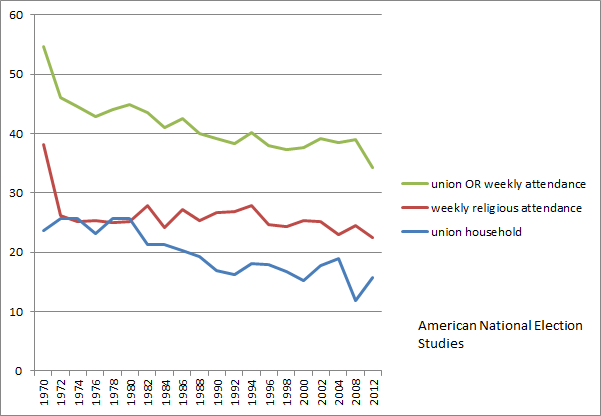
I believe that people learn from experience that disagreement exists and compromise is necessary. They learn those truths by participating in diverse groups that can make consequential decisions. But the proportion of adult Americans who either attend weekly religious services or belong to a union has dropped by 21 points, from a majority of 55 percent in 1970 to a minority of 34 percent in 2012. The proportion of all Americans who serve on any local board had plummeted by 75% since the mid-1900s, due mostly to consolidation of governmental functions plus professionalization. Juries are also much less prevalent: 1 in 40 felony cases now goes to a jury trial, down from 1 in 12 as recently as the 1970s.

People still know how bosses operate in the private sector. But few know what it’s like to be democratic leaders, because few are allowed to play such roles locally. That’s a recipe for a rejection of democratic values.

*Stealth Democracy: Americans’ Beliefs about How Government Should Work (Cambridge University Press, 2002). I draw here from my own 2003 summary.

the hollowing out of US democracy

How could a celebrity with no governing experience and no grassroots infrastructure alienate and offend an outright majority of Americans, adopt positions far from the mainstream, and yet become our president?* I argue that the underlying reason is a hollowed-out democracy in which many citizens no longer expect to be represented by accountable organizations and are no longer invited to share in governing. A celebrity who offers symbolic politics has the number of followers and the level of attention that professional politicians strive to buy with their cash. In an environment of isolated citizens, he wins.

We still have plenty of voluntary associations and networks concerned with politics. But politics is a minority taste, so these groups draw a small proportion of the population. And because most of them attract members by offering a political message or agenda, they produce ideologically homogeneous groups.

We also still have very large numbers of professional advocacy organizations, but many of them are accountable to donors rather than members, and their capacity and vision come from their highly-skilled professional staff, not from citizens.

We also have some large movements that look accountable but aren’t. The Koch Brothers network, for example, employs 1,200 full-time, year-round staffers in 107 offices nationwide, more than the Republican Party. The Koch Brothers own it.

What we lack now are the kinds of organizations that I believe have been core to US civil society since the era of de Tocqueville. They offer benefits other than politics to attract members. They draw a range of people–not representative samples of the US population, but diverse groups. They give their members reasons to think politically and aggregate their political power. They create pathways to political leadership for those who become most interested. And they depend on their members’ support for survival.

In short, they offer what I’d call SPUD–Scale, Pluralism, Unity, Depth–which is the magic recipe for civic engagement.

Four traditional types of organizations that offered SPUD were unions, political parties dependent on local voluntary labor, religious congregations, and metropolitan daily newspapers. All four were imperfect, but each was much better than nothing. And they are all in bad shape today.

I’ve previously shown that newspapers have lost readership precipitously and parties have become loose networks of entrepreneurial politicians and donors instead of actual organizations. Unions and religious congregations have also shrunk. To illustrate those two trends, here is a new graph that shows the rates of union membership and weekly religious attendance. The top line is the proportion of adult Americans who either attend weekly services or belong to a union, or both. That proportion has dropped by twenty points, from a majority of 54.6 percent in 1970 to a minority of 34.3 percent in 2012. (By the way, I am skeptical that union membership really rose in 2012; I suspect that’s random noise.) I would look no further than this 20-point drop for the underlying conditions that yielded The Donald.

*The echo of Hamilton was inadvertent but seemed apt once I noticed it.

responding to the deep story of Trump voters

(Washington, DC) This is Arlie Russell Hochschild’s now-famous “deep story” of Louisiana Tea Party supporters, their “account of life as it feels to them.” It’s become famous because it’s also the “deep story” of at least some Trump voters:

You are patiently standing in the middle of a long line stretching toward the horizon, where the American Dream awaits. But as you wait, you see people cutting in line ahead of you. Many of these line-cutters are black—beneficiaries of affirmative action or welfare. Some are career-driven women pushing into jobs they never had before. Then you see immigrants, Mexicans, Somalis, the Syrian refugees yet to come. As you wait in this unmoving line, you’re being asked to feel sorry for them all. You have a good heart. But who is deciding who you should feel compassion for? Then you see President Barack Hussein Obama waving the line-cutters forward. He’s on their side. In fact, isn’t he a line-cutter too? How did this fatherless black guy pay for Harvard? As you wait your turn, Obama is using the money in your pocket to help the line-cutters. He and his liberal backers have removed the shame from taking. The government has become an instrument for redistributing your money to the undeserving. It’s not your government anymore; it’s theirs.

One response to anyone who holds this story is basically: Drop it. The people you believe have moved ahead of you on line are actually still behind, in the sense that they still face unfair disadvantages. For example, an applicant with an identical resume is much less likely to receive a job interview if his name sounds African American rather than White. (My own team is replicating this finding now, as part of a larger study to be released later.) To the extent that some people are moving forward on line, it’s because the most blatant inequalities are being to some extent remedied.

This is true, but I don’t believe it will work politically. I can’t think of any group in history that, upon being informed of its unfair advantages, has responded by yielding them willingly.* The standard response to being told you are privileged is to realize that you have something to defend. And I think that’s an especially likely response if you actually face hardships and disadvantages–which is true of White working-class rural Louisianans.

Waiting in line is a perfect example of a zero-sum situation. Literally, to move one space forward in a queue is to move everyone else one space back. As long as people see themselves in zero-sum relations with others, politics will be ugly. Of course, people don’t have to see the competition in racial terms. If, for instance, White rural Louisianans saw themselves as part of the same group as African-American rural Louisianans, they wouldn’t count successful Black people as winning against them. As Jamelle Bouie wrote yesterday, “many white Americans hold (and have held) a zero-sum view of politics, where gains and benefits for nonwhites are necessarily an imposition on their status.” He adds that how to “fix this white voter problem … is a separate and difficult question.” Telling the people whom Hochschild interviewed that they are racists does not seem to me a likely solution (nor does Bouie suggest it).

A different approach is to attack the zero-sum framing of the situation. People should be asking why anyone must wait so long for the American Dream. White Americans have voted for progressive policies when they have come to think that maybe everyone could achieve a good, secure, prosperous life. The underlying rules could be changed so that everyone wins.

The immediate barrier to that kind of solution is distrust in government. If you don’t believe that government can be trusted to improve the social contract, then the existing contract may seem inevitable. Then your struggle with other people is zero-sum.

And people no longer trust the government much …
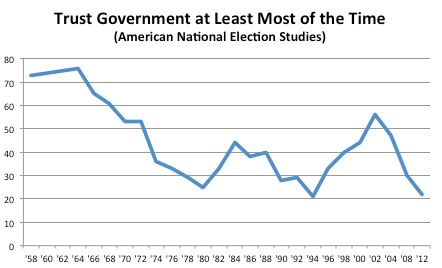
Perhaps the most common way to change this trend is to try to “sell” people on the government again– to persuade them that it offers solutions by outlining the policies that it can achieve and by using more effective rhetoric to defend it as an institution.

I dissent in part. People should not trust governments. As Jean Cohen writes, “One can only trust people, because only people can fulfill obligations.” Trust in the US government, as displayed by the American public ca. 1958, was naive. It often involved viewing presidents and other national leaders as friendly personalities, which reflected poor judgment. When it comes to governments and other large institutions, we ought to use one of these substitutes for trust:

  1. A sober assessment that the incentives are aligned to make the people who run the government also look out for our interests. I don’t think rural White Louisianans have much reason to make that assessment, even though, in my view, they would have been much better off with Clinton than with Trump.
  2. Personal connections to people who work in or closely with government. Because politics and government service are now the preserves of white-collar professionals, working-class people have few such connections. Consider, for example, the almost total absence of actual, current working-class people at both the Democratic and Republican National Conventions.
  3. Intermediary organizations that tangibly answer to us and (in turn) influence governments. Unions [and grassroots-based political parties] were prime examples, but they are shattered.

I’d support anything that makes White Americans less likely to see zero-sum situations in racial terms. But I believe it’s most promising to reduce the zero-sum situation more generally. Improving the social contract requires large institutions. Governments are strong candidates, although unions, co-ops, and other nongovernmental structures can be effective as well. Any large institution must, in turn, have direct, human connections to the people whose support it seeks. That means that even if the government is our main tool for social change, we need more than the state by itself; it must come with a panoply of social movements and organizations that link people to it. The hollowing out of these movements and organizations is thus at the root of our problems.

See also why the white working class must organizeto beat Trump, invest in organizingbuilding grassroots power in and beyond the election.

*Partial exception: the French nobility voted on August 4, 1789 to abolish the privileges of feudalism, spending all night eliminating one major privilege at a time by majority vote. It was a heady spectacle, but many of them lost their actual heads in 1793-4. Besides, they were voting for a new regime that promised all kinds of glories, not just moving themselves down the social hierarchy.
the Democrats and religious Americans

In The Atlantic just before the New Year, Michael Wear–an evangelical who helped Barack Obama with “faith outreach”–offered a critical assessment of the Democrats’ relationships with Evangelicals, 81% of whom supported Trump in 2016. Wear argued that it is a civic obligation to strive to engage all sectors of the society, and it’s a political necessity to engage religious Christians, given their large numbers. Wear wouldn’t expect Democrats to compromise on the substance of abortion, but he suggested that they could acknowledge the moral motivations of abortion’s opponents and look for common ground where it exists. He also decried a certain tone-deafness or ignorance about religious values and traditions, which sometimes verges implicitly on contempt. For instance:

[Wear] once drafted a faith-outreach fact sheet describing Obama’s views on poverty, titling it “Economic Fairness and the Least of These,” a reference to a famous teaching from Jesus in the Bible. Another staffer repeatedly deleted “the least of these,” commenting, “Is this a typo? It doesn’t make any sense to me. Who/what are ‘these’?”

Wear’s remarks are a bit anecdotal and could give a misleading overall impression. However, in The New Republic, Sarah Jones responded in a way that I thought vindicated Wear’s point. She argued that the Democrats should “frame abortion access as a moral good”; women suffer from any wavering on that topic. (Note that an outright majority of women have been against abortion in several recent years.) She added, “The country is becoming increasingly secular and increasingly liberal on issues like marriage equality. The Democratic party won’t win by catering to social conservatives, and it shouldn’t try.”

Leaving aside Wear’s point that national leaders should always try to engage any significant group, Jones is also wrong empirically. It’s true that the proportion of Americans who do not believe in God has risen–to 10% in 2016. Still, 89% say they believe in God, 64% believe in Hell, 54% believe that “religion can answer all or most of today’s problems,” 53% say that religion is very important in their own lives, and 55% claim to belong to a church or synagogue. The secularization trend is subtle and modest. I also fail to see a trend in the pro-choice direction:

Ed Kilgore offers a more interesting response to the Wear interview. He notes that whenever Democrats become concerned about losing “religious” voters, the conversation turns to White Evangelicals (see the Wear interview) or to “cultural conservatives” (as in Jones’ reply), with sometimes a passing reference to Jews. The discussion overlooks Catholics of all backgrounds, Protestants of color, Mainline Protestants (who number 36 million, mostly Whites), Muslims, Hindus, and other religious minorities.

Many of these constituencies see politics through religious lenses, at least in part. They are prone to be alienated by an aggressive secularist agenda, and they are likely to see issues like abortion as morally complicated, wherever they land. Often enough they vote for reasons other than religious ones. For instance, a majority of Mainline Protestants supported Trump, which I would attribute mainly to their race and class rather than their faith. Still, there are powerful faith-based reasons that they might oppose not only Trump but also Paul Ryan’s economics. Meanwhile, religious congregations remain sources of social capital and bottom-up political power that progressives ignore at their peril.

See also the political advantages of organized religion.

why the global turn to authoritarian ethnonationalism?

It seems impossible to explain why Donald Trump won the 2016 election. For one thing, he lost the popular vote. Besides, a single election is an “n” of one with numerous contingent circumstances, in this case including the FBI’s last-minute intervention, Hillary Clinton’s gender, and the behavior of cable news. We often think of a cause as something that would yield a different result if it were changed. In this case, changing any of a dozen or more factors might have put Clinton in the White House.

More valuable is to consider why authoritarian, illiberal nationalists either dominate or (like Trump) have narrowly missed winning majorities in many countries: at least in Austria, China, Hungary, India, Israel, the Philippines, Poland, Russia, South Africa, Turkey, and the United States–with England and France also looking at risk. Across the 34 OECD countries, true right-wing parties still capture only about 8 percent of total popular support, but that’s steadily up from five percent in the 1970s. This graph from Funke, Moritz & Schularick shows the recent shift in nine major European nations.

Vote Share for the Far Right Since 2004

At the global level, the “n” is much greater than one, and we can rule out certain explanations for the trends. For instance, in other counties, an authoritarian leader hasn’t replaced a person of color or defeated a female opponent.

I cannot estimate the relative impact of the following factors, but they seem plausible to me across the whole range of cases:

Oligarchy: Many of the authoritarian leaders are billionaires or closely associated with billionaires. Their supporters are personally wealthy individuals rather than multinational public companies, which are more comfortable with predictable centrists like Hillary Clinton. A billionaire can know political leaders personally, can trade wealth for influence, and can profit from disruptions in the larger economy. Several of the key billionaires are media personalities. I think some of them develop authoritarian expectations by being the barons of large private enterprises, within which their word is law. Billionaires have almost tripled their share of global GDP since 1996, and their inflation-adjusted total assets have risen by 7.5% annually over those two decades. They represent a global force that was absent in 1996.

A gap in the ideological landscape: For this purpose, let’s categorize ideologies along two dimensions. They are either pro-state or anti-state/pro-market. And they either favor a narrowly defined ethnocultural group or they support diversity and globalism. I’ll call the latter spectrum closed versus open.

Since the 1950s, the dominant parties and movements in the wealthy democracies were all fairly open, at least in principle; the debate was about how much the state should intervene. We often thought of the US ideological spectrum as one-dimensional, from pro-state to pro-market, with everyone giving lip-service to openness. Some conservatives claimed to be pro-market and nationalist, but it’s not clear that that was a coherent position. The whole structure ignored the possibility of a pro-state, explicitly closed position. Like entrepreneurs who have discovered a market niche, authoritarian nationalists have filled the corner previously occupied by fascism. To be sure, Trump may govern like a market libertarian if he turns things over to Paul Ryan and contents himself with symbolic nationalism, but that’s not what he promised to do.

You would think that nationalist authoritarians wouldn’t cooperate much across international borders, because they are xenophobic. But there was a short-lived Fascist International in the 1930s, and we definitely see some coordination today.

Al Qaeda/ISIS: Before explaining why I think these terrorist organizations share causal responsibility for the global turn to authoritarianism, I want to stipulate that we are morally responsible for how we have responded to them. We did not have to invade Iraq, pass the Patriot Act, or turn Guantanamo into a prison. Those stupid and harmful acts are our responsibility as American citizens. Still, it seems both naive and misleading to omit the intentional acts of Al Qaeda and ISIS from our causal theory. They sought to provoke antidemocratic reactions, and they succeeded. An admired friend of mine recently summarized her qualitative research with Muslim teenagers in suburban New Jersey over the past decade, explaining that they have moved from a comfortable feeling of being Americans to a sense of vulnerability and alienation. This is an injustice that is up to remedy. But it struck me as a mistake not even to mention Al Qaeda as a major cause of the change. Osama bin Laden got what he wanted when he sent those planes into the Trade Towers. Although the US leadership of 2001 (including H. Clinton) proved monumentally stupid, Al Qaeda found a vulnerability that would have been hard to defend.

The 2007-8 financial crisis: Funke, Moritz & Schularick show pretty compellingly that voters shift to the far right after financial crises. This has been a pattern across many nations for at least a century. The 2007-8 collapse was an especially terrible one. It hit the advanced economies particularly hard, thus giving their voters a sense that they were losing comparative advantage as well as absolute wealth. It was followed by fiscal austerity that punished ordinary people, while no elites were held accountable for the trillions of dollars of waste and disruption. My sense is that Barack Obama got a pass from a majority of Americans because he wasn’t responsible at the time of the crisis, and he has been seen as laboring to repair the damage. But Hillary Clinton was part of the governing elite that was on duty when the fateful decisions were made.

Cultural backlash: Pippa Norris proposes that cultural liberalization (marriage equality, improving sexual equality, growing racial diversity, etc.). have produced a backlash rooted in the White working class of OECD countries. She clearly favors the trend of cultural liberalization and abhors the backlash, but a different take is Nancy Fraser‘s: people are rightly rejecting a form of “progressive neoliberalism” that unites “new social movements (feminism, anti-racism, multiculturalism, and LGBTQ rights)” with the cultural agendas of “high-end ‘symbolic’ and service-based business sectors (Wall Street, Silicon Valley, and Hollywood).” That is the coalition that delivers diversity in schools and workplaces along with “the weakening of unions, the decline of real wages, the increasing precarity of work, and the rise of the two–earner family in place of the defunct family wage.”

A hollowing out of democracy: People have died or placed themselves in terrible danger in the name of democracy and liberal values, whether on Omaha Beach or the Edmund Pettus Bridge. But an inspiring vision of democracy means more than the right to choose among professional politicians every few years. Even a call for equality isn’t inspiring enough, because how much should each of us care whether our share of power is as great as everyone else’s? Democracy must mean working together to create a better world.

Instead, the US rightwing has abandoned the sometimes inspiring pro-democratic rhetoric of Ronald Reagan to claim that we are not a democracy at all, but a republic. Similar rhetorical shifts away from democracy are evident in other countries as well. Meanwhile, the technocratic center presents democracy as a system of regular elections along with transparent information. Even defenders of the EU admit that it demonstrates a severe “democracy deficit.” Democratically governed associations, such as unions and congregationalist churches, are in decline. And several strands of the left are reflexively critical of any pro-democratic project that emerges in the US or elsewhere in the wealthy global North. People seem increasingly sophisticated about democracy’s drawbacks (misinformation, majority tyranny, cultural bias, etc.) and decreasingly inspired by its promise. That leaves the field open for explicitly illiberal and antidemocratic movements.