Category Archives: philosophy

seeking a religious congregation for a research study

I am seeking a congregation (of any religion, denomination, tradition, size, and location) for a research study. My interest is in testing a new method that I have been developing with colleagues that could apply to any community. I would give the congregation’s leadership–or its full membership–easy-to-understand findings about shared values and areas of disagreement within their congregation that should have practical value for planning events and programs.

Please consider whether this project might interest a congregation to which you belong or one that you know. Inquiries are welcome. More details follow:

I would ask the clergy or other leader(s) of the congregation to encourage members to take anonymous online surveys. The minimum would be two: a short survey with open-ended responses followed by a multiple-choice survey a week or two later that is based on the first one. I would be interested in repeating the multiple-choice survey months later to understand change, although that’s optional. If it’s practical, I would also like to visit and observe informally to get a feel for the community.

I would publish a scholarly study that would refer to the congregation anonymously (e.g., “a Protestant church in the Northeastern USA”). I would also provide the congregation with concise findings in PowerPoint format and would be happy to discuss them. No money would change hands. The congregation would own the PowerPoint and would not be obliged to publish or share it in any way. No individuals would be obligated to take the surveys, and I would expect only some people to do so. No identifiable information about individuals would be shared either within or beyond the congregation.

I could provide more detail about the method, but in brief, we don’t simply ask people their opinions about values, beliefs, and norms. Instead, we ask them how their personal opinions relate to each other. For instance, do they value A because they value B? Do they think that A causes B? From those responses, we generate network diagrams of the beliefs of each respondent and of the community as a whole. In this study, the questions would focus on religion and the congregation as a community, not on politics (unless respondents happen to bring up political matters).

Typically, each person’s responses are unique—a nice illustration of the uniqueness of human beings and how much we lose when we assign people to categories. Yet we typically see clusters of agreement and disagreement that can otherwise be overlooked. Understanding these patterns should provide ideas for visitors, readings, events, discussion groups (etc.) that would be valuable for the specific congregation.

what if people’s political opinions are very heterogeneous?

Here is what I will call a “top-down” theory of public opinion: Everyone should assess the most important issues of the day. An example might be the federal budget. Individuals are entitled to their personal beliefs or preferences about taxation, spending, and deficits; nevertheless, these three topics have an objective logical structure. If you want lower taxes and no deficits, you must favor spending cuts. If you want more spending, you must support either tax increases or bigger deficits. It is a civic obligation to think through your own complete view of these issues.

Analyzing a nationally representative survey of such matters should reveal that: a) most citizens hold opinions about them, and b) everyone recognizes the same underlying logic, even as they disagree about priorities. Citizens should vote according to their priorities, and the majority should prevail.

If, however, a) and b) are false, then democracy is flawed. Perhaps people should learn more and pay more attention, or the political system should offer greater clarity, or perhaps democracy is simply a false ideal.

Philip Converse’s “The Nature of Belief Systems in Mass Publics” (1964) has been enormously influential (cited more that 11,000 times). He does not employ exactly the framework with which I began this post, but his analysis suggests that democracy is a flawed ideal.

Analyzing surveys of political specialists, such as congressional candidates, Converse finds that these respondents meet both tests mentioned above. Professional politicians and other experts hold opinions on the great issues of the day that fit together in similar ways, even as they debate the contested questions. However, according to Converse, surveys of representative Americans reveal scant opinions and no consistent structure among opinions. Ordinary people are not, therefore, in a position to weigh in on the debates of the day.

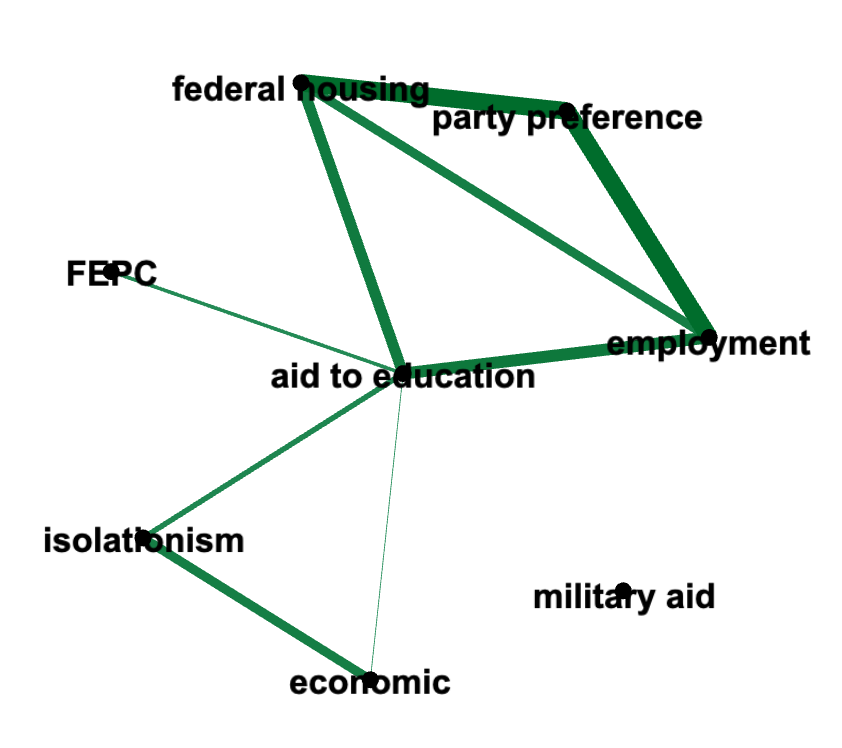
Converse doesn’t use network analysis, but I can convert his core findings into network maps. (For those interested, I turned every tau-gamma coefficient above .05 in Converse’s Table 7 into an edge in these graphs.)

Congressional candidates share the following model of the political debate ca. 1962.

Whether candidates are Democrats or Republicans is strongly related to their views of federal interventions on education, housing, and employment, and those issues are linked together. Military aid to foreign countries is not connected–it stands alone as a topic. (“FEPC” means the proposed Fair Employment Practices Commission.)

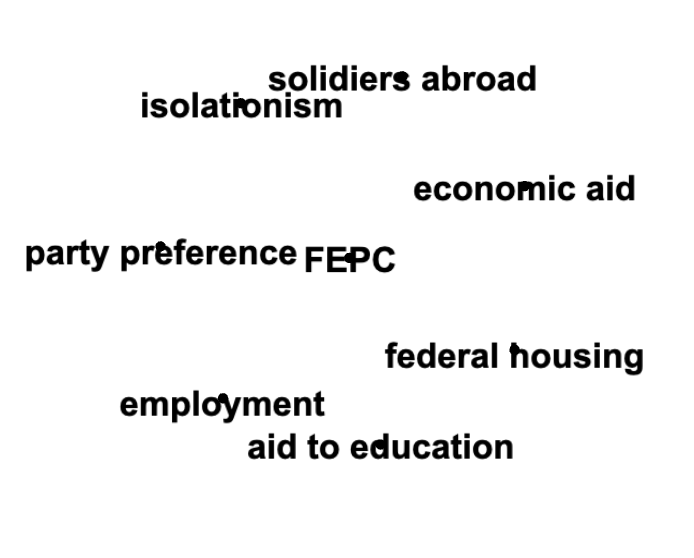
Meanwhile, this is the result of using the same method with Converse’s data from representative adults at the same time:

There are no links at at all among the ideas (meaning no coefficients > .5). Converse suggests that people are not in a position to play the role expected in a “civics class” theory of democracy, assessing and voting on the issues of the day.

Now here is a rival, “bottom up” theory: The social world is enormously complex. Responsible people may hold opinions on myriad issues, and no one can have a view about everything. Even if we focus on a single domain, such as the federal budget, it is highly complex. Federal spending includes funds for many different purposes. Each federal program has a financial cost, but it also has moral significance, behavioral impact, symbolic meaning, likelihood of success, etc. If people are diverse and free, they will naturally form many different structures of opinions about the range of topics that they have considered so far.

Imagine a sample of people, each of whom holds a thoughtful and carefully considered view of public issues and connects each opinion to other opinions in rigorous ways. However, each person holds a unique structure. Then, if researchers contact each person and ask a short list of survey questions (out of the innumerable questions that they could ask), and the aggregate survey data is analyzed using the methods pioneered by Converse, it will reveal no significant links at all. The heterogeneity of individuals’ beliefs will yield very low coefficients at the group level. Their graph will look just like the second graph above–not because they are tuned out of politics or undisciplined in their thinking, but because they differ.

Converse (p. 44) explicitly acknowledges this possibility. He notes that if people’s opinions become “increasingly idiosyncratic” as they move away from the elite, we will find “little aggregative patterning of belief combinations” in their data, because they will not know “what goes with what” (presumably, according to the elites) and will “therefore put belief elements together in a great variety of ways.”

However, Converse counters with a different kind of evidence. According to his analysis of longitudinal data from the American National Election Studies from 1958-60, most people’s opinions on most issues change as if by sheer chance as time passed. This implies that they do not hold “well knit but highly idiosyncratic belief systems” (p. 47). Instead, they have no “meaningful beliefs” at all (p. 51). The exceptions are various small and specialized “issue publics” who hold stable opinions about specific concerns, including many Blacks and some White Southerners on questions of race.

On this point, I would only note that an enormous number of longitudinal studies have been conducted since 1962, and some find stability over time (e.g., Kustov, Laaker & Reller 2021), unexplained–and perhaps random–change (Jaeger, M. M. 2006), or a mix of the two, depending on this issue (Kiley & Vaisey 2020). For instance, according to the last of those studies, the proportion of individuals who change their opinions about abortion is extraordinarily low. Converse’s blanket claim that most people’s opinions on most issues change randomly seems overstated.

I do not assume that all of my fellow Americans (or anyone else) holds complex and rigorous mental models of politics. Some people hardly hold any opinions, or cannot connect their opinions together, or do so in illogical ways. My point is that we cannot tell from aggregate data what proportion of people hold thoughtful views unless we assume that all worthy views must manifest the same structure. Converse uses scare quotes around the word “proper” when he mentions “the sophisticated observer’s assumption of what beliefs go with other beliefs,” but if we seriously doubt that elites understand the “proper” arrangement, then we should expect regular people to exhibit great diversity.

In that case, we should seek to understand the heterogeneous structures of ordinary people’s views. This kind of research has three important purposes:

  1. It may counter the very low assessment of public capacity that is fashionable now in political science, deriving from Converse. That skepticism may prove self-reinforcing, since experts who doubt the public’s ability to reason will not be motivated to defend or improve democracy.
  2. It may yield specific findings about structures of thought shared by sub-groups. Those insights will be invisible as long as we only we ask whether the public shares the structures assumed by political elites.
  3. It offers a perspective on political institutions. Even if many people hold worthy but heterogeneous structures of ideas, we probably still need mass elections to address prominent topics, such as whether to raise or cut taxes. I support that kind of democracy. But it will always be frustrating, because the structure presented by elites will fail to match the reasonable structures in many people’s minds. Fortunately, we can complement mass majoritarian democracy with other forms of participation. Civil society provides an enormous range of specialized groups, and individuals can choose to join the groups that match their personal ideologies, exit ones that don’t, advocate for adjustments within the groups they belong to, and compete for new members. Meanwhile, relatively small and relatively discursive bodies, such as local town meetings or Participatory Budgeting sessions, offer individuals opportunities to share their idiosyncratic views in public. We might understand those venues as opportunities for deliberation that can yield wiser judgments. Or we might understand such venues as places where people can display their uniqueness, as Hannah Arendt advocated. Thus a “bottom up” theory supports decentralization, pluralism, or polycentricity.

See also: Moral and Political Discussion and Epistemic Networks; modeling a political discussion; individuals in cultures: the concept of an idiodictuon; ideologies and complex systems; don’t let the behavioral revolution make you fatalistic, polycentricity: the case for a (very) mixed economy, etc. I also acknowledge Jon Green, Nic Fishman, Sarah Shugars, and others who are working in this general domain today.

Moral and Political Discussion and Epistemic Networks

Yesterday, I got to give an International Society for Quantitative Ethnography (ISQE) Webinar on “Moral and Political Discussion and Epistemic Networks.” I really enjoyed the questions and conversation. This is the video of the whole event:

Abstract: An individual holds linked beliefs about political or moral issues, which we can model as a network. How these ideas are linked together influences the person’s actions and opinions. When individuals discuss, they share some portions of their respective networks of which they are conscious at the time. Some network structures are better than others for discussion: overly centralized or scattered networks are problematic. Individuals tend to demonstrate similar network structures on different issues. Thus, relying on certain kinds of networks is a character trait. People, with their respective networks of ideas, are also embedded in social networks. An idea is more likely to spread depending on features of both the social network and the idea networks of the people who interact. As a whole, a population may develop a shared network structure. An idea that is widely shared and frequently central in individuals’ networks becomes a norm. Institutions are partly composed of such norms. A community or a culture is a single network with disagreement. Ultimately, all such networks interconnect. This theory has implications for politics, ethics, and research methodologies.

Additional ISQE webinars are listed here.

Transformative Learning and Civic Studies

Newly in print: The Palgrave Handbook of Learning for Transformation, edited by Aliki Nicolaides, Saskia Eschenbacher, Petra T. Buergelt, Yabome Gilpin-Jackson, Marguerite Welch and Mitsunori Misawa (2022).

Although I am not deeply knowledgable about Transformative Learning, a movement launched by the sociologist Jack Mezirow, I like its emphasis on learning as a lifelong process of transforming one’s perspective on society.

This volume includes a chapter entitled “Reconsidering the Roots of Transformative Education: Habermas and Mezirow” by Saskia Eschenbacher and me (pp. 45-58). Our abstract:

Jack Mezirow acknowledged the deep influence of the German philosopher Jürgen Habermas (1929–) on the development of transformative learning. We describe some fundamental elements of Mezirow’s and Habermas’ thought, explore their affinities, and argue that Mezirow did not give adequate attention to two important themes in Habermas: the power and value of social movements and the need to reform the overall structure of a society to enable transformative learning. We argue that transformative learning would benefit from a deeper consideration of these topics. Finally, we introduce Civic Studies, a parallel intellectual movement that also owes much to Habermas, and we suggest a convergence.

when you know, but cannot feel, beauty

In his “Dejection: An Ode,” Coleridge describes the sparkling stars and crescent moon above but bemoans his own state of mind:

I see them all so excellently fair,
I see, not feel, how beautiful they are!

The reason is what we would call depression:

A grief without a pang, void, dark, and drear,
         A stifled, drowsy, unimpassioned grief,
         Which finds no natural outlet, no relief,
                In word, or sigh, or tear—

I consulted Coleridge’s “Dejection” thanks to Anahid Nersessian’s essay on Keats’ “Ode to a Nightingale” (Nersessian 2021). Nersessian is great at wiping away that sense of Keats as a languorous aesthete, a maker of pretty lyrics. As she shows, the Nightingale ode reports suicidal thoughts. The narrator is “half in love with easeful Death” and seriously considering whether it is time to end it all: “Now more than ever seems it rich to die.” The three hard opening words, as Nersessian notes, violate iambic pentameter and ignore the ostensible addressee of the ode. Keats doesn’t begin, “O, Nightingale …” but rather, “My heart aches.”

Nersessian’s essay is not a close reading, but it made me turn back to the text of the ode. I wondered: what exactly is the narrator’s mental condition? (Remember: Keats had medical training, and the first stanza seems almost clinical.) The presenting complaint is a heart that aches. More specifically, “a drowsy numbness pains / My sense.”

This is complicated. Being drowsy and numb suggests a lack of sensation, and that interpretation is reinforced by the analogy to a “dull opiate” that suppresses the narrator’s conscious thoughts, sending him toward Lethe. But the numbness “pains” his sense, as though he had drunk hemlock. I am not sure whether we should assume that hemlock causes a quiet, sleepy death or an agonizing one: Wikipedia suggests that it triggers respiratory distress. I think that the question of lacking consciousness versus suffering is central to the poem as a whole.

In any case, what is the etiology of this numbness/ache? The narrator denies that he is envious of the nightingale’s “happy lot.” (The word “thy” in that sentence is the first mention of the ode’s subject.) When people deny that they are jealous, sometimes they actually are. But the narrator follows with a subtler point. He does not envy the bird’s “happy lot,” where “happy” could mean “favoured by good fortune; lucky, fortunate; successful” (OED). The bird’s lot is to sing in the mid-May evening, and Keats denies being envious of that. Instead, the nightingale causes heartache by “being too happy in [its] happiness”–in other words, by enjoying its role. This is precisely what Keats’ narrator, being depressed, cannot do. The poem describes beauty, yet the narrator cannot feel what such precise and evocative words as these should convey:

The grass, the thicket, and the fruit-tree wild;
         White hawthorn, and the pastoral eglantine;
                Fast fading violets cover’d up in leaves;
                        And mid-May’s eldest child,
         The coming musk-rose, full of dewy wine,
                The murmurous haunt of flies on summer eves.

Do we think that the nightingale is happy, in the subjective sense–happy in its happiness? Keats writes that the bird “sing[s] of summer in full-throated ease.” I suppose I doubt that it sings “of” summer. I assume it sings because the month is May, and its song is a component of what makes an English early summer lovely. I don’t believe that the bird is describing summer, as a poet could.

To modify an example from Robert B. Brandom (who discusses a parrot trained to say “red” in the presence of red objects), the nightingale reliably informs us that it is summer by singing, but the bird cannot express the premises and conclusions that relate to this information. The bird cannot say, “It is summer; therefore, it is not winter,” or “It is summer because spring is over,” or “Since it is summer, we should spend evenings outdoors.” To express points like that would be to talk of summer. Instead, the nightingale sings because it is summer, and as an aspect of summer.

Indeed, its happiness relates to its ignorance. Keats wishes to forget

What thou among the leaves hast never known,
The weariness, the fever, and the fret
         Here, where men sit and hear each other groan;
Where palsy shakes a few, sad, last gray hairs,
         Where youth grows pale, and spectre-thin, and dies ...

That last line may describe the recent and agonizing death of Keats’ brother from tuberculosis, and it eerily foretells Keats’ own death from the same cause two years later. These are serious matters, wrenching tragedies, and the bird’s enviable condition is to know nothing of them. Its mental state is like that of a human being who has forgotten memories and fears of suffering.

We might expect that the bird’s song would cause Keats to forget pain, at least briefly, as he becomes absorbed in the music; but that doesn’t work for this narrator, because he is depressed. “Still wouldst thou sing, and I have ears in vain.” Instead, the narrator considers artificial solutions: “some dull opiate,” “a draught of vintage,” distracting reveries of “faery lands,” or–most effective of all, intentional death.

The darkness and anger of the poem should be taken seriously; it is not some pretty thing. Yet it is rapturously beautiful, the source of such nuggets as “tender is the night” and Ruth “amid the alien corn.” It is about not being able to feel beauty, yet it conveys beauty from that ailment.

In the fourth stanza, Keats commits to join the nightingale not by drowning his sorrows in drink but through the power of verse:

Away! away! for I will fly to thee,
         Not charioted by Bacchus and his pards,
But on the viewless wings of Poesy,
         Though the dull brain perplexes and retards ...

His brain is a problem: it perplexes and retards. “Poesy” looks, at least temporarily, like a way out. But why is it “viewless”? That word could mean invisible: we cannot observe how poetry moves the writer or the reader to a better place. Or it could mean unable to see. Certainly, this poet has trouble seeing. Due to the deep darkness where the nightingale sings, “I cannot see what flowers are at my feet.” Poetry offers words that name objects, but it does not actually allow us to see them. I think the central idea in the fifth stanza (Keats knows which flowers are present from their scent but cannot see them) is a metaphor for literary description. A poem conveys information but not actual experience.

Then he addresses the bird: “Darkling, I listen.” Calling a nightingale “darkling” is a clear allusion to Book III of Paradise Lost, where Milton writes:

            ... as the wakeful bird
Sings darkling, and in shadiest covert hid
Tunes her nocturnal note. ....

The argument of this passage is that God is light; beautiful things reflect God’s love. Since Milton is blind, he cannot see these objects. He misses the “sight of vernal bloom, or summer’s rose …  the cheerful ways of men.” Yet a miracle occurs. God makes the “celestial Light, / Shine inward,” and by purging and dispersing all the ordinary sights of life, allows Milton to “see and tell / Of things invisible to mortal sight.” Milton is like the nightingale, whose song tells of grace even though the bird cannot see in the darkness.

No such consolation is available to the narrator of Keats’ ode, who offers no hint that nature has a benign author. Nature is what gives people tuberculosis. Keats’ narrator is not only depressed but angry about it.

I will offer an alternative perspective, even though I don’t think Keats would agree with it. We are all like the nightingale; our vocalizations and other behaviors are caused by natural processes. (“Dependent origination.”) We cannot escape suffering, which is intrinsic to sentience and afflicts the bird as well as us. (“The first noble truth.”) Mental pain arises naturally. For instance, Keats must think of his recently deceased brother, because he is physically designed to feel grief. Forgetting such things is impossible, and drowning them out would be unethical. (“The middle way.”) However, Keats is not a real entity, and his condition needn’t interest the poet as much as it does. As he writes elsewhere, the poet “has no self”; “not one word I ever utter can be taken for granted as an opinion growing out of my identical nature–how can it, when I have no nature?” (“No-self.”) His protean mind can, however, fill with thoughts such as appreciation, gratitude, and compassion. (Mindfulness, the “third noble truth.”) The beauty of the night is real, just like suffering, and he can focus on the former.

Those who make it across the river and come back to help others over do the most good (“karma”), and Keats’ lyrics provide an example. They enrich the inner lives of us who read them. Keats claims no satisfaction from doing this, because he is depressed and because he doesn’t hold a Buddhist-ish theory. But he achieves what he cannot recognize, and we can read him compassionately for that reason. After all, the last five words (“Do I wake or sleep?”) are no longer addressed to the nightingale, which has departed for the “next valley-glades.” They must pose a question for us, opening a dialogue with readers and perhaps seeking our compassion, which we can give. If our minds are filled with compassion, we have less space for pain.

Keats was an unbelievably good poet. What if we can’t write immortal verse–can we then return to help others cross to a better place? I would say: Keats is a stranger to us, dead two centuries, and worth reading because his words are so excellent. The rest of us just say mundane things, like, “Did you hear that bird?” But we can say such things in relationships–to people we know and like or love. When embedded in a friendship or love, a remark like “Did you hear that bird?” conveys pleasure and care. By that means, we can alleviate suffering even if we could never come up with a phrase as good as “with beaded bubbles winking at the brim.”

Sources: Robert B. Brandom, Articulating Reasons: An Introduction to Inferentialism (Cambridge: Harvard University Press, 2000); Anahid Nersessian, Keats’ Odes: A Lover’s Discourse (Chicago: University of Chicago Press, 2021). See also the sublime and other people; the politics of negative capability; “Keats against Dante: The Sonnet on Paolo and Francesca“; a poem should; empathy: good or bad?; and three endings for Christabel.