Category Archives: Artificial intelligence

can AI help governments and corporations identify political opponents?

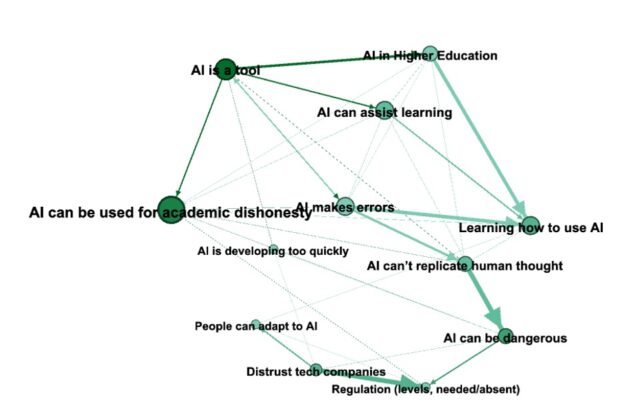
In “Large Language Model Soft Ideologization via AI-Self-Consciousness,” Xiaotian Zhou, Qian Wang, Xiaofeng Wang, Haixu Tang, and Xiaozhong Liu use ChatGPT to identify the signature of “three distinct and influential ideologies: “’Trumplism’ (entwined with US politics), ‘BLM (Black Lives Matter)’ (a prominent social movement), and ‘China-US harmonious co-existence is of great significance’ (propaganda from the Chinese Communist Party).” They unpack each of these ideologies as a connected network of thousands of specific topics, each one having a positive or negative valence. For instance, someone who endorses the Chinese government’s line may mention US-China relationships and the Nixon-Mao summit as a pair of linked positive ideas.

The authors raise the concern that this method would be a cheap way to predict the ideological leanings of millions of individuals, whether or not they choose to express their core ideas. A government or company that wanted to keep an eye on potential opponents wouldn’t have to search social media for explicit references to their issues of concern. It could infer an oppositional stance from the pattern of topics that the individuals choose to mention.

I saw this article because the authors cite my piece, “Mapping ideologies as networks of ideas,” Journal of Political Ideologies (2022): 1-28. (Google Scholar notified me of the reference.) Along with many others, I am developing methods for analyzing people’s political views as belief-networks.

I have a benign motivation: I take seriously how people explicitly articulate and connect their own ideas and seek to reveal the highly heterogeneous ways that we reason. I am critical of methods that reduce people’s views to widely shared, unconscious psychological factors.

However, I can see that a similar method could be exploited to identify individuals as targets for surveillance and discrimination. Whereas I am interested in the whole of an individual’s stated belief-network, a powerful government or company might use the same data to infer whether a person would endorse an idea that it finds threatening, such as support for unions or affinity for a foreign country. If the individual chose to keep that particular idea private, the company or government could still infer it and take punitive action.

I’m pretty confident that my technical acumen is so limited that I will never contribute to effective monitoring. If I have anything to contribute, it’s in the domain of political theory. But this is something–yet another thing–to worry about.

See also: Mapping Ideologies as Networks of Ideas (talk); Mapping Ideologies as Networks of Ideas (paper); what if people’s political opinions are very heterogeneous?; how intuitions relate to reasons: a social approach; the difference between human and artificial intelligence: relationships

the age of cybernetics

A pivotal period in the development of our current world was the first decade after WWII. Much happened then, including the first great wave of decolonization and the solidification of democratic welfare states in Europe, but I’m especially interested in the intellectual and technological developments that bore the (now obsolete) label of “cybernetics.”

I’ve been influenced by reading Francisco Varela, Evan Thompson, and Eleanor Rosch, The Embodied Mind: Cognitive Science and Human Experience (first ed. 1991, revised ed., 2017), but I’d tell the story in a somewhat different way.

The War itself saw the rapid development of entities that seemed analogous to human brains. Those included the first computers, radar, and mechanisms for directing artillery. They also included extremely complex organizations for manufacturing and deploying arms and materiel. Accompanying these pragmatic breakthroughs were successful new techniques for modeling complex processes mathematically, plus intellectual innovations such as artificial neurons (McCullouch & Pitts 1943), feedback (Rosenblueth, Wiener, and Bigelow 1943), game theory (von Neumann & Morgenstern, 1944), stored-program computers (Turing 1946), information theory (Shannon 1948), systems engineering (Bell Labs, 1940s), and related work in economic theory (e.g., Schumpeter 1942) and anthropology (Mead 1942).

Perhaps these developments were overshadowed by nuclear physics and the Bomb, but even the Manhattan Project was a massive application of systems engineering. Concepts, people, money, minerals, and energy were organized for a common task.

After the War, some of the contributors recognized that these developments were related. The Macy Conferences, held regularly from 1942-1960, drew a Who’s Who of scientists, clinicians, philosophers, and social scientists. The topics of the first post-War Macy Conference (March 1946) included “Self-regulating and teleological mechanisms,” “Simulated neural networks emulating the calculus of propositional logic,” “Anthropology and how computers might learn how to learn,” “Object perception’s feedback mechanisms,” and “Deriving ethics from science.” Participants demonstrated notably diverse intellectual interests and orientations. For example, both Margaret Mead (a qualitative and socially critical anthropologist) and Norbert Wiener (a mathematician) were influential.

Wiener (who had graduated from Tufts in 1909 at age 14) argued that the central issue could be labeled “cybernetics” (Wiener & Rosenblueth 1947). He and his colleagues derived this term from the ancient Greek word for the person who steers a boat. For Wiener, the basic question was how any person, another animal, a machine, or a society attempts to direct itself while receiving feedback.

According to Varela, Thompson, and Rosch, the ferment and diversity of the first wave of cybernetics was lost when a single model became temporarily dominant. This was the idea of the von Neumann machine:

Such a machine stores data that may symbolize something about the world. Human beings write elaborate and intentional instructions (software) for how those data will be changed (computation) in response to new input. There is an input device, such as a punchcard reader or keyboard, and an output mechanism, such as a screen or printer. You type something, the processor computes, and out comes a result.

One can imagine human beings, other animals, and large organizations working like von Neumann machines. For instance, we get input from vision, we store memories, we reason about what we experience, and we say and do things as a result. But there is no evident connection between this architecture and the design of the actual human brain. (Where in our head is all that complicated software stored?) Besides, computers designed in this way made disappointing progress on artificial intelligence between 1945 and 1970. The 1968 movie 2001: A Space Odyssey envisioned a computer with a human personality by the turn of our century, but real technology has lagged far behind that.

The term “cybernetics” had named a truly interdisciplinary field. After about 1956, the word faded as the intellectual community split into separate disciplines, including computer science.

This was also the period when behaviorism was dominant in psychology (presuming that all we do is to act in ways that independent observers can see–there is nothing meaningful “inside” us). It was perhaps the peak of what James C. Scott calls “high modernism” (the idea that a state can accurately see and reorganize the whole society). And it was the heyday of “pluralism” in political science (which assumes that each group that is part of a polity automatically pursues its own interests). All of these movements have a certain kinship with the von Neumann architecture.

An alternative was already considered in the era of cybernetics: emergence from networks. Instead of designing a complex system to follow instructions, one can connect numerous simple components into a network and give them simple rules for changing their connections in respond to feedback. The dramatic changes in our digital world since ca. 1980 have used this approach rather than any central design, and now the analogy of machine intelligence to neural networks is dominant. Emergent order can operate at several levels at once; for example, we can envision individuals whose brains are neural networks connecting via electronic networks (such as the Internet) to form social networks and culture.

I have sketched this history–briefly and unreliably, because it’s not my expertise–without intending value-judgments. I am not sure to what extent these developments have been beneficial or destructive. But it seems important to understand where we’ve come from to know where we should go from here.

See also: growing up with computers; ideologies and complex systems; The truth in Hayek; the progress of science; the human coordination involved in AI; the difference between human and artificial intelligence: relationships

what I would advise students about ChatGPT

I’d like to be able to advise students who are interested in learning but are not sure whether or how to use ChatGPT. I realize there may also be students who want to use AI tools to save effort, even if they learn less as a result. I don’t yet know how to address that problem. Here I am assuming good intentions on the part of the students. These are tentative notes: I expect my stance to evolve based on experience and other perspectives. …

We ask you to learn by reading, discussing, and writing about selected texts. By investing effort in those tasks, you can derive information and insights, challenge your expectations, develop skills, grasp the formal qualities of writing (as well as the main point), and experience someone else’s mind.

Searching for facts and scanning the environment for opinions can also be valuable, but they do not afford the same opportunities for mental and spiritual growth. If we never stretch our own ideas by experiencing others’ organized thinking, our minds will be impoverished.

ChatGPT can assist us in the tasks of reading, discussing, and writing about texts. It can generate text that is itself worth reading and discussing. But we must be careful about at least three temptations:

  • Saving effort in a way that prevents us from using our own minds.
  • Being misled or misinformed, because ChatGPT can be unreliable and even unbiased.
  • Violating the relationship with the people who hear or read our words by presenting our ideas as our own when they were actually generated by AI. This is not merely wrong because it suggests we did work that we didn’t do. It also prevents the audience from tracing our ideas to their sources in order to assess them critically. (Similarly, we cite sources not only to give credit and avoid plagiarism but also to allow others to follow our research and improve it.)

I can imagine using ChatGPT in some of these ways. …

First, I’m reading an assigned text that refers to a previous author who is new to me. I ask ChatGPT what that earlier author thought. This is like Google-searching for that person or looking her up on Wikipedia. It is educational. It provides valuable context. The main concern is that ChatGPT’s response could be wrong or tilted in some way. That could be the case with any source. However, ChatGPT appears more trustworthy than it is because it generates text in the first-person singular–as if it were thinking–when it is really offering a statistical summary of existing online text about a topic. An unidentified set of human beings wrote the text that the AI algorithm summarizes–imperfectly. We must be especially cautious about the invisible bias this introduces. For the same reason, we should be especially quick to disclose that we have learned something from ChatGPT.

Second, I have been assigned a long and hard text to read, so I ask ChatGPT what it says (or what the author says in general), as a substitute for reading the assignment. This is like having a Cliff’s Notes version for any given work. Using it is not absolutely wrong. It saves time that I might be able to spend well–for instance, in reading something different. But I will miss the nuances and complexities, the stylistic and cognitive uniqueness, and the formal aspects of the original assignment. If I do that regularly, I will miss the opportunity to grow intellectually, spiritually, and aesthetically.

Such shortcuts have been possible for a long time. Already in the 1500s, Erasmus wrote Biblical “paraphrases” as popular summaries of scripture, and King Edward VI ordered a copy for every parish church in England. Some entries on this blog are probably being used to replace longer readings. In 2022, 3,500 people found my short post on “different kinds of freedom,” and perhaps many were students searching for a shortcut to their assigned texts. Our growing–and, I think, acute–problem is the temptation to replace all hard reading with quick and easy scanning.

A third scenario: I have been assigned a long and hard text to read. I have struggled with it, I am confused, and I ask ChatGPT what the author meant. This is like asking a friend. It is understandable and even helpful–to the extent that the response is good. In other words, the main question is whether the AI is reliable, since it may look better than it is.

Fourth, I have been assigned to write about a text, so I ask ChatGPT about it and copy the response as my own essay. This is plagiarism. I might get away with it because ChatGPT generates unique text every time it is queried, but I have not only lied to my teacher, I have also denied myself the opportunity to learn. My brain was unaffected by the assignment. If I keep doing that, I will have an unimpressive brain.

Fifth, I have been assigned to write about a text, I ask ChatGPT about it, I critically evaluate the results, I follow up with another query, I consult the originally assigned text to see if I can find quotes that substantiate ChatGPT’s interpretation, and I write something somewhat different in my own words. Here I am using ChatGPT to learn, and the question is whether it augments my experience or distracts from it. We might also ask whether the AI is better or worse than other resources, including various primers, encyclopedia entries, abstracts, and so on. Note that it may be better.

We could easily multiply these examples, and there are many intermediate cases. I think it is worth keeping the three main temptations in mind and asking whether we have fallen prey to any of them.

Because I regularly teach Elinor Ostrom, today I asked ChatGPT what Ostrom thought. It offered a summary with an interesting caveat that (I’m sure) was written by an individual human being: “Remember that these are general concepts associated with Elinor Ostrom’s work, and her actual writings and speeches would provide more nuanced and detailed insights into her ideas. If you’re looking for specific quotes, I recommend reading her original works and publications.”

That is good advice. As for the summary: I found it accurate. It is highly consistent with my own interpretation of Ostrom, which, in turn, owes a lot to Paul Dragos Aligica and a few others. Although many have written about Ostrom, it is possible that ChatGPT is actually paraphrasing me. That is not necessarily bad. The problem is that you cannot tell where these ideas are coming from. Indeed, ChatGPT begins its response: “While I can’t provide verbatim quotes, I can summarize some key ideas and principles associated with Elinor Ostrom’s work.” There is no “I” in AI. Or if there is, it isn’t a computer. The underlying author might be Peter Levine plus a few others.

Caveat emptor.

See also: the design choice to make ChatGPT sound like a human; the difference between human and artificial intelligence: relationships

the human coordination involved in AI

When we are amazed by the magic of a new software application, like ChatGPT, we should not be impressed by the machine, nor by the specific firm that offers the product, but by the enormous array of human brains that have been connected so that they can accomplish complex tasks together.

Brian Chau is writing a series of detailed posts arguing that the innovation curve for artificial intelligence may be tapering off, not accelerating. The curve may be s-shaped, starting with a long period of slow progress, followed by rapid breakthroughs that are now largely over, with another period of slow growth ahead.

Although his evidence seems robust, I cannot assess his thesis. What struck me as I read his analysis was the vast amount of coordinated human effort that produces something like ChatGPT.

AI requires hardware–not just the big servers that run the model, but also the components that connect to it, including my laptop, and its power cord, and the generator that supplies it with electricity. All hardware requires design, manufacture, raw materials, and transportation.

AI also involves software of many kinds, which requires vast amounts of human work. People need appropriate educations and training to do all the relevant tasks, from mining minerals to writing code. Information must be created and circulated, including information that is free and public rather than proprietary. And a whole range of businesses and other organizations (e.g., engineering schools) must be financed, managed, marketed, staffed, etc.

Prices play important roles in all of this. They are signals that create incentives. For instance, there is a market price for the kinds of data-processing required by AI, and as that price rises, people see that they can make money providing the service. But prices hardly ever suffice for coordinating large and complex systems.

For one thing, you can’t interpret a price signal without a lot of information. For instance, the starting salary of computer science majors is projected to fall by 4 percent this year. That is a price signal, but it’s confusing without more context. A prospective major would need to know what is causing this short-term shift in the average price of this category of labor.

Even when the message of a price signal is clear, you can’t act on it unless you have substantive knowledge of the topic. I am aware that certain kinds of software are in high demand, but I don’t know how to write modern code, so I couldn’t take advantage of the price (even if I wanted to). Many people who do know how to code were taught that skill, and teaching is a different form of communication from prices (even though most teachers are paid, and schools and colleges have market aspects).

Whether the results of all this human coordination are beneficial is a different question …

See also the design choice to make ChatGPT sound like a human ; the difference between human and artificial intelligence: relationships; artificial intelligence and problems of collective action.

the difference between human and artificial intelligence: relationships

A large-language model (LLM) like ChatGPT works by identifying trends and patterns in huge bodies of text previously generated by human beings.

For instance, we are currently staying in Cornwall. If I ask ChatGPT what I should see around here, it suggests St Ives, Land’s End, St Michael’s Mount, and seven other highlights. It derives these ideas from frequent mentions in relevant texts. The phrases “Cornwall,” “recommended” (or synonyms thereof), “St Ives,” “charming,” “art scene,” and “cobbled streets” probably occur frequently in close proximity, because ChatGPT uses them to construct a sentence for my edification.

We human beings behave in a somewhat similar way. We also listen to or read a lot of human-generated text, look for trends and patterns in it, and repeat what we glean. But if that is what it means to think, then LLM has clear advantages over us. A computer can scan much more language than we can and uses statistics rigorously. Our generalizations suffer from notorious biases. We are more likely to recall ideas we have seen most recently, those that are most upsetting, those that confirm our prior assumptions, etc. Therefore, we have been using artificial means to improve our statistical inferences ever since we started recording possessions and tallying them by category thousands of years ago.

But we also think in other ways. Specifically, as intensely social and judgmental primates, we frequently scan our environments for fellow human beings whom we can trust in specific domains. A lot of what we believe comes from what a relatively small number of trusted sources have simply told us.

In fact, to choose what to see in Cornwall, I looked at the recommendations in The Lonely Planet and Rough Guide. I have come to trust those sources over the years–not for every kind of guidance (they are not deeply scholarly), but for suggestions about what to see and how to get to those places. Indeed, both publications offer lists of Cornwall’s highlights that resemble ChatGPT’s.

How did these publishers obtain their knowledge? First, they hired individuals whom they trusted to write about specific places. These authors had relevant bodily experience. They knew what it feels like to walk along a cliff in Cornwall. That kind of knowledge is impossible for a computer. But these authors didn’t randomly walk around the county, recording their level of enjoyment and reporting the places with the highest scores. Even if they had done that, the sites they would have enjoyed most would have been the ones that they had previously learned to understand and value. They were qualified as authors because they had learned from other people: artists, writers, and local informants on the ground. Thus, by reading their lists of recommendations, I gain the benefit of a chain of interpersonal relationships: trusted individuals who have shared specific advice with other individuals, ending with the guidebook authors whom I have chosen to consult.

In our first two decades of life, we manage to learn enough that we can go from not being able to speak at all to writing books about Cornwall or helping to build LLMs. Notably, we do not accomplish all this learning by storing billions of words in our memories so that we can analyze the corpus for patterns. Rather, we have specific teachers, living or dead.

This method for learning and thinking has drawbacks. For instance, consider the world’s five biggest religions. You probably think that either four or five of them are wrong about some of their core beliefs, which means that you see many billions of human beings as misguided about some ideas that they would call very important. Explaining why they are wrong, from an outsider’s perspective, you might cite their mistaken faith in a few deeply trusted sources. In your opinion, they would be better off not trusting their scriptures, clergy, or people like parents who told them what to believe.

(Or perhaps you think that everyone sees the same truth in their own way. That’s a benign attitude and perhaps the best one to hold, but it’s incompatible with what billions of people think about the status of their own beliefs.)

Our tendency to believe select people may be an excellent characteristic, since the meaning of life is more about caring for specific other humans than obtaining accurate information. But we do benefit from knowing truths, and our reliance on fallible human sources is a source of error. However, LLMs can’t fully avoid that problem because they use text generated by people who have interests and commitments.

If I ask ChatGPT “Who is Jesus Christ?” I get a response that draws exclusively from normative Christianity but hedges it with this opening language: “Jesus Christ is a central figure in Christianity. He is believed to be … According to Christian belief. …” I suspect that ChatGPT’s answers about religious topics have been hard-coded to include this kind of disclaimer and to exclude skeptical views. Otherwise, a statistical analysis of text about Jesus might present the Christian view as true or else incorporate frequent critiques of Christianity, either of which would offend some readers.

In contrast, my query about Cornwall yields confident and unchallenged assessments, starting with this: “Cornwall is a beautiful region located in southwestern England, known for its stunning coastline, picturesque villages, and rich cultural heritage.” This result could be prefaced with a disclaimer, e.g., “According to many English people and Anglophiles who choose to write about the region, Cornwall is …:” A ChatGPT result is always a summary of what a biased sample of people have thought, because choosing to write about something makes you unusual.

For human beings who want to learn the truth, having new tools that are especially good at scanning large bodies of text for statistical patterns should prove useful. (Those who benefit will probably include people who have selfish or even downright malicious goals.) But we have already learned a fantastic amount without LLMs. The secret of our success is that our brains have always been networked, even when we have lived in small groups of hunter-gatherers. We intentionally pass ideas to other people and are often pretty good at deciding whom to believe about what.

Moreover, we have invented incredibly complex and powerful techniques for improving how many brains are connected. Posing a question to someone you know is helpful, but attending a school, reading an assigned book, finding other books in the library, reading books translated from other languages, reading books that summarize previous books, reading those summaries on your phone–these and many other techniques dramatically extend our reach. Prices send signals about supply and demand; peer-review favors more reliable findings; judicial decisions allow precedents to accumulate; scientific instruments extend our senses. These are not natural phenomena; we have invented them.

Seen in that context, LLMs are the latest in a long line of inventions that help human beings share what they know with each other, both for better and for worse.

See also: the design choice to make ChatGPT sound like a human; artificial intelligence and problems of collective action; how intuitions relate to reasons: a social approach; the progress of science.