I showed the image that accompanies this post in class recently, when we discussed these articles:
Enos, Kaufman and Sands (2019): The 1992 Los Angeles riots caused local voters to support more funding for public schools, presumably because voters became more concerned about racial justice.
Wasow (2020): The nonviolent Civil Rights Movement dramatically shifted public opinion in favor of civil rights and helped cause major favorable legislation, but rioting later in the 1960s caused a backlash and helped elect Richard M. Nixon.
Ebbinghaus, Baile & Rubel (2024):Black Lives Matter protests–which, research shows, were overwhelmingly nonviolent and which called for reductions in police budgets–were associated with increases in police spending.
My image is meant to be a framework that can accommodate these divergent examples and findings. You can read it like this:
A social injustice (or at least a perceived one) may cause a reaction in the form of violence and/or nonviolence. This reaction may be largely spontaneous or may reflect leadership and structure. The vast majority of citizens and decision-makers will not directly witness the reaction. However, it may be conveyed in media, which may present the reaction positively or negatively and may describe, ignore, or downplay the underlying injustice. As a result, public opinion may shift, favorably or unfavorably. A substantial shift in public opinion may cause policymakers to ameliorate or to exacerbate the original injustice. This whole system may be affected by intentional state violence directed at the protesters, the media, or the public.
I used conditional verbs throughout the previous paragraph because none of this is inevitable. Sometimes people just bear injustice, or the media ignores a protest, or the public retains its opinions, or policymakers shrug off a shift in opinion. But change is possible, for better or worse.
Given the very different outcomes discussed in our readings, one might conclude that the outcomes are random. A nonviolent movement may be depicted as violent and cause a backlash. A riot may draw sympathy. A huge march may barely cause a ripple. A tiny protest can start something big.
In my view, history always involves an element of randomness, but it still pays to plan, train, and organize. The dramatic shift in public opinion about civil rights that Wasow describes was due to the Civil Rights Movement.
Looking ahead to the next 2-4 years, I think we can anticipate a significant amount of planned, structured, nonviolent resistance that will be met with state violence. The state violence is likely to pay off if the protesters (or insurrectionists) can be depicted as violent and lawless, whether that is true or not. But state violence may badly backfire on the government if it looks cruel.
It is not fair that organizers must navigate these issues, but then again, organizing would be unnecessary if the society were just. I believe this kind of analysis is necessary if you are willing to strategize to combat injustice.
I believe that left parties should draw their votes from lower on the socio-economic hierarchy, so that they can compete by offering more governmental support. Right parties should draw their votes from the upper end, so that they can compete by promising economic growth. This debate and competition is healthy.
In contrast, when left parties draw from the top of the social order, they tend to offer performative or symbolic policies, while the right promises low-SES voters some version of ethnonationalism. This debate is unhealthy because it blocks more effective and fair social policies, and it sets the right on a path whose terminus can be fascism.
Education is a marker of social class. We saw a social class inversion in the US 2024 election, with Harris getting 56% of college graduates and Trump getting 56% of non-college-educated adults.
Nowadays, we are used to assuming that Republicans have an advantage in the Electoral College because they are dominant in the states with the lowest percentages of college gradates, while Democrats win easily in the most educated states. But the opposite should be true.
I am fully aware that race is involved in the USA. Recently, less-educated white voters have formed the Republican base, whereas voters of color have preferred Democrats, regardless of their social class. However, in 2024, we saw a significant shift of low-education voters of color toward Trump.
Besides, race plays different roles in various countries, but many countries display a trend of lower-educated people preferring the right and moving in that direction .
The World Values Survey has periodically surveyed populations in 102 countries since 1989, for a total sample of almost half a million individuals in the dataset that I used for this post. The WVS asks most respondents to place themselves on a left-right spectrum, and the global mean is somewhat to the right of the middle. It also asks people their education level. For the entire sample, the correlation between these two variables is slightly negative and statistically significant (-.047**). In about two-thirds of sampled countries, the correlation is negative. This pattern is upside-down, suggesting the people with more education tilt mildly to the left around the world.
However, considering the heterogeneity of the countries and years in this sample (from Switzerland in 1989 to India in 2023), it is important to break things down.
The graph with this post shows the correlations for wealthy countries with democratic elections: the EU countries, the USA, Canada, Australia, New Zealand, South Korea, Japan, and Taiwan. A positive score indicates that people lower on the educational spectrum are more likely to vote left. The trend is slightly downward, meaning that the highest-educated have moved a bit left (and the lowest have moved right).
Among the countries that have recently demonstrated a class reversal (with the lower classes voting right) are Australia, Canada, Greece, Germany, Japan, the Netherlands, New Zealand, Northern Ireland, the UK and the USA. Czechia and Slovakia are the main exceptions. In Japan and South Korea, less educated people have consistently favored the right to a small degree.
By contrast, for a sample of Latin American and Caribbean countries, the trend has generally been toward what I consider the desirable pattern, with lower-educated people increasingly voting left. The mean for all voters in this region is distinctly left of center.
In a cluster of countries that were part of the Warsaw Pact and are not now members of the EU, the trend is flat. Interestingly, in these countries, the mean voter is on the right.
Finally, the WVS surveys in some countries from the Global South–from Bangladesh to Zimbabwe-but these countries do not seem representative of the whole hemisphere. For what it’s worth, the trend for this sample is just slightly upward, and the results vary a great deal among countries.
I am still in the “deliverism” camp, believing that left parties have not delivered sufficient tangible benefits to less advantaged voters since the 1990s. (One explanation could be their dependence on affluent voters, who do not really want them to do much.) Achieving more tangible change could turn things right-side-up again.
However, it should give us pause that the Biden Administration actually spent trillions of dollars in ways that will benefit working-class Americans, yet Trump won and drew an increasing proportion of lower-educated voters of color. The “deliverist” thesis now depends on the premise that Biden-Harris had too little time and suffered from post-COVID inflation.
Meanwhile, if your premise is that US working-class voters moved right due to (increasing?) racism and sexism, you need an explanation of similar trends in many countries, including some without substantial ethnic minorities.
In How Democracies Die, Steven Levitsky and Daniel Ziblatt summarize the current playbook for authoritarian rule in countries whose constitutions are officially democratic.
Note that canceling elections, banning opposition parties, and summarily arresting opponents are not in this playbook, because they are unnecessary and too risky for the perpetrators. Authoritarians have moved beyond such tactics, which tended to fail from 1985-2010. They have improved their success rate by becoming more sophisticated. The graph with this post, by Erica Chenoweth and Maria J. Stephan, shows a disconcerting decline in the success rates of popular movements since 2010, which also illustrates that state repression has become more effective.
Key Trump loyalists like Russell Vought and Steven Miller have explicitly learned the current authoritarian playbook from its main practitioners. Their tactics are consistent with Trump’s personality and how he navigates life, so he doesn’t really have to learn them from the likes of Viktor Orban.
Here is the core:
[T]he government [can] selectively enforce the law, punishing opponents while protecting allies. Tax authorities may be used to target rival politicians, businesses, and media outlets. The police can crack down on opposition protest while tolerating acts of violence by progovernment thugs. Intelligence agencies can be used to spy on critics and dig up material for blackmail. Most often, the capture of the referees is done by quietly firing civil servants and other nonpartisan officials and replacing them with loyalists.
… Once the referees are in tow, elected autocrats can turn to their opponents. Most contemporary autocracies do not wipe out all traces of dissent, as Mussolini did in fascist Italy or Fidel Castro did in communist Cuba. But many make an effort to ensure that key players—anyone capable of really hurting the government—are sidelined, hobbled, or bribed into throwing the game. Key players might include opposition politicians, business leaders who finance the opposition, major media outlets, and in some cases, religious or other cultural figures who enjoy a certain public moral standing …
Players who cannot be bought must be weakened by other means. Whereas old-school dictators often jailed, exiled, or even killed their rivals, contemporary autocrats tend to hide their repression behind a veneer of legality. This is why capturing the referees is so important. …
Governments may also use their control of referees to “legally” sideline the opposition media, often through libel or defamation suits. … As key media outlets are assaulted, others grow wary and begin to practice self-censorship. …
Finally, elected autocrats often try to silence cultural figures—artists, intellectuals, pop stars, athletes—whose popularity or moral standing makes them potential threats. …
The quiet silencing of influential voices—by co-optation or, if necessary, bullying—can have potent consequences for regime opposition. When powerful businesspeople are jailed or ruined economically, as in the case of Khodorkovsky in Russia, other businesspeople conclude that it is wisest to withdraw from politics entirely. And when opposition politicians are arrested or exiled, as in Venezuela, other politicians decide to give up and retire. Many dissenters decide to stay home rather than enter politics, and those who remain active grow demoralized. This is what the government aims for. Once key opposition, media, and business players are bought off or sidelined, the opposition deflates. The government “wins” without necessarily breaking the rules.
Levitsky & Ziblatt 2018, pp. 78-85)
One appropriate response is to raise the price of subservience, as many tried to do when they dropped their Washington Post subscriptions after Jeff Bezos blocked a presidential endorsement. I am not against this strategy, but I do worry that it can inflict collateral damage (in that case, to journalists) and further encourage other organizations to stay out of view.
Thus I believe it’s at least as important to do the opposite: to assist individuals and groups that suffer selective harassment, so that they experience benefits as well as costs. For instance, we should subscribe to targeted publications, donate to nonprofits that are threatened with investigations or the loss of tax-exempt status, and make heroes out of people who are harassed.
Michael Schaffer has a piece in Politico entitled, “The Resistance Is Not Coming to Save You. It’s Tuning Out.” He collects indicators of low engagement, such as declining audiences for MSNBC and the number of people who are projected to attend a January protest march in DC: 50,000, instead of the 500,000 who showed up in January 2017.
I don’t think Schaffer is wrong about the present moment. In 2016, the election surprised many liberal, centrist, and principled conservative Americans and jolted them into action. This year, most anti-Trump voters dreaded the outcome and now feel resigned. The various contingent explanations for Trump’s 2016 election (Comey, Russian interference, an Electoral College fluke) can’t apply in 2024, so it’s common to blame the American people, the media landscape, or the American left–none of which appear alterable in the near future. Certain scenarios, such as Trump’s overriding the 22nd Amendment, are causing fearful paralysis and resignation.
But there is a tide in the affairs of men–as Brutus said, when he advocated a battle that proved disastrous for his own cause. The tide had turned against Brutus well before that moment (at Caesar’s funeral). As Shakespeare’s dramatic irony implies, momentum is easy to misread, especially when it seems to be with you. Today, Trump thinks everything is flowing his way, and that is when leaders make fatal errors.
I wouldn’t be surprised if Trump’s momentum carries him to early victories, such as ramming his whole cabinet through the Senate on 50-50 votes (with J.D. Vance as the tiebreaker). But I’m also confident that this lame-duck, second-term, cognitively impaired president who surrounds himself with sycophantic fools will lose momentum as his popularity tanks.
Although the threat of primaries will keep incumbent Republicans in line, they will face tough reelection races against Democrats and will scramble to contain the damage. The Democratic Party is only one element of the resistance–and electoral politics is only one avenue–but Democrats will gain momentum in inverse proportion to Republicans’ approval ratings. The military, the legal and medical professions, the intelligence agencies, and big companies that have liberal consumers all have considerable capacity.
Seasoned organizers (both leftists and those who are trans-partisan advocates of democracy) may be dispirited right now, but we will rally. New people will join as a result of Trump’s provocations or encouraged when he stumbles.
Leaders will emerge. Some may be contenders for 2026 statewide races or the 2028 presidential election, but some will be celebrities, clergy, or organizational leaders who attract broad support without seeking public office. While I certainly hope that no one dies as the direct result of conflict about Trump, tragedies can reverse public opinion. Political prosecutions will also create heroes.
Some us are in a position to act right now. We have the security, resources, and space to work in defense of democracy. We may feel tired and dispirited, but we are obligated to step up.
For now, I don’t think our message should be that everyone else must rush out and join us. Many people have good reasons to be afraid, or at least confused and demoralized. Now is not the time to mobilize but to work quietly to build the skills, networks, and organizational muscle for popular resistance in 2025 or 2026. Short-term indicators of passivity are largely irrelevant. Our job is to prepare for a riper moment.
(I’ll be posting regularly about concrete actions and strategies.)
In July, Heritage Foundation President Kevin Roberts said, “We are in the process of the second American Revolution, which will remain bloodless, if the left allows it to be.” His statement reflected some bluster and hype, and Trump distanced himself from Heritage. Nevertheless, Roberts expressed a mood that will be shared by many–perhaps more than 1,000–new White House staff, senior federal appointees, allied members of Congress and staff, and ideological lobbyists. They will all be thinking hard about what to do to advance their “revolution.”
To plan a response, we should imagine what such people will do. Here is a SWOT (Strengths, Weaknesses, Opportunities, and Threats) assessment of the situation from the perspective of the second Trump Administration:
Strengths: Ability to make appointments, issue executive orders, negotiate with foreign governments, and command attention. Immunity from prosecution for all official acts and the power to pardon people who follow illegal orders. A compliant congressional GOP, a friendly Supreme Court, and some fawning media platforms. A claimed mandate from the election, and tens of millions of actual supporters.
Weaknesses: At this moment, the House remains in play. Democratic control would mean no laws or budgets without Democratic support. Even if Democrats lose the House, they will be able to filibuster legislation in the Senate. The economy looks healthy right now, but Trump’s tariffs and other economic proposals would cause inflation and/or contraction. MAGA true-believers will be tempted to introduce bills that are clearly unpopular.
Opportunities: Picking fights to establish dominance, discourage opposition, motivate supporters, and dare opponents to promote positions that many voters consider radical. If the opposition looks radical, many voters will perceive that politics is polarized, not that the president is extreme, and they may accept authoritarianism to “restore order.”
Threats: Trump voters include substantial subgroups who don’t really share his ideology but who believe that he is competent to deliver prosperity and order. (According to the exit polls, 31% of voters chose the economy as their top issue, and of those, 78% voted for Trump.) If he causes chaos and controversy, and many voters abandon him, he will become toxic for GOP candidates looking toward 2026. If a small group of GOP defectors in Congress join the Democrats, they can block Trump. If he loses the appearance of influence and momentum, he could quickly become a lame-duck (especially if he continues to display cognitive decline). If momentum swings strongly to the opposition, there will be opportunities to make the Supreme Court and other institutions more democratic, rather than less so.
Next, we might brainstorm specific moves that Trump may make in the early stages of his administration and think about counter-moves.
Their most pragmatic option would be to avoid prominent controversies while turning the quieter processes of the executive branch against immigrants and environmental programs. If Trump took that path, he might be able to avoid an energetic resistance and claim credit for the positive economy that he will inherit. He could play golf and retire in four years. But he and his people will be tempted to take riskier actions:
Appoint numerous radical supporters to senior positions. Perhaps give them all “acting” titles and not even request Senate confirmation, thus defeating the norm that political appointees require approval. They will cancel grants and contracts, slow-walk appropriations, fire civil servants, and direct funds to friendly groups and legislative districts. Much of this activity will be unreported, since the executive branch gets little coverage.
Negotiate privately with Putin, without a readout or meaningful public declaration. Offer Russia free scope in Ukraine and promise to block or sabotage US aid. Likewise, communicate privately with Netanyahu and encourage Israel to operate without limits in both the West Bank and Gaza.
Pardon all the January 6th insurrectionists. Convene them on the White House lawn. Possibly deputize them as federal agents or at least encourage them to organize as a private militia. If any of them commit violent crimes against protesters, journalists, or residents, immediately pardon them again. Deploy them to break up marches and demonstrations and to patrol the capital.
Order federal law enforcement and perhaps state national guards to detain immigrants in large numbers, hold them, and physically move them across the southern border.
Some counter-moves:
Large, regular, orderly marches that, as Bayard Rustin would recommend, are aimed at winning mass public support. At first, the main message should not be that Trump is illegitimate, since he won the election. Nor is this an opportunity to advance progressive policies, including those that I passionately support. Rather, the message should be opposition to specific things that Trump does that are both unpopular and illegal. The aim is to establish a legitimate counter-force in support of the Constitution and the rule-of-law. The priority is to preserve a system within which progressives (and others) are able to advocate their goals, not to accomplish those goals immediately. The larger and more diverse the protests, the better.
A mass walkout like the one that defeated the Kapp Putsch in Berlin in 1920 and preserved German democracy for more than a decade. That story makes important reading right now. I could envision Trump provoking a self-coup, much like the Kapp Putsch, even if he doesn’t really plan to do so. This could begin to happen if armed MAGA supporters exercise violent control in DC, perhaps in reaction to peaceful marches. However, a similar attempt failed in 1920 when Berliners refused to work in the face of a coup, the city shut down, and civilian resistance spread to regular military units. The Berlin work-stoppage did not begin with a formal strike but happened organically when frightened Berliners just stayed home.
Building organizations that allow many Americans to take concrete steps to protect democracy in a coordinated fashion.
Finally, some points about the movements that should form:
There should be no expectation that the opposition will coalesce into one big organization. For one thing, the Democratic Party will constitute part of the opposition, but not everyone will want to–or be able to–coordinate with any party. Besides, diversity and choice are valuable. We should expect opponents of Trump to hold diverse beliefs, from radical leftist ideals to genuinely conservative or libertarian values. It is important for people to be able to find groups in which they can feel reasonably comfortable.
On the other hand, the opposition will be weak if it consists of lots of evanescent, hyper-local, voluntary groups that have loose and shifting memberships. Such groups simply cannot accomplish much. In turn, a grassroots opposition will quickly lose momentum and confidence unless it enlists many Americans in tangible work that accomplishes victories.
The middle ground between one big organization and lots of ad hoc meetings is a widespread commitment to organize at medium scales. People need templates for forming small organizations that function and survive, including processes for selecting accountable leaders, making concrete decisions, and recruiting new members. Leaders of small groups should then seek each other out and form coalitions that, in turn, make decisions and elect accountable leaders for larger scales.
A healthy, broad-based nonviolent resistance movement will have leaders, but not just one or a few. It will be “leaderful,” and its best-known representatives will demonstrate some diversity.
I am in the camp that says that Kamala Harris ran a nearly flawless campaign, and she will make a plausible case to be renominated in 2028. But she cannot be the leader of a whole broad-based movement, if only because she is a potential presidential candidate. I would not be surprised to see a range of people from various sectors and walks of life gain prominence as part of a civil resistance. There is no need for them to agree in detail, but we will benefit if they communicate and come together at key moments.
As I have argued, successful movements need scale (lots of people), unity (the ability to coalesce), depth (some activists who develop impressive skills and networks), and pluralism (disagreement and dissent about many issues).
SPUD is hard to attain because combining unity with pluralism requires tolerance and patience within the movement; and combining scale with depth means finding ways for committed activists and peripheral supporters to collaborate. Nevertheless, good movements build SPUD.
One pitfall to avoid right now is debating whether Kamala Harris lost because she didn’t stand for what you believe–whatever that may be. Maybe you’re right (although it is always hard to prove such counterfactuals). If you’re planning a partisan political campaign for 2026 and 2028, you should think about why Trump won this time. But retrospective arguments will not help to build a citizens’ pro-democracy movement that includes people who both agreed and disagreed with Harris on key points.
To put it more bluntly: it’s alienating to be told that Trump won because Harris took a stance that one agrees with, and why alienate people whom we need? This was an election season of shifting “vibes,” and now we need the vibe to shift to unified resistance.
When brainstorming concrete actions for people to take, one option that is always worth considering is to send everyone out to conduct one-to-one meetings. In the tradition of relational organizing, these are not mainly about persuading individuals to endorse, support, or join the group. They are about genuine listening: learning what a range of people believe, experience, and care about. That said, whenever anyone demonstrates enthusiasm for the organization’s current vision, that person should be recruited to join.
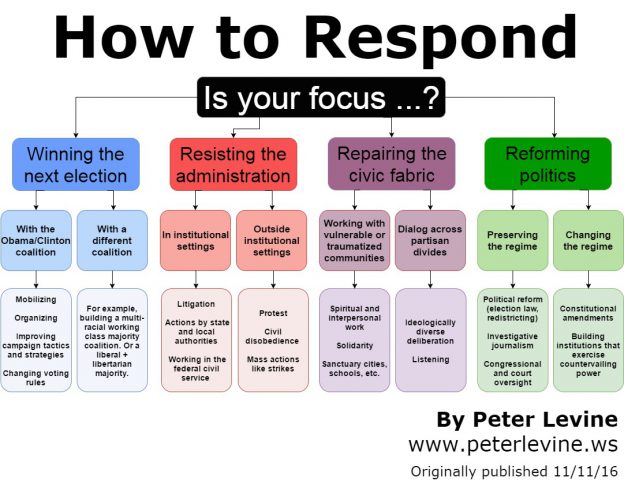
I posted the graphic that accompanies this post immediately after the 2016 election, and it went a bit viral. (Thanks to my colleague Alberto Medina for improving its appearance.) Although the name “Obama” should be changed to “Biden,” and some other minor tweaks might apply, I think the diagram remains pertinent and is perhaps even more urgent today.