Category Archives: epistemic networks

a different take on coherence in ethics

There have traditionally been two families of answers to the question: How can a moral belief be justified? Foundationalists think that beliefs are justified if they follow from beliefs that are somehow “foundational.” As Geoffrey Sayre-McCord writes, “traditionally, foundational beliefs have been credited with all sorts of wonderful properties, with being, for instance, infallible, or indubitable, or incorrigible, or certain” (p. 154). Foundational beliefs are also frequently assumed to be big: very general in scope and application. So the belief that all humans are created equal may be considered a worthy candidate to be foundational. Skepticism about foundationalism usually takes the form of asking: How can you tell that such beliefs are true? What justifies them?

Sayre-McCord divides the turf a bit differently, so that a foundationalist is simply someone who holds that some moral beliefs have a special status. They are “privileged.” They may nevertheless be fallible and modest in scope. They may, for example, be concrete judgments that we draw from experience. But they are privileged because their justification is not the support that they receive from other moral reasons. A foundationalist thinks that a given moral belief is justified only if it is foundational or it follows from foundational beliefs.

Coherentists say, instead, that all moral beliefs are on par. There is no privileged class. Any moral belief is justified by the other beliefs that relate to it. The reasons we give for a belief take the form of connections to other beliefs. By the way, the fact that a moral worldview (such as utilitarianism, or Judaism) coheres is not a reason to hold each of its component beliefs. Rather, the reason for each belief just is the support it gets from other beliefs. The more such support exists, the more we say that the whole coheres (p. 170). But we shouldn’t believe something just because it belongs to some coherent system.

Continue reading

on the moral peril of cliché and what to do about it

1. It’s likely that the moral beliefs and precepts that should guide us are unoriginal. Billions of people have already thought about the same matters; it’s unlikely that any of us will hit a new theme that has merit.

2. To shun moral ideas that are clichés would mean putting oneself above duty and justice for aesthetic reasons. That is immoral. It is a form of aesthetic immoralism common in modernism and post-modernism.

3. But clichés have moral drawbacks. Because they are well-known and well-worn, they lose their psychological force; we can ignore them. (Think of a phrase like “war is hell,” and how little it influences us.) Because they sound right and are easily portable, we can apply them where they do not belong, committing Whitehead’s Fallacy of Misplaced Concreteness. We are especially likely to misuse them to excuse and justify ourselves, because we are fierce advocates for own cause. As George Eliot’s narrator remarks in Middlemarch, “the use of wide phrases for narrow motives” is a common human frailty. Eliot adds, “There is no general doctrine which is not capable of eating out our morality if unchecked by the deep-seated habit of direct fellow-feeling with individual fellow-men.”

4. The solution, I think, is to regard one’s own moral worldview not as a list of precepts (each of which will be a cliché), but as an intricate network of ideas and implications, some general and some concrete, many in tension with each other. Only the most concrete and particular elements will be original–coming directly from your own experience. The general ones will be, for the most part, clichés. But the overall structure will be unique to you and should demand your attention.

(I treat these issues at probably excessive length in Reforming the Humanities and in a longer post “on the moral dangers of cliché.”)

toward a technique for moral reflection

classmapmarch

My undergraduate students have identified their own most significant moral ideas and commitments and the important connections among them. The image above shows the networks that have resulted so far–with each student colored differently, and each idea shown as shared if two or more students held it. Today, students are pairing up to explain their moral networks and will adjust their own maps if their partners propose persuasive ideas (or remind them of any ideas they forgot). I anticipate that the class map will become a tighter network as a result.

As I briefly explained in class, a network is a model that can be used to describe anyone’s moral thought. The nodes are ideas; the links are various kinds of connections. That people have moral networks is not a theory that could be found true or false. Rather, a network is a tool for visualizing how anyone thinks.

Often, when we try to improve our moral thought, we seek a systematic philosophy or theology. At any rate, systems (such as Kantianism, utilitarianism, or the classical Hinduism of the Bhagavad Gita) are what we most often teach in courses on philosophy and religion.

Any system organizes the whole network in some way. For instance, the system may assert that there is one highest good (very general and abstract) that should imply all the other ideas on our map. Or the system may offer an algorithm for determining which ideas belong and which ones trump other ones.

If a moral system is valid, then an individual can relate directly to it. You can adopt it as your network. You don’t need other people to help apply the system to your own life.

If you can make a moral system work, that’s fine. But I find that almost all reflective people are not systematic; they have lots of related ideas without a coherent structure. (The same has also been found by some psychologists and sociologists.) This is even true of very religious people. They may assert that God knows one organized structure or even the God holds just one idea. But we can’t know it. We humans must hold lots of different beliefs, values, stories, heroes, etc.–closely connected but not reducible to a system.

If we can’t adopt a system, the other way to improve is constantly to reflect on and revise our own networks. This is more like gardening than architecture. You start with what’s already growing, and you trim, weed, and plant one idea at a time. That process requires other people because we need their perspectives and experiences to provide ideas and to check our own biases. We can expect that our moral network will be dynamic and somewhat situational. (We’ll have different ideas in different contexts.)

At times in the history of thought, systematic moral theories have been dominant. But those moments have alternated with times when many of the leading thinkers just can’t assent to the available systems. They instead offer techniques for moral reflection and self-improvement (a.k.a. moral therapy, or moral hygiene). For instance, the systematic moment of Plato and Aristotle gave way to Stoicism, Epicureanism, and Skepticism, which are all about techniques of self-improvement. The high point of medieval Catholic systematic theology gave way to Renaissance essayists like Montaigne. The era of Kant and Hegel gave way to Emerson and Nietzsche. I think the same alternation has occurred in Eastern thought as well.

The thinkers who teach methods of continuous moral improvement vary a great deal, but I find a very frequent return to three fundamental criteria, each in tension with the other two: 1) truth, or at least the avoidance of error; 2) community or justice; and 3) happiness or inner peace. For instance, those are the three criteria in Greco-Roman thought after Aristotle. Rabbi Shimon ben Gamliel, a rabbi of about the same time, is supposed to have said: “On three things the world stands: justice, truth, and peace.” In Buddhism, the Three Jewels are Buddha (freedom from suffering), dharma (law—but in Buddhism, it often means truth), and sangha (community).

And that is why I am interested in putting people into dialogue with each other about their moral networks and asking them to reflect on whether their networks are compatible with truth, community, and happiness.

looking for your own central ideas

I have been suggesting that people map their own moral opinions as networks and critically examine the shapes that result. My students are doing that (because they have to), and some friends are doing it voluntarily. See my students’ collective map as an illustration.

One way in which networks vary is in their degree of centralization. If you map all your moral commitments and the links among them, you may reveal a network that centers around a single idea, or a very flat network in which no idea has more links than any other–or something in between. I personally favor flatter networks (for abstract philosophical reasons), but I don’t believe my reasons are decisive. So instead, I would pose these questions:

If you have a very flat network, in which no idea is appreciably more important than any other, is that a mistake? Should any of your existing commitments be made more central, because they are particularly important? What would happen, hypothetically, if you added to your network a new general and demanding principle that would link to many other ideas? (For instance: “Always maximize the well-being of all sentient creatures.”) Look at the resulting network and consider whether it has any pull on you.

If you have a highly centralized network, ask yourself whether the ideas that have proven so important deserve their weight. Are you certain that they are valid? Are you sure they are more important than your other commitments? What would happen if, for some reason, you ceased to believe in these central nodes–would the whole network fall apart? And are you able to reason with another person who does not happen to share your central commitments? Could you avoid your central beliefs in order to make arguments that the other person could accept and still navigate through your own network?

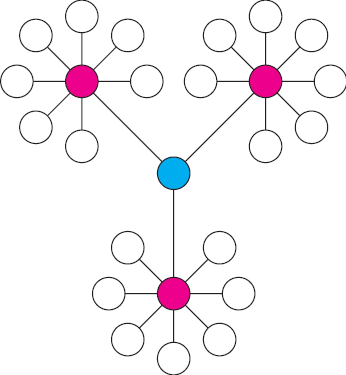
Now for a little more technical detail. There are actually several ways in which a node can be central in a network. In the image below, the red nodes are the most central in the sense that they have the most direct links to other nodes (7 each). A better way to say that is that each red node has 7 out of the total 24 links on the map, or 29%.
From Junker et al. BMC Bioinformatics 2006 7:219   doi:10.1186/1471-2105-7-219

From Junker et al. BMC Bioinformatics 2006 7:219 doi:10.1186/1471-2105-7-219

However, the blue node is central in a different sense: it lies on the path between the greatest number of other nodes. To get from any node in one cluster to any node in a different cluster, you have to go through the blue node. Yet the blue node only has 3 direct links (12.5%).

It is worth checking your own moral network for both kinds of centrality because they both matter.

Consider a person who believes in God. Presumably, God should be linked to a lot of other moral ideas–to all of them, at least indirectly. Some believers would aim for a spoke-and-wheel network in which God directly touched every other idea. To drop the network metaphor for a moment, they would immediately invoke God as the reason for every moral belief. “Purity of heart is to will one thing.”

But I do not believe that such a network design is characteristic of pious people in any religious tradition. Typically, faith takes the form of a whole set of linked ideas, some abstract and general and others very concrete. The ideas may include the stories and characters in scripture, the metaphysical attributes of God, the community of believers and their institutions, and the traditions of the faith (see my typology). Monotheists struggle to maintain one reasonably coherent network in which God is very important, but they do not organize their whole network as a single spoke-and-wheel.

Thus, for a monotheistic believer, God could appear as either the blue node or as one of the red nodes in the figure above.

In the blue-node scenario, God is what links everything together. Sooner or later, when discussing moral issues, this person would invoke God as a fundamental reason. Yet God would not be directly and immediately pertinent to most everyday decisions. The person might decide what to buy, how to vote, and how to raise her kids without immediately citing God. The connection to God goes through other ideas, such as “Do unto others as you would have them to do you,” or “Be a good member of the community.”

In the red-node scenario, God is immediately relevant in one domain of life: presumably, the religious domain. When deciding how to worship, what dietary rules to follow, etc., God comes immediately to mind. God is also linked indirectly to the whole network. But God is rather far removed from some domains of life, which might include the economy and politics.

I am using monotheistic faith as an example here, because everyone is familiar with what it means. But we could replace God with a strongly secular principle, such as “science offers the only truth.” In that case, too, the principle might be placed as the blue node, as the red node, or as one of the white nodes.

Overall, the network shown above is fragile because it only holds together thanks to the one blue node. Knock that out and there is no network at all. If the central node is true and deeply significant, then so be it. Deep faith (whether religious or otherwise) means committing to an idea even at the risk of having a fragile network. But if one believes that it is important to deliberate with other people, then the network shown above is problematic because the conversation will break down as soon as your interlocutor denies the contents of the blue node. You will have no other way to make your point than to repeat that node.

I fundamentally believe in deliberation because of human cognitive and motivational limitations. Each of us has a narrow and biased worldview, and the best we can do is to interact with others. That means that if your network is as centralized as the one shown above, you are at risk. On the other hand, if your network is completely flat, maybe you lack a sense of what is most important.
mapping a class as a moral community

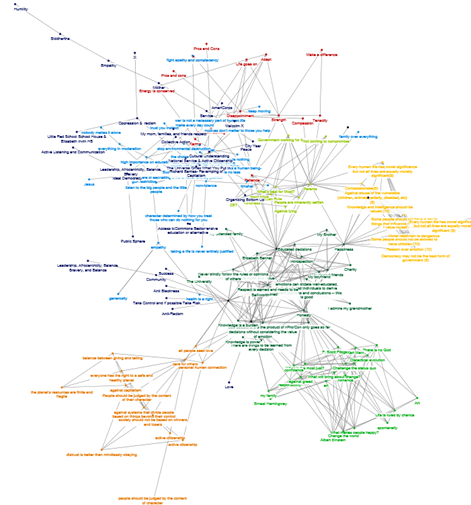
On the first day of the spring semester, I asked members of a small philosophy seminar to reflect on their own core moral ideas–meaning not only their abstract principles but also their concrete commitments and role models–and how those interconnect. They gave me their data (concealing any ideas that they wanted to keep private), and I mapped the results as one network for the class as a whole.

In general, the ideas cluster by student (each colored differently in this map); but when two or more people share an idea, the borders among individuals begin to break down.

class map 1.17
I hope that over the course of the semester, the map will become more integrated and denser as the students add ideas and connections among ideas and begin to hold more ideas in common. Their thinking should be influenced, in part, by the readings and by me; therefore, ideas discussed in class should pop onto the map. Agreement is not the goal, but members of a discursive community should share reference points. One student actually predicted increased polarization as new ideas are thrown into the mix, and that is certainly possible.

Why did I ask them to give me networks? I could have asked for lists of ideas (perhaps ordered by importance); for structures (with fundamental ideas implying consequences); or for bodies of text that explained each students’ views.

A list seems problematic because one cannot tell whether each item belongs on it. For instance, if it is true that one should maximize the happiness of the greatest number, then that concept should appear on your list. But if not, it should not be there. How can one tell? In contrast, you can ask questions about your network independent of the content of each node. Is the network dense? Does it cover a wide range of ideas? Are the ideas that turn out to be central worthy of their importance? Is the network connected to other people’s networks?

For elaborate reasons, I am skeptical of ordered structures for moral reasoning. But a network is actually a flexible form that can encompass a hierarchical structure. A utilitarian could give me a network that centered around the utilitarian principle. A network model simply does not presume that a moral worldview must be highly centralized or ordered.

Finally, a body of text would be valuable–but it would have to be very long, and I would be inclined to analyze it by looking for the ideas and connections that it implied. Thus the network is an efficient representation of the text, albeit one that leaves unexplained the individual nodes and the reasons for their connections.

(see also: the place of argument in moral reasoning; epistemic network analysis and morality: applying David Williamson Shaffer’s methods to ethics; Emerson’s mistake; character understood in network terms; and envisioning morality as a network)