Category Archives: civic theory

Generous Listening Symposium

This week, I am helping to lead a research symposium on “Generous Listening in Organizations” in partnership with the Vuslat Foundation. The main topic is listening to colleagues, including supervisors and employees. This practice is important for society and it matters to me, as a long-time middle-manager in a large organization (a university).

I also come into this conversation as someone who studies politics, broadly defined, and who believes that a better understanding of listening may create fruitful openings for strengthening democracy.

There is a vast literature on political communication, speech and rhetoric, deliberation, debate, and the public sphere–defined as the institutions in which people express their views. This topic is important because we do not automatically hold opinions, even about our own circumstances. We usually obtain our views through communication, which can go either well or badly. We can be persuaded to sacrifice for the common good or to become murderous racists. We can be persuaded that we are citizens of the world or members of narrow communities. Political action then follows communication.

Listening is one side of this exchange. It is certainly not absent in the literature but is less often discussed than the other side: speaking.

The research on political communication is diverse and nuanced, but quite a lot of it is critical. Survey-based research in the United States–and in many other countries–often finds that people are ill-informed, biased, and incoherent. I semi-facetiously summarize the overall message of current political science as: “People are stupid and they hate each other.”

The specific findings are often valid and worth consideration, but the overall message may hamper efforts to improve civic life. The message is most discouraging when the specific findings are linked to general claims about human beings, e.g., that we are naturally self-interested or that we evolved to use heuristics helpful in small groups of hunter-gatherers that fail to equip us for responsible self-government at a mass scale. If human beings have deep psychological limitations for participating in democracy, then perhaps we had better shore up our most basic safeguards (especially the peaceful transition of power after each election), and not be distracted by more ambitious democratic ideals.

I start with a different assumption. I presume that we exchange ideas in artificially designed settings that can help us to be wise or foolish: assembly halls, churches, newspapers, classrooms, laboratories, online networks, and many more. Designing and expanding good settings requires a degree of optimism about human potential. Therefore, research that implies we are hard-wired to be foolish can discourage people from working to build better institutions. And when our institutions are weak, we tend to think and behave in troubling ways that research then reveals, thereby reinforcing the researchers’ skepticism–a classic vicious cycle.

A focus on listening might help break the cycle. The evidence is pretty strong that when we form and state opinions, we are not as wise as we believe. We offer reasons for what we think and value that sound good to us–they sound like explanations of our views. But often, we have formed our views intuitively and then merely rationalized them in speech. Furthermore, our intuitions are unreliable, because they often reflect cognitive biases, selfishness, and limited empathy.

However, there is also evidence that we can be pretty good at listening. We can assess the reliability and competence of speakers and the cogency of their claims. In turn, our assessments of others’ statements can shift our intuitions. Indeed, Mercier & Sperber (2017) argue that we evolved to do this–to scan our human environment for people whose views are worthy of trust.

But then the questions include: How can we listen well? And how can we design institutions to enable and reward good listening?

Reference: Mercier, Hugo and Dan Sperber, The Enigma of Reason, Cambridge, MA: Harvard University Press 2017. See also: how intuitions relate to reasons: a social approach; how the structure of ideas affects a conversation; An agenda for R&D for democracy etc.
Providence College talk on What Should We Do?

This is the video of my Jan. 31 presentation about my recent book, What Should We Do? A Theory of Civic Life at The Providence College Humanities Forum, along with a Q&A session with good questions from the audience. The presentation should make sense and, I hope, have some value for people who don’t read the book. I am grateful to my Providence College friends for the opportunity.

civic leverage

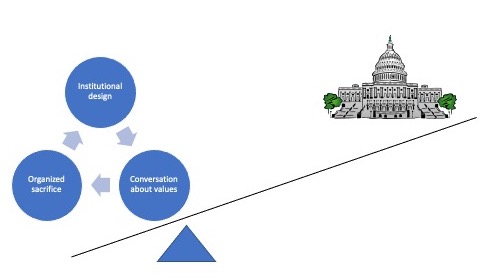
The illustration with this post illustrates an idea from my book What Should We Do? A Theory of Civic Life, but it is not included in the book (because I just thought of it.)

The circle labeled “institutional design” refers to a process of establishing rules, norms, membership criteria, etc. for any group. Unless an institution evolves from its predecessors, it is usually designed by a single founder or a small leadership team. An inchoate collection of people cannot design an institution from scratch. Only once the design is reasonably effective will many human beings be able to coordinate their behavior sufficiently to accomplish anything worth discussing. The options for designs include democratic processes, market mechanisms, strong leaders, bureaucratic structures, and many more.

From a civic perspective, a good institution is one that encompasses some variety of perspectives and values and that enables its members to express their contrasting views in ways that inform the whole. The circle labeled “conversation about values” can mean a deliberative democracy, but it can take many other forms as well. For instance, although the Catholic Church does not purport to be a democracy, it is a rich platform for discussion and debate. Conversations about values increase the chances that a group will make wise choices and allow individuals to exercise voice and agency, which is part of a good life.

When people in a functioning group discuss values, they may motivate themselves to make sacrifices (the third circle in the diagram). Even an ordinary voluntary association asks people to spend time attending its meetings. A movement that confronts violent repression may ask its participants to put their lives at extreme risk. The degree of contribution varies, but some level is inevitable. “Organization is sacrifice,” as WEB DuBois once wrote.

Sacrifice can affect the original institutional design. For instance, an ordinary voluntary association will wax or wane depending on who gives time and money, and how much. A social movement may change the fundamental structure of the government itself.

This cycle must occur at a human scale. It’s about discussion, relationships, and individuals’ impact on groups. Participants must know one another. The maximum number of people who can engage together is not clear, but it is much less than the eight billion people who share our earth today. Thus the limitation of this cycle is its size in comparison to the scale of our problems.

The answer must be leverage–smallish groups affecting much larger groups by influencing governments, markets, corporations, or media-producers.

Leverage affords power, but it is problematic because it is unidimensional: some people affect others without knowing them or hearing from them. I think we must accept the moral disadvantage of leverage, but we can mitigate it by expecting the people who exercise power over others to do so as members of groups that are somewhat diverse and porous (or connected to other groups) and that go through the cycle of institutional design, conversation about values, sacrifice, and re-design. That process increases the odds that they will be wise in their treatment of strangers.

See also du Bois: “Organization is sacrifice.”; the kind of sacrifice required in nonviolence; a flowchart for collective decision-making in democratic small groups; both detailed institutional analysis and holistic critique;  a template for analyzing an institution; Complexities of Civic Life, etc.

Mapping Ideologies as Networks of Ideas

Newly published (behind a firewall): Peter Levine (2022) Mapping ideologies as networks of ideas, Journal of Political Ideologies, DOI: 10.1080/13569317.2022.2138293.

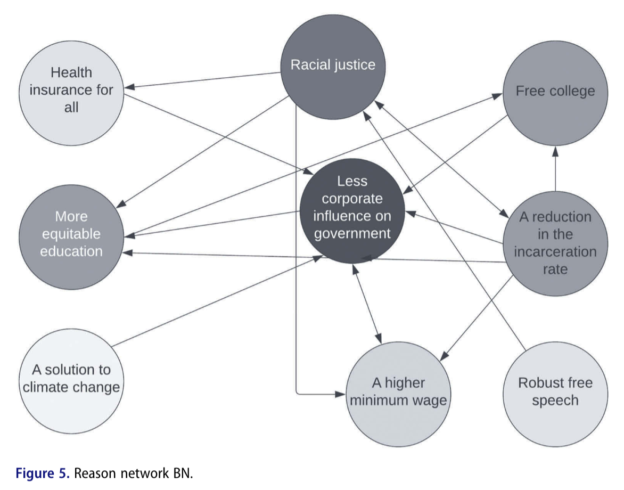
This is an early publication from my main current scholarly project. I am concerned that several streams of research and intellectual conversations are converging on the same conclusion: people just aren’t very thoughtful or rational about politics. This stance discourages efforts to enhance democracy and the public sphere. However, the most prevalent measurement tools–standard opinion surveys–are systematically biased against detecting the complexity and individuality of individuals’ political views. Various colleagues and I are experimenting with alternative quantitative methods that involve directly asking people about the connections among their distinct beliefs and analyzing the results as networks. This sole-authored article is a pilot study aimed at validating the method.

Abstract:

Individuals in a non-representative sample of 93 US progressives were asked which social outcomes they valued and then asked about the relationships among these opinions. Did each outcome provide a reason for a different one? Would each outcome cause a different one? If each outcome came to pass, would it make them more likely to support another outcome? Network diagrams derived from these responses represent portions of these individuals’ ideologies, understood as structures of political thought. Scrutiny of the network diagrams and analysis of the aggregate data suggest that most respondents carefully and reasonably identified relationships among their own ideas. Features of their networks predicted their assessments of five prominent politicians. This exploratory study paints a strikingly different picture of the sample than what would emerge from more conventional methods, such as factor analysis. Instead of a group that looks ideologically homogeneous on a unidimensional scale or that exhibits a low level of ideological coherence (because very few of their ideas are correlated), this method displays a collection of people who hold diverse and complex structures of thought. The method should be replicated with representative samples to explore the variation and significance of such structures.

See also: what if people’s political opinions are very heterogeneous?;  individuals in cultures: the concept of an idiodictuon; ideologies and complex systems; don’t let the behavioral revolution make you fatalistic, etc.

who are today’s republicans (in the classic sense of the word)?

In our Introduction to Civic Studies course, we are briefly discussing both the classical tradition of republican thought (from Cicero to John Adams) and the contributions of Black American republican thinkers of the 19th century, as described by Melvin Rogers (2020). In this brief introductory video, I identify the following components of traditional republicanism:

  • Opposition to domination (which republicanism defines as the basic problem)
  • Rule of law
  • Separation of powers
  • Deliberation
  • The common good
  • Popular participation (going beyond voting, which by itself can allow domination by the majority)
  • Anti-elitism
  • Civic virtues and an expectation of sacrifice for the common good

One of our US political parties happens to be called “Republican,” and I think that is not merely coincidental. The GOP has roots in antebellum abolitionist movements that, in turn, explicitly invoked republican ideas.

But that doesn’t mean that either of our major parties today is necessarily more republican (in the classical sense) than the other. The recent Civic Language Perceptions Project from Philanthropy for Active Civic Engagement (PACE) offers a chance to see how partisanship–as well as demographics–relate to classical republican ideals. Not all of the components of republicanism are tested, but some are. The data come from a nationally representative random sample of 5,000 registered voters conducted in 2021.

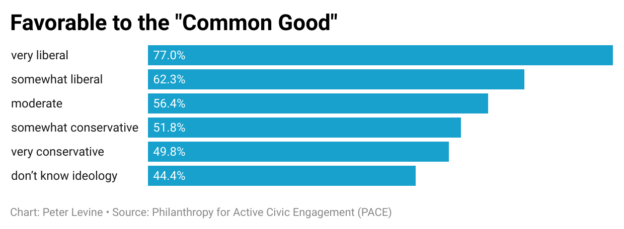
One component of traditional republicanism was an orientation to the common good. That phrase might seem like empty rhetoric, but classical republican authors placed the common good ahead of individual negative freedom, material prosperity, and pluralism, which they often decried as “factionalism.”

PACE asked respondents to react to the phrase “common good,” and it performed best among people who identified as “very liberal.” (See the graph above.)

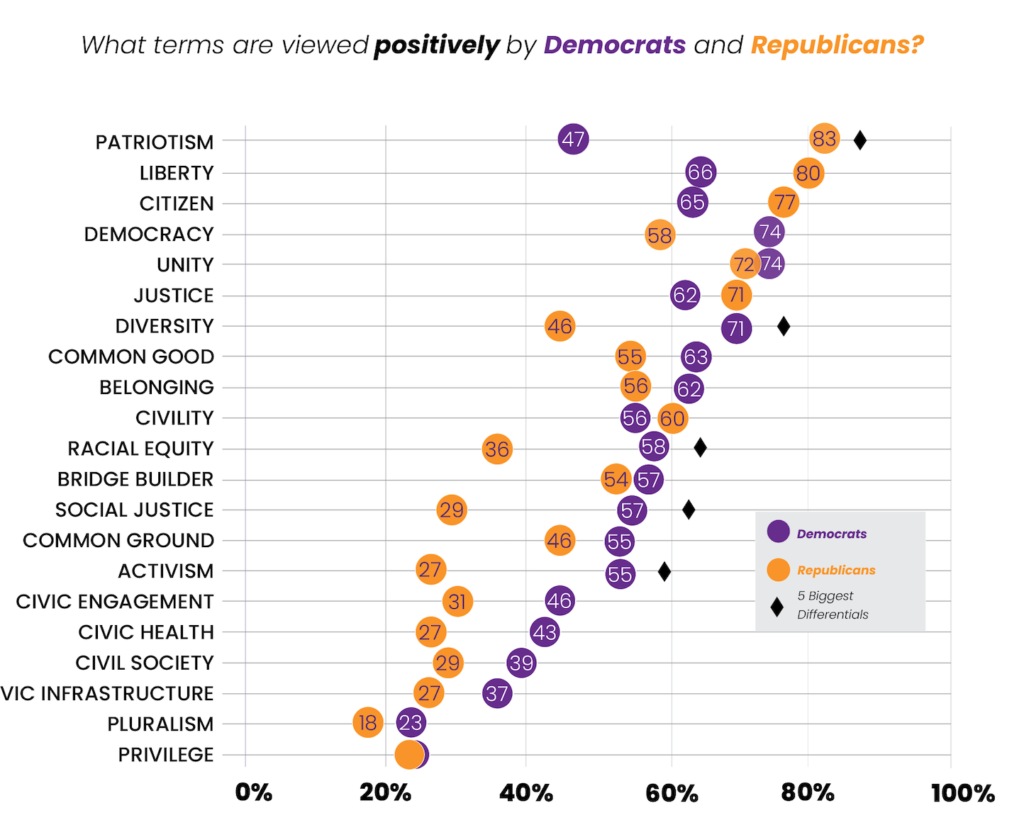
Patriotism is not on my list of components of republicanism, but often the civic virtues have been defined in patriotic terms. Although some today may see patriotic rhetoric as conservative, it was fundamental to left-wing revolutionary republican movements, from France in 1789 to Mexico in 1910 to Russia in 1917. According to the PACE data, patriotism polls far better among Republicans than among Democrats: a 36-point gap. (See below.)

“Liberty” was the great principle for classical republicanism, and it polls better among Republicans than Democrats. However, some Americans may think of liberty as non-interference (simply being left alone), whereas for classical republicans, it meant non-domination (freedom from arbitrary will). This semantic ambiguity makes the result hard to interpret.

Both parties like “unity,” which was a classical republican value, but Democrats like “diversity” much more than Republicans do. Classical republicans tended to be skeptical of diversity. Therefore, either Democrats dissent from classical republicanism on this issue, or else the word “diversity” is being used in a new way–basically to mean racial equity, which Democrats like much more than Republican do: a 22-point gap. Classical republicans should have embraced racial equity, even though few actually did.

Republics require participation, also known as civic engagement, and that phrase is more popular among Democrats than Republicans.

Democracy is compatible with republicanism, although proponents of democracy tend to emphasize majority rule and responsiveness to mass opinion, whereas republicans want voting to play the limited role of checking elite domination. Madison writes, “If a faction consists of less than a majority, relief is supplied by the republican principle, which enables the majority to defeat its sinister views, by regular vote” (Federalist 10). In this passage and many others, he’s defining “republican” as majoritarian, but his own overall view is more complex. Democrats are more favorable to the word “democracy” than Republicans are, according to the PACE data, although a majority of Republicans do support it.

On balance, one might conclude that today’s Democrats are more republican than Republicans are; but perhaps it’s more accurate to regard the classical republican tradition as marginal all across our spectrum.

PACE infographic

Source: Melvin Rogers, “Race, Domination, and Republicanism,” in Difference without Domination: Pursuing Justice in Diverse Democracies, edited by Danielle Allen and Rohini Somanathan (University of Chicago Press 2020). See also introducing republicanism; James Madison in favor of majority rule; every Republican president [until Trump] insisted that the US is a democracy; a Democratic Republican Federalist; what defines conservatism?; liberals, conservatives, and love of the Constitution etc.