Category Archives: civic theory

new journals related to civic renewal

Scholars working on civic engagement, civic education, and related topics have no shortage of publication venues, including free, online–but peer-reviewed–journals:

The International Journal of Research on Service-Learning and Community Engagement has published its first issue. Articles include “Rethinking Peer Review: Expanding the Boundaries for Community-Engaged Scholarship” by Sherril B. Gelmon, Cathy M. Jordan, Sarena D. Seifer, and “A Research Agenda for K-12 School-based Service-Learning: Academic Achievement and School Success” by Andrew Furco.

The Journal of Public Deliberation (JPD) is now up to volume 9, issue 2.  The new issue includes articles on stakeholders and citizens in deliberation; participation in the New York Public Schools; and the effects of non-neutral moderators. The current editorial team has done a great job, but they are handing it over to a great new team of Laura Black, Tim Shaffer, and Nancy Thomas.

The Journal of Civic Literacy has launched its website and invites research on “the causes and consequences of low levels of literacy, the role of public education, the comparative efficacy of available curricula and programs (what is working? why and how?), the connections between the current media environment and deficient civic understandings, and the role of civic literacy in defining ethical and trustworthy public service.”

The eJournal of Public Affairs is published by Missouri State University and affiliated with the American Democracy Project. “Public Affairs” means different things to different people, but this journal is actually devoted to civic engagement, civic education, and closely related topics.

Partnerships: A Journal of Service-Learning and Civic Engagement comes out of North Carolina Campus Compact but has national reach and is also a peer-reviewed, open-access journal.

The Journal of General Education (“A Curricular Commons of the Humanities and Sciences”) is edited by Jeremy Cohen, who has a deep commitment to civic education, free speech, and public media. So, although its topic is “general education” at the undergraduate level, it is an important site for discussions of civic education and engagement.

[Added later:]

The Good Society is a distinguished journal of political theory, now turning to what we call Civic Studies. It is not open-source because of the contract with the publisher, but articles are freely available for two months after publication. In any event, it is a fine journal.

And Public, from Imagining America, is a peer-reviewed, multimedia e-journal focused on humanities, arts, and design in public life.
do companies control governments?

Consider that:

  • The same US government that can apparently tap almost any telephone in the world cannot harvest information that people voluntarily provide on the government’s own website regarding their eligibility for insurance.
  • A private firm, CGI Federal, botches healthcare.gov. A private firm, Dell, employs the analyst, Edward Snowden, who leaks the NSA’s secrets.
  • Snowden reveals (inter alia) that the NSA has been spying on Angela Merkel, whose main impact has been holding down government spending and debt throughout Europe, in keeping with neoliberal economic doctrine.
  • Companies like Google and Facebook possess unprecedented knowledge of the private behavior and beliefs of citizens. They profess “outrage” at the government’s collection of private information. They call it “outright theft.” Apart from their annoyance at losing their data to the state, they fear that consumers will now be reluctant to share information on US-based networks–information that is currently worth about $1,200/person to firms like Google and Facebook.
  • The Tea Party is a loose movement that professes support for free markets and resistance to government. Its power has presumably kept corporate taxes and regulations lower than they would be otherwise. Yet the US Chamber of Commerce and individual companies like AT&T and Caterpillar are so angry about the recent federal shutdown that they are spending significant money to defeat Tea Party-backed candidates in Republican primaries.
  • Facebook founder Mark Zuckerberg creates FWD.us to promote immigration reform. Through a subsidiary called Americans for a Conservative Direction, FWD.us funds conservative candidates who support reducing certain barriers to immigration. Through a different subsidiary called the Council for American Job Growth, it “reach[es] out to progressive and independent voters.”

One way to put these scattered points together is to talk about “the neoliberal state.” Big businesses basically get the policies they want, whether in the US, Germany, Russia, or in (nominally communist) China. Far from constraining them, the state is their assistant. The news consists of little skirmishes between particular businesses and forces not completely under their control: Tea Partiers, the national security apparatus, the US Attorney in Manhattan, and the Democratic Party. Business wins virtually all the skirmishes, and the underlying reality is even more favorable to its interests than the scattered conflicts suggest.

I mention the idea of the neoliberal state because I see that it contains a lot of truth. But I dissent in part on theoretical, moral, and strategic grounds:

Theoretically: we have to remember the problem of collective action. Each business gains from laissez-faire policies–but only a bit, and the competition gains as well. It is not in each firm’s self-interest to be too politically active. Eruptions like the Chamber versus the Tea Party, the Koch Brothers versus Obama, or Google versus the NSA show that it is genuinely difficult for a whole array of competing businesses to coordinate their efforts to achieve the ends they want. Clearly, ordinary people face even more daunting collective-action problems, but that is what political organizing is for.

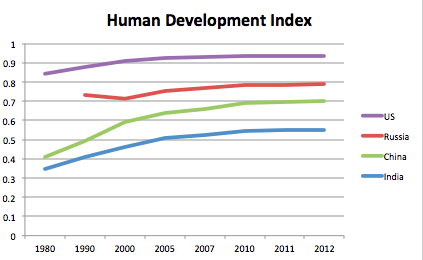
Morally: the critique of the neoliberal state ignores the benefits of global markets. The Human Development Index is a pretty good measure of actual well-being, incorporating not just per capita wealth, but also outcomes like health, education, safety, and women’s empowerment. This graph shows the trends in HDI since China and India opened their economies to direct foreign investment and became sensitive to global markets. The upward trends represent substantial net improvements in the lives of billions of human beings.

Screen Shot 2013-11-03 at 8.33.29 PM

Strategically: the theory of the neoliberal state gives the impression that ordinary people have no power. That impression is itself disempowering. Elections in the US are influenced by cash, but no one literally has more than one vote. If we choose not to do what big businesses tell us to do, we win. A defeatist theory makes that less likely.

I am not saying that the governments of the US, the EU’s members, China, India, and Russia are independent of big business or that corporate pressure is benign. I am claiming that the situation is somewhat complicated and unpredictable, and there is room for strategic action. Each of the bullet points with which I began this post is a pressure point.

(See also “two doses of realism about democracy,” “what is corruption?,” and “putting facts, values, and strategies together: the case of the Human Development Index.”)

music and civic engagement (an analysis of private and public goods with intrinsic value)

A colleague recently suggested an analogy between music and civic engagement, emphasizing that both have been transformed by technological/economic changes, and there is no going back to the old days. We used to get music from recording companies and participate in public life thanks to daily newspapers, unions, grassroots political parties, and durable civic associations. The traditional institutions for both music and citizenship have been replaced by loose networks and individual choice.

We could extend the analogy by noting that civic engagement, like music, can bring satisfaction to the participants. Neither activity is a mere chore to be done to achieve an outcome. In both cases, people may be enthusiastic to participate (or not–their interest varies). Both activities are heavily collaborative. And in both cases, we should welcome a wide range of excellence. The one-in-a-million talent is admirable in politics, as in music, but we also need average people to sing and to express their political views. In both cases, people appreciate excellence better if they also contribute at their own level.

The differences are also worth noting. For one thing, civic engagement has a strong ethical aspect. Mussolini was active and skillful, but he made the world worse. We must able to evaluate civic engagement ethically with attention to means and ends. I would, for example, build into the definition of good engagement a strong desire to understand alternative views. The most ethically demanding aspects of citizenship do not come naturally. Neither does good musicianship, but I think that the ethical demands of citizenship are more onerous than the preconditions of making music.

Also, certain forms of civic engagement are rivalrous or competitive. More engagement by Tea Partiers means less success for liberals, and vice-versa.

Everyone has a right to be heard in the political domain. Although no one is obligated to listen to me sing (an unpleasant experience), my fellow citizens must give me equal time in a public meeting, just because I am a member of their community.

Finally, it is healthy in both civic life and music for people to form smaller communities of interest with diverse styles. However, as long as important decisions are made by governments, the people of each political jurisdiction must sometimes form a single political community to discuss and act on their common fate. In contrast, we never have to bring all the choirs, bands, and orchestras together to make one stream of music.

The differences between music and citizenship mostly point to the need for intervention in the civic domain. I think music will thrive in a world of digital files, free choice, and loose voluntary networks. Civic engagement needs help.

the death of an ancient commons?

Vista típica de la Huerta de Valencia.

(Near Tarrytown, NY) The huertas of Valencia, Spain, represent a magnificent example of human cooperation, but I am told they are now doomed. The reasons are endemic to modernity and require serious consideration.

Water is a scarce resource, essential for life. If you can take water for your own crops, basic economic theory says you will take lots of it even if others downstream don’t get enough. The rain and the river can’t be privatized in simple ways. The state can police water-use, but it’s hard and rare to build states that are smart, responsive, virtuous, and just enough to accomplish tasks like efficient and fair water-management.

But, contrary to a simplistic economic model, farmers in Valencia, Spain, have been distributing very scarce water consistently since before 1238. The rules and tools they developed are summarized here. Their tribunals and other processes were already in place during the Muslim period and may have predated the Islamic conquest. They continued more or less smoothly despite the Christian Reconquista, the unification of Spain, its economic decline, Civil War, and fascism.

But, as I am told by Francisco Arenas-Dolz (a distinguished Spanish academic whose own family used to farm in the huerta system), it is now disappearing. Former farmers are moving to high-rises in the city, and suburban sprawl is swallowing up agricultural land.

One cannot blame people for “exiting.” I would not want to be a farm-worker in an arid climate (or anywhere). I suspect that, despite the radical shifts in Valencia’s political and religious regimes over a millennium, one thing remained constant: peasants couldn’t leave the land. Now they can leave, and they are leaving, and I don’t lament that.

But we can lament two outcomes. First, the huertas have aesthetic, cultural, and environmental value that individual participants (as well as outsiders) prize. The individuals’ exit benefits them but destroys something that they love. They would all be better off if somehow the huertas could be preserved. The agricultural landscape could perhaps have evolved into something new and better, an economy that offered higher-skilled and more profitable jobs to a few people still in touch with their traditions. Instead, it is just vanishing.

Second, the heurtas taught ethics, skills, habits, and techniques for solving collective-action problems. Even if we give up on small-scale agriculture in Valencia, we still face inescapable problems at a bigger scale. Climate change is only the most dire example. If everyone exits the huertas and that model vanishes, how will we learn to address bigger Tragedies of the Commons?

(See also “Why Engineers Should Study Elinor Ostrom,” my obituary of Ostrom, and “Albert O. Hirschman on Exit, Voice, and Loyalty.”)

Albert Dzur and democracy inside institutions

Albert Dzur, author of Democratic Professionalism and Punishment, Participatory Democracy, and the Jury, is writing a series in the Boston Review entitled “Trench Democracy: Participatory Innovation in Unlikely Places.”

When we think of democratic reform, our minds usually turn to explicitly political upheavals: the Civil Rights Movement, the Arab Spring. In such cases, masses of people put aside their ordinary lives of family and work to press for a new government–or at least for new laws.

That definition of reform hides a different kind of democratic politics that is more sustained, less state-centric, and less obvious to reporters and average citizens. It is what Dzur calls “the public work of self-directing community groups that band together to secure affordable housing, welcome new immigrant groups, and repair common areas like parks and playgrounds.”

I am aware of this kind of public work and have put it at the center of my book We Are the Ones We Have Been Waiting For. I argue that about one million Americans are engaged in “self-directing community groups” in particular places and issue areas. But they do not yet see themselves as part of a civic movement that is larger than their particular projects and causes. So we must organize them to advocate in their common interest–for funds to support civic processes, rights to public participation, education policies that support high-quality civic education, and news coverage of citizens’ work.

In developing this strategy and counting my one million civic activists, I did not pay sufficient attention to the layer of politics and reform that Dzur investigates. I describe leaders and members of civic groups, but his main topic is the everyday pro-democratic work of professionals within mainstream organizations:

[T]hey take their public responsibilities seriously and listen carefully to those outside their walls and those at all levels of their internal hierarchy in order to foster physical proximity between formerly separated individuals, encourage co-ownership of problems previously seen as beyond laypeople’s ability or realm of responsibility, and seek out opportunities for collaborative work between laypeople and professionals.We fail to see these activities as politically significant because they do not fit our conventional picture of democratic change. As if to repay the compliment, the democratic professionals I have interviewed in fields such as criminal justice, public administration, and K-12 education rarely use the concepts employed by social scientists and political theorists. Lacking an overarching ideology, they make it up as they go along, developing roles, attitudes, habits, and practices that open calcified structures up to greater participation. Their democratic action is thus endogenous to their occupational routine, often involving those who would not consider themselves activists or even engaged citizens.

Though they belong to practitioner networks and engage in ongoing streams of print, online, and face-to-face dialogue, the democratic professionals I have met do not form a typical social movement. Rather than mobilizing fellow travelers and putting pressure on government office holders to make new laws or rules, or convening temporary participatory processes such as citizens’ juries, deliberative polls, and citizens’ assemblies, democratic professionals are making real-world changes in their domains piece by piece, practice by practice. In the trenches all around us they are renovating and reconstructing schools, clinics, prisons, and other seemingly inert bodies.

The rest of Dzur’s series will explore examples of this work, using his own interviews with committed democratic professionals. These professionals must be part of a movement for civic reform. The first step is to learn who they are and what they are striving for. Dzur’s work is indispensable for that purpose.