Category Archives: civic theory

when political movements resemble religions

In The Atlantic, John McWhorter suggests analogies between current movements against racism and religious revivals:

Third-wave antiracism is a profoundly religious movement in everything but terminology. The idea that whites are permanently stained by their white privilege, gaining moral absolution only by eternally attesting to it, is the third wave’s version of original sin. The idea of a someday when America will “come to terms with race” is as vaguely specified a guidepost as Judgment Day. Explorations as to whether an opinion is “problematic” are equivalent to explorations of that which may be blasphemous. The social mauling of the person with “problematic” thoughts parallels the excommunication of the heretic. What is called “virtue signaling,” then, channels the impulse that might lead a Christian to an aggressive display of her faith in Jesus.

… The new religion, as a matter of faith, entails that one suspends disbelief at certain points out of respect to the larger narrative. ….

When someone attests to his white privilege with his hand up in the air, palm outward—which I have observed more than once—the resemblance to testifying in church need not surprise. Here, the agnostic or atheist American who sees fundamentalists and Mormons as quaint reveals himself as, of all things, a parishioner.

McWhorter presents this analogy as a critique. He advises: “Social concern and activism must not cease, but proceed minus the religious aspect they have taken on.”

One obvious question is whether McWhorter is right that the anti-racist left is losing because of its rhetorical style. Jeffrey Sachs, for example, thinks it is winning.

But I am interested in a different question: why does political ideology often resemble religion? After all, anti-racist politics is not unusual in this respect.

  • Environmentalism offers an account of original sin (human exploitation of nature), an eschatology (the planet will be wrecked by greed and waste), authorities (climate scientists) whose conclusions must be trusted even though we can’t see or replicate what they see, heretics (climate skeptics), a moral critique of everyday behavior, and a path to salvation through sacrifice.
  • Libertarians define original sin as the influence of the state, which relies on violent force. Its tentacles reach into everyday life through taxation and regulation, corrupting the free condition of voluntary exchange. The state has a satanic tendency to expand, preying on human weakness. Until freedom is restored, libertarians should gather to read scripture (Hayek, von Mises) and convert wavering souls.
  • Marxism offers the whole package: scripture, prophets, martyrs, hymns, icons, metaphysics, eschatology, multiple denominations and sectarian schisms, heretics and excommunications, revival movements, fundamentalist and revisionist strands …

This list could probably be extended to include New Deal liberalism, various forms of nationalism, third-wave feminism, Bonapartist populism, etc.

A resemblance to religion does not invalidate a political movement. I am an environmentalist and I am not shaken by the fact that environmentalism bears a point-by-point similarity to Protestant Christianity. Faith in climate science is a necessary step to saving the planet. Maybe confessing white privilege is a necessary step to racial justice.

But we might ask: do these political movements so closely resemble religions because we have mental habits that we lazily or uncritically apply to new domains? Could we be more effective if we were more original?

Alternatively, are these excellent ways for human beings to organize our thoughts, and that is why they have reappeared in secular contexts after first flourishing in religions?

Also, are these forms of thought characteristic of religion, or only of Abrahamic religions? Some aspects of environmentalism and libertarianism (original sin, individual responsibility as part of voluntary groups) remind me specifically of Lutheran Christianity. They don’t sound at all like Buddhism, for example. Does that mean that these movements are problematically “Western”? Or did the Reformation give us tools for understanding and improving the world that we should be glad to use for other purposes?

See also: is everyone religious?; are religions comprehensive doctrines?; the political advantages of organized religion; the I and the we: civic insights from Christian theology; and avoiding the labels of East and West.

against inevitability

These are examples of social theories that emphasize inevitability:

  • Classical Marxism: “[The bourgeoisie’s] fall and the victory of the proletariat are equally inevitable.” — Marx and Engels, The Communist Manifesto
  • Rational choice theory: What defines the tragedy of the commons is the “solemnity of the relentless working of things,” “the inevitableness of destiny,” and “the futility of escape” — Garret Hardin, “The Tragedy of the Commons” (quoting Alfred North Whitehead about tragedy)
  • Skepticism about Great Men: “But the mysterious forces that move humanity (mysterious because the laws of their motion are unknown to us) continued to operate. Though the surface of the sea of history seemed motionless, the movement of humanity went on as unceasingly as the flow of time. Various groups of people formed and dissolved, the coming formation and dissolution of kingdoms and displacement of peoples was in course of preparation.” –Tolstoy, War and Peace
  • Progressivism: “The current has set steadily in one direction: toward democratic forms” — John Dewey, The Public and its Problems
  • A small-d democratic version: “Never doubt that a small group of thoughtful, committed citizens can change the world. Indeed, it’s the only thing that ever has.”–Margaret Mead (attributed)

One thing that unites the disparate authors in our canon of Civic Studies authors is a refusal to accept any of these forms of inevitability.

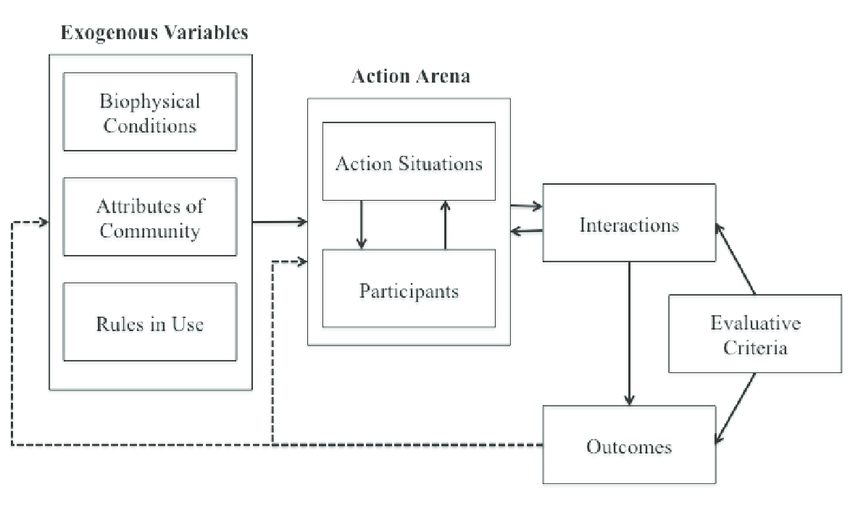
Elinor Ostrom was part of the rational choice tradition, but she argued that whether we succumb to collective action problems–including today’s peril of climate change–depends on how we organize ourselves. It is neither a tragedy nor a comedy but a “drama.” She found that bottom-up solutions sometimes worked, and their chances of working depending on whether the participants used smart practices.

Jürgen Habermas came out of the Frankfurt School, which had assumed that capitalism inevitably blocks free inquiry and emancipatory reason. He also read theorists like Dewey, for whom (at least in my interpretation) emancipation is inevitable. Habermas holds, instead, that how well we reason and deliberate depends on how we organize our public life, and we have a chance to improve it if we work hard and wisely.

Gandhi and Martin Luther King confronted people who were deeply skeptical of nonviolent resistance, as well as quietist religious believers who preferred to wait for providence to sort things out. Their constant refrain was that we have a chance to improve the world if we try. Social science confirms that civil resistance sometimes works–and more often than violence does–although it depends on how the resistance is organized. During the century after Gandhi’s youth, the record of civil resistance improved, as activists learned better tactics, but lately, its record has gotten worse due to the autocrats’ ability to learn from their experience.

A major 20th century debate was about the relative importance of structure versus agency. Is history driven by inevitable processes or by intentional human action? The answer to that empirical question is: Some of both. But a much better question is: How can we enhance the better forms of human agency? The role of theory is not to weigh the past impact of structure and agency but to make agency more important in the future.

See also: beyond civic pietyOstrom, Habermas, and Gandhi are all we need and Habermas, Ostrom, Gandhi (II).

the justice-oriented citizen had better be personally responsible and participatory

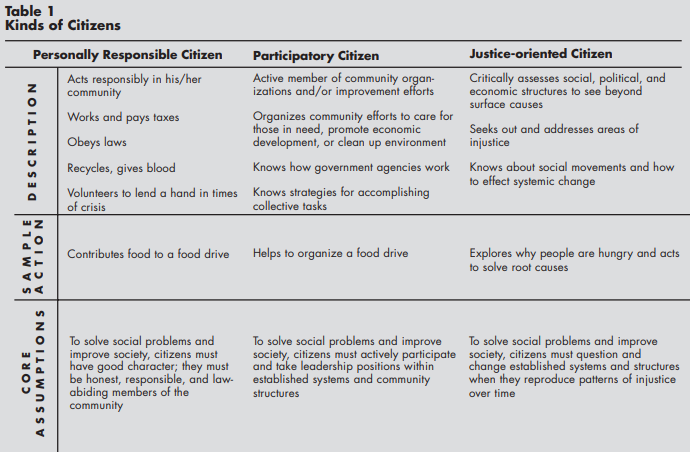
Joel Westheimer’s and Joe Kahne’s typology of civic education programs and their intended outcomes is justly seminal in the field of civic education.* Many civics people are familiar with their distinctions among “personally responsible,” “participatory” and “justice-oriented” citizens as the goals of real-world programs and curricula. Most reflective educators favor the last type, although the first type is the most common in everyday practice.

Discussing their article in an undergraduate course in which we also read Martin Luther King, Jr’s book Stride Toward Freedom, I was struck by how perfectly the first two columns describe the people who won the struggle of the Montgomery Bus Boycott. They “volunteer[ed] to lend a hand” so that thousands of Black workers could get to and from their workplaces without using the segregated buses. They had long traditions of belonging and tithing to churches, so they could be organized in their pews to support a boycott. They “obeyed laws,” except when they broke very specific laws as part of civil disobedience campaigns, and they followed the emergent rules of their own movement. They knew “how government agencies worked”–so well that they won federal lawsuits. And they were brilliant at “strategies for accomplishing collective tasks.”

To be sure, they were also justice-oriented. That is why I cite them as an example. Justice rolled down like waters. But imagine a bunch of individuals who “critically assessed” the “structures” of white supremacy and “explored” its “root causes,” asking whether it was fundamentally based in racism, or imperialism, or capitalism, or in-group bias, or law and government, or the fallen state of Man. These people might be justice-oriented but completely ineffective–hence complicit in the maintenance of the system.

If most schools try to impart personal responsibility and evade the question of justice, then it’s important to put the debate about justice on the educational agenda. But in circles where people are eager to debate the root causes of injustice, it’s vital to study how to identify levers for change, organize individuals to contribute their time and effort, and get things done.

Source: Westheimer, Joel, and Joseph Kahne. “Educating the “good” citizen: Political choices and pedagogical goals.” PS: Political Science & Politics 37.2 (2004): 241-247. See also: against root cause analysisincreasing the odds of success for young people’s civic worksocial movements depend on social capital (but you can make your own); and the kind of sacrifice required in nonviolence

civic responses to crime

(Fishkill, NY) In an American Sociological Review article, Patrick Sharkey, Gerard Torrats-Espinosa, and Delaram Takyar find that “every 10 additional organizations focusing on crime and community life in a city with 100,000 residents leads to a 9 percent reduction in the murder rate, a 6 percent reduction in the violent crime rate, and a 4 percent reduction in the property crime rate.” This is not an iron law or conclusive finding, but it’s an impressive piece of social science. The authors use several methodological approaches to triangulate on the same basic finding: civic associations cut crime.

Incidentally, crime rates fell in major US cities just as the number of anti-crime civic groups rose. That doesn’t prove causality, any more than the decline of the European stork population is responsible for declining birth rates in Europe. But along with the causal evidence assembled by Sharkey et al., there really is a plausible case that a bottom-up, voluntary movement to make cities safer worked in the 1990s.

The evidence also suggests that it wasn’t mainly the explicit anti-crime groups that had the biggest effect. Substance-abuse and workforce-training organizations seem to be more important, although that finding is less secure than the general relationship between voluntary groups and safety.

The question is how to get more citizens involved in the kinds of civic work that can make neighborhoods safer and otherwise better places to live. One opportunity is presented by all the citizens who step forward to give hours of service. Instead of being satisfied with low-impact volunteering efforts, we could help these citizens to organize themselves into powerful groups. And instead of letting them work in isolation, we could coordinate their efforts with those of city officials and agencies and local businesses to address common goals together.

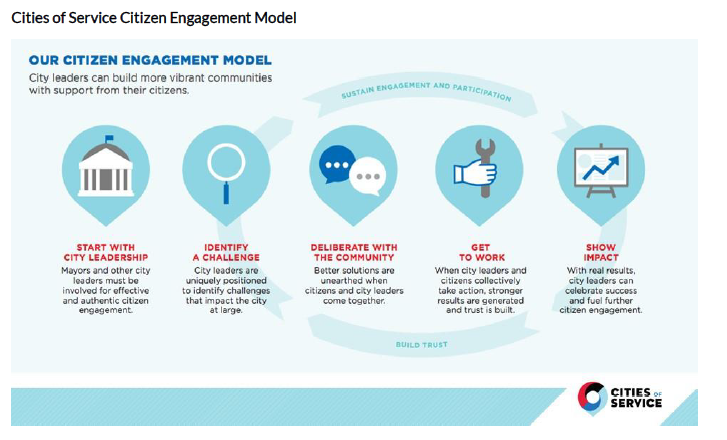
That is the model of Cities of Service, about which Myung Lee and I wrote a Stanford Social Innovation Review article. One specific project of Cities of Service is Love Your Block, in which cities and neighborhood residents get resources to identify and work together to address local needs–the residents contributing free labor, and the city offering its support.

Last year, Mary Bogle, Leiha Edmonds, and Ruth Gourevitch of the Urban Institute wrote a qualitative evaluation of three Love Your Block projects–in Phoenix, Lansing, and Boston. Here are my Google Streetview pictures of the Phoenix and Boston projects, both of which are park renovations.

Bogle, Edmonds, and Gourevitch talked to active grassroots leaders involved in these projects and to other people in the same neighborhoods. They produced social network maps of old and new relationships among the people involved (as a way of measuring changes in social capital). They asked interviewees whether the projects had affected relationships, collective efficacy (the ability of a community to control its own environment), public ownership of public spaces, and safety.

Overall, the results were positive. Participants generally reported more and stronger working relationships. Everyone perceived that crime had declined, although they understandably cited many causes for that trend, not just Love Your Block. Relatively few of the interviewees who were not directly involved in the project saw evidence of stronger community ties, but they were more likely to see such value in Lansing than in the other two cities.

The contexts differ a lot. In Boston, the neighborhood is changing fast–pressures of gentrification are powerful. Some of the Boston participants are well connected to local elected officials and took advantage of that form of social capital. But horizontal ties in the Boston neighborhood are weaker. “A few participants thought community cohesion had gotten worse.” That would not be an effect of the park restoration but rather a consequence of rapid demographic shifts in the neighborhood.

In contrast, Lansing seems more stable, and more residents perceive more impact of Love Your Block on the community as a whole. Horizontal relationships are more important there.

In Boston and Phoenix, gentrification is a concern, and residents involved in improving their communities worry that their good work will displace residents. One Phoenix interviewee said, “I do have this anxiety about being so involved in the organizational side of things and also recognizing that any positive impact we have is veiled privilege.” That is not a problem in Lansing, where capital and population is at risk of flight. The Lansing team worked to restore a garden immediately adjacent to a public school that is vacant due to population-loss–not a problem in Boston.

Although local community work against a problem like crime is not likely to stop gentrification, it can mitigate some of its disruptive effects and empower residents so that they are able to negotiate somewhat better policies. In a 2016 report, HUD argued,

Although residential displacement is a primary concern of many changing neighborhoods, communities should also act to ensure that residents are not left alienated from neighborhood changes. … In order for low-income residents to garner the benefits of neighborhood change, communities should also pursue policy objectives further than affordable housing by supporting neighborhood organizations that foster greater connections between newcomers and long-time residents and that encourage civic engagement among all groups.

Similarly, my colleagues and I are studying the potential of an arts center in Boston’s Chinatown not to stop gentrification but to mitigate its damaging effects.

In the network diagrams of Love Your Block, local businesses emerge as important nodes, and “anchor institutions” (notably ASU in Phoenix and MSU in Lansing) are important assets. In Boston, these institutions are less important, and City Hall is more so. Interestingly, in Boston “the park is falling into modest disrepair already,” whereas Lansing’s park is “self-sustaining” thanks to active volunteer gardeners. That suggests that truly community-based networks are more valuable than ones that rely on official power. But it’s also easier to build horizontal networks in smaller places where the population is more stable and gentrification is much slower or nonexistent.

In July 2018, Cities of Service launched a new 10-city program focused on Legacy Cities (“older, industrial cities that have faced substantial population loss”). It will be evaluated by the Urban Institute.

Overall, the evidence seems strong that how communities organize themselves matters for reducing crime. Cities of Service Love Your Block program is one of the most ambitious and well-designed national efforts to engage communities. Early returns suggests that it may help cut crime. Although additional research and evaluation is appropriate (as always), the evidence already suggests that cities should use this approach to boosting public safety.

See also: can the arts mitigate the harms of gentrification? A project in Boston’s Chinatownorganizing is renewable energycivic responses to Newtown and “the rise of urban citizenship

who must be included in which meetings, committees, and movements?

At a recent meeting, we discussed people who should be encouraged to join the effort we were working on. We quickly listed demographic categories that we should pay attention to: race and ethnicity, gender and sexuality, age, class, ideology, partisanship, and religion.

I think these categories are important for outreach and recruitment–but importantly different.

Race, gender, and sexual orientation

Race, gender, and sexual orientation matter because we live in a society that is deeply unequal on those dimensions. Unless you seriously strive for equal representation, you are likely to end up with a panel or committee full of straight white men–and the more influential and prestigious the group is, the more that will be the outcome. Failing to address it preserves inequality.

A demographically homogeneous group may also lose the wisdom that comes from a wider range of perspectives and experiences, but to me, that is not an essential argument. Sometimes, adding racial or sexual/gender diversity won’t actually add relevantly different perspectives on the issue under discussion, but inclusion is still important for addressing inequality in the society as a whole. There is often also a pragmatic imperative for improving racial and gender representation. Without such diversity, a group looks illegitimate and can’t win the support it needs to move forward.

I would equate religion with race/ethnicity insofar as it’s an identity that provokes discrimination by others. As a set of beliefs about the world, a religion is more like an ideology, which I will address below.

Social class

Our society is also unequal by class, but this is different. Class is a name for social inequality. It doesn’t make sense to imagine a society with different classes that are equal to each other. If you have equality, you don’t have classes at all. However, it is not clear that a classless society can be accomplished. State communist societies produced the nomenklatura, a powerful new class or (as Trotsky thought) a caste composed of party officials and their families. According to Robert Michels, social democratic parties and unions quickly created “oligarchies” of professional organizers, notwithstanding their sincere commitments to equality. By virtue of being a union official instead of a unionized line worker, you are now part of a different class.

If you organize a meeting of people who hold a certain range of positions in society–a meeting of union leaders, or teachers, or leaders of nonprofit organizations, or college students, or miners–it will have a class “bias.” Yet surely there is value in such meetings. It wouldn’t be reasonable to argue, for example, that teachers should never organize except along with students, parents, and others. But if teachers organize, that is a middle class movement.

Therefore, it is a bit disingenuous to imagine that you can be “inclusive and diverse” with respect to class. But you can strive (1) to be inclusive of people who have various class origins and cultural markers of class, such as accents; and (2) to organize meetings and movements that engage grassroots participants, not merely leaders and experts. But (2) is hard. After, who will organize, pay for, and advertise the big meeting that is open to the public as a whole? Surely some kind of specialized subgroup will be responsible. Michels thought oligarchy was an “iron law,” and even if it’s less rigid than that, there is still a powerful tendency for people who hold certain social positions to run things. That’s what it means to have those positions.

Age

Age is different, too. We should be concerned about including younger people because we should be worried about future leadership and must create opportunities to learn and to develop power. But age equality is not like racial or gender equality. There are actual differences among people of different ages. For instance, senior managerial positions cannot be equally distributed between the young and old. It takes time to develop the experience, expertise, and connections that institutions need.

The House Democrats who will lead important committees if the party wins in November  will include Elijah Cummings, age 67, Bennie Thompson, 70, Maxine Waters, 80, Nita Lowey, 81, and Eddie Bernice Johnson, 82. These are women or men of color who have waited a long time for gavels. To be sure, the party caucus could replace them with younger leaders who were also diverse, but these people’s claims to leadership rest on seniority, and that deserves consideration. I wouldn’t oppose replacing them with younger chairs, but I would insist that age is different from, say, race. It can be legitimate to consider seniority or experience.

Ideology, partisanship, and theology

It’s worth bearing in mind that our goal is to develop the right views so that we can do what is right. The right views are not equally consistent with all ideologies, party platforms, or applications of theology.

In pursuing the right views, we must be humble. It is very likely that each of us is wrong and that others are more right. So we must be open and interested in alternative views.

I am typically a mainstream liberal, center-left. I especially benefit from being an outlier in meetings that are dominated by libertarians/neoliberals or by radical proponents of identity politics. I don’t fully align with either position but always learn from them–usually more than I learn from hanging around other people with whom I easily agree.

Learning provides a rationale for philosophical diversity–but with important caveats. First, some alternative views are more worthy than others. I seek out libertarians but not Trump-supporters to learn from. That is a judgment, and it could be wrong, but it’s my best judgment at this moment. I don’t believe that I have anything whatsoever to learn from Donald Trump himself, yet more than 60 million Americans really like him. Demographic representativeness would argue for including Trump-supporters, but my judgment about how to learn does not.

Furthermore, the value of ideological diversity depends on the purpose of a meeting or event. If I am trying to advance an agenda, I want a majority of participants to share my considered views of the topic. I may value some minority views to keep us sharp, but I’d like the majority to agree with me. I can achieve that goal either by recruiting like-minded participants or by persuading other attendees to agree. I would never treat racial or gender/sexual diversity in a similar way, trying to stack the room with people who were like me. On the other hand, if my goal is to learn, I may prefer to be one of a few participants in a meeting dominated by people who oppose my views, so that I can get a full dose of their perspective.

Conclusion

In sum, race/ethnicity and gender/sexuality make powerful claims for equal representation. Class and age are more complicated; it can be disingenuous to imagine that a meeting can be egalitarian on those dimensions. And ideological diversity is not a good in itself, but intellectual humility and striving to learn are genuine goods that sometimes provide reasons to be ideologically inclusive.

The complication is that race and ethnicity, gender, age, religion, ideology and partisanship correlate in the population. Say you want a meeting of influential people who are in a position to allocate resources, but you also demand racial diversity in your meetings. The most influential people are likely to be predominantly white. Or say you’re a libertarian who is genuinely committed to racial equality (as some are). You’re entitled to form a committee of libertarians, but it’s your problem if they all turn out to be white men.

I think these points of conflict among different kinds of diversity generate some of the hardest issues, both ethically and pragmatically.

See also: what is privilege?the rise of an expert class and its implications for democracyto what extent can colleges promote upward mobility?defining equity and equalitytwo approaches to social capital: Bourdieu vs. the American literature; and a college class on equalitywhen social advantage persists for millennia.