Category Archives: Uncategorized

the empirical impact of the humanities

(Washington, DC) I have two major professional interests: civic engagement and the humanities. Thanks to a partnership with the organization Indiana Humanities, I am enjoying an opportunity to bring the two together. Up to now, my arguments for the humanities have been theoretical and philosophical. (They are in my books Reforming the Humanities: Literature and Ethics from Dante through Modern Times, 2009; Living Without Philosophy: On Narrative, Rhetoric, and Morality, 1998; and Nietzsche and the Modern Crisis of the Humanities, 1995.) But there are also empirical questions about what happens when people experience the humanities–and especially when laypeople participate in the “public humanities” in the form of book clubs, museum visits, or maintaining local historical sites. We at CIRCLE are helping Indiana Humanities with a case study of their state’s humanities “ecosystem.” As it says on their website:

Using a survey method, Indiana Humanities (along with leading researchers) will collect data on humanities-related institutions and program opportunities in Indiana, how they are connected to one another, and how people in Indiana participate in the humanities. The goal is to “map” the network of relationships among the various public and academic humanities sectors and between the humanities enterprise and the broader community.

The next stage–if we can pull it off later on–will be to find out whether the strength of the humanities “ecosystem” in a community is related to important social outcomes.
 

young people on guns and gun control

A Black Youth project study entitled “Gun Violence and Public Opinion on Gun Control among America’s Young People” presents data that should be basic to the national debate, along with some relatively surprising findings. First, almost half of White youth (18-29) recently carried a gun or know someone who did. Less than one in four Black and Latino youth report that experience. Yet Black and Latino youth are much more supportive of gun control. Given a choice between protecting the rights of gun owners versus controlling gun ownership, Black youth favor control by a three-to-one margin, but a majority of White youth prefer gun owners’ rights. Two-thirds of Black and Latino youth would ban assault weapons, versus just over half of White youth. Perhaps more interesting is the finding that two thirds of Black youth support having “More police/armed guards in public places like schools and malls.” Considering the frequent tensions and complaints involving those guards, that is interesting. It may reflect something of a Hobson’s choice: more guns or more armed guards. After all, almost one quarter of Black youth say that they or someone they know “experienced gun violence in the last year,” versus just 8.3% of White youth.


having one conversation for 26 years

(Salem, MA) I am here for a retreat of the Jonathan M. Tisch College of Citizenship and Public Service, where I work. In the summer of 1987, I came here for a retreat of the Charles M. Kettering Foundation, where I served as an intern between my sophomore and junior years in college. I’ve been back to Salem since then–we don’t live very far away now–but I recollect the first retreat forcefully. Early impressions bite deeply; later experiences just leave surface scratches.

The 1987 retreat was my first business trip: we could charge meals and get reimbursed for them. It was one of my first times sitting around open tables with water pitchers and notepads, talking about what an organization should do. (How many hundreds of such meetings have I attended since?) It was not my first time in an old city, because I had been privileged to spend years of my childhood in Europe, but it was my first time in an old American town. I remember thinking that Salem’s crooked, narrow streets and houses with historic placards were exotic. And it was one of my first discussions about civic engagement: why do Americans not participate as much as we would like in civil society and politics, and what should we do about that?

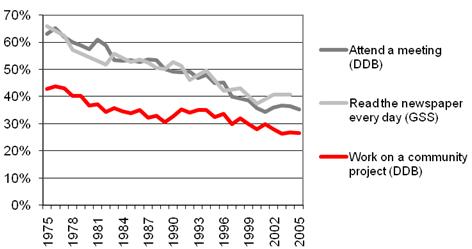
Now I am grey and “experienced,” a board member of the Kettering Foundation instead of an intern. We’ve seen Prague Spring, Bowling Alone, Points of Light and AmeriCorps, the Tea Party, Occupy. I can’t remember the conversation in 1987 well enough to be sure, but I would bet our analysis is more sophisticated now. People at the 1987 retreat–and many of their colleagues–have done important and valuable things in the past quarter-century. The large-scale trends, however, have mostly been for the worse.

indicators of civic engagement (DDB = DDB Needham Life Styles Survey. GSS = General Social Survey)

If I’m fortunate still to be having these conversations in 2039, I hope we will be able to point to upward trends, not necessarily in the measures depicted above (for instance, newspapers will probably be defunct), but in their functional equivalents.

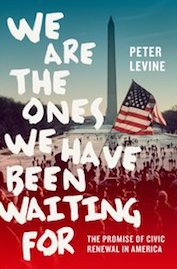
first review of We Are the Ones We Have Been Waiting for

“Political philosopher and activist Levine (The Future of Democracy) argues that global problems can best be addressed by a targeted increase in deliberative democracy and citizen action. But the U.S. is currently marked by a decline in civic engagement, Levine notes, resulting largely from structural changes since the mid-20th century that have eroded many working-class organizations. Wielding an impressive command of research and statistics, as well as finer points of moral and political philosophy, Levine’s discussion of the benefits and contours of public engagement draw on lucid analogies and real-world examples (like the annual budget summits convened by Washington, D.C., mayor Anthony Williams, which empowered groups of citizens to deliberate on an area of central import to the whole community). Throughout, the message is that deliberative action among diverse networks of citizens goes beyond injecting public influence into the formal policy apparatus. The necessary goal, Levine writes, “is to democratize the whole process of shaping our common world.” Free market libertarians and others wary of civic engagement–especially where it impinges on market forces or the operation of business–will raise objections, although Levine anticipates these arguments to some degree. Broad in scope yet eminently practical, this book should be an enduring contribution to the study of democratic theory and social action.” –Publishers Weekly

a Democratic Republican Federalist

AuroraYesterday, I wrote a long post about the uses of the words “democracy” and “republic” to describe the United States. I argued that they’ve had various and sometimes indistinguishable meanings–and both words are appropriate.

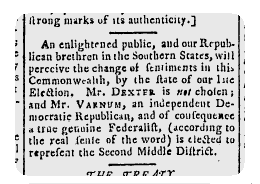
In the process, I started looking at some old newspapers, which are wonderfully accessible via Google’s news archive. This clip comes from the Aurora General Advertiser (Philadelphia), Apr. 30, 1795.  I read several days’ worth of the Aurora. It is enthusiastic about the French Revolution, hostile to Britain, and suspicious of the Federalists. It is Jeffersonian, so its favored politicians are mostly Southerners. However, this brief article concerns a Massachusetts congressional election that would give heart to the “Southern brethren.” The winner is described as an “independent Democratic Republican (and of consequence a true genuine Federalist, (according to the real sense of the word).” I was amused by that conjunction of four supposedly irreconcilable concepts: independent, republican, democratic, federalist.

For the record, Joseph Bradley Varnum was later Speaker of the House and a US Senator, and an abolitionist. His defeated opponent, Samuel Dexter, was a Federalist, later turned Republican, and a temperance advocate.