Category Archives: Uncategorized

#Blacklivesmatter and Sen. Sanders: social democracy and identity politics

(Winston-Salem) Last weekend, #BlackLivesMatter activists disrupted a forum with Democratic presidential candidates Martin O’Malley and Bernie Sanders at Netroots Nation. An objection to Gov. O’Malley was that he oversaw the State of Maryland while it incarcerated many thousands of young Black people. That was a pretty standard case of holding a leader accountable for his performance, and the governor’s response was terrible.

The critique of Sen. Sanders was more interesting, and I would love to see a real dialogue between the activists and Sanders–rather than what sounds like a dismissive response on his part. Without wanting to stereotype any individual, I would propose that Sanders and #Blacklivesmatter represent two wings of the American left that are genuinely different and that need more conversation. (See also “Why doesn’t Bernie Sanders talk about race” and “#BernieSoBlack: Why progressives are fighting about Bernie Sanders and race,” both in Vox.)

Consider two simplified ideological positions. One can be called classical social democracy. It holds that the root cause of social injustice is the economic and political power of capital, referring to the companies and individuals who control large economic investments. They represent a small slice of the population. The Occupy Movement asserted that the economic oppressors were 1% of Americans; and while that claim rested on some recent data about wealth distributions in the US, it has always been the case that capitalists are outnumbered by something like 99-to-1.

The classical democratic socialist view is that other problems follow from the power of concentrated capital. For instance, as I have argued, a situation like police violence in Ferguson, MO can be interpreted as a result of massive deindustrialization (the loss of hundreds of thousands of unionized blue-collar jobs in that region), which rendered young men without college degrees very economically weak, which has enabled violent abuse. So—argues the classical democratic socialist—it should be everyone’s priority to reduce the economic and political power of big capital. That means financial reform, antitrust, tax reform, and campaign finance reform to get capital out of politics.

Dara Lind writes:

When my colleague Andrew Prokop profiled Sanders last year, he pointed out astutely that Sanders’s career has been ‘laser-focused on checking the power of the wealthy above all else.’ Sanders believes in racial equality, sure, but he believes it will only come as the result of economic equality. To him, focusing on racial issues first is merely treating the symptom, not the disease.

Meanwhile, the political strategy of classic democratic socialists is to build very broad solidarity. Ninety-nine percent of us are not big capitalists, so we are in basically the same boat and should not allow ourselves to be divided. For instance, police officers are blue-collar or lower-income white-collar unionized state employees who need to be brought into the same coalition with unemployed youth.

The second view—I struggle to name it fairly—takes seriously many other sources of power, privilege, and domination. According to this view, we are not divided between the 99% and the 1%, but into a rainbow of racial/ethnic groups, genders, sexual identities, etc. Oppression is manifold and complex, and often “intersectional” in the sense that race, gender, sexual orientation, and class can overlap. Although it may be valuable to reform capital markets, that is neither sufficient nor the central concern. Power must be confronted directly in all of its forms and settings.

I suspect that neither Senator Sanders nor the #Blacklivesmatter activists at Netroots Nation would want to be placed simply in one of those two boxes. Every serious person develops more complex views in the course of struggling with difficult realities. But these are two general tendencies and they do explain, for instance, why the demographics of an #Occupy gathering or a Bernie Sanders rally are so different from the demographics of a #Blacklivesmatter protest.

For my part: I am not a democratic socialist, for two reasons. First, I am somewhat more enthusiastic about markets, individual economic liberties, and pluralism than a classical (statist) socialist would be. Secondly, I am somewhat persuaded by the second position summarized above and do not believe that concentrated capital is our only problem.

But I do worry a lot about concentrated, unregulated capital and doubt that much can be accomplished on other fronts if we don’t address that. I observe that concerns about race, gender, and sexual orientation have produced scattered victories over the past 30 years, not only in national politics (e.g., marriage equality) but also within institutions like corporations and universities. Meanwhile, the traditional democratic socialist agenda has been in steady retreat for the same 30 years, sometimes verging on a disorganized rout. National and global policies are more neoliberal and less economically egalitarian than at any time since the 1920s.

Younger people on the left typically have a lot to say about issues of race, gender, and sexual orientation. They have diagnoses, solutions, heroes, and movements they can join. But most struggle for comparable ideas about reforming the global political economy, if they think about that at all. Despite the terrible injustices that motivate movements like #Blacklivesmatter, there is some sense of momentum toward policy changes, such as sentencing reform. We see nothing comparable when it comes to global capital markets. Thus I am glad to see the voices of Bernie Sanders and Elizabeth Warren resonating with at least some Americans.

I wish Sanders had taken the #Blacklivesmatter protesters seriously, because they deserve that, and the progressive movement needs their support to win. Yet I’d prefer that Sanders stuck to his position in a respectful debate, so that his side of the argument would convey. He is not going to be president; his contribution may be to put a different diagnosis and solutions on the table. The last thing I’d do is to silence #Blacklivesmatter protesters, but I wish that they and the Senator could have a substantive debate, in which both sides laid out some of these genuine points of disagreement.

Donald Trump as the schoolyard bully

(Winston-Salem, NC) Recent events involving The Donald strike me as powerfully reminiscent of an unpleasant schoolyard. Wanting to be popular and the leader of the cool clique, he picks on the most marginal group–in real life, Mexican immigrants. The other would-be leaders don’t necessarily like his bullying, and they worry that everyone may get in trouble for it, but they see that the abuse is popular among the bystanders, so they keep their objections to a low mutter. As for the bystanders, they are looking for a bad boy who will make trouble for the teachers and the school. Plus a lot of them dislike the marginal kids in the first place, or they want to differentiate themselves from them.

Then the bully, who is stupid as well as mean, makes a mistake. Instead of just picking on the weakest kids in the schoolyard, he says something utterly offensive about one of the cool kids. In real life, The Donald insults a Republican senator, war hero, former presidential nominee of the party, and son of an admiral. Now all the other would-be alpha dogs see an opening. This is not cool. They can criticize him. And once the mood has shifted, they can start throwing all kinds of other objections at the bully. They still won’t say anything in defense of the weak and the marginalized, but they can start questioning the bully’s claims to be cool. In a schoolyard, they would ridicule his clothing or musical tastes. In real life, they can all start saying that Trump isn’t a conservative because he has been pro-choice, has donated to the Clintons, etc. And whoever does the best job taking down the bully has the best chance of replacing him. That is the phase that has now begun.

youth Participatory Budgeting in Boston

In April, 2014, I had the pleasure of watching Boston teenagers begin a youth Participatory Budgeting process. The city has asked them to decide how to allocate $1 million of capital funds, engaging their peers in research, deliberation, and voting. I described my observations in “You can add us to equations but they never make us equal: participatory budgeting in Boston.”

Now their decisions have been announced. The projects they selected include extending the city’s bicycle share system and free WiFi to additional neighborhoods, installing water bottle refill stations, and renovating a high school gym. The photo below shows some of the kids with Boston Mayor Marty Walsh. More here.

the encyclical Laudato Si and the power of peoples to organize

On July 9, Pope Francis addressed the Second World Meeting of Popular Movements in Santa Cruz de la Sierra (Bolivia). In that speech, he built on his recent Encyclical letter, Laudato Si: On Care for Our Common Home, by emphasizing that saving the planet will require organized action from the bottom up. In Bolivia, he said:

People and their movements are called to cry out, to mobilize and to demand – peacefully, but firmly – that appropriate and urgently-needed measures be taken. … In conclusion, I would like to repeat: the future of humanity does not lie solely in the hands of great leaders, the great powers and the elites. It is fundamentally in the hands of peoples and in their ability to organize.

Laudato Si’ offers a deep and complex basis for this conclusion. I do not agree with all of it, and I think a serious response to the Pope’s call for dialogue across religious and ethical traditions requires us to share both our agreements and our dissents. But I believe Laudato Si’ is one of the most thoughtful, deeply rooted, and potentially powerful statements of our century so far. It does not reflect the Pope’s opinions alone, but–as the notes indicate–it summarizes a whole internal discussion that is valuable to people outside the church as well.

The title is a quotation from St. Francis, that “attractive and compelling figure, whose name I took as my guide and inspiration when I was elected Bishop of Rome.” My wife and I were just in St. Francis’ country for two weeks, visiting not only Assisi but a cell that he apparently built with his own hands in a remarkably verdant forest outside of Cortona. One sees evidence everywhere of the revolutionary early years of the Franciscan order.

Although not a believer, I have long acknowledged St. Francis as a world-historical figure, not only because of his theological and political (i.e., radically pro-poor) views, but also because he responded to a new sociological reality–the growth of cities–by building a new kind of institution/social movement, an order of mendicant friars. Unlike traditional monks, friars worked directly and daily in communities. The Franciscans and their rivals, the Dominicans, were primarily responsible for building the public-service institutions of the high middle ages, including universities, schools, hospitals, and charity homes. So Francis is an apt inspiration for the current pope, especially as he calls for new forms of civic organization.

In my own view, our current environmental crisis has many causes, but they fall into two broad categories. The first category involves rules and incentives. The global political economy is so organized that it pays to pollute. That is true for individuals (who benefit directly from releasing carbon and other pollutants and share only a tiny bit in the cost); for countries (which have radically different abilities to produce and use carbon and radically different vulnerabilities to climate change); and for generations (since exploitation today hurts those not yet alive).

As Francis writes, “The natural environment is a collective good, the patrimony of all humanity and the responsibility of everyone.” Collective goods must be governed in such a way that contributions are rewarded and exploitation has costs. For instance–I would argue–taxing carbon and spending the proceeds equitably would change the incentives so that people cut carbon consumption. The word “tax” does not appear in Laudato Si. I am not sure why the Holy Father doesn’t endorse taxes as part of his position. But I do share his view that all the talk about new rules and incentives hasn’t gone very far so far:

It is remarkable how weak international political responses have been. The failure of global summits on the environment make it plain that our politics are subject to technology and finance. There are too many special interests, and economic interests easily end up trumping the common good and manipulating information so that their own plans will not be affected.

The failure (so far) of international political agreements is–unfortunately–very easy to explain. Just as individuals and nations have incentives to pollute, they have disincentives to enter agreements that would reduce their pollution.

That is why, in the absence of pressure from the public and from civic institutions, political authorities will always be reluctant to intervene, all the more when urgent needs must be met. To take up these responsibilities and the costs they entail, politicians will inevitably clash with the mindset of short-term gain and results which dominates present-day economics and politics. But if they are courageous, they will attest to their God-given dignity and leave behind a testimony of selfless responsibility. A healthy politics is sorely needed, capable of reforming and coordinating institutions, promoting best practices and overcoming undue pressure and bureaucratic inertia. It should be added, though, that even the best mechanisms can break down when there are no worthy goals and values, or a genuine and profound humanism to serve as the basis of a noble and generous society.

The second category of problems (already hinted at above) involves subjective beliefs and attitudes:

Regrettably, many efforts to seek concrete solutions to the environmental crisis have proved ineffective, not only because of powerful opposition but also because of a more general lack of interest. Obstructionist attitudes, even on the part of believers, can range from denial of the problem to indifference, nonchalant resignation or blind confidence in technical solutions. We require a new and universal solidarity.

Some (including an outright majority of members of the Senate of the most powerful country on earth) actually deny that humans are causing dangerous climate change. Others accept the evidence but don’t take it fully seriously as something that should affect their daily behavior and their political priorities.

Pope Francis recognizes both sources of problems: 1) bad rules and incentives, and 2) problematic attitudes and priorities of human beings.

The problem is that we still lack the culture needed to confront this crisis. We lack leadership capable of striking out on new paths and meeting the needs of the present with concern for all and without prejudice towards coming generations. The establishment of a legal framework which can set clear boundaries and ensure the protection of ecosystems has become indispensable; otherwise, the new power structures based on the techno-economic paradigm may overwhelm not only our politics but also freedom and justice.

The Pope is, however, much less focused on rules and laws than on the culture of denial and its spiritual roots in consumerism, scientism, selfishness, and human-centeredness. He cites the leader of today’s Orthodox churches, Patriarch Bartholomew, who “has drawn attention to the ethical and spiritual roots of environmental problems, which require that we look for solutions not only in technology but in a change of humanity; otherwise we would be dealing merely with symptoms.”

In fact, Francis is sometimes dismissive of practical reforms that I would endorse. For instance:

The strategy of buying and selling ‘carbon credits’ can lead to a new form of speculation which would not help reduce the emission of polluting gases worldwide. This system seems to provide a quick and easy solution under the guise of a certain commitment to the environment, but in no way does it allow for the radical change which present circumstances require. Rather, it may simply become a ploy which permits maintaining the excessive consumption of some countries and sectors.

I see this danger, but if a cap-and-trade system set appropriately low caps, it would provide incentives to reduce global carbon production. I don’t share the Pope’s view that the only truly “radical” change is spiritual, although I think his diagnosis of our spiritual condition is valuable and perceptive–and he is right that by treating nature better, we can improve our own inner lives. “Such sobriety, when lived freely and consciously, is liberating. It is not a lesser life or one lived with less intensity. On the contrary, it is a way of living life to the full.”

It would be unfair to the Pope to think that he is simply calling for changes in personal beliefs and priorities:

Self-improvement on the part of individuals will not by itself remedy the extremely complex situation facing our world today. Isolated individuals can lose their ability and freedom to escape the utilitarian mindset, and end up prey to an unethical consumerism bereft of social or ecological awareness. Social problems must be addressed by community networks and not simply by the sum of individual good deeds.

He argues that spiritual transformation must manifest itself both at the personal level and in large, impersonal institutions such as states and markets. At the end of this sentence, he quotes Pope Benedict: “Love for society and commitment to the common good are outstanding expressions of a charity which affects not only relationships between individuals but also ‘macro-relationships, social, economic and political ones.’” (See my post “friendship and politics” for some thoughts on that matter.)

Pope Francis recognizes the value of political diversity and debate; he does not want everyone to join one big social movement. “On many concrete questions, the Church has no reason to offer a definitive opinion; she knows that honest debate must be encouraged among experts, while respecting divergent views.” He is also open to a division of labor, in which some are more deeply involved in civic work than others:

Not everyone is called to engage directly in political life. Society is also enriched by a countless array of organizations which work to promote the common good and to defend the environment, whether natural or urban. Some, for example, show concern for a public place (a building, a fountain, an abandoned monument, a landscape, a square), and strive to protect, restore, improve or beautify it as something belonging to everyone. Around these community actions, relationships develop or are recovered and a new social fabric emerges.

However, despite his (welcome) endorsement of political pluralism and diversity, the Pope does want all of us to organize–both to put pressure on powerful organizations and to change prevailing cultures and values. This is a powerful and timely message.

See also: the cultural change we would need for climate justice; where is the public on climate change?; and a different approach to human problems.

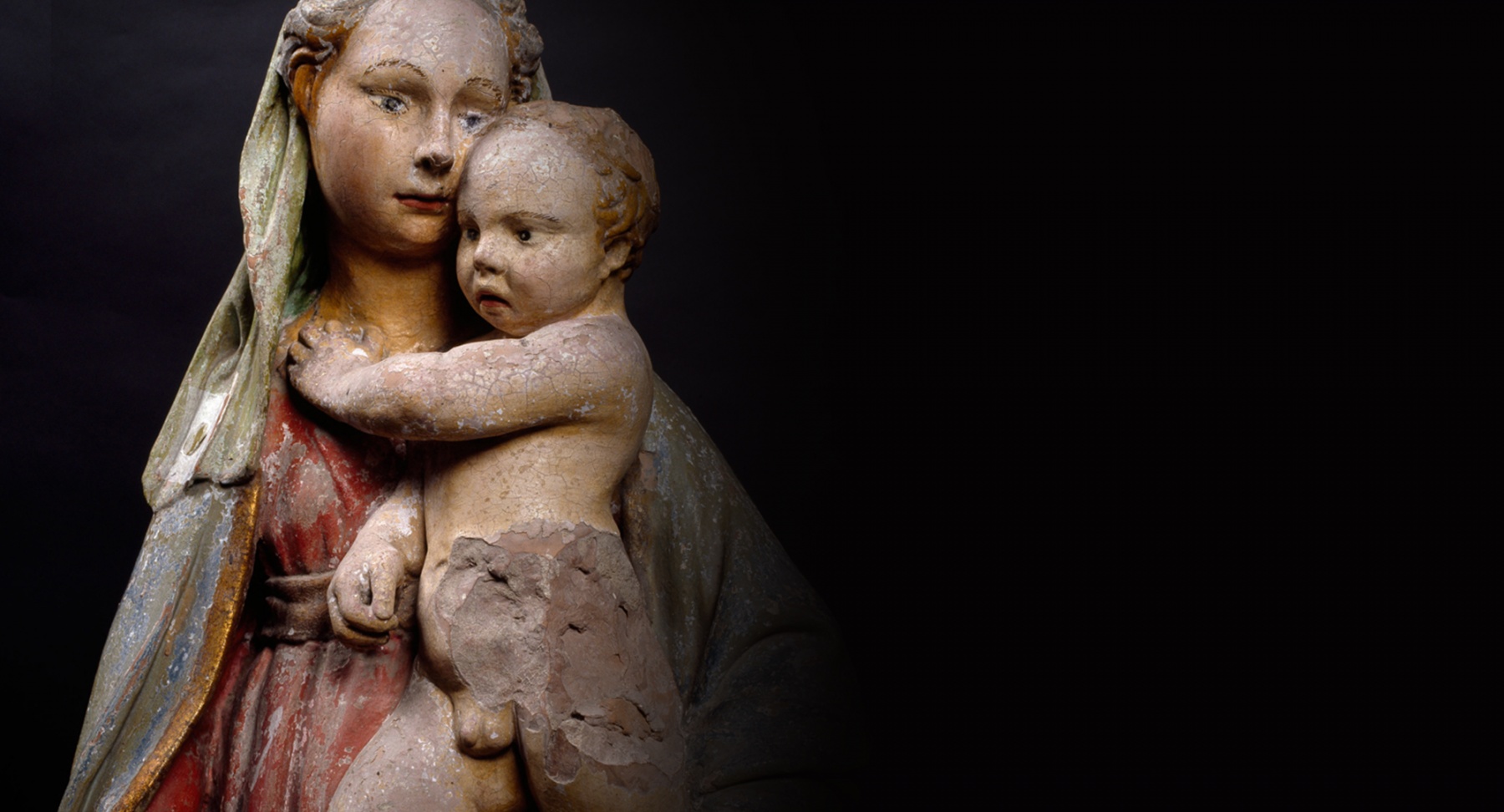
Donatello’s Madonna in Citerna

This is highlight #1 from our recent Italian vacation. In the little Umbrian hill town of Citerna, in the church of San Francesco, a small, badly damaged, and heavily painted terracotta Madonna and Child stood on a shelf above the choir for many centuries, unnoticed by art historians. To the extent that its existence was recorded at all, it was assumed to be a folk work from the 15th-16th centuries.

In 2001, Laura Ciferri–then a graduate student–paid it a visit and realized that it was not the kind of Umbrian folk piece that she was studying for a paper. She proposed instead that it had been made by the great Donatello himself.

Experts in Florence removed numerous layers of thick paint, chemically tested the materials, and rebuilt portions of the sculpture, working on the little object for seven years. Although I have found peer-reviewed scholarly articles from ca. 2002 that doubt its attribution, now that the restoration is complete, the consensus seems to be that it is a work of Donatello. He probably made it in Florence between 1415 and 1420–not using a mold but working directly with clay. He personally painted the baked terracotta, and his polychrome surface is now visible again.

To support the attribution, specialists point to similarities with more famous works, such as the hands of Donatello’s “David.” I would add that this most idiosyncratic artist always visualized scenes in his own unprecedented way. Here the baby senses an unknown danger in the distance. His face is disturbed; his body tenses even as one hand reaches for his mother. He curls the big toe of his left foot. Most of his wrap has fallen away to reveal his vulnerability and humanity. Mary, who knows what lies ahead for him, reflects soberly as she touches her cheek to his forehead and very gently supports his foot.