Category Archives: Uncategorized

youth don’t always tilt left

(Washington, DC) In the US since 2004, young voters have tilted moderately leftward. They gave very strong support to Barack Obama, especially in 2008. And in Britain right now, only voters under-25 favor Labour:

But young people are not consistently liberal or progressive. In 1984, US voters under 30 decisively chose Ronald Reagan, and as recently as 2000, they split their votes evenly between Bush and Gore. This is a reason, by the way, for both of our major parties to contest the US youth vote.

In 2012, a plurality of young White voters chose Donald Trump over Hillary Clinton. (Her lead among all youth was due, in large measure, to the racial diversity of the Millennial generation.) Among young Trump voters, many expressed concerns about foreign influence on US culture and political correctness.

Meanwhile, Marine Le Pen did quite well among young French voters. In the second round, she seems to have drawn about one third of youth, the same proportion as in the population as a whole. For the first round, Yascha Mounk provides the chart below. A plurality of French voters under-25 chose the candidate of the left, Jean-Luc Mélenchon. However, Le Pen’s strongest support came from voters under 35, and particularly those between 25 and 34. Emmanuel Macron, the ultimate winner, performed worse among 18-24s than in any other age range.
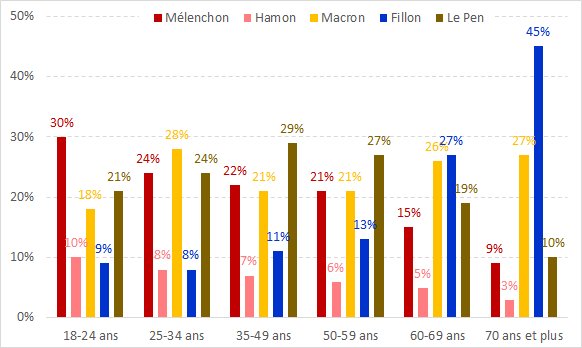
These results do not quite match pre-election hype about Le Pen’s youth base. In a poll conducted before the first round, Ipsos had Le Pen leading the youth vote with a plurality of 35%, and reporters for Foreign Policy found many enthusiastic right-wing youth to quote:

At the [FN] conference, smartly dressed, articulate young activists were among those pushing Le Pen’s message most fervently. They hammered home the dangers of multiculturalism and Muslims who “segregate” themselves from secular French society; they pronounced themselves enthusiastically in favor of a “Frexit” from the European Union. Like Dieulafait, who joined the FN at 16, they want a government that puts French citizens’ needs before those of immigrants, and they are not ashamed to say so.

Importantly, this article noted that the National Front is way ahead of other French parties at advancing young candidates for office at all levels.

A much more extreme example: In the 1932 German election that led to Hitler’s dictatorship, the Nazi party received an essential boost from new voters, and specifically from young first-time voters. Christopher Browning writes, “The first groups to be taken over by Nazi majorities were student organizations on university campuses. In their electoral breakthrough in 1930, the Nazis won the vast majority of first-time voters, especially the youth vote.” And Dick Geary writes that Nazi Party “membership was younger than that of other parties; the average age of those joining between 1925 and 1932 was slightly under twenty-nine.”

It is always right to encourage youth engagement in democracy and to support young people to form their own view of issues and values. In a country like the US, it’s also important to boost their turnout levels because they (and their interests) are under-represented. Of course, if they prefer parties to the right of center, that is their prerogative. But progressives, liberals, mainstream conservatives, and libertarians shouldn’t romanticize youth as some kind of natural base for their movements or assume that generational change shifts the world toward democratic and cosmopolitan values. If a society harbors nationalistic, xenophobic, or downright racist views, those values will probably transmit to each new generation.

I love Hannah Arendt’s fundamental insight that only “the birth of new men and the new beginning, the action they are capable of by virtue of being born … can bestow upon human affairs faith and hope.” In other words, because new human beings are always coming into the world, we can hope that things will change for the better. But there’s certainly no reason to assume that this will happen on its own.

See also: Millennials’ political opinions: insights from the new CIRCLE pollthe Millennials and politicsin what ways are Millennials distinctive?; and the Millennials’ political values in context.

is everyone religious?

In the perennial debate about the place of religion in politics and public life, one available stance is: “Everyone is religious.” This position has weaknesses, which I will mention below, but here are three points in its favor:

  1. Ethical people hold beliefs that are hard, if not impossible, to justify with empirical evidence. For example, I believe that all human beings are equal. That is not a scientifically demonstrable claim. Science finds all kinds of inequalities of capacity, potential, and importance among actual human beings, who include speechless infants and late-stage Alzheimer’s patients. Equality is instead a moral premise. I don’t happen to take it directly from an overtly religious source, but it could be viewed as similar to a religious statement, such as “God loves the world.”
  2. Everyone should recognize that the universe exceeds our capacity to understand it, even by means of cumulative empirical research. I know things that our dog just can’t. I know, for example, that he and I live in the United States, which is a republic. Perhaps he knows some things that I can’t. With appropriate tools, I could collect the same information that he takes in with his remarkable nose, but I wouldn’t know what it feels like to sense that a cat crossed “his” yard five hours ago. A creature with a much different brain from either my dog’s or mine could know things that neither of us can. One needn’t believe in God, then, to acknowledge the likelihood that the universe is permanently unknowable by us and a place of mystery.
  3. Religions do not have foundational articles of faith from which all their other beliefs flow. Sometimes they present themselves that way. Some Jews say that the whole Law follows logically from the revelation on Sinai; some Christians, that everything is implied by God’s sacrifice of His Son on the cross; some Muslims, that everything results inevitably from believing in God and His last prophet. But I don’t think these claims do justice to their respective traditions. Religions are actually large webs of metaphysical beliefs, stories, characters, rules, examples, traditions, rituals, and hopes. Everyone has such a web, whether we see ourselves as religious or not. In fact, many items in the idea-network of a religious person are also present in my network.

In the end, it’s probably a mistake to lose the category of religion or to view religious worldviews as completely parallel to secular ones. The main reason is sociological. Since (I think) the Babylonian Captivity, the Abrahamic religions have organized themselves in a certain way within larger societies. They treat membership in the religious community as an identity: something you are, not just a set of ideas you endorse. They view certain texts as canonical. They emphasize beliefs that are matters of faith (“things hoped for, evidence of things not seen”) over memories or observations. And they gather their believers in groups that form larger networks or structures. The original meaning of the words “congregation,” “synagogue,” and ecclesia (Greek for “church”) is coming-together, a tangible social act. I think the great Asian traditions have been influenced by these sociological forms and have begun to look somewhat like Abrahamic faiths, as a result of isomorphism.

Such religions operate as identity groups and convene in organized structures. They can thus be oppressed and persecuted but can also dictate to others when they control power. That means that a liberal state is wise to identify religions for protection but also to make the government and law neutral among religions. The reason is not metaphysical or epistemological–it’s not that religious people fundamentally believe in different kinds of truths or think in different ways from secular people–but sociological. Religions function differently from other clusters of beliefs and practices.

However, if we adopt this position, then we should at least inquire into whether certain secular belief-communities have also taken forms parallel to those of the Abrahamic faiths, again perhaps due to isomorphism. Doesn’t, for instance, medical science offer its own bounded identities, canonical texts, hierarchies, moral premises, rituals, heroes, and exemplary cases? If it does, then possibly it should be viewed as similar to a religion–which is an idea as old as Durkheim.

I would be reluctant to draw radical implications for US constitutional law. Our traditional ways of defining and protecting religions reflect some pragmatic experience and help to constitute our political culture. I wouldn’t necessarily rock that boat. But if the question is not “How should the Supreme Court interpret the Establishment Clause?” but rather, “What distinguishes religious thinking?” then I am inclined to suspect that everyone is religious and that religion is everywhere.

See also a typology of denominationsare religions comprehensive doctrines? and is all truth scientific truth?

mini-conference on Facts, Values, and Strategies

We are about to begin discussions of the papers listed below, in draft form. They are destined for The Good Society journal. The conversations are at the Tisch College of Civic Life at Tufts

For me, the underlying rationale goes like this. A good person is always asking “What should I do?” That question must become plural–“What should we do?”–for two reasons: we cannot accomplish enough alone, and we must reason together to improve our opinions. Both questions integrate facts and values. Something that works but isn’t good is not what we should do. Likewise, we want to avoid something that is good but doesn’t fit the circumstances of the time and place.

The structure of intellectual life in modernity frustrates asking these questions, for several reasons. One major reason is that matters of value are assigned to certain disciplines in the humanities, while matters of fact go to disciplines that widely imitate science and present themselves as value-free.

It’s easy to call for a reintegration of facts and values (and strategy), but very hard to pull that off. Fortunately, we have traditions of thought–always contributed by many thinkers and practitioners rather than a single luminary–that do reintegrate facts, values, and strategies. Names that stand for these traditions include Gandhi, Pope Francis, Hannah Arendt, William James, Amartya Sen, Elinor Ostrom, and Jurgen Habermas. These names recur in interesting combinations in the following papers. So do certain themes: the limitations of human cognitive abilities and the positive potential of certain kinds of affect; the value of institutions for structuring deliberation; the link between work and reflection; and the value of deep, responsive uncertainty–wonder.

“Public Entrepreneurship, Civic Competence, and Voluntary Association: Self-Governance Through the Ostroms’ Political Economy Lenses” — Paul Dragos Aligica, George Mason University

“Giving Birth in the Public Square: Dialogue as a Maieutic Practice” — Lauren Swayne Barthold, Endicott College and Essential Partners

“William James’s Psychology of Philosophizing: Selective Attention, Intellectual Diversity, and the Sentiments in Our Rationalities” — Paul Croce, Stetson University

“Democracy as Group Discussion and Collective Action:Facts, Values, and Strategies in Rural Landscapes” — Timothy J. Shaffer, Kansas State University

“Social Media, Dismantling Racism and Mystical Knowing: What White Catholics are Learning from #BlackLivesMatter” — Mary E. Hess, University of Toronto

“Institutions, Capabilities, Citizens” — James Johnson, University of Rochester, and Susan Orr, SUNY College at Brockport

“Forgiveness After Charleston: The Ethics of an Unlikely Act” — Larry M. Jorgensen, Skidmore College

“Facts, Values, and Democracy Worth Wanting: Public Deliberation in the Era of Trump” — David Eric Meens, University of Colorado Boulder

“The Praxis of Amartya Sen and the Promotion of Democratic Capability” — Anthony DeCesare, St. Louis University

“A Civic Account of Justice” — Karol Edward Soltan, University of Maryland

American tapestry

6:10 am, Monday, Boston, MA: My taxi driver is a retired guy from the South Shore. His son is a Ranger, active duty. The son curls up on the floor now when fireworks go off: PTSD. He is friends with all the generals, ever since he use a banned weapon in Afghanistan to save some guys despite the orders of an interfering German NATO officer. According to him, the US generals believe we have to stop fighting all these little wars, because then the media turns every bit of collateral damage into a war crime. We need one big war to just end it.

3:30 pm, Monday, Ferguson, MO: I am getting a detailed and extraordinarily well-informed and thoughtful driving tour through this city, traversing all the main roads plus several of the back streets and cul-de-sacs. My guide, an African American woman and longtime resident of Ferguson, is also a scholar with a PhD, an educator, and an activist. Through her windshield, Ferguson looks remarkably ordinary: Anywhere, USA. Sam’s Club, Walmart, mowed median strips, the Interstate, tidy homes of brick or wood, low-rise apartment complexes, some fancy older houses along one side of town, and knots of happy kids walking home from their schools. It is Anywhere, USA–which is the problem.

7:30 pm, Monday, Kansas City, MO: Sitting at the bar of a BBQ restaurant that caters to tourists, with baseball on the TV screens and the news on my smartphone that the President of the United States has casually divulged secret information to the Russian ambassador.

what does it mean to attribute narcissistic personality disorder to a person?

(St Louis, MO) We have two rival languages for analyzing personality: the medical and the moral. They are largely incommensurable, yet cases force us to choose between them.

For instance, psychiatrists and pundits are currently debating whether to diagnose Donald Trump with “narcissistic personality disorder.” The Mayo Clinic tells us that the DSM-5 defines this disorder using the following criteria (of which five are normally considered adequate for a diagnosis):

  • Having an exaggerated sense of self-importance
  • Expecting to be recognized as superior even without achievements that warrant it
  • Exaggerating your achievements and talents
  • Being preoccupied with fantasies about success, power, brilliance, beauty or the perfect mate
  • Believing that you are superior and can only be understood by or associate with equally special people
  • Requiring constant admiration
  • Having a sense of entitlement
  • Expecting special favors and unquestioning compliance with your expectations
  • Taking advantage of others to get what you want
  • Having an inability or unwillingness to recognize the needs and feelings of others
  • Being envious of others and believing others envy you
  • Behaving in an arrogant or haughty manner

All “disorders” defined in medical discourse are like diseases or injuries. Any disorder must be found repeatedly in a population: the various criteria must cluster statistically. It must harm the individual who suffers from it: the patient. The harm usually takes the form of preventing the patient from enjoying “normal” or healthy functioning. Medical science seeks to explain the disorder as a result of prior causes, and it looks for treatments that prevent, remove or at least mitigate any impairment.

Medicine marginalizes moral judgments. Even if you broke your leg because you were jumping on your bed, once you get to the ER, you’re a patient suffering from a fracture, and the point is to make you better so that you can jump again.

Thus the Mayo Clinic uses its standard format (Definitions, Symptoms, Causes, Risk factors, Complications, Preparing for your appointment, Tests and diagnosis, Treatment and drugs, Lifestyle and home remedies, and Prevention) to discuss narcissistic personality disorder, exactly as it discusses strep throat. It’s all addressed to the patient, who is assumed to want to avoid the impairments attributable to this disorder. “If you recognize aspects of your personality that are common to narcissistic personality disorder or you’re feeling overwhelmed by sadness, consider reaching out to a trusted doctor or mental health provider. Getting the right treatment can help make your life more rewarding and enjoyable.”

The causes of narcissistic personality disorder are unknown, but likely suspects fall into two clusters that are equally beyond the control of the patient: “Mismatches in parent-child relationships with either excessive pampering or excessive criticism” and “Genetics or psychobiology.” Complications are said to include “Relationship difficulties,” “Problems at work or school,” “Depression,” “Drug or alcohol abuse,” and “Suicidal thoughts or behavior.”

After preparing for your doctor’s visit and receiving a diagnosis of narcissistic personality disorder, you may be prescribed psychotherapy (which “may take several years” to work) or given drugs for anxiety or depression, because “there are no medications specifically used to treat [this] disorder.”

Moral discourse, in contrast, views every item on the list above as a vice. Olivia says that to be “sick of self-love” is to “taste / with a distempered appetite,” which means misinterpreting what others say. To be sure, our personalities are not fully under our control: parents, genes, and other factors shape us. Still, if we have a vice, we must acknowledge and strive fix it. The primary reason is that it hurts other people. That means that a vice is a vice even if it causes us no “complications” along the lines of “problems at work or school” or depressive thoughts.

Nor does it matter whether vices correlate statistically in a population so that they can be treated as a single syndrome. Each fault stands on its own. However, there may be interesting logical or causal links among specific vices. For instance, maybe it’s because you are “envious of others” that you “exaggerate your achievements and talents.” Since Aristotle, moral philosophers have closely analyzed vices and virtues to understand their logical interrelationships. But even if you happen to be the only person in the world who has put together a given set of moral flaws into its own ugly combination, you need to fix them.

In Vox recently, David Roberts wrote:

All nine [criteria of Narcissistic Personality Disorder] describe Trump’s public behavior with eerie accuracy. But a disorder, by definition, inhibits normal functioning, impedes success. And Trump is inarguably successful. He’s one of the most powerful people in the world. Whatever kind of personality he may have, some psychiatrists argue, he can’t have a disorder. He’s doing well for himself.

These psychiatrists cited in this article epitomize medical discourse. Their standard is the “normal functioning” of the patient who might make an appointment because of an impairment.

I have no doubt that the medical framework has to some extent liberated us. By analogizing psychological problems to diseases or physical accidents, it has challenged the presumption that emotions lie under the conscious control of actors and has put us on the path to at least a few treatments–when otherwise all we would have is censure. In his homage to Freud, who had devoted a whole 1914 essay to Narcissism, W.H. Auden wrote:

[He] showed us what evil is, not, as we thought,
deeds that must be punished, but our lack of faith,
     our dishonest mood of denial,
   the concupiscence of the oppressor.

With Freud’s death, said Auden,

One rational voice is dumb. Over his grave
the household of Impulse mourns one dearly loved:
     sad is Eros, builder of cities,
   and weeping anarchic Aphrodite.

But notice that Auden’s encomium was deeply moral. He rightly saw that the only value of a scientific/medical discourse is its potential to improve the world. If that discourse makes it impossible for us to censure, judge, and demand restorative justice from a person who is harming others, then it is clearly inadequate.

It is a moral, not a scientific, assertion that Trump is a narcissist. Narcissism is compatible with his successful functioning, and it may even partly explain his success to date (although I have the feeling that a reckoning is not far off now). If lots of people exhibit the same set of traits he does, that is interesting; it increases the odds that some kind of drug or standardized treatment may ultimately target the syndrome as a whole. But even if Donald Trump is the only person with his precise list of vices, he merits condemnation. As Lord Byron (who had plenty of personal experience of the matter) observed, “self-love forever creeps out, like a snake, to sting anything which happens, even accidentally, to stumble upon it.”

See also insanity and evil: two paradigms;  and morality in psychotherapy.