Category Archives: Uncategorized

college student voting rose in 2016

Today, my colleagues at Tisch College’s Institute for Democracy and Higher Education have released their national study of college students’ voting, based on the voting records of 9,784,931 students at 1,023 higher education institutions.  The team finds a national college turnout rate of 48.3% in the 2016 presidential election, up from 45.1% in 2012, with significant variations by race, gender, field of study, and institution type. Women voted at rates about seven points above men in both years. (It’s interesting that the dynamics of the 2016 campaign didn’t change that pattern.) Asians and Latinos increased their turnout substantially. African Americans’ turnout slipped from a high baseline in 2012.

  • Here is the full national report.
  • This is an interactive portal where you can explore the data yourself.
  • The team also sent individual reports to 1,005 colleges, with their own turnout data broken down as much as possible by students’ demographics and fields of study.
  • On NPR, Danielle Kurtzleben covers the release in a story headlined, “2016 Voter Turnout Dropped At HBCUs, Climbed At Women’s Colleges, Study Finds.”

becoming adults more slowly

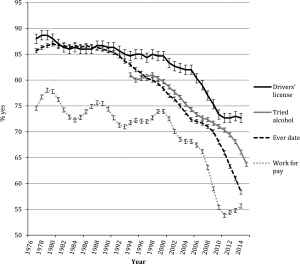
A new paper by Jean Twenge and Heejung Park (2017) is getting a lot of coverage. The main finding is a delay in the onset of certain activities traditionally defined as “adult.” This graph shows the trends in having a driver’s license, drinking alcohol (ever), dating, and working for pay–all down steeply for teenagers.

Twenge and Park find that these trends are parallel for different racial and economic groups. They also find that adolescents simply go outside their homes without their parents much less often than their predecessors did.

These data jibe with my observations teaching college and raising kids (and observing their cohorts) for 25 years. But I would have strongly surmised that my observations had a class bias. I would have explained the delay in adult activities as a result of increasing investments in children by parents who have assets to invest. American parents spend an average of $38,000 per child while their children are between the ages of 18 and 34 (Furstenberg, Rumbaut, Settersten 2005). That statistic conceals huge differences by social class. Some young people are rationally delaying their careers and the formation of their families while they accumulate human capital, thanks to their parents. Other people are on their own at age 15.

This graph, from Kei Kawashima-Ginsberg’s paper on extracurricular activities, shows a widening disparity in the sheer cash invested in organized activities.

Another reason to hypothesize a growing gap in the onset of adulthood by social class is Annette Lareau’s finding (ca. 2003) that middle-class American parents use a strategy of “concerted cultivation”–viewing childhood as an opportunity to develop human capital–while working-class parents prefer “the accomplishment of natural growth,” or letting kids be kids. One reason that middle-class and affluent American teenagers don’t spend much time away from their parents is that their parents are now providing “concerted cultivation” in the form of paid after-school activities, supervised homework, intentional conversations about valuable topics, etc. Meanwhile, the working class are trying to let their kids enjoy some freedom before they have to get jobs.

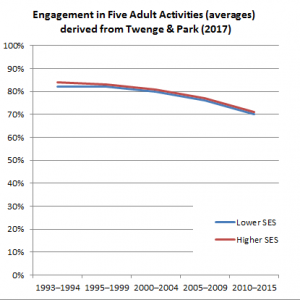
Given these prior assumptions, this is my biggest surprise in the Twenge and Park article: the lack of difference in rates of “adult” activities by social class. Here I graph the data in their Table 2.

Twenge, J. M. and Park, H. (2017), The Decline in Adult Activities Among U.S. Adolescents, 1976–2016. Child Dev. doi:10.1111/cdev.12930.

Furstenberg, F.F,  Rumbaut, R.G. Settersten, R.A. , “On the Frontier of Adulthood,” in Settersten, Furstenberg, and Rumbaut, eds., On the Frontier of Adulthood: Theory, Research, and Public Policy (University of Chicago Press, 2005)

See also: the changing transition to adulthoodcoming of age in your thirtiesGeneration Me?

religion and politics in the US versus many other countries

Here is a thesis that experts can evaluate better than I: The issue of religion in politics is fundamentally different in the US from many other countries. In the US, it is mainly about majority opinions versus minority rights. In countries from Mexico to Myanmar, it is about the social functions of a single organized body, the clergy. This difference matters for everyday politics.

The US has always had a religious majority that has been divided among many Christian denominations, with other faiths also represented. The Constitution gives individuals the right to exercise their religions freely. It also prevents any religion from being “established.”

The classic questions of religion and politics in the US involve majorities versus minorities. Sometimes, a coalition composed of many denominations supports a policy (e.g., banning abortion) for reasons that include religious ones. Then the questions become: 1) Does the desired policy impinge on constitutional rights? and 2) Are religious reasons for the policy acceptable or desirable in the public sphere? At other times, the majority becomes adverse to a particular religion–Mormonism in the 1800s being a clear example. Then the same two questions arise, but now the majority threatens the minority’s free exercise.

In nations with a single dominant religion that is organized in a hierarchical fashion (Catholic countries, but also, perhaps, some Muslim, Orthodox, Buddhist, Lutheran, and Anglican countries, plus in some respects, Israel), the issue is different. These countries have an organized, institutionalized body: the clergy. Typically, the clergy has a history of delivering some public services to the nation as a whole. For example, there may have been a time when the Catholic Church ran and staffed almost all of the state-funded schools in a given country. Sometimes, there is also a history of violent reaction against the clergy as an institution. Priests were executed in the French and Mexican revolutions, for instance.

In these countries, the question is not directly about whether to enact laws consistent with religious values. The question is whether to entrust an organized group of people, the clergy, with particular social functions. At the anti-clerical end of the spectrum, the clergy or priesthood is seen as a bane on society. At the clerical end, it is seen as a bulwark. These positions are, in principle, separate from one’s opinions of theology and of policy issues. A person could agree with the Church on most topics but distrust the clergy, or vice versa.

Here are some practical consequences of the difference:

  1. In the US, when debates over policy have religious components, they are deeply divisive and feel existential. At least some other countries treat such debates as fairly routine. The divisive issues for them concern the prerogatives of the clergy as an institution. An interesting hybrid case is Ireland, where the ballot victory on same-sex marriage was greeted with joy, at least in Dublin. I think voters were pro-equality, they celebrated because they had defeated the Irish clergy, a (currently unpopular) institution.
  2.  In the US, religious involvement in politics is usually mediated by officially secular political parties. The parties strive to assemble majorities by drawing people from several denominations. They typically recruit believers, not churches, into their ranks. In many other countries, each political party has a relationship with the main denomination, ranging from a formal partnership (e.g., for the Christian Democratic parties) to official hostility. Indifference may also be an option, just as a party can be neutral on other issues, but it will face questions about the clergy.
  3. In the US, it doesn’t really make sense to ask a candidate what she thinks of “the clergy.” You can ask her about abortion, God, her own faith, or the First Amendment, but there is no national clergy to have an opinion about.

See also: a typology of denominationsthe political advantages of organized religionreligion and politics in the Muslim world and the USA; and on religion in public debates and specifically in middle school classrooms.

Lifeworld and System: a primer

The great social theorist Jürgen Habermas has drawn attention–for more than half a century–to the problem that he calls the “colonization of the Lifeworld by System.” Here is my explanation, based mainly on a rare concrete example from his Theory of Communicative Action, vol. 2. 

The Lifeworld, for Habermas, is the background of ordinary life: mainly private, somewhat naive and biased, but also authentic and essential to our satisfaction as human beings. It is a “reservoir of taken-for-granteds, of unshaken convictions that participants in communication draw upon in cooperative processes of interpretation.” In the Lifeworld, we mostly communicate with people we know and who share our daily experience, so our communications tend to be opaque to outsiders and certainly not persuasive to people unlike us. But Habermas argues that we are incapable of thinking about everything at once. In order to reason and communicate, we must take most points as givens. Only then can “single elements, specific taken-for-granteds” be brought up for conversation and critical analysis.

Meanwhile, the “System” is composed of formal organizations, such as governments, corporations, parties, unions, and courts. People in a System have official roles and must pursue pre-defined goals (albeit sometimes with ethical constraints). For example, defense lawyers are required to defend their clients, corporate CEOs are supposed to maximize profit, and comptrollers are supposed to reduce waste in their own organizations. In the current period, there are fundamentally two Systems: markets (in which instrumental action leads to profit) and governments (in which instrumental action demonstrates power). Although the people who work in markets and governments are complex individuals with other commitments, their official work responsibilities are to maximize money or to administer power.

To illustrate the Lifeworld, Habermas invites us to envision an “older construction worker who sends a younger and newly arrived co-worker to fetch some beer, telling him to hurry up and be back in a few minutes.” The senior worker assumes that a whole set of beliefs and values are shared on the team: German construction workers enjoy and expect to drink beer at breaks during the workday, beer is for sale in the vicinity, the younger and/or most recently hired person is the one who does unpaid chores for the group, and so on. Each of these assumptions could be brought into doubt and subjected to debate. For instance, as Habermas suggests, the younger worker might say, “But I don’t have a car,” or “I’m not thirsty.” Other “elements of the situation” might generally pass unnoticed yet become relevant as circumstances change. If the younger worker is an immigrant without health coverage and he falls off the ladder as he goes to buy the beer, several relevant laws and controversies may suddenly occur to the workers, moving from their background knowledge to topics of explicit discussion. But at any given moment, simply by virtue of being human, the workers must assume most features of the situation as a shared and implicit background, a “vast and incalculable web of presuppositions.” This is their Lifeworld.

In order for the workers (or any other group of people) to be free and self-governing, they must be able to render any aspect of the Lifeworld problematic. It is a definitive feature of modernity that no assumptions are considered immune to critique; and it is a condition of democracy that no critique is blocked by law or other force. When the younger construction worker notes that no beer is available within walking distance and he doesn’t have a car, he is giving a reason for someone else to go. This turns his work group into a small Public Sphere. To the extent it is democratic and deliberative, his reasons will require responses.

Imagine (to go beyond Habermas’ presentation of this example) that the radio is playing as these men work. A news program includes an interview with a feminist activist who criticizes the construction industry for hiring very few women, followed by an immigrant leader who notes that alcohol is forbidden to Muslims (thus the assumption that everyone wants to drink beer is exclusionary), followed by a health expert who attributes disease to excessive daytime beer consumption. These people are making arguments that compel critical attention to specific aspects of the workers’ Lifeworld. They represent the larger Public Sphere of the Federal Republic or the European Union. It doesn’t matter whether the interviewees have self-interested motivations, such as selling copies of their books, or whether the radio station is a for-profit company trying to attract listeners. The format of any reasonably well-run news program will compel the speakers to give reasons that can be checked and assessed by reporters and listeners. This is a case of a democratic Public Sphere challenging citizens to reflect about aspects of their Lifeworld.

But although every particular point should be subject to discussion, the whole Lifeworld must be protected. One reason is that we need the Lifeworld to think at all, for we are capable of testing a specific assumption only while holding our other assumptions for granted. A second reason is that our Lifeworld is ours, a condition of living authentically. Any political program that tries to strip a group of people of their accumulated assumptions all at once would be totalitarian. A radio program that brings separate issues to the workers’ attention expands their thinking; but if a revolutionary government seizes all the radio stations and begins broadcasting propaganda against contemporary German working-class culture as a whole, that is a threat to their Lifeworld.

Meanwhile, the Lifeworld is vulnerable to manipulation by interested parties who act instrumentally. For example, suppose that on the radio, the workers hear men with similar accents to their own praising a particular brand of beer. Maybe women are also heard, enjoying these men’s company and appreciating their good taste. It sounds as if friends have entered the real Lifeworld of the construction site, but these supposed friends are really actors who are are paid to sell beer. Of course, the workers will understand the purpose of an advertisement, yet by skillfully imitating their authentic Lifeworld, the ad can affect their behavior. No reasons need be given; no rebuttal is invited. In this case, Habermas would say that the Lifeworld of the workers has been colonized by the System of markets. The System of government might similarly colonize their Lifeworld if a candidate for public office started talking on the radio as if he were their friend who shared their values and experiences.

In discussions of Systems colonizing Lifeworlds, common examples include commercial advertisements that masquerade as authentic communications. These are cases of “commodification”: firms mining the Lifeworld for economic advantage. Habermas also emphasizes the tendency of welfare state bureaucracies to “juridify” or “judicialize” the Lifeworld. For instance, when well-intentioned states seek to protect pupils and parents against unfairness in testing and discipline, fairness “is gained at the cost of a judicialization and bureaucratization that penetrates deep into the teaching and learning process,” depersonalizing the school, inhibiting innovation, and undermining relationships.

A neo-Marxist line of criticism faults Habermas for equating juridification with commodification and the state with the market. This critique hold that the underlying process is capitalist exploitation, and the welfare-state is only a threat to the Lifeworld because it is a tool of capital. Habermas disagrees. For him the underlying process is growing specialization, a feature of modernity. He insists that in socialist societies, the state colonizes the Lifeworld in a parallel way to the market’s colonization in capitalist societies; and in welfare states, both threats operate at once.

[It turns out that I have posted 58 times before on Habermas, collected here. My broadest posts are probably Habermas and critical theory (a primer)saving Habermas from the deliberative democrats; and Ostrom, Habermas, and Gandhi are all we need.]
Democrats as technocrats

This web search takes you to a whole stack of good recent writing about the Democratic Party as the technocratic party, with headlines ranging from Twilight of the Technocrats? to The Triumph of the Technocrats. In lieu of a critical review, I’d pose these questions:

  1. What would a technocrat support and do in our context? It’s possible to be a socialist technocrat or a technocrat who works for a huge, for-profit company. I presume that a technocratic Democrat today is someone who believes in optimizing GDP growth, environmental sustainability, and reductions in tangible human distress (e.g., disease, homicide) through efficient governmental policies. These desired outcomes often conflict, and then technocrats are fine with compromise. To qualify as a technocrat, you can’t be too enthusiastic about working with ordinary citizens on public issues, and you can’t base your agenda on controversial, challenging moral ideals.
  2. Do Democrats present themselves as technocrats, in this sense? Some do and some don’t. It seems fair to read the positive agenda of Hillary Clinton’s 2016 campaign as largely technocratic (she promised to govern competently and continue the balanced progress of her predecessor), although her critique of Donald Trump was ethical rather than technical. I also think that Clinton was in a tough spot because she didn’t believe that she could accomplish transformative change with a Republican Congress; thus managerial competence seemed a workable alternative. The 2016 campaign does not demonstrate that she–let alone all Democrats–are fully technocratic. However, consider a different case that is pretty revealing: the Josiah Bartlet Administration. This is an informative example just because it is idealized and fictional, free of any necessary constraints. The Bartlet White House is staffed with hard-working, highly-educated, unrealistically competent, smartest-guy-in-the-room, ethical people who strive to balance the budget while making incremental progress on social issues. Hollywood’s idealized Democrats are technocrats in full.
  3. Do Democrats choose technocratic policies? Again, I’d say “sometimes.” Both the Clinton and Obama Administrations definitely showed some predilection for measurable, testable outcomes; for behavioral economics; and for models that were consistent with academic research about the economy and the climate. They weren’t particularly good at empowering citizens to govern themselves or collaborating with social movements. On the other hand, the Affordable Care Act has a moral core (aiming to cover people without health insurance), even if many of its tools and strategies are best defined as technocratic.
  4. Are Democrats good technocrats? There has been more economic growth under Democratic than Republican presidents. But the sample is small, several Democratic presidents faced conservative congresses, and any correlation with a small “n” can easily be spurious. A deeper point is that Democrats are currently more committed to the mainstream findings of climate science, social policy research, and academic economics than Republicans are. Their accomplishments may be affected by sheer chance, but their strategies tend to be consistent with positivist, empirical research.
  5. Is Democratic technocracy consistent with justice? No. Almost any theory of justice, from libertarian to strongly egalitarian, would demand fundamental shifts from the status quo. Certainly, I would favor deeper changes in our basic social contract. On the other hand, compared to what? Managing our existing social policies in a competent way delivers substantial, if inadequate, justice. It beats incompetence or deliberate assaults on existing social institutions. In a multi-party parliamentary democracy, a center-left technocratic party would play an important role. I would be open to voting for it, depending on the circumstances and the alternatives. In our two-party system, a technocratic and centrist component competes for control of the Democratic Party. It shouldn’t be surprising that this component receives constant criticism from within the Party, because the Democrats represent a broader coalition, and there is plenty of room to the left of someone like Hillary Clinton. Whatever you think of her, I don’t think you can complain that she was criticized from her left.
  6. Is Democratic technocracy good politics? That’s not a question that will be settled to everyone’s satisfaction any time soon. Clinton lost to Trump but also won the popular vote. She was technocratic but not completely so. She faced many contingencies, from Fox News to Bernie to Comey, and handled them in ways that we can debate for the next decade. Again, the answer has to be: Compared to what? A compelling new vision of America’s social contract would beat competent management at the polls. But competent management may beat incompetence or a deeply unpopular vision (from either right or left).
  7. What’s driving the Democratic Party’s drift to technocracy? One could explain it in class terms: the Democratic coalition is now highly educated, including many people who make a living by demonstrating expertise. But I would propose a deeper thesis. Modernity itself is defined by constant increases in specialization and differentiation, plus radical doubts about our ability to know which ends are moral or just. In that context, people prosper who are good at applying technical reasoning to complex problems without worrying too much about whether the ultimate ends are right. Modernity has generated a white-collar governing class that is currently aligned with the Democrats, but more than that, it has generated a very high estimation of expertise combined with a leeriness about moral discourse. Religious conservatives monopolize the opposition to both of these trends. Getting out of this trap requires more than new messages and policies. It is a fundamental cultural problem.

See also: the rise of an expert class and its implications for democracyvarieties of neoliberalismthe big lessons of Obamacarethe new manipulative politics: behavioral economics, microtargeting, and the choice confronting Organizing for Action; and why the white working class must organize.