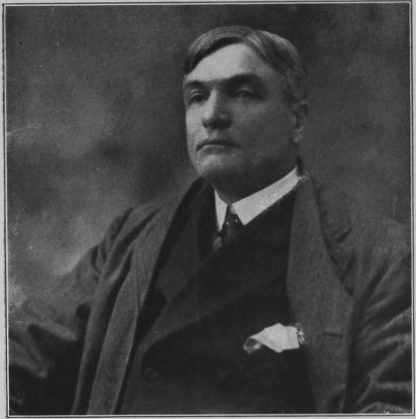
the only man who pardoned himself out of prison

If—very hypothetically—Donald J. Trump were to be convicted and even incarcerated, but also elected president in 2024, could he pardon himself? Since a president’s pardoning power is unlimited, the constitutional question might turn on whether the act of pardoning can be reflexive. Is it a correct use of the word “pardon” to say that someone pardoned himself?

The caption with above photo reads: “The only Man on Record who is known to have Pardoned himself out of Prison. He began life as a School Teacher, Clerk in a Law Office, full fledged Lawyer and Treasurer of a Political organization in New England, with whose funds he decamped. He has been in Prison a dozen times under as many aliases, where he has spent twenty-five years. When he pardoned himself out of prison he was in Nashville, Tenn. under the name of Henry B. Davis. He is now supposed to be dead.”

Leaving aside the Trumpian capitalization in this passage, the man who called himself Henry B. Davis did not actually pardon himself. He confessed that he “forged a petition bearing upward of 150 signatures, writing differing in each, the names of the leading citizens of Tipton, Tenn., the county in which I was sentenced. I then forged a letter bearing the signature of the firm of attorneys that defended me, one of whom was a friend of the Governor … I then forged another letter purporting to have been written by the aforesaid attorney to John Tipton, representative in the Legislature in Nashville, in which he was asked to see Governor Buchanan, and to urge him to pardon Henry B. Davis (my alias). All this was done in March, 1891. On the third day of April, 1891, the pardon reached the warden at Tracy City.”

In any case, this was not the only person to have pardoned himself. A Google search led me to a book by my friend Cynthia Levinson and Sanford Levinson, Fault Lines in the Constitution, which mentions the case of Isaac Stephens. While governor of the Territory of Washington, Stephens was convicted and fined for abusing his power. He was fighting a terrible war against Native people but was fined for offenses against white settlers. He actually pardoned himself and got away with it, although just six years later he died heroically on the Union side of the Civil War.

Neither example is very honorable, and I haven’t been able to find other cases of successful self-pardoning … so far.

Sources: John Josiah Munro, The New York Tombs, Inside and Out!: Scenes and Reminiscences Coming Down to the Present.–A Story Stranger Than Fiction, with an Historic Account of America’s Most Famous Prison (1909) and Cynthia Levinson and Sanford Levinson, Fault Lines in the Constitution: The Framers, Their Fights, and the Flaws that Affect Us Today.

Portraits of featured speakers

Frontiers of Democracy 2023

The annual Frontiers of Democracy conference at Tufts is coming up: July 13 (5-7 pm) to July 15 (noon) at Tufts University in Medford, MA. We have an excellent complement of registered participants, but there is still room for some more to register.

Come for:

  • Nine profound and experienced thinkers who will discuss religious pluralism, democracy, and racial equity in plenary panels.
  • Twenty-one carefully constructed, interactive concurrent sessions on a range of topics, from the North Carolina Leadership Forum’s model of transpartisan dialogue to lowering the voting age, from faith and trauma to climate resilience, from civic education to community organizing.
  • Six opportunities to learn specific methods of democratic practice in training sessions.
  • The rough-cut of a new documentary, with an opportunity to influence the final version.
  • Open-space discussions of topics that you can propose on the spot.
  • A display of books by authors at the conference, which you can purchase.
  • A beautiful art installation celebrating a major influence on our conference, Elinor Ostrom.
  • Snacks and meals.
  • Lots of interaction with 100 or more experienced and diverse activists for democracy from several countries.

The draft agenda is here: https://tufts.app.box.com/v/tisch-frontiers-2023-schedule. Registration information is here.

when does a narrower range of opinions reflect learning?

John Stuart Mill’s On Liberty is the classic argument that all views should be freely expressed–by people who sincerely hold them–because unfettered debate contributes to public reasoning and learning. For Mill, controversy is good. However, he acknowledges a complication:

The cessation, on one question after another, of serious controversy, is one of the necessary incidents of the consolidation of opinion; a consolidation as salutary in the case of true opinions, as it is dangerous and noxious when the opinions are erroneous (Mill 1859/2011, 81)

In other words, as people reason together, they may discard or marginalize some views, leaving a narrower range to be considered. Whether such narrowing is desirable depends on whether the range of views that remains is (to quote Mill) “true.” His invocation of truth–as opposed to the procedural value of free speech–creates some complications for Mill’s philosophical position. But the challenge he poses is highly relevant to our current debates about speech in academia.

I think one influential view is that discussion is mostly the expression of beliefs or opinions, and more of that is better. When the range of opinions in a particular context becomes narrow, this can indicate a lack of freedom and diversity. For instance, the liberal/progressive tilt in some reaches of academia might represent a lack of viewpoint diversity.

A different prevalent view is that inquiry is meant to resolve issues, and therefore, the existence of multiple opinions about the same topic indicates a deficit. It means that an intellectual problem has not yet been resolved. To be sure, the pursuit of knowledge is permanent–disagreement is always to be expected–but we should generally celebrate when any given thesis achieves consensus.

Relatedly, some people see college as something like a debate club or editorial page, in which the main activity is expressing diverse opinions. Others see it as more like a laboratory, which is mainly a place for applying rigorous methods to get answers. (Of course, it could be a bit of both, or something entirely different.)

In 2015, we organized simultaneous student discussions of the same issue–the causes of health disparities–at Kansas State University and Tufts University. The results are here. At Kansas State, students discussed–and disagreed about–whether structural issues like race and class and/or personal behavioral choices explain health disparities. At Tufts, students quickly rejected the behavioral explanations and spent their time on the structural ones. Our graphic representation of the discussions shows a broader conversation at K-State and what Mill would call a “consolidated” one at Tufts.

A complication is that Tufts students happened to hear a professional lecture about the structural causes of health disparities before they discussed the issue, and we didn’t mirror that experience at K-State. Some Tufts students explicitly cited this lecture when rejecting individual/behavioral explanations of health disparities in their discussion.

Here are two competing reactions to this experiment.

First, Kansas State students demonstrated more ideological diversity and had a better conversation than the one at Tufts because it was broader. They also explicitly considered a claim that is prominently made in public–that individuals are responsible for their own poor health. Debating that thesis would prepare them for public engagement, regardless of where they stand on the issue. The Tufts conversation, on the other hand, was constrained, possibly due to the excessive influence of professors who hold contentious views of their own. The Tufts classroom was in a “bubble.”

Alternatively, the Tufts students happened to have a better opportunity to learn than their K-State peers because they heard an expert share the current state of research, and they chose to reject certain views as erroneous. It’s not that they were better citizens or that they know more (in general) than their counterparts at KSU, but simply that their discussion of this topic was better informed. Insofar as the lecture on public health found a receptive audience in the Tufts classroom, it was because these students had previously absorbed valid lessons about structural inequality from other sources.

I am not sure how to adjudicate these interpretations without independently evaluating the thesis that health disparities are caused by structural factors. If that thesis is true, then the narrowing reflected at Tufts is “salutary.” If it is false, then the narrowing is “dangerous and noxious.”

I don’t think it’s satisfactory to say that we can never tell, because then we can never believe that anything is true. But it can be hard to be sure …

See also: modeling a political discussion; “Analyzing Political Opinions and Discussions as Networks of Ideas“; right and left on campus today; academic freedom for individuals and for groups; marginalizing odious views: a strategy; vaccination, masking, political polarization, and the authority of science etc.

the human coordination involved in AI

When we are amazed by the magic of a new software application, like ChatGPT, we should not be impressed by the machine, nor by the specific firm that offers the product, but by the enormous array of human brains that have been connected so that they can accomplish complex tasks together.

Brian Chau is writing a series of detailed posts arguing that the innovation curve for artificial intelligence may be tapering off, not accelerating. The curve may be s-shaped, starting with a long period of slow progress, followed by rapid breakthroughs that are now largely over, with another period of slow growth ahead.

Although his evidence seems robust, I cannot assess his thesis. What struck me as I read his analysis was the vast amount of coordinated human effort that produces something like ChatGPT.

AI requires hardware–not just the big servers that run the model, but also the components that connect to it, including my laptop, and its power cord, and the generator that supplies it with electricity. All hardware requires design, manufacture, raw materials, and transportation.

AI also involves software of many kinds, which requires vast amounts of human work. People need appropriate educations and training to do all the relevant tasks, from mining minerals to writing code. Information must be created and circulated, including information that is free and public rather than proprietary. And a whole range of businesses and other organizations (e.g., engineering schools) must be financed, managed, marketed, staffed, etc.

Prices play important roles in all of this. They are signals that create incentives. For instance, there is a market price for the kinds of data-processing required by AI, and as that price rises, people see that they can make money providing the service. But prices hardly ever suffice for coordinating large and complex systems.

For one thing, you can’t interpret a price signal without a lot of information. For instance, the starting salary of computer science majors is projected to fall by 4 percent this year. That is a price signal, but it’s confusing without more context. A prospective major would need to know what is causing this short-term shift in the average price of this category of labor.

Even when the message of a price signal is clear, you can’t act on it unless you have substantive knowledge of the topic. I am aware that certain kinds of software are in high demand, but I don’t know how to write modern code, so I couldn’t take advantage of the price (even if I wanted to). Many people who do know how to code were taught that skill, and teaching is a different form of communication from prices (even though most teachers are paid, and schools and colleges have market aspects).

Whether the results of all this human coordination are beneficial is a different question …

See also the design choice to make ChatGPT sound like a human ; the difference between human and artificial intelligence: relationships; artificial intelligence and problems of collective action.

from Andalusia to Cornwall

Four sabbatical months in Europe are coming to a close this week. We spent three of those months in Granada, Spain, until our Schengen tourist visas ran out. Since then, we have mostly stayed in Penzance, Cornwall.

It’s a study in contrasts. To name one: Andalusia is famous for fervent Catholic spirituality, although I’ve written a bit about how that reputation is exaggerated.* Meanwhile, Cornwall may be the most Methodist region on earth, with Methodists representing an outright majority of Cornish churchgoers since the 1800s. Few expressions of Christianity could be as different as a stark, sober Nonconformist chapel versus a whole city that pulsates with baroque, syncretic Catholicism during Holy Week.

But I want to mention water.

Andalusia has always been semi-arid, and its classic landscape is dry earth studded with olive trees between stony mesas. Right now, the region is suffering a catastrophic draught that is probably related to climate change. However, the Nasrid (medieval Arabized Muslim) rulers of Granada built a remarkable irrigation system for the city. Snow melts on the Sierra Nevada mountains, fills Nasrid aqueducts, flows through high-pressure pipes under the Alhambra to the Plaza Nueva, and then up to the area around today’s Church of San Nicolás, where a mosque covered a large public cistern. From that reservoir, pipes still fill more than a dozen other Nasrid cisterns, from which water irrigates backyard gardens and squares filled with flowering trees and other plants that attract an exuberant array of birds. The whole city is an artificial oasis, more than eight centuries old, which is surviving the ecological crisis so far. You can clearly see the distant snow that waters the trees around you.

When we arrived in Cornwall, it stopped raining here, as if we had brought the Andalusian draught with us. The skies have been almost as blue as they were in Spain. But this is a watery place. Everywhere, burbling streams rush down to the nearby sea. Most streams are overgrown, almost concealed in foliage, as is nearly everything. The entire county has been covered by a thick mat “Of tendrils, leaves, and rough nuts brown”–not inert, but luxuriantly growing as you watch; and flowers have been generously sprinkled over all that deep green.

*See also reflections on modern Granada (Spain); Richard Wright’s Pagan Spain.