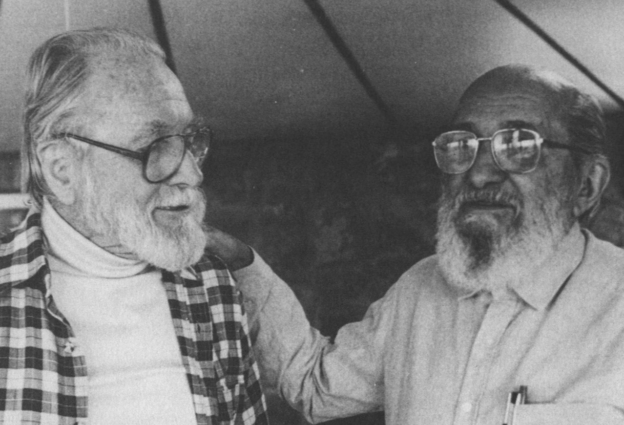
Miles Horton & Paolo Freire in 1987, photo by Candie Carawan, in Horton & Freire 1990.

highways on the sea: from Machado to Paolo Freire

This is a perfect short poem from Antonio Machado’s Proverbios y Cantares (1912):

     XLIV

Todo pasa y todo queda:
pero lo nuestro es pasar,
pasar haciendo caminos,
caminos sobre la mar

Everything passes and everything stays,
But ours is to cease to be. 
As we go, we make a highway,
A highway on the sea. 

[revised on Dec 1, 2023.] 

Machado had already juxtaposed caminos (roads, paths, journeys) with el mar (the sea) in the second poem of the volume:

     II

¿Para qué llamar caminos 
a los surcos del azar?... 
Todo el que camina anda, 
como Jesús, sobre el mar. 

Why designate as highways
furrows left aimlessly? ...
Anything that travels moves,
like Jesus, on the sea.

The same pairing recurs in the most-quoted lyric of the whole book:

     XXIX

Caminante, son tus huellas
el camino y nada más;
caminante, no hay camino,
se hace camino al andar.
Al andar se hace camino,
y al volver la vista atrás
se ve la senda que nunca
se ha de volver a pisar.
Caminante, no hay camino,
sino esteles sobre la mar.


Traveler, the highway
is your footprints, nothing more;
Traveler, there is no highway,
you make it as you walk.
As you walk, you make the highway—
and the path you see when you turn back
is the route where you'll never be.
Traveler, there is no highway,
save for trails upon the sea.

In 1987, the Brazilian educator Paolo Freire (then 66 years old) and the American organizer Myles Horton (82) interviewed each other at the Highlander Folk School in Tennessee, which Horton had led. Freire says, “Myles, I think we could start our conversation by saying something to each other about our very existence in the world.” A little later, he adds, “It’s very important for Brazilian readers to have information about Myles. About me, they have already, but about Myles they don’t have and it’s very, very important.”

Horton adds, “Yes, but the people in this country need the same thing about you.” He then proposes to talk “mainly [about] the things that would help people understand where I came from in terms of my ideas and my thinking, what they are rooted in. Is that the idea?” Freire replies, “Yes. Everything you recognize as something important. I think that even though we need to have some outline, I am sure that we make the road by walking. It has to do with this house [Highlander], with this experience here. You’re saying that in order to start, it should be necessary to start.”

The resulting book, We Make the Road by Walking (Horton & Freire 1990), explains in a footnote that Freire is adapting “a proverb by the Spanish poet Antonio Machado, in which one line reads “se hace camino al andar,” or “you make the way as you go.”

For activists, this phrase suggests that people can make new pathways by taking action, and perhaps that we should learn the trails that our elders have left for us. But I think Machado’s original point was apolitical. He meant that the stories we tell about ourselves are not permanent–or even important–and they vanish as we pass through them.

Translations by Peter Levine. Photo by Candie Carawan in Horton & Freire, We Make the Road by Walking (Temple University Press 1990). See also: Machado: Glory is never what I’ve sought; Lorca’s rivers.

[I had misread “esteles” as “estellas” and thus written “stars” instead of “trails.” Thanks to reader Barry Cusack for the correction.]
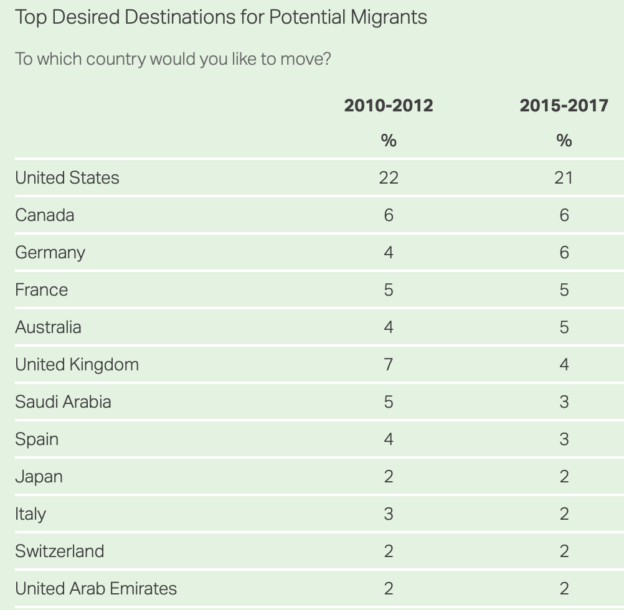

Gallup survey of potential migrants, asking where they would prefer to move. The USA is top for 21%, followed by Canada and Germany at 6%.

Is the USA the favorite destination for migrants?

When a conversation in this country turns critical about the USA, someone may interject that foreigners want to move here more than anywhere else. I have heard that point made quite a few times over the years.

It is not exactly false. The Gallup World Poll purports to be a representative global sample. It asks whether you would like to move to another country and, if so, which one you would most prefer. The USA is the most popular destination, at 21%, followed by Canada and Germany, at 6%, and France and Australia, at 5%.

But there are other ways to slice the data. One is to adjust for population size. The USA is almost 13 times as populous as Australia, but only 4.2 times as popular as the first choice for potential migrants. If you imagine that migrants could allocate themselves to the countries of their choice, then Australia would draw many more immigrants per capita than the USA. In fact, migration involves many factors apart from the potential migrants’ preferences, but 30% of Australian residents are actually foreign-born, versus 13.6 of US residents.

Likewise, 3.5 times more potential migrants would go to the USA than to Canada, but the US is 8.7 times more populous than Canada. And in reality, 23 percent of Canadians are foreign-born, versus 13.6 percent of US residents.

Another way to analyze the data is to combine countries. Gallup does not provide statistics on the popularity of smaller European countries, such as Belgium, whose actual immigrant population is 17.2% (i.e., higher than that of the USA). But if you combine the EU countries that Gallup lists, they total 20%, just shy of the USA’s 21%. I imagine that adding the other EU countries would make Europe more popular than the United States in aggregate. To be sure, some European migration is among the EU countries, but why shouldn’t that count?

Another interesting tidbit is that 10% of US and Canadian residents (combined) would prefer to migrate away from their countries. That is actually a higher rate than in Asia.

People who consider migrating tend to want to move to places where there is capital, demand for labor, and no war. Some countries that meet these standards rank unusually low as the preferred destinations for migrants, Japan being the most prominent example. But most of America’s counterparts would attract at least as many immigrants on a per-capita basis as we do, and many actually have more foreign-born residents.

Meanwhile, the countries that draw the most migrants are mostly not democratic, social-democratic, or liberal. Not counting micro-states, six of the eight sovereign nations that have the highest proportions of migrants are monarchies in the Persian Gulf (the other two being Luxembourg and Singapore). They are not necessarily preferred destinations–they register on the global poll but fall behind NATO members and Australia–but they do meet the criteria of capital and domestic peace, and they let people in.

See also: American exceptionalism; American exceptionalism, revisited; and anxieties about American exceptionalism

Reformation propaganda (note #2 from the Levine library)

This post is one of a series about books that my father left to me and that now line my office shelves at Tufts. More on how that happened is here.

In a folio volume of almost 2,000 dense pages, informally known as Foxe’s Book of Martyrs, John Foxe describes the persecutions of true-believing Christians since Roman times. Most of the book is devoted to its own period, when the persecutors were Catholics. This narrative helped create a sense of Protestantism as distinct from Roman Catholicism, and of England as a Protestant nation. It influenced and supplied some illustrations for my book The Anachronist.

Foxe’s Booke was a massive undertaking. It required the vast collaborative labor of collecting the names and stories of tortured and executed Protestants from across Europe. Foxe published numerous editions as new names arrived, and many copies were sold.

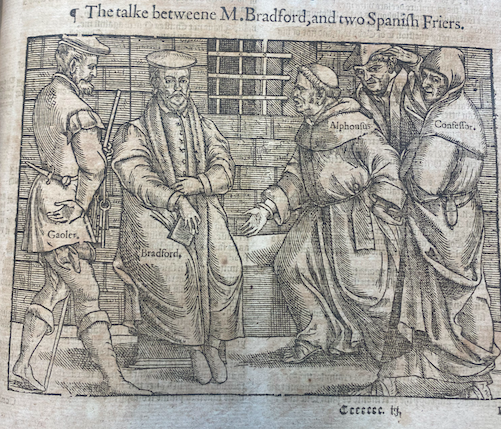
I have the 1576 edition, a great block of Gothic text with numerous engravings, most of which depict Protestants being tried or killed by Catholics. Here, for example, is the image on p. 1468, which shows “The talk between M[r] Bradford, and two Spanish Friers.”

John Bradford (1510–1555) was a Protestant clergyman who was burned by the government of Mary Tudor. The image shows him in his cell in the Tower of London, being interrogated by Spaniards. Queen Mary–“Bloody Mary” to Protestants–had married King Phillip II of Spain and brought England back into the Roman Church. However, by the time Foxe published an edition of his Booke in England, the Protestant Queen Elizabeth was “our gracious Lady now reigning,” and Spain was the hated enemy. This is an image of foreign treachery as well as Roman Catholic intolerance.

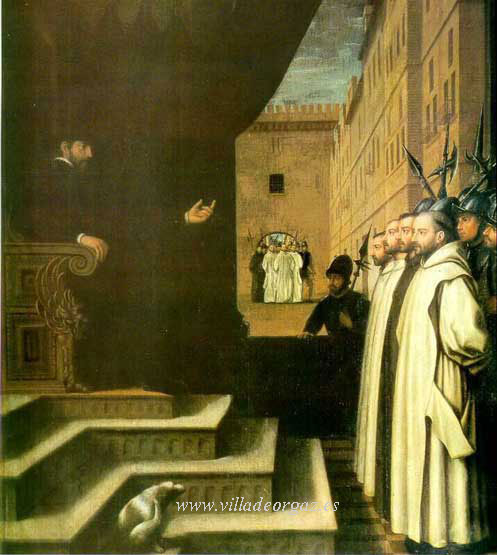
I thought of it last spring when I saw a painting in the Carthusian monastery of Granada, Spain. Painted in the early 1600s, it shows Thomas Cromwell condemning four Catholic clergy to death for their faith. He is likely sitting in an imagined Tower of London. That is where John Bradford met the Spanish friars under Queen Mary and where Cromwell had his own head chopped off (meriting a heroic account in Foxe’s book).

Juan Sánchez Cotán, Historia de los mártires de Inglaterra. Tres priores y un monje de Santa Brígida juzgados por C[r]onwel, Granada, Spain, via villadeorgaz.es

This painting hangs in the refectory, where the monks would dine, as part of a series entitled “The History of the Martyrs of England” by Juan Sánchez Cotán. Its didactic purpose was to remind the Spanish friars of Granada that Protestant Englishmen were their persecutors and foes.

The two images have some iconographic and stylistic similarities, although the “Gaoler” in the English print looks Mannerist (with his elongated body), and the Spanish painting is baroque.

Most of the specific stories that both sides collected were probably true. Each side interpreted the persecutions of their own co-religionists as clear evidence that their enemy was cruel. There is perhaps a lesson here about selection bias …

See also Coryat’s Crudities (note #1 from the Levine library); twenty-five thousand books to Bosnia; and my father’s books are going to James Madison’s desk at Montpelier.

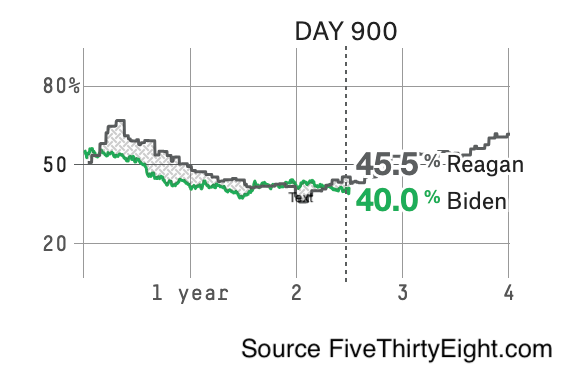
Regan and Biden approval ratings through day 913 of their respective administrations.

1984 all over again? The Reagan/Biden analogy

The Biden team is preparing for a Reagan-style victory lap in the event that the economy looks healthy in 2024. I hope they are also prepping for more difficult circumstances, since the economic forecast is highly uncertain. However, for what it’s worth, Morgan Stanley “now projects 1.9% GDP growth for the first half of this year.”

These are my prior assumptions:

  1. A president has limited and ambiguous impact on macroeconomic trends. Too many other factors matter, from the Federal Reserve and Congress to the business cycle, and from wars and technological developments to the budgets of 50 states.
  2. Although many people vote on other grounds, enough marginal voters are influenced by recent changes in the economy that those trends predict the results of presidential elections.
  3. People cite the economic and electoral fortunes of each presidential administration to support their ideological positions. For instance, the apparent successes of FDR and Reagan were used to vindicate New Deal liberalism and neoliberalism, respectively.
  4. Economic trends influence public opinion, but they do not determine the outcome of the debate about ideology. Eisenhower, Clinton, and Obama are examples of presidents who saw healthy net economic growth and were reelected, yet their administrations did not move public opinion as FDR’s and Reagan’s did. The big shifts in opinion seem to reflect changes in the Zeitgeist, not just electoral and economic developments.

Applying #1 means that Biden’s policies will not affect the economy much in 2024, even though Morgan Stanley believes that he is responsible for the upturn. According to #2, Biden will win pretty easily if growth is robust but could lose to Trump or another Republican if it stalls.

Per #3, if the economy grows and Biden wins, the President and many Democrats will argue that the reason was his industrial policy, which is aggressive, green, and pro-equity. I favor the policy, so I will be hoping that this argument sticks, even though I believe that macroeconomic trends are out of his hands.

If the case for Bidenomics does persuade, it will be thanks to the Zeitgeist. To make that explanation a little less mystical, I would focus on two factors.

First, the previously dominant neoliberal view really is fading now, much as late-Victorian laissez-faire was faltering by 1932 and New Deal liberalism had run its course by 1980. By a certain point, established theories don’t offer plausible solutions to the problems of the day, but alternatives do. By the time FDR took office, his home state of New York and several others had already moved in the direction of the New Deal; Roosevelt took the opportunity to bring their ideas to Washington. Likewise for Reagan in 1980–and for Biden in 2020. Indeed, Trump is no neoliberal, and there will probably be no national candidate who runs on cutting taxes and spending.

Second, the demographic basis of politics has shifted. I avoid crude materialistic and class-based predictions, yet the people who have the most to gain from low taxes and light regulation are business owners and investors. They are now outweighed in the GOP (which they once controlled) by working-class voters. They are represented in the Democratic Party, but outweighed there, too, by diverse lower-income voters, public sector workers, and salaried professionals.

The tectonic plates are shifting, and it’s at such moments that presidential administrations become examples or even metaphors for fundamental change. We had a “new deal for America” and then saw “morning in America” once the actual New Deal state faltered. The opportunity to make another such shift is a good reason to run a celebratory campaign in 2024–if (but only if) the economy holds up.

See also: federal spending for both climate and democracy