Postdoctoral Fellow, CIRCLE (Center for Information and Research on Civic Learning and Engagement) at Tufts University

Description

The Center for Information and Research on Civic Learning and Engagement (CIRCLE) at Tufts University’s Jonathan M. Tisch College of Civic Life will award a Postdoctoral Fellowship in Youth Civic Learning and Engagement for the 2023-24 academic year (August 2023- July 31, 2024).

CIRCLE is a research-based think tank studying how young people in the United States learn to become active participants in our democracy. CIRCLE studies a broad range of topics, including K-12 civic education, youth organizing, youth and civic media, and community characteristics that promote civic development. The central focus of its work is expanding access to civic learning and engagement opportunities by illuminating and working with others to address systemic inequalities and marginalization.

The Jonathan M. Tisch College of Civic Life, where CIRCLE is based, prepares Tufts students in all fields of study for lifetimes of active citizenship, and conducts critical national research to build stronger communities and democracy. Tisch College promotes new knowledge in the field and applies evidence-based practices in its programs, community partnerships, and advocacy efforts. Central to the university’s mission, the college offers opportunities for students to engage in meaningful community building, gain civic and political experiences, and explore their commitments to civic participation.

Operating under the directorship of Dr. Kei Kawashima-Ginsberg, CIRCLE is a team of twelve individuals representing diverse professional and academic backgrounds, perspectives, and lived experiences. In service of our goal to ultimately eliminate the systemic barriers that keep some young people marginalized from and underrepresented in civic life, we engage in impact-driven partnerships. By consistently seeking out opportunities to learn with and from people and organizations representing marginalized communities, we are able to intentionally iterate our approach to research and aim to achieve equal and just outcomes.

We take a systems-approach to understand and address barriers and widen pathways toward civic learning and engagement, which in turn drives a wide-ranging portfolio. CIRCLE focuses on the following major areas of inquiry through multidisciplinary lenses and a vision of equitable systems:

·       Broadening Youth Voting/Growing Voters

·       Equitable K-12 Civic Learning

·       Understanding Youth Attitudes and Beliefs

·       Youth in Media for Democracy

·       Youth Activism and Change

·       Civic and Economic Mobility

The postdoctoral fellow will be invited to provide their expertise and knowledgebase in the projects that CIRCLE currently engages in. The postdoctoral fellow will co-lead a major predetermined project, take significant responsibility on another, and also have a portion of their time (~20%) to conduct independent research of their choice within the major topical areas of CIRCLE’s work and will have access to many datasets for developing publishable research. These main projects focus on the (largely structural) relationships between civic media and information access, use, creation and youth civic engagement.  

The position is currently set up as a one-year engagement but will be renewed for another year pending availability of funds (over half is already raised) and mutual agreement between the scholar and CIRCLE’s leadership. This fellowship does not come with a teaching requirement, nor is that something that can be guaranteed. 

Qualifications

A scholar with a Ph.D. in any relevant discipline who is not yet tenured, or an ABD whose defense date is no later than December 31, 2023.  The scholar must have authorization to work in the United States for at least 12 months.  Tufts University is not able to sponsor a visa for this position.

Desirable qualifications, experiences, and skills include, but are not limited to:

Strong commitment to and track record of advancing equitable outcomes in a community through research, partnerships and/or civic action.

Expertise in at least one of the following areas: Civic media, youth media or participatory media; Media and youth development, specifically civic and political development; or, News, civic information and youth civic engagement.

At least two of the following: Experience leading a mixed methods research project; Implementation of a large qualitative research project; and/or Experience with community-based research implementation.

Ability to collaborate with colleagues and partners from varied backgrounds and to interact with practitioners of diverse backgrounds, views, and positions.

Strong interest in pursuing a career that involves partnership with community groups, public agencies, and nonprofit organizations.

Knowledge and experience in one or more of the following: Partnership with young people through research initiatives (including YPAR); Communicating about research with non-research audiences; Creating research-based products for non-research audiences (Not limited to written); or Articulating and/or organizing around implications of research for change. 

Capacity to function well in a fast-paced, impact-driven workplace working on several projects at one time. Although the postdoctoral fellow will not have the same expectations of a full-time CIRCLE staff member, they are expected to meet deadlines, respond to partner requests and project expectations in a timely, partner-centered manner.

More details here: https://apply.interfolio.com/128422
Generous Listening Symposium

This week, I am helping to lead a research symposium on “Generous Listening in Organizations” in partnership with the Vuslat Foundation. The main topic is listening to colleagues, including supervisors and employees. This practice is important for society and it matters to me, as a long-time middle-manager in a large organization (a university).

I also come into this conversation as someone who studies politics, broadly defined, and who believes that a better understanding of listening may create fruitful openings for strengthening democracy.

There is a vast literature on political communication, speech and rhetoric, deliberation, debate, and the public sphere–defined as the institutions in which people express their views. This topic is important because we do not automatically hold opinions, even about our own circumstances. We usually obtain our views through communication, which can go either well or badly. We can be persuaded to sacrifice for the common good or to become murderous racists. We can be persuaded that we are citizens of the world or members of narrow communities. Political action then follows communication.

Listening is one side of this exchange. It is certainly not absent in the literature but is less often discussed than the other side: speaking.

The research on political communication is diverse and nuanced, but quite a lot of it is critical. Survey-based research in the United States–and in many other countries–often finds that people are ill-informed, biased, and incoherent. I semi-facetiously summarize the overall message of current political science as: “People are stupid and they hate each other.”

The specific findings are often valid and worth consideration, but the overall message may hamper efforts to improve civic life. The message is most discouraging when the specific findings are linked to general claims about human beings, e.g., that we are naturally self-interested or that we evolved to use heuristics helpful in small groups of hunter-gatherers that fail to equip us for responsible self-government at a mass scale. If human beings have deep psychological limitations for participating in democracy, then perhaps we had better shore up our most basic safeguards (especially the peaceful transition of power after each election), and not be distracted by more ambitious democratic ideals.

I start with a different assumption. I presume that we exchange ideas in artificially designed settings that can help us to be wise or foolish: assembly halls, churches, newspapers, classrooms, laboratories, online networks, and many more. Designing and expanding good settings requires a degree of optimism about human potential. Therefore, research that implies we are hard-wired to be foolish can discourage people from working to build better institutions. And when our institutions are weak, we tend to think and behave in troubling ways that research then reveals, thereby reinforcing the researchers’ skepticism–a classic vicious cycle.

A focus on listening might help break the cycle. The evidence is pretty strong that when we form and state opinions, we are not as wise as we believe. We offer reasons for what we think and value that sound good to us–they sound like explanations of our views. But often, we have formed our views intuitively and then merely rationalized them in speech. Furthermore, our intuitions are unreliable, because they often reflect cognitive biases, selfishness, and limited empathy.

However, there is also evidence that we can be pretty good at listening. We can assess the reliability and competence of speakers and the cogency of their claims. In turn, our assessments of others’ statements can shift our intuitions. Indeed, Mercier & Sperber (2017) argue that we evolved to do this–to scan our human environment for people whose views are worthy of trust.

But then the questions include: How can we listen well? And how can we design institutions to enable and reward good listening?

Reference: Mercier, Hugo and Dan Sperber, The Enigma of Reason, Cambridge, MA: Harvard University Press 2017. See also: how intuitions relate to reasons: a social approach; how the structure of ideas affects a conversation; An agenda for R&D for democracy etc.

Mani Rao’s innovative Sanskrit translations

How can you translate writing that’s densely allusive if you expect few of your readers to recognize the allusions? How can you translate poetry–or any other formally complex writing–into a totally different language while conveying some of the experience of the original form? And how can you translate passages from a language that has one kind of grammatical structure into an entirely different one?

One option is to translate loosely into a poem that works in your own language, sacrificing accuracy for experience. An alternative is to translate into literal prose and provide many footnotes or other explanations. That gives your readers some of the information they need, but it offers a very different experience from reading the original poem.

For instance, consider these two translations of the first stanza of a Sanskrit classic, The Meghaduta or Cloud Messenger by Kalidasa. First, H.H. Wilson (1786-1860) offers a loose translation into Victorian rhymed couplets.

Spoiled from his glories, severed from his wife,
A banished Yaksha passed his lonely life:
Doomed, by his lord's stern sentence to sustain,
Twelve tedious months of solitude and pain.
To these drear hills, through circling days confined,
In dull, unvaried grief the god repined... 

In contrast, E.H. Rick Jarrow (2021) translates “scrupulously and thoroughly,” avoiding constructions that would sound “choppy” in English but striving to convey each name and idea from the original text

A Yaksha, banished in grievous exile from his beloved for a year,
his power eclipsed by the curse of his Lord for having swerved from his duty,
made his dwelling among the hermitages of Ramagiri
whose waters were hallowed by the ablutions of Janaka's daughter
and whose trees were rich with shade.

“Drear hills” may convey some of the mood of the poem but gives us no sense of the importance of the particular hills where the Yaksha has to live. Jarrow’s “The hermitages of Ramagiri whose waters were hallowed by the ablutions of Janaka’s daughter” incorporates more information but sends us to notes if we want to make sense of the references. Both translations are poems, but Wilson’s is rhymed and metered in a way that is typical of Victorian verse and perhaps honors the formal regularity of the Sanskrit.

Both translations have merit, but I am excited by the innovative approach of Mani Rao (2014). Here is how she renders the same first stanza:

Some yaksha who made a mistake was cursed by his master: 
Suffer! 
One entire year 

   An ordinary yaksha 
   Not a hero 

   When even a season’s separation’s unbearable 
   Imagine six 

   What mistake 
   Kalidasa does not specify 
   Some lapse of duty 
   Same word for ‘duty’ and ‘right’ 

   Has the hero lost the reader’s heart
    In the very first line? 

Heavy the pangs of separation from his beloved 
His prowess gone like a sun that’s set 
   Year-long night 

He lived in hermitages on a mountain 
named after Rama 

Groves cool, waters pure 
Sita once bathed here 

    Remember Rama remembered Sita 
    Remember messenger Hanuman 
    Flying like a cloud 
    Why hermitages, in the plural? 
    More than exiled. Unsettled.

The plain text is her translation of the original poem into free English verse. The italicized text is her own commentary, also in verse. It’s as if we were listening to someone–or perhaps a chorus–recite the poem while another person interjected comments and questions from the side.

Rao’s additions are not exhaustively explanatory. For instance, she does not retell the story of Rama remembering the absent Sita, which is an allusion at the beginning of the Meghaduta. I do not know that story–but I can look it up once someone mentions the names. The explanation, being a poem itself, is marked by explicit emotion, irony, misdirection, and other literary features.

Rao’s approach may have precedents. (I would not necessarily know.) I have appreciated how Anne Carson supplies prefaces to her Greek translations that are themselves poems. For instance:

                      i wish i were two dogs then 
                             i could play with me 
         (translator’s note on euripides’ bakkhai) 

Dionysos is god 
of the beginning 
before the beginning.

What makes 
beginnings special? 
Think of 

your first sip of wine
from a really good bottle.
[...]

I see great potential in this general approach of using verse to convey context for verse.

Sources: The Megha d?ta or Cloud Messenger: A Poem in the Sanskrit Language
by K?lid?sa
, translated by Horace Hayman Wilson, revised edition (London: R. Watts, 1843). E. H. Rick Jarow, The Cloud of Longing: A New Translation and Eco-Aesthetic Study of Kalidasa’s Meghaduta (Oxford University Press 2021); Mani Rao, Kalidasa for the 21st Century (New Delhi: Aleph Book Company, 2014); Anne Carson, Euripides: Bakkhai (New Directions, 2017). See also: The Kural; translations from Kuruntokai; there are tears of things.

a presidential election with two incumbents?

Incumbent presidents have a substantial advantage for reelection. Only 10 have lost. Statistical models that attempt to control for other factors, such as the economy, typically give a presidential candidate a bonus of 4-8 percentage points just for being the incumbent. In 2009, David Mayhew noted that parties had won the White House only half the time when they didn’t run an incumbent for reelection, but two thirds of the time when they did. That disparity is a little smaller now that Trump has lost a reelection race, but it’s still substantial.

Incumbents also have a vast advantage in their own party’s nomination race, with only Franklin Pierce actually losing his party’s support while he was in the White House. (Several others have chosen not to run.)

However, it’s not clear what these patterns mean for 2024. After all, two leading candidates have recently been presidents of the United States. Whether one, both, or neither will get an incumbency advantage is hard to tell from the historical data. There have only been 59 presidential elections ever, and only 23 in the modern era since FDR beat Hoover. Many variables are relevant to the outcomes of these cases. It is therefore hard to detect which aspects of incumbency may matter–and certainly hard to extrapolate any patterns to our unprecedented situation.

(I think that only one president was unseated but got his original party’s nomination again in a subsequent year: that was Grover Cleveland, who won the rematch.)

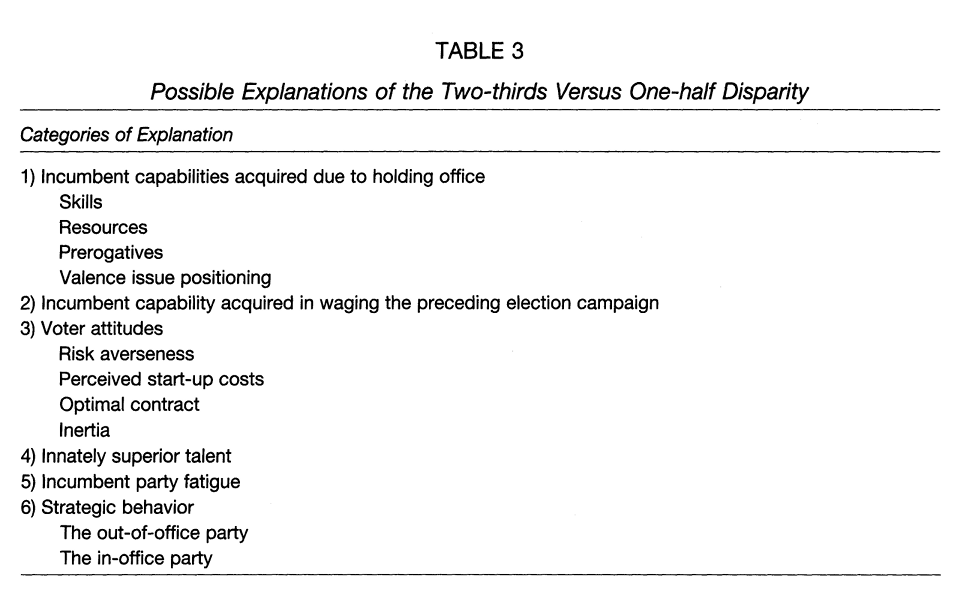
Mayhew identified 12 possible explanations for the presidential incumbency advantage and collected the evidence that might bear on each explanation. See his table 3.

Possible explanations of presidential incumbency bias from Mayhew 2008.

Some of these factors presume that the incumbent typically has impressive “capabilities,” because a president has already managed to win a national election and has governed for up to four years. The challenger could be equally capable, but the odds are against it.

In this case, I personally think that Joe Biden has demonstrated strong capabilities, whereas Trump’s campaigns and his time in office demonstrate a blatant lack thereof. However, it doesn’t matter what I think, but what the electorate decides. According to today’s New York Times/Siena poll, 44 percent of Americans agree with me–they hold a very unfavorable view of Trump–but 42 percent strongly disapprove of Biden’s performance in office. What is unusual is the fact that both likely nominees have recently served as the president, which may make this factor a wash.

Voters might also simply prefer a candidate who already holds office. For instance, perhaps some voters are risk-averse: biased against changing horses. Or perhaps they think that any newcomer would need too much time to become effective. Risk-aversion might help Biden a bit in 2024, although some voters may feel that electing him in 2020 was the unwise change. Voters can presumably see either Trump or Biden as the status quo if they want to. Some Trump voters even believe that he is the rightful winner of the most recent election.

“Incumbent party fatigue” refers to the pattern that each party loses a small amount of support–on average–each year that it holds the White House. However, this trend does not doom incumbents, in part because too little “fatigue” typically occurs within four years. The candidates who tend to suffer are those who try to succeed a president of the same party.

The explanations that Mayhew calls “strategic behavior” are of the following type. Perhaps the party of an incumbent president typically organizes to renominate him if he’s been doing well but moves against him if not–as was the case with LBJ in 1968. That would imply that incumbents who run for reelection have generally had successful first terms. And perhaps the opposition party is easily captured by marginal figures when its prospects already look weak against a popular incumbent (consider Barry Goldwater in 1964, or Michael Foot against Margaret Thatcher in 1983). However, Mayhew does not see a lot of power in this type of explanation.

Somewhat buried in his list are factors under the incumbent president’s direct control, such as the ability to allocate funds (e.g., to decide whether to locate the Space Command in Colorado or Alabama), where to deploy cabinet members, which bills to sign or veto, etc. Early in 2021, I predicted that the “$1.9 trillion American Rescue Plan Act of 2021 would prove popular by putting cash directly and quickly into people’s pockets,” and this would help Democrats in 2022. Democrats did somewhat better than most people expected that year, but there’s no evidence that nearly $2 trillion helped them electorally. (In other words, I was wrong.) The other side of the coin is that presidents must make difficult and unpopular decisions.

Overall, I think that Biden has an advantage in 2024 if the economy avoids a deep recession. I think a substantial Biden victory is possible if the economy starts to lift. I suspect that the 4-8 point incumbency advantage–which would typically give Biden a landslide–will not apply, because the electorate will split on the question of who is the rightful incumbent in the first place.

*Mayhew, David R. “Incumbency Advantage in U.S. Presidential Elections: The Historical Record.” Political Science Quarterly, vol. 123, no. 2, 2008, pp. 201–28. See also: 1984 all over again? The Reagan/Biden analogy; What kind of a claim is “Biden has an 87% chance of winning”? (on the metaphysics of probability)

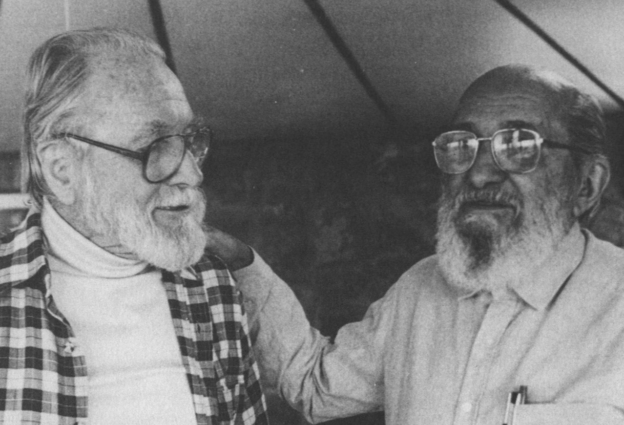
Miles Horton & Paolo Freire in 1987, photo by Candie Carawan, in Horton & Freire 1990.

highways on the sea: from Machado to Paolo Freire

This is a perfect short poem from Antonio Machado’s Proverbios y Cantares (1912):

     XLIV

Todo pasa y todo queda:
pero lo nuestro es pasar,
pasar haciendo caminos,
caminos sobre la mar

Everything passes and everything stays,
But ours is to cease to be. 
As we go, we make a highway,
A highway on the sea. 

[revised on Dec 1, 2023.] 

Machado had already juxtaposed caminos (roads, paths, journeys) with el mar (the sea) in the second poem of the volume:

     II

¿Para qué llamar caminos 
a los surcos del azar?... 
Todo el que camina anda, 
como Jesús, sobre el mar. 

Why designate as highways
furrows left aimlessly? ...
Anything that travels moves,
like Jesus, on the sea.

The same pairing recurs in the most-quoted lyric of the whole book:

     XXIX

Caminante, son tus huellas
el camino y nada más;
caminante, no hay camino,
se hace camino al andar.
Al andar se hace camino,
y al volver la vista atrás
se ve la senda que nunca
se ha de volver a pisar.
Caminante, no hay camino,
sino esteles sobre la mar.


Traveler, the highway
is your footprints, nothing more;
Traveler, there is no highway,
you make it as you walk.
As you walk, you make the highway—
and the path you see when you turn back
is the route where you'll never be.
Traveler, there is no highway,
save for trails upon the sea.

In 1987, the Brazilian educator Paolo Freire (then 66 years old) and the American organizer Myles Horton (82) interviewed each other at the Highlander Folk School in Tennessee, which Horton had led. Freire says, “Myles, I think we could start our conversation by saying something to each other about our very existence in the world.” A little later, he adds, “It’s very important for Brazilian readers to have information about Myles. About me, they have already, but about Myles they don’t have and it’s very, very important.”

Horton adds, “Yes, but the people in this country need the same thing about you.” He then proposes to talk “mainly [about] the things that would help people understand where I came from in terms of my ideas and my thinking, what they are rooted in. Is that the idea?” Freire replies, “Yes. Everything you recognize as something important. I think that even though we need to have some outline, I am sure that we make the road by walking. It has to do with this house [Highlander], with this experience here. You’re saying that in order to start, it should be necessary to start.”

The resulting book, We Make the Road by Walking (Horton & Freire 1990), explains in a footnote that Freire is adapting “a proverb by the Spanish poet Antonio Machado, in which one line reads “se hace camino al andar,” or “you make the way as you go.”

For activists, this phrase suggests that people can make new pathways by taking action, and perhaps that we should learn the trails that our elders have left for us. But I think Machado’s original point was apolitical. He meant that the stories we tell about ourselves are not permanent–or even important–and they vanish as we pass through them.

Translations by Peter Levine. Photo by Candie Carawan in Horton & Freire, We Make the Road by Walking (Temple University Press 1990). See also: Machado: Glory is never what I’ve sought; Lorca’s rivers.

[I had misread “esteles” as “estellas” and thus written “stars” instead of “trails.” Thanks to reader Barry Cusack for the correction.]