democracy’s sovereignty

Human beings have invented a vast and diverse set of institutions that coordinate behavior and allocate resources.

These forms include disciplined organizations headed by leaders, voluntary groups that strive to operate by consensus, procedures for voting directly on policies, elected bodies that deliberate and vote, courts that decide cases and controversies (with or without juries, which may or may not be randomly selected), bureaucracies characterized by hierarchies of defined positions, markets with or without firms (which may themselves by mini-dictatorships, bureaucracies, or co-ops), markets for capital, informal norms defined by a widespread assumption that everyone else will behave in certain ways, scientific disciplines organized by peer-review and replication, and networks that newcomers can join by agreeing to relay messages to other members.

This list is not meant to be comprehensive and is not closed. Several important forms are no more than 300 years old, and the last one originated within the past half century. In the future, new forms will be invented.

We should not view current institutions complacently, since many originated in injustice and still perpetuate bad outcomes. To name just one example, the Dutch East India Company, founded in 1602, pioneered essential features of capital markets, including shares that could be resold on the world’s first stock market and a board accountable to shareholders. Its major activities included conquest, ethnic cleansing, and slavery. And I do not mean to cite a corporation alone, since governmental forms are also rooted in cruelty.

But I do start with the assumption that each of these forms has been invented and has survived because it serves significant functions and offers distinctive advantages. Also, each one can be improved. Progress is by no means inevitable, but we can identify and enhance changes that are beneficial. A certain kind of arrogance is required to assume that any one of these forms is simply bad and should be dispensed with.

In that case, we must decide which institutional forms should be used for each social purpose. And a second-order question: which institution(s) should decide this matter?

A decision about which institution should play any given role typically looks like a law (although it might technically be a constitutional provision, a decree, or a regulation). For example, to have an independent, private press or else a governmental media system requires a law. Likewise for health insurance.

Which institutions can yield such laws? Not a market, which simply doesn’t offer products that look like laws. Nor are people invited to reason about the role of various other institutions when they are participating in market exchanges.

A king, dictator, high priest, or junta can decide which institution will do what. Instead of grabbing all power for himself, a ruler may favor courts or markets (think of Frederick the Great or Augusto Pinochet). Regardless, we do not want rulers to make these decisions for two major reasons. First, they cannot be trusted to decide which institutions work best for all, when they stand to profit for making them work mainly for themselves. Besides, even in the rare case of a benign despot, he cannot know enough about how each institution affects all the people of the society to be able to decide wisely.

In the US system, courts sometimes decide which kinds of institutions may do what. In the 1905 Lochner decision, the Supreme Court notoriously gave control over wages and working decisions to companies rather than the state. When judges seem to be deciding such cases on the basis of their own views (a charge against the current Supreme Court), then they appear no different from juntas. The special advantage of a court is not allocating responsibilities among institutions but interpreting and applying laws created by other institutions to adjudicate specific cases.

Science might be able to decide which institution works best for each purpose–if this turns out to be a tractable research question. Coase’s Theorem is supposed to be a result of research that proves the superiority of competitive markets for many purposes; some versions of Marxism are supposed to prove the deep flaws of capitalism.

I view these claims as useful inputs to reasoning about which institutions are best for various purposes. Research should be taken seriously and should develop further. I doubt it will ever resolve the discussion, because the choice of institutions involves conflicting values and interests, not merely empirical claims, and also because the world keeps changing as a result of people’s uncontrollable behavior. Any institution that is neatly designed according to a theory will soon be subverted by people who understand it and “hack” its design.

If the decision about which institution should do what looks like a law, and we don’t want rulers, judges, or specialized experts to make such laws, then the best candidate is a democracy. As Knight and Johnson (2014) argue, a democracy elicits views about the role of various other institutions, it gives everyone an equal opportunity to affect the decision, and it permits continued reflection once a decision is made.

One does not need optimistic assumptions about individuals’ wisdom or their tendency to learn from other people to believe that our best available way to decide the role of other institutions is to have an ongoing debate in civil society, then to empower elected, accountable representatives to vote, and then to debate the results and reconsider the decisions.

In fact, a reasonably healthy democracy seems to be one in which political competition is about the role of other institutions. For example, things would be going better if US voters were thinking about whether the government of the United States should channel resources into “green” technologies or else leave the allocation of capital to markets. I mention this example because the 2024 election is not about the pros or cons of Biden’s channeling more than a trillion dollars into green industries, but about who counts as a real American.

The above argument is deeply inspired by Knight and Johnson. Paul Aligica (2014) dissents in part. He sees all the different kinds of institutions as more or less on par within a polycentric order. He argues that institutions should and do grow and change as a result of decentralized decisions made by many actors across the society as a whole. In that sense, the people rule through all the institutions. Aligica defends an elected, democratic government but emphasizes that it cannot assess and influence the other institutions wisely unless they develop robustly and independently and demonstrate successes and failures.

I think Aligica makes valid points, but the gap between him and Knight and Johnson is not very wide, and I’m inclined to endorse the priority of democracy as long as we remember (as Knight and Johnson do) that a plurality of institutions is an asset for democratic government.

Sources: Jack Knight and James Johnson, The priority of democracy: Political consequences of pragmatism. Princeton University Press, 2014; Paul Aligica, Institutional Diversity and Political Economy: The Ostroms and Beyond. New York: Oxford University Press, 2014. See also polycentricity: the case for a (very) mixed economy; modus vivendi theory; what if people’s political opinions are very heterogeneous?; China teaches the value of political pluralism, etc.
class inversion in France

After the 2022 French election, I wrote:

The left should represent the lower-income half of the population; the right should represent the top half. When that happens, the left will generally advocate government spending and regulation. Such policies may or may not be wise, but they can be changed if they fail and prove unpopular. Meanwhile, the right will advocate less government, which (again) may or may not be desirable but will not destroy the constitutional order. After all, limited government is a self-limiting political objective.

When the class-distribution turns upside down, the left will no longer advocate impressive social reforms, because its base will be privileged. And the right will no longer favor limited government, because tax cuts don’t help the poor much. The right will instead embrace government activism in the interests of traditional national, racial or religious hierarchies. The left will frustrate change, while the right–now eager to use the government for its objectives–will become genuinely dangerous.

I wrote this as a US citizen, concerned that the Democratic Party relies on upper-income liberals while the GOP is increasingly based in the working class. But the pattern is seen internationally, which should influence how we seek to explain it.

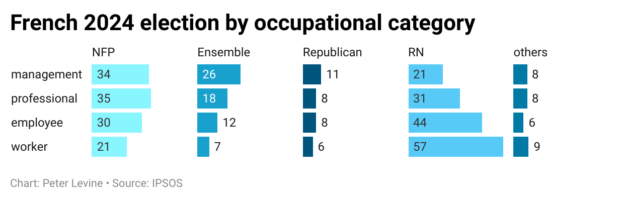
At that time, I noted that the French electorate had turned upside-down. The right-wing far surpassed the center and the left among voters from the lowest occupational class, while the top stratum of the society favored the center or the left.

The same pattern was not clear in Britain’s recent election, where Labour performed about as well across the social spectrum (although the Tories did best among workers). However, the inversion did repeat in last week’s French election, as shown in the graphic with this post.

The data come from IPSOS. The occupational categories, in declining order of prestige, are: “cadre,” “profession intermédiaire,” “employé,” and “ouvrier.” (See more here.) The parties, in order from left to right, are the leftist New Popular Front, Macron’s “Ensemble,” the Gaullist Republicans, and the rightwing National Rally.

The inversion is most clearly illustrated by a comparison between Ensemble and the National Rally. Macron drew from the top; the right-wing party, from the bottom. But the supposedly left-wing New Popular Front performed worst among workers (ouvriers), and was the top choice of the managerial class (cadres).

IPSOS also asked about self-described class, educational attainment, and economic circumstances. The patterns are the same as shown in my graphic, but I thought that occupation would be the most reliable measure. (Reports of class identity and economic circumstances can be affected by people’s political views, rather than the reverse; but IPSOS derives its occupational categories from people’s actual jobs.)

In the USA, race is certainly relevant. The working-class Americans who have shifted right are mostly (but not exclusively) white. This may also be the case in other countries, but it is important not to assume that race and racism explain the class inversion without looking more closely at the data from the country. Unfortunately, per French law, voters cannot be asked about their race/ethnicity. However, in the IPSOS poll, just 16 percent of Catholics, versus 34 percent of members of other religions, voted for the left, and the “other” category may pick up a fair proportion of immigrants. This may suggest that some French citizens who identify as white and Catholic are voting for the right on cultural/national grounds, but that explanation is not clear from these data.

See also: UK election results by social class; social class inversion in the 2022 US elections;  class inversion as an alternative to the polarization thesissocial class in the [2022 French election; and what does the European Green surge mean?

listeners, not speakers, are the main reasoners

Robert Brandom offers an influential and respected account of reasoning, which I find intuitive (see Brandom 2000 and other works). At the same time, a large body of psychological research suggests that reasoning–as he defines it–is rare.

That could be a valid conclusion. Starting with Socrates, philosophers who have proposed various accounts of reason have drawn the conclusion that most people don’t reason. Just for example, the great American pragmatist Charles Sanders Peirce defines reason as fearless experimentation and doubts that most people are open to it (Peirce 1877).

Brandom’s theory could support a similarly pessimistic conclusion. But that doesn’t sit well with me, because I believe that I observe many people reasoning. Instead, I suggest a modest tweak in his theory that would allow us to predict that reasoning is fairly common.

Brandom argues that any claim (any thought that can be expressed in a sentence) has both antecedents and consequences: “upstream” and “downstream” links “in a network of inferences.” To use my example, if you say, “It is morning,” you must have reasons for that claim (e.g., the alarm bell rang or the sun is low in the eastern sky) and you can draw inferences from it, such as, “It is time for breakfast.” In this respect, you are different from an app. that notifies you when it’s morning or a parrot that has been reliably trained to say “It is morning” at sunrise. You can answer the questions, “Why do you believe that?” and “What does that imply?” by offering additional sentences.

(By the way, an alarm clock app. cannot reason, but an artificial neural network might. As of 2019, Brandom considered it an open question whether computers will “participate as full–fledged members of our discursive communities or … form their own communities which would confer content” [Frápolli & Wischin 2019].)

Whenever we make a claim, we propose that others can also use it “as a premise in their reasoning.” That means that we implicitly promise to divulge our own reasons and implications. “Thus one essential aspect of this model of discursive practice is communication: the interpersonal, intra-content inheritance of entitlement to commitments.” In sum, “The game of giving and asking for reasons is an essentially social practice.” Reasoning in your own head is a special case, in which you basically simulate a discussion with real other people.

The challenge comes from a lot of psychological research that finds that beliefs are intuitive, in the specific sense that we don’t know why we think them. They just come to us. One seminal work is Nisbett and Wilson (1977), which has been cited nearly 18,000 times, often in studies that add empirical support to their view.

According to this theory, when you are asked why you believe what you just said, you make up a reason–better called a “rationalization”–for your intuition. Regardless of what you intuit, you can always come up with upstream and downstream connections that make it sound good. In that sense, you are not really reasoning, in Brandom’s sense. You are justifying yourself.

Indeed, the kinds of discussions that tend to be watched by spectators or recorded for posterity often reflect sequences of self-justifications rather than reasoning. I recently wrote about the scarcity of examples of real reasoning in transcripts and recordings of official meetings. As Martin Buber wrote in The Knowledge of Man (as pointed out to me by my friend Eric Gordon):

By far the greater part of what is called conversation among men would be more properly and precisely described as speechifying. In general, people do not really speak to one another, but each, although turned to the other, really speaks to a fictitious court of appeal where life consists of nothing but listening to him.

Some grounds for optimism come from Mercier and Sperber (2017). They argue that people are pretty good at assessing the inferences that other people make in discussions. Although we may invent rationalizations for what we have intuited, we can test other people’s rationalizations and decide whether they are persuasive.

Furthermore, our intuitions are not random or rooted only in fixed characteristics, such as demographic identities and personality. Our intuitions have been influenced by the previous conversations that we have heard and assessed. For instance, if we hold an invidious prejudice, it did not spring up automatically but resulted from our endorsing lots of prejudiced thoughts that other people linked together into webs of belief. And it is possible–although difficult and not common–for us to change our intuitions when we decide that some inferences are invalid. Forming and revising opinions requires attentive listening, critical but also generous.

The modest tweak I suggest in Brandom’s view involves how we understand the “game of giving and asking for reasons.” We might assume that the main player is the person who gives a reason: the speaker. The other parties are waiting for their turns to play. But I would reverse that model. Giving reasons is somewhat arbitrary and problematic. The main player is the one who listens and judges reasons. A speaker is basically waiting for a turn to do the most important task, which is listening.

This view also suggests some tolerance for events dominated by “speechifying.” To be sure, we should prize genuine conversations in which people jointly try to decide what is right, and in which one person’s reasons cause other people to change their minds. This kind of relationship is the heart of Buber’s thought, and I concur. But it is unreasonable to put accountable leaders on a public stage and expect them to have a genuine conversation. None of the incentives push them in that direction. They are pretty much bound to justify positions they already held. Although theirs is not a conversation that would satisfy Buber, it does have two important functions: it allows us to judge people with authority, and it gives us arguments that we can evaluate as we form our own views.

Again, if we focus on the listener rather than the speaker, we may see more value in an event that is mostly a series of speeches.


Sources: Robert R. Brandom, Articulating Reasons: An Introduction to Inferentialism. (Harvard 2000); Charles S. Peirce, “The Fixation of Belief,” Popular Science Monthly 12 (November 1877), 1-15; María José Frápolli and Kurt Wischin, “From Conceptual Content in Big Apes and AI, to the Classical Principle of Explosion: An Interview with Robert B. Brandom” (2019); Richard E. Nisbett and Timothy D. Wilson. “Telling more than we can know: Verbal reports on mental processes,” Psychological review 84.3 (1977); and Hugo Mercier and Dan Sperber, The Enigma of Reason (Harvard University Press 2017. See also: looking for deliberative moments; Generous Listening Symposium; how intuitions relate to reasons: a social approach and how the structure of ideas affects a conversation

Social class in the 2024 UK general election

UK election results by social class

One of my obsessions is the social-class inversion that has been visible in several countries in the 21st century, in which parties of the left draw their strongest support from highly educated, “professional” voters and those on the right appeal best to the working class. Under those circumstances, left parties will block bold economic initiatives (which would cost their voters), and right parties may offer ethno-nationalism and authoritarianism, since libertarian economic policies have little relevance to workers. This is potentially a road to fascism.

The full exit polls from yesterday's UK election do not seem to be available yet (I assume they are still embargoed for the media companies that subscribe to Ipsos' service), so I have used Ipsos' final pre-election survey as a rough substitute. The interactive graphic above lets you see each party's support by social class.

The image above this post simplifies matters by grouping the Tories and Reform as "all right," and Labour, the Liberal Democrats, the Greens, and the Scottish and Welsh nationalists as "all left."

You can see evidence here of a class inversion, but it is not as dramatic as in some 21st century elections. The Reform and Green parties illustrate the pattern best, drawing their support (respectively) from the bottom and the top of the social class structure. The Conservatives perform best at the bottom, but only by a bit. In all, the right does considerably better among semi-skilled and unskilled workers than among managers and professionals, but Labour holds its own across all categories, blurring the pattern.

I would argue that Labour must pursue policies that benefit the lowest social class category, not only for social justice but also to reverse the class inversion that threatens democracy itself.

See also: social class inversion in the 2022 US elections;  class inversion as an alternative to the polarization thesissocial class in the French election.

some basics

I was the world in which I walked, and what I saw
Or heard or felt came not but from myself;
And there I found myself more truly and more strange.
-- Wallace Stevens, "Tea at the Palaz of Hoon" (1921)

For those who are interested in the most fundamental questions, it has often proven useful to ask about the thinker rather than what is thought. We can derive insights about the world by first understanding our own predispositions and limitations.

Hence the early Buddhists went searching for the self and found only the five aggregates (form, sensation, perception, volition, consciousness), Socrates tested various kinds of expertise, Aristotle based his system on logic, the sixth Chan patriarch Huineng found truth in his own original nature once all attachments fell away, Ibn al-Haytham explored optics to understand space and matter, Descartes proposed to ground philosophy on a critical theory of reason, Hegel analyzed the logic of history because he saw reason as cumulative, Husserl turned to pure experience, and Wittgenstein looked to the ordinary language with which we express thoughts.

These are examples of examining the subjective to understand what is objective.

For me, the most basic truth about our thought is that we use brains that evolved for specific needs, leaving us with severely limited cognitive powers and motives that are dubious, even by our own lights.

Indeed, we come into the world knowing almost nothing and hold most of our beliefs because of what other members of our species have told us. We are able to believe many different things, but what we actually believe depends in large part on who has influenced us, which is the result of our surrounding social structure–things like schools and publishers and churches and governments. And all social structures are dubious, even by our own lights.

I would believe very different things if I were a medieval Catholic, let alone a dolphin. Each organism has its own Umwelt (self-centered world), or kyogai (bounded consciousness, in Zen), or “mundo” in Stevens’ idiosyncratic vocabulary.

This relativism is grounds for humility but not an excuse for blanket skepticism. We can make and test specific inferences. Our understanding can accumulate, albeit from many starting points. We are obliged to think as well as we can and not to ignore what we have reason to believe.

Considering the knowledge that has accumulated for me, I think I discern two main pillars.

One is natural science, which assumes and reinforces a picture of nature as impersonal, purposeless. Things happen because things previously happened.

The other is ethics, in the very general sense that what matters is experience, not only my experience. “Without exception, no sufferings belong to anyone. They must be warded off simply because they are suffering” (Shantideva, 8.102-3).

Science and ethics stand separately. Neither lends support to the other. Each can be doubted in a very abstract way. Many human beings have denied each of them, and I could deny them as well. But such doubt is abstract because I have been formed by accumulated thought that supports both pillars.

Further, these two assumptions are responsible. Not to care about others is selfish; not to accept the basic purposelessness of nature is sentimental. We are to address suffering in a world that will not offer respite by itself. To doubt science or ethics is a mere temptation, not a responsible option.

On this planet, the general principles of a purposeless nature have generated the logic of natural selection, which causes increasingly complex organisms to proliferate against the current of entropy. In earth’s animal kingdom, this complexity has yielded sensitivity and, ultimately, experience.

Nothing suggests that evolution would tend toward happiness. On the contrary, a sensitive animal is more likely to survive if it experiences negative emotions, such as fear and aversion. Nor is there any reason to expect that an evolved brain would be able to understand itself. The first-person world–the stream of consciousness–is a slippery thing for us because we are not well designed for meta-cognition. We can describe the Umwelt of a deer-tick but not our own. We resort to crude words like “self” and “world” or “cause” and “effect” that seem inadequate to what we experience.

Recognizing the abstract idea that the world is experienced differently by other kinds of people and species reminds us that it has unplumbed depths. Attending very closely to our own experience offers hints of what we normally miss. Listening to others describe their experience enriches our own and encourages compassion by directing attention to their emotions and the causes of their experiences, something that our evolved brains seem able to do.

Genuine compassion demands action, and action to address suffering keeps one from marinating in one’s own concerns. We should listen not only to homo sapiens but also to other sentient creatures. But it is a mistake to attend only to others, since each of us is usually best placed to hear and respond to our own stream of consciousness, which is easy for us to ignore. If we can find ways to share what we find within, without burdening other people with self-indulgent confessions, then what we share about ourselves may be a gift for them.

Modern philosophers call the very close description of one’s own experience “phenomenology.” This practice has ancient roots. For Husserl, the ancient Buddhist Pali Canon was exemplary of phenomenology. He wrote that understanding its “joyous mastery of the world … means a great adventure” for those who start with different assumptions–in his case, with concepts derived from Protestantism (trans. in Hanna 1995). In other words, the Pali Canon offered both a skillful description of human experience in general and an alternative to Husserl’s local context. Exploring this alternative liberated him from himself.

Not only ancient Buddhist scriptures and dense modern phenomenological treatises but also many literary texts and images offer hints about consciousness as experienced by specific people. Since the mind is constantly attentive to the world and to other minds, a work that describes nature or people is also an account of the one who experiences such things. Thus a poem about a nightingale or a painting of a haystack or a fiction about one day in Dublin is also a kind of phenomenology. As Stevens said (I am on a Stevens kick right now), “Poetry is one of the enlargements of life.”

We have brains designed for survival, which means that they are destined for suffering. But this inheritance has equipped us with the capacity to “enlarge” ourselves by listening generously–listening to others, to nature, and to ourselves.

Again, to listen seriously compels compassionate action. If we act for the sake of a good outcome, we will inevitably be frustrated, so we must act just to be compassionate (which, however, implies thoughtfully choosing the most effective means). And since each of us is cognitively limited and motivationally flawed, we should almost always decide what to do together. This is where the inner life and civic life come together.

Sources: F.J. Hanna, “Husserl on the teachings of the Buddha,” The Humanistic Psychologist, 23(3), (1995) 365–372; Shantideva, The Bodhiicaryacatara, trans. by Kate Crosby and Andrew Skilton (Oxford University Press, 1995). See also: Cuttings version 2.0: a book about happiness; verdant mountains usually walk; Montaigne the bodhisattva?; Wallace Stevens’ idea of order; the fetter; thinking both sides of the limits of human cognition; joys and limitations of phenomenology; and a Husserlian meditation.