You all knew that some things are worth dying for. One’s country is worth dying for, and democracy is worth dying for, because it’s the most deeply honorable form of government ever devised by man. — President Ronald Reagan, Normandy, June 6, 1984
From World War I until recently, leaders of both major political parties routinely claimed that the United States was a democracy. Politicians often called us “the greatest democracy on earth” and asserted that the purpose of both world wars, Korea, Vietnam, and the Cold War had been to defend democracy. The main debate was whether we had attained a democracy or were still struggling to be one, with the strongest skeptics on the left. A perennial argument pitted left critics–who asserted that our domestic and foreign policies were anti-democratic–against conservative defenders of our credentials as a real democracy.
This consensus about goals has broken down because the hard right now says that we were not founded as a democracy and should not be one.
For example, when Rush Limbaugh reprinted Reagan’s 1984 Normandy speech on his website, he ended the long excerpt just before the invocation of “democracy” that I quoted above. (The words “BREAK TRANSCRIPT” mark where that passage would start.) If the sainted President Reagan said that our men died at Normandy for democracy, Limbaugh would have to agree. But a current right-wing talking point holds that we are a republic and not a democracy. So Reagan’s speech is truncated.
I have been involved in writing a new voluntary framework for state social studies standards. A conservative blogger named Shane Vander Hart reviewed a draft, writing, “I noticed that on pg. 29 it is mentioned we live in a constitutional democracy when in fact we live in a constitutional republic. It is troubling that those writing this document couldn’t get something as basic as that right.”
It is debatable whether the United States is a democracy, but you aren’t making a factual error if you use the word that was preferred by virtually all 20th century presidents.
First of all, even if the US was not founded as a democracy, the 15th, 17th, 19th, and 24th amendments to the Constitution, the state constitutions, two centuries of legislation, and Lincoln’s interpretation of the Civil War as a struggle for government “by the people” have made us a representative government on the basis of one person/one vote, which is a reasonable definition of a democracy.
Second, it is not clear that the founders intended a republic in contrast to a democracy, if we look past the words (whose meanings vary depending on the writer and the time) and think instead about the underlying ideas.
Madison wrote of a “pure democracy, by which I mean a society consisting of a small number of citizens, who assemble and administer the government in person.” He was thinking of Athens and other Greek city states. He did not recommend this model: “Such democracies have ever been spectacles of turbulence and contention.”
Note that Madison says “such democracies,” referring to the “pure” type, which is small and direct. That doesn’t rule out the possibility of other types of democracy. He calls his own preferred form of government a republic, which is (a) representative and (b) very large. He considers both features as definitive and essential to success. If a republic’s representatives were directly chosen by the people on the basis of one person/one vote (as ours are today), that would fit most definitions of a “democracy,” although it would no longer be the pure and original type. It would still meet Aristotle’s criterion that “the partnership (koinonia) of democracy is based on numerical equality” (NE 1241b). Thus we could say that Madison co-founded a republic that became a democracy with the passage of the 17th Amendment.
Jefferson is more favorable than Madison to popular rule. He does not use the word “democracy,” but “the core of [his] thought is a project for democracy.”* Like Madison, he prefers the word “republic,” but he uses it to name the very system that Madison would call a democracy:
Indeed, it must be acknowledged, that the term republic is of very vague application in every language. Witness the self-styled republics of Holland, Switzerland, Genoa, Venice, Poland. Were I to assign to this term a precise and definite idea, I would say, purely and simply, it means a government by its citizens in mass, acting directly and personally, according to rules established by the majority; and that every other government is more or less republican, in proportion as it has in its composition more or less of this ingredient of the direct action of the citizens. — Jefferson to John Taylor, 1816
His idea of a republic is not a constitutional system, because the majority not only governs but establishes the rules and can alter them at will. Jefferson goes on to say that a real republic must be small, and he cites the New England township as a model. But, he adds, one can mix the “ingredient of the direct action of the citizens” with other ingredients to produce hybrid systems at larger scales. They may incorporate elected or appointed offices as well as popular votes. “The further the departure from direct and constant control by the citizens, the less has the government of the ingredient of republicanism.”
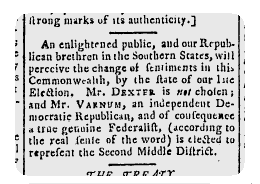
Madison and Jefferson jointly founded the Democratic-Republican Party in 1791. It was often simply called the Republican Party, although the terminology was unofficial and varied. It rested on democratic/republican societies, which variously chose the words “Democratic,” “Republican,” “True Republican,” “Constitutional,” “United Freeman,” “Patriotic,” “Political,” “Franklin,” and “Madisonian” in their names. They were the opponents of the Federalists. Once the French Revolution turned bloody, “the very name ‘Democracy’ was used as part of the Federalist attack on [these] societies. ‘Democracy’ was carefully distinguished from ‘republicanism,’ and the former was equated with French Jacobinism. A poem entitled ‘Democracy,’ published in 1794, linked democracy with lawless confusion.”** Yet the Federalists were badly beaten in the election of 1800, and the party that Madison and Jefferson founded dominated American politics for a generation.
The word “democracy” still had partisan overtones in Lincoln’s day. Although deeply democratic himself, he often often used the word pejoratively to mean rule by his opponents, the capital-D Democrats. His Republican successor Teddy Roosevelt, however, called our system a “democratic republic” in his inaugural address of 1905. That was about the time when a bipartisan consensus formed that our aspirations ought to be democratic.
Today, we have a mixed form of government with a strong element of popular or majority rule. Jefferson would call that element “republican”; many people today would call it “democratic.” No one, then or now, would assert that we have a pure democracy. In the social studies framework, we called our system a “constitutional democracy” to indicate that the powers of the people are checked. The government is not in “direct and constant control by the citizens.” [Likewise, the powers of the federal government are limited.]
How did this semantic ambiguity arise? The word “democracy” is of Greek origin. It literally means “rule of (or by) the people.” One could hold that the sovereign power in the US is the people–and hence we have a democracy in the etymological sense. Like all old words, however, “democracy” has accumulated resonances beyond its etymological origins. It may invoke the Greek city-states (whether seen as ideals or as disasters) or mass modern societies.
“Republic” comes from the Latin. My Latin dictionary says that “publicus” means “belonging to the people.” Thus “res publica” means the “thing belonging to the people,” whereas “democracy” is the “people’s rule.” If there is a significant difference in the etymological sense of these words, it is the difference between something that the people have (a republic) versus a power they wield (democracy). A better translation than “the public thing” is “commonwealth.” The words “republic” and “commonwealth” invoke the Roman regime before Caesar Augustus, the Cromwellian state, the early American colonies, and the ante-bellum US system. The meaning of “republic,” however, is malleable, because it depends on which features of the Roman republic and its descendents one considers definitive.
Ultimately, the United States can be called republican and democratic. The two words have interestingly different origins and resonances but are not sharply distinguishable. Nor do we have either a pure republic/democracy. Some limitations on the republic/democratic element are wise, but our current system is flawed by most standards. Although our democratic/republican aspirations are only partly realized, they remain beacons.
*Michael Hardt, “Jefferson and Democracy, ” American Quarterly, Vol. 59, No. 1 (Mar., 2007). **Sheldon Foner, The Democratic-Republican Societies, 1790-1800: A Documentary Sourcebook of Constitutions, declarations, Addresses, Resolutions, and Toasts (Greenwood, 1976). p. 25