MOOCs are old and shopworn

This is from a Connected Planet article in 1997:

Ah, spring – the time of year when students decide to skip classes en masse and sit outside enjoying the sun and fresh air. For the students of the University of Phoenix Online Campus, however, that ritual loses something in the translation: To duck their professors, all they have to do is turn off their PCs and unhook their modems.

But it’s a tradeoff that they’re willing to make in order to earn their undergraduate and graduate degrees on a part-time basis from the comfort of their own homes. The University of Phoenix opened its doors to its first 12 on-line students in 1989, and it now boasts 2500 students, 250 faculty members and eight degree program. …

However, one education industry analyst wonders how much credibility an on-line degree really has in the marketplace. “I would imagine there would be a bias against on-line degrees of any kind,” said Rick Hesel, principal at Art & Science Group. “Face-to-face contact with the faculty is considered to be a mark of quality, and because this program doesn’t have that, I think both employers and prospective students would be wary.”

But that could change soon, as the big names in education get into the on-line arena, Hesel said.

“Once you see Harvard or other prestigious MBA programs getting into it, all bets are off,” he said.

And Hesel believes that will be sooner rather than later.

Contrast that with the talk of a “MOOC Revolution” in (for instance) this 2103 Tom Friedman article. Friedman, like many others, presumes that MOOCs (massive open online courses) are very new, rapidly spreading, highly promising, originating in institutions like Stanford and Harvard with distinguished educators like Michael Sandel, and motivated by the goals of better and more accessible education. But, as Aaron Bady argues in Liberal Education, even the word “MOOC” is now almost six years old, and the basic practice dates to 1989. Even then, students were assigned to online discussion groups and showed videos of lectures. MOOCs did not originate at luminous, global intellectual powerhouses but at the University of Phoenix, which is now rapidly shrinking and faces widespread criticism for achieving a loan default rate higher than its graduation rate. Dispersion of the MOOC model has been slow and halting due to poor reputation and questionable impact. The prediction that “Harvard and other prestigious MBA programs” would soon adopt MOOCs turned out to be 16 years premature.

As Bady argues, there is no reason to rush to adopt MOOCs. We are not going through a “MOOC revolution.” Rather, we have extensive experience and it is not encouraging. To be sure, online courses have educational potential; a CIRCLE paper outlines some advantages. But we must avoid the hype. If college administrators were asked whether they wanted to implement the University of Phoenix’s 1989 model instead of Stanford’s latest MOOC, I doubt they would feel as excited.

(I take this overall argument from Bady, but I found the 1997 article quoted above.)
lowering the voting age to 17

(New York City) One of the recommendations of our major recent report, “All Together Now: Collaboration and Innovation for Youth Engagement,” is to experiment with lowering the voting age to 17 in local and state elections. Voting for the first time at 18 is a bit problematic, because that is just when many people have left the communities in which they grew up for work or college. They are suddenly in networks of other 18-year-olds, in which everyone is new to politics, and less connected to older adults. On the other hand, if you could vote at 17, you could register in school and learn about the political system and how to vote in your social studies class.

In November, Takoma Park, MD tried it. Their 16- and 17-year-old residents voted in the city’s municipal election. Their turnout was 16.9%, nearly double the 8.5% turnout rate of eligible residents 18 and up.

This is a tiny data point–one election in one small community. A possible explanation for the respectable turnout is that it was the first time; there was a “buzz” about the new right to vote. We know that the first presidential election in which 18-21’s could vote, 1972, set a turnout record never since matched. But the more optimistic explanation is that Takoma Park kids heard about the election in school and were encouraged to vote. That could happen every year.

the aspiration curve from youth to old age

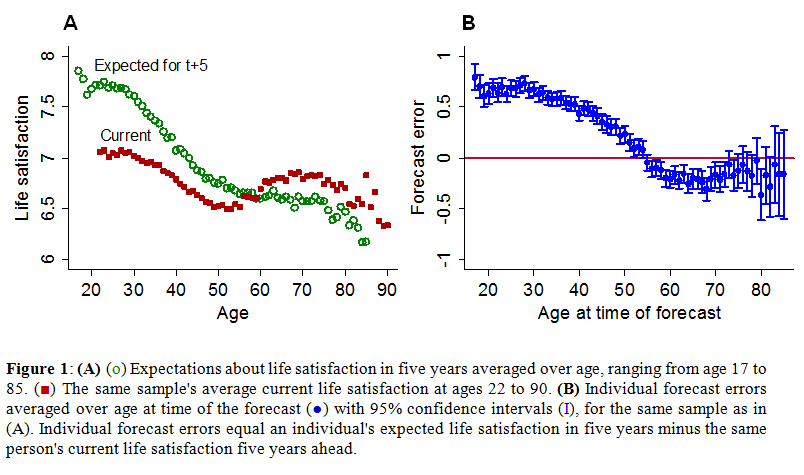
This is a interesting pair of graphs produced by an economist named Hannes Schwandt. Graph A shows people’s reported life satisfaction at each age (the square dots) and their expectations for how satisfied they will be five years later (open dots). Most young people expect to see dramatic improvements in the near future, whereas older people expect to be worse off after five years. But their actual (self-reported) satisfaction does not climb and then fall off in old age. Quite the contrary: it falls and then rises. Graph B shows the error in their predictions: they are substantially too optimistic until about age 50, and then too pessimistic from age 60+ (although life takes so many directions in the last decades that a few people err on the side of excessive optimism).

Schwandt thinks that the U-shaped curve in our subjective life-satisfaction results from errors in expectations. Although people of all ages hold diverse views, many young adults feel that they are not yet getting what they want from life (money, security, positive impact, love, sex, or whatever). Many expect to get all this in five years. In middle age, the same people are disappointed not to have seen their expectations met and rate themselves dissatisfied. This is the notorious Midlife Crisis. They also expect life to get worse–it won’t offer important new satisfactions or successes, but their health will decline as their years  run out. Instead, life does offer new rewards in the later decades, and so people are pleasantly surprised. Mean self-reported satisfaction is the same at age 70 as it was at age 30 (and much higher than it was at 50).

For those of us who work primarily on issues of youth, this is a challenging theory. It suggests that young people’s expectations are often so high as to cause distress later. This pattern certainly does not affect everyone. We found that before teenagers enter YouthBuild, just 30% expect even to live to old age. YouthBuild raises their hopes to the point that 90% of its graduates expect to live past 65. That is clearly a success. The U-curve may be a “first world problem,” affecting people whose teenage years have gone reasonably well. It is still a problem, however, and I have never seen an effort to address it. Maybe encourage young adults to read Stoic or classical Indian philosophy?

The Center for Public Integrity

(St Louis) The traditional model of paying reporters by selling subscriptions and advertisements is broken. John W. Henry paid $70 million for the Boston Globe and the Worcester Telegram & Gazette, less than the $110 million he pays Justin Pedroia of the Red Sox (which he also owns). When one second baseman is worth more than two newspapers, you know the news business is in trouble. Yet information about public issues is a public good, and the people who collect it have to be paid and supported, or we will be an ignorant and manipulable electorate.

Yesterday, in DC, I got a chance to visit the newsroom of the Center for Public Integrity. It is a full-scale news operation with a whole staff of seasoned reporters. The newsroom is quieter than most because CPI’s reporters do more number-crunching than traditional newspaper journalists do and spend less time calling people for quotes. Their business model also differs from that of traditional newspapers, in that CPI raises grants and donations for investigative journalism and then gives away the results. You can read CPI’s stories on their own website, but a lot more people read them as syndicated items in other publications or come across their findings in other reporters’ work.

This is the emerging nonprofit model for journalism in the public interest.

putting action in the state standards

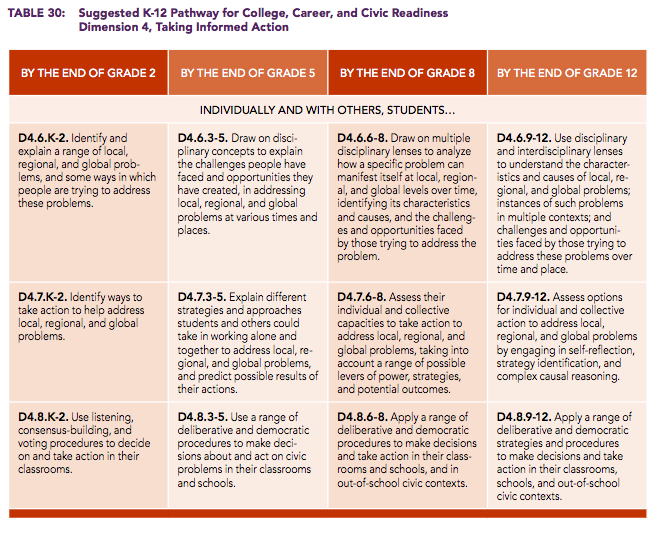
I am in St. Louis for the big annual gathering of social studies teachers, the National Council for the Social Studies conference. Last fall, the NCSS released a new voluntary framework for state standards entitled College, Career, and Civic Life (C3). For full disclosure, I helped write it. One part that seems especially important to me is the section near the end about “taking informed action” (shown below). I will be discussing why this is important and what it means in classrooms.

Screen Shot 2013-11-21 at 4.19.50 PM

At each level, we ask students to analyze a problem, then consider options for addressing the problem, and then make deliberative decisions about what they will do. The scope of action expands from the classroom in grades k-2 to beyond the school by 12th grade.

These standards were written by a large group, but they are consistent with my personal view that good citizens deliberate. By talking and listening to people who are different from ourselves, we learn and enlarge our understanding. We check our values, strategies, and facts with other people. We form ideas about topics that we didn’t even consider before we talked and listened. We also make ourselves accountable to our fellow citizens.

But (I argue) deliberation is not enough. Talking without ever acting is pretty empty. You can say most anything without learning from the results or affecting the world. Deliberation is most valuable when it is connected to work or action. At least sometimes, we should be part of groups that talk about what we should do, then actually do what we have talked about doing, and then reflect on the experience, holding themselves ourselves for the results. This is both the best way to improve the world and the best way to learn to be a good citizen.

Concretely, “taking action” can mean many things: not just community service, and definitely not just political activism (which is hard for a public school to recognize), but also managing and leading student groups, organizing public events, and creating and sharing knowledge.

As Meira Levinson and I argue in the new issue of the NCSS journal, taking action is nothing new.* There is a great old tradition of American students being asked to deliberate and then act as part of their social studies classes. If anything, I suspect the prevalence of action has declined because high schools now mimic colleges (which makes social studies into History or Poli Sci 101 for teenagers) and because conventional standardized tests cannot measure students’ facility at deliberation and action. The new framework, if taken seriously, would require a whole new approach to assessing students’ work.

*Meira Levinson and Peter Levine, “Taking Informed Action to Engage Students in Civic Life,” Social Education, vol. 77, no. 6 (Nov/Dec, 2013) pp. 337-9