All welcome …

Washington Monthly has a cover story by Phil Kiesling arguing that voting by mail would raise turnout substantially and also produce a more representative electorate, especially in primaries, thus reducing partisan polarization. Kiesling makes many good points, and his argument is definitely worth reading. Among other things, he is right to be frustrated by the research on voting-by-mail, although I wouldn’t characterize the problem as he does–as “the tyranny of dated, superficial, and/or irrelevant, academic research.” In fact, my colleagues and I are responsible for some of that research, and there are reasons that we analyze the data as we do. It is genuinely hard to measure the effects of a policy that has been adopted in only one or a few states. But that methodological challenge can limit our imaginations as reformers. Even though I don’t think he characterizes the research fairly, Kiesling helpfully challenges our imaginations.
Before getting into the methodological weeds, let me explain why I am not yet convinced that vote-by-mail would increase turnout. Below is Oregon’s turnout trend compared to the national trend. I show the presidential years and off-years as separate lines, because otherwise you get a confusing zigzag pattern. Oregon abolished polling places in 2000 and has run its elections entirely by mail since then. Turnout in the 2004 presidential election was strong, but not so great in 2008 and 2012. Turnout in the off-year elections since 2000 has been lower than it was in the 1980s and 1990s. I don’t see evidence of positive impact here.
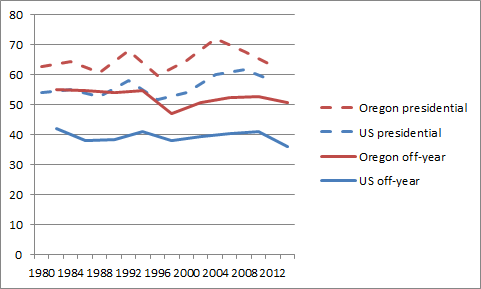
Kiesling calls it a “problematic assumption” to measure turnout as I do above: as the percentage of all eligible citizens who voted. (My data come from Michael McDonald.) Kiesling would rather define turnout as the percentage of registered citizens who vote. But if votes-per-registered rises, and yet votes-per-eligible-citizens does not, then there is only one mathematical possibility: the percentage of the population that registered must have fallen. That’s not a good thing. So the only way to assess the net impact of a reform on our democracy is by measuring turnout as votes per eligible population. We always do this, not in a “selective manner … to overlook (or even disparage)” vote-by-mail.
My graph simply allows you to see whether turnout has risen or fallen in Oregon before and after the vote-by-mail reform. That is not really a satisfactory method because many other factors are obviously at work. Nor can we conduct randomized experiments with new voting laws. Thus the way almost all academics study state policy reforms is by building large datasets that include statistics from all 50 states over many years. Then we try to isolate the apparent impact of a given change, controlling for everything else that we have measured, including the baseline turnout rates for states prior to the reform.* That method has yielded a rough consensus in favor of Election Day Registration–mentioned by Kiesling and exemplified in our own research.
This method cannot, however, assess the impact of a reform that has only been implemented in one or a handful of states. The math just doesn’t allow estimates of impact when there are very few cases in the category of interest. Thus, frustratingly, we omit Oregon’s vote-by-mail system from most of our models. Kiesling is right to complain about that gap, but I know of no satisfactory solution. One potential option would be to lump universal vote-by-mail together with other reforms, to increase the number of cases, but that would hide any special advantages of universal vote-by-mail.
Kiesling says that the research “lazily tries to extrapolate absentee ballot-based data, inappropriately uses VEP-based yardsticks, and/or focuses on presidential contests only—ignoring midterm and primary elections, where the approach is best suited to show dramatic results.” Those are not fair complaints about our models.
I’d still vote for and recommend universal vote-by-mail, as an experiment. The graph shown above makes me a little pessimistic about its impact (particularly in midterm elections). And I do lament the loss of a secret ballot when elections move to mail. The secret ballot was a hard-won reform designed to prevent voters from being coerced by employers and relatives or from selling their votes. (If you promise to pay me for voting for A, but my ballot is secret, I can take your money and vote for B, which ruins the market. In an election-by-mail, however, your boss, your spouse, or a bribe-giver can check your ballot.) Kiesling says the Oregon Secretary of State is aware of “just a dozen documented cases,” and I guess we could live with that–although each case of coercion is a human rights violation.
More broadly, I resonate with Kiesling’s frustration. If a state does something bold and different, the standard methods of social science really struggle to assess its impact. When a bunch of states implement the same rather modest change, we can measure impact, but often it’s disappointing. For instance, we have found that the variation in states’ education laws does not seem to matter for students’ media literacy or electoral participation. I don’t conclude that reforming education is a waste of time, but rather that the prevailing reform strategies are too weak. A few states have done more interesting things with civic education policy, but we can’t assess their impact using multivariate models.
As citizens, we must keep our imaginations vivid and hopeful. Statistics are always about the past, and the future can be different. I welcome the Washington Monthly’s cover article as a spur to creativity. A 21st-century election system should look very different from the clunky mechanisms we have in place today. Universal vote-by-mail could be the answer. I just don’t read the existing research evidence as Kiesling does.
—
*Kiesling writes: “But point out that in 2014, the nation’s three UVBM [universal vote-by-mail] states’ voter turnout—based on the identical VEP denominator—was 16 percent higher than non-UVBM states, and the response is often something along the lines of, ‘Yes, but that’s irrelevant because Oregon (and presumably now Washington and Colorado) have always been high-turnout states.’ As if Minnesota, Maine, and Wisconsin are any different?” This is overlooking the power of a multivariate model, which takes into account the historical turnout rate as well as many other variables. We favor Same Day Registration not because turnout is simply higher in states that have it, but because it is higher controlling for other factors.
In today’s column, Paul Krugman defends president Obama as “an extremely consequential president, doing more to advance the progressive agenda than anyone since L.B.J.” Krugman challenges “the persistent delusion that a hidden majority of American voters either supports or can be persuaded to support radical policies, if only the right person were to make the case with sufficient fervor.” He rejects the premise that a “sufficiently high-minded leader can conjure up the better angels of America’s nature and persuade the broad public to support a radical overhaul of our institutions.” Obama’s achievements, Krugman says, “have depended at every stage on accepting half loaves as being better than none: health reform that leaves the system largely private, financial reform that seriously restricts Wall Street’s abuses without fully breaking its power, higher taxes on the rich but no full-scale assault on inequality.” And that, Krugman argues, is the only way change happens in our system.
Between 2008 and 2010, I wrote a dozen posts and a Huffington Post piece defending President Obama against Krugman’s persistent critiques from the left. Then Krugman argued that we were in serious trouble because we had been “governed by people with the wrong ideas.” Obama should have challenged Republicans’ ideas with much stronger and more effective rhetoric in order to change public opinion. Instead, the president compromised on his progressive stance, and therefore Americans did not understand their options. Communication was everything for Krugman in those days. One column alone included these phrases: “What Mr. Obama should have said… Mr. Obama could and should be hammering Republicans… There were no catchy slogans, no clear statements of principle.” The president “has the bully pulpit,” but it will be worthless unless he “can find it within himself … to actually take a stand.”
Now Krugman says that it has never worked to try to shift public opinion dramatically to achieve radical policy. “Even F.D.R., who rode the depths of the Great Depression to a huge majority, had to be politically pragmatic, working not just with special interest groups but also with Southern racists.”
I absolutely do not blame Krugman for changing his mind. I am not calling him on an inconsistency here. He is doing what any intelligent person should do: intently studying the unfolding of history and forming and revising his opinions. My views have also changed since 2008, and if they hadn’t, I would be ashamed of my pig-headedness. I call attention to Krugman’s evolved views because they provide a kind of evidence in favor of one view of American politics. A Nobel-laureate economist with a very sharp eye for politics has tried out a couple of hypotheses, and the accumulated evidence as of 2016 leads him to endorse the strategies of Barack Obama ca. 2008-10.
I think the British Parliament made the right decision when it voted not to ban Donald Trump from entering the UK. During the debate, MPs had the opportunity to call him–and I quote–“poisonous,” “a buffoon,” “crazy,” “wrong,” “stupid,” and a “wazzock.” (The Urban Dictionary suggests, as an example of that last term, “You great useless spawny-eyed parrot-faced wazzock.”)
It’s almost never smart to respond to odious speech by keeping it out. It’s almost always better to respond with confident, reasonable, yet forceful speech on the opposite side.
That said, the British are certainly not the only ones to consider banning people on the basis of speech. Indeed, they have a long, if not spotless, record of accepting radicals and subversives of all stripes; Karl Marx is buried in Highgate Cemetery. And we–meaning the executive branch of our federal government–have a long tradition of barring people because of their speech. E.g.,
I omit from this list two heads of state who were banned for reasons that arguably involved action as well as speech. Former Austrian President Kurt Waldheim was barred for his Nazi affiliation in WWII. Before taking his current office as Indian PM, Nerendra Modi was denied a diplomatic visa and his existing visa was revoked for having (per the US government) “directly carried out … particularly severe violations of religious freedom.”
US policy has oscillated. The 1952 McCarren Walter Act aimed to bar anyone whose presence could be “prejudicial to the public interest,” a 1978 amendment reversed that law, and the Patriot Act excludes aliens who “endorse or espouse terrorist activity” (i.e., for speech alone). Despite these vacillations, barring people from entering the US on the basis of their speech has been rather common. If it was an unwise proposal to ban Donald Trump from the UK, we ought to reconsider our own policies.
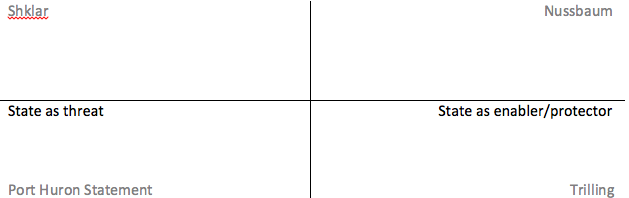
This simple typology might be helpful for distinguishing tendencies within liberal political thought. The x-axis measures attitudes toward the state, ranging from fear to enthusiasm. The y-axis measures the degree to which the state is central to politics. If you are primarily concerned with the state, you belong at the top, and if you focus on horizontal relations among people, you’re at the bottom.
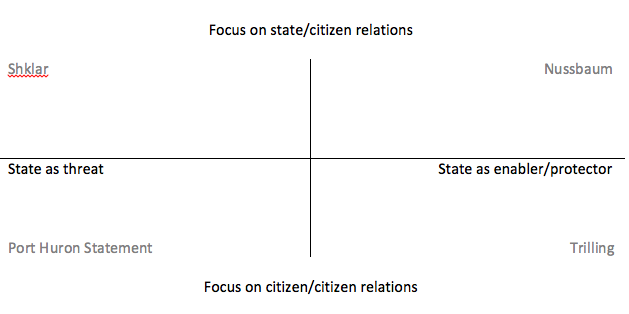
Judith Shklar exemplifies the top-left quadrant. She is explicit that the question for liberals is how the state treats citizens, and the driving concern is the state’s potential for cruelty and oppression:
Given the inevitability of that inequality of military, police, and persuasive power which is called government, there is evidently always much to be afraid of. And one may, thus, be less inclined to celebrate the blessings of liberty than to consider the dangers of tyranny and war that threaten it. For this liberalism the basic units of political life are not discursive and reflecting persons, nor friends and enemies, nor patriotic soldier-citizens, nor energetic litigants, but the weak and the powerful. And the freedom it wishes to secure is freedom from the abuse of power and intimidation of the defenseless that this difference invites.[1]
Martha Nussbaum exemplifies the top-right. She is also fundamentally concerned with the government, but she emphasizes its potential to enhance human capabilities:
In the end it is government, meaning the society’s basic political structure, that bears the ultimate responsibilities for securing capabilities. [Government] must actively support people’s capabilities, not just fail to set up obstacles. … Fundamental rights are only words unless and until they are made real by government action.[2]
Despite the manifest disagreements between these two authors, both view politics mainly as a set of relationships between the state and citizens.
Down at the bottom right is someone like Lionel Trilling, who thinks that liberalism is about relations among citizens—“discursive and reflecting persons,” in Shklar’s phrase. In a liberal culture, fellow members of a community develop close, responsive relations with one another so that they can enrich their inner lives and develop mutual understanding before they seek to influence the state, their culture, or their community. In passing in The Liberal Imagination, Trilling endorses laws and institutions that enhance freedom and happiness (that puts him on the right side of the spectrum), yet he wishes to “recall liberalism to its first essential imagination of variousness and possibility, which implies the awareness of complexity and difficulty.”[3] For Trilling, sensitive literary criticism is a characteristic liberal act because it involves the recovery of another individual’s thought.
The bottom-left belongs to people who see great importance and positive potential in human beings when they relate appropriately to each other, and who fear the state as a threat to authenticity and creativity. This is at least a thread in the Port Huron Statement, which inaugurated the New Left in America:
Men have unrealized potential for self-cultivation, self-direction, self-understanding, and creativity. It is this potential that we regard as crucial and to which we appeal, not to the human potentiality for violence, unreason, and submission to authority. … Human relationships should involve fraternity and honesty. Human interdependence is contemporary fact; human brotherhood must be willed however, as a condition of future survival and as the most appropriate form of social relations. Personal links between man and man are needed, especially to go beyond the partial and fragmentary bonds of function that bind men only as worker to worker, employer to employee, teacher to student, American to Russian. … Loneliness, estrangement, isolation describe the vast distance between man and man today. These dominant tendencies cannot be overcome by better personnel management, nor by improved gadgets, but only when a love of man overcomes the idolatrous worship of things by man.
[1] Cf. Judith Shklar, The Liberalism of Fear, reprinted in Nancy L. Rosenblum (ed.), Liberalism and the Moral Life (Cambridge, MA: Harvard University Press, 1989), p. 27.
[2] Martha Nussbaum, Creating Capabilities: The Human Development Approach, pp. 64-5.
[3] Trilling, The Liberal Imagination: Essays on Literature and Society (New York: New York Review of Books, 2008), Preface (1949), p. xxi