the 10 places where youth voters will have the most impact

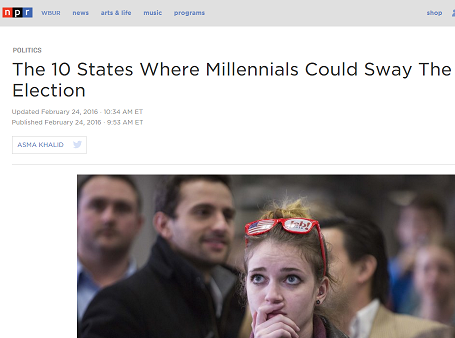
The current homepage of NPR news is a feature article by Asma Khalid about CIRCLE’s Youth Electoral Significance Index (YESI). My CIRCLE colleagues have identified the top 10 states and 10 congressional districts where the youth vote will matter most in Nov. 2016.

Politicians, campaigns, educators, and civic leaders should reach out to young people everywhere. But we recognize that political actors with limited resources will want to invest where they can have the biggest impact, and reporters may want to cover the youth vote where it counts for the most in electoral terms. Hence the YESI.

YESI

why don’t young people like parties?

Young Americans are not very loyal to parties. Many young people hold political beliefs that may make them almost guaranteed to vote for one party rather than the other–true “swing” voters are very rare–but they don’t identify with parties as organizations or devote their energy to parties as opposed to candidates and causes. I think that is partly why young people have so far been happy to vote for Bernie Sanders over Hillary Clinton by 4:1 margins. Remember that the primary election process was set up to allow party members to choose their party’s nominee, but young people who vote in the Democratic primaries don’t blink an eye to support a candidate who has chosen not to be a Democrat during his political career. I am not saying they should behave differently; I just think it’s interesting.

I have often heard cultural/generational explanations of this trend. Supposedly, Millennials are less favorable to organizations of all kinds. They prefer and expect looser and less hierarchical networks. There may be some truth to that, but I would suggest a different hypothesis. Young people are less loyal to parties than their predecessors were because parties don’t do anything any more.

Parties used to have functions, such as recruiting volunteers, paying workers, and organizing events (not to mention controlling patronage). Parties are now labels for clusters of entrepreneurial candidates and interest groups. The change occurred because the campaign finance reforms of the early 1970s defunded the parties, and then the deregulation of the 2000s allowed vast amounts of money to flow to entities other than parties. The Koch Brothers’ political network, for instance, employs 3.5 times as many people as the Republican National Committee does.

If parties do nothing for or with young people, it is easy to explain why youth don’t care about parties.

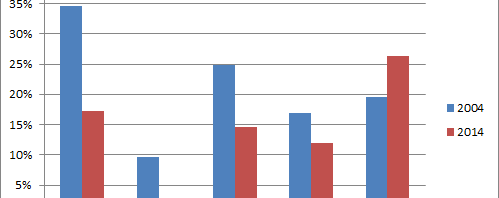
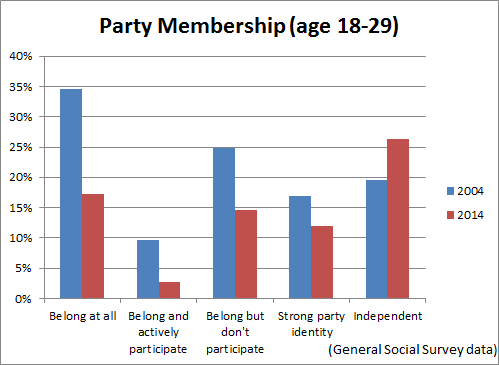
The General Social Survey asks about partisan ID at least every other year. The proportion of younger people who are Independents has grown, but most political scientists argue that that trend is misleading since the number of undecided or swing voters has actually shrunk. More to the point are questions that the GSS has asked only twice, about membership and active participation in parties. We know that parties didn’t do much to engage youth in 2004, because Dan Shea surveyed local party leaders that year, and “Only a handful of [county] party chairs mentioned what we might call significant activities, programs that require a significant amount of time or resources.” The parties were already hollow compared to decades earlier. He also asked an open-ended question: “Are there demographic groups of voters that are currently important to the long term success of your local party?” Just eight percent named young voters.

Nevertheless, the GSS indicates that the proportion of youth who actively participated in parties was 3.6 times higher in 2004 than it was in 2014. The hollowing-out continues.
partyID

every Republican president since 1901 has insisted that the US is a democracy

Anyone who works on civic education or grassroots civic engagement will sooner or later encounter critics who say, “The US is not a democracy–it is a republic” as if that were a profound objection to teaching or practicing democratic values. In a longer post, I analyzed the terms “democracy” and “republic” in the language of the Framers and subsequent authors. I argued that: (1) populist Framers like Jefferson used the word “republic” to mean what can also accurately be called a democracy, and (2) the original Constitution did include undemocratic elements, but they have been deliberately removed by the 15th, 17th, 19th, and 24th amendments to the Constitution. That means that although the Framers would call the United States a republic, it is now a democracy, at least in aspiration.

Here I would like to emphasize a related point. During the 20th century, almost all American political leaders asserted that the US was a democracy. Conservatives tended to be more sanguine about how much of a democracy we actually had. Left-liberals were the ones who argued that America was not authentically democratic because of persistent injustices. It is only in the last decade that it has become a talking-point for some conservatives that the US is (and ought to be) a republic and not a democracy.

I have quickly found one quotation from each GOP president since McKinley in which the president called the US a democracy. This was the result of 30 minutes of web searching; many more examples could be found:

[*It’s been noted that I accidentally omitted William Howard Taft, and it’s not easy to find a positive statement by him about democracy. He was, indeed, an opponent of the direct-democracy reforms of his era. So Taft may be an exception.]

  • Teddy Roosevelt, “A Charter of Democracy” (1912): “I believe in pure democracy. With Lincoln, I hold that ‘this country, with its institutions, belongs to the people who inhabit it. Whenever they shall grow weary of the existing government, they can exercise their constitutional right of amending it.'”
  • Warren Harding, Inauguration Address (1921): “Because we cherish ideals of justice and peace, because we appraise international comity and helpful relationship no less highly than any people of the world, we aspire to a high place in the moral leadership of civilization, and we hold a maintained America, the proven Republic, the unshaken temple of representative democracy, to be not only an inspiration and example, but the highest agency of strengthening good will and promoting accord on both continents.”
  • Calvin Coolidge’s Address at the Celebration of the 150th Anniversary of the Declaration of Independence (1926) is probably the most interesting, because it is an explicit and rather scholarly argument that the Framers had created a democracy. “Placing every man on a plane where he acknowledged no superiors, where no one possessed any right to rule over him, he must inevitably choose his own rulers through a system of self-government. This was their theory of democracy. In those days such doctrines would scarcely have been permitted to flourish and spread in any other country. This was the purpose which the fathers cherished.” Coolidge quotes Thomas Jefferson saying that his “‘best ideas of democracy’ had been secured at church meetings.” Coolidge says that Jefferson was influenced by John Wise, who had written, “Democracy is Christ’s government in church and state.”
  • Herbert Hoover, in a Challenge to Liberty (193o) argued that the New Deal had repudiated democracy, leaving “the Republican Party alone the guardian of the Ark of the Covenant with its charter of freedom.” He added, “You might think that reform and change to meet new conditions of life are discoveries of the New Deal. Free men have always applied reform. We have been reforming and changing ever since George Washington. Democracy is not static. It is a living force. Every new idea, every new invention offers opportunity for both good and evil.”
  • President Eisenhower’s Farewell Address as president (1961): “We must never let the weight of this combination endanger our liberties or democratic processes. … We want democracy to survive for all generations to come, not to become the insolvent phantom of tomorrow.”
  • Richard Nixon, State of the Union Address (1970): “In the majesty of this great Chamber we hear the echoes of America’s history, of debates that rocked the Union and those that repaired it, of the summons to war and the search for peace, of the uniting of the people, the building of a nation. Those echoes of history remind us of our roots and our strengths. They remind us also of that special genius of American democracy, which at one critical turning point after another has led us to spot the new road to the future and given us the wisdom and the courage to take it.”
  • Ronald Reagan, Normandy, June 6, 1984: “You all knew that some things are worth dying for. One’s country is worth dying for, and democracy is worth dying for, because it’s the most deeply honorable form of government ever devised by man.”
  • George H.W. Bush, Inaugural Address (1989): “We meet on democracy’s front porch. … Our children are watching in schools throughout our great land. And to them I say, Thank you for watching democracy’s big day. For democracy belongs to us all, and freedom is like a beautiful kite that can go higher and higher with the breeze. And to all I say, No matter what your circumstances or where you are, you are part of this day, you are part of the life of our great nation.”
  • George W. Bush at the National Endowment for Democracy (2005) “The roots of our democracy can be traced to England, and to its Parliament — and so can the roots of this organization. … Working democracies always need time to develop — as did our own. We’ve taken a 200-year journey toward inclusion and justice — and this makes us patient and understanding as other nations are at different stages of this journey.”

For more than a century, both Democrats and Republicans vigorously claimed that the US was a democracy as well as a republic. It’s possible that the names of the two major parties have recently encouraged some people to view the words “republic” and “democracy” as partisan labels. That is both an etymological error and an unfortunate barrier to what used to be shared aspirations. I happen to be confident that the language of democracy will regain its consensus appeal for Americans, thus inspiring us to honor our democratic ideals. But we are sailing through a rough patch right now, and virtually no political word seems able to unite rather than divide.

Association for Moral Education 2016 conference theme is civic engagement

(Arlington, VA) Tisch College is a cosponsor of the Association for Moral Education’s 42nd Annual Conference: 8–11th December, 2016 at the Harvard Graduate School of Education, Cambridge, MA, USA

Conference Theme: Civic engagement: a cultural revolution? The expanding definitions of ‘civic’ participation, their intersections with ethics, and the implications for education

The challenges and innovations in civic engagement in and beyond formal education are gaining worldwide attention. There are interesting links, synergies and dialogues among civics, ethics and moral development, including the significance of new media.

Submissions are welcome from scholars, students and practitioners across the many disciplines that contribute to the study and practice of moral and civic education, including psychology, education, sociology, philosophy, interdisciplinary, cultural studies, among others.

Submission deadline: March 14, 2016.

For submission details, and/or to register or the conference, please go to the conference website.