the remarkable persistence of social advantage

Matthew Yglesias draws attention to a study showing that if you were wealthy in Florence in 1427, there is a statistically significant greater chance that your descendants are wealthy in Florence today (where “wealth” is defined as your relative standing atop the economic hierarchy of your own time). I’ve had the chance to live in Florence and have observed that the local aristocracy of the present bear the same names that grace the elegant chapels and palaces of the 1400s. This persistence should surprise us, however, because Florence has gone through tremendous political, economic, demographic, and technological change over the past six centuries.

Yglesias also cites evidence that people who have noble surnames in Sweden have above-average wealth today, even though Sweden stopped ennobling families in the 16o0s and has now had a century of democratic socialism. Yet you’re still likely to be wealthier in Sweden today if your paternal ancestor was an aristocrat in 1650.

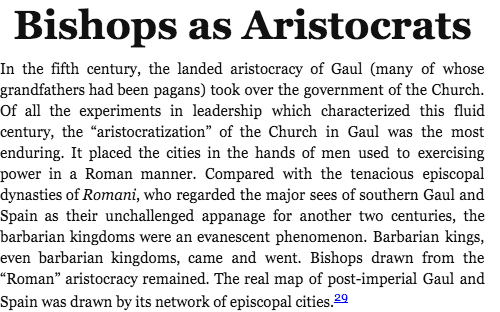
I’d add this passage from Peter Brown’s The Rise of Western Christendom: Triumph and Diversity, A.D. 200-1000 (p. 110):
Screen Shot 2016-05-20 at 3.58.02 PM

You would think that after barbarian invasions, the collapse of civilization as it was known, the replacement of aristocratic paganism with a radical religion of equality, and the rise and fall of barbarian kingdoms, the old pagan Roman landowning families would have slipped a notch or two. On the contrary, they seem to have morphed into powerful and wealthy bishops in Merovingian Gaul. Brown doesn’t trace the story after that, but it wouldn’t surprise me to learn that the provincial gentry of today’s France descend from these bishops’ families.

We needn’t be fatalistic. Societies change, often for the better. But it’s interesting that neither a radical Millenarian religion nor socialism–nor invasions and civilizational collapse–necessarily interrupts the transmission of advantage from one generation to the next. I presume that social and cultural capital can survive immense disruptions of physical capital, or–to put it more bluntly–people who know how to play one system make sure that their kids do well in the next one.
the Massachusetts Citizens Initiative Review

A Citizens Initiative Review is a very clever innovation. A randomly selected jury of citizens assesses a pending ballot initiative or referendum, deliberates, and produces an explanation (and in some versions, an opinion) of the measure that is disseminated to the voters at large. It’s a promising form of voter education, a way to counter money in politics, and even an experiment in connecting high-quality, relational, but small-scale politics to the mass scale. (I think the gap between human-sized politics and public policy is one of the flaws of our current system.) My CIRCLE  colleagues evaluated the degree to which the Oregon Citizens Initiative Review was covered in the media and found good results.

This summer, we will bring the CIR to Massachusetts. As Michael P. Norton of State House News Service writes:

STATE HOUSE, BOSTON, MAY 18, 2016….In an era of expensive initiative petition fights, Watertown Rep. Jonathan Hecht this year will lead a new way for voters to scrutinize a ballot question and then inform their fellow voters of their findings. …

In the coming weeks, a Massachusetts Citizens’ Initiative Review Advisory Board featuring Democrats and Republicans will notify the campaigns pressing forward with November ballot questions that one of their proposals will be chosen for a vetting process unlike any that’s occurred in Massachusetts. …

Hecht and the Tisch College of Civic Life at Tufts University are partnering with Healthy Democracy, which implemented Oregon’s citizens’ initiative review system in 2010, on a privately funded examination of a Bay State ballot question. …

Project organizers plan in June to assemble 20 Massachusetts voters, a group that will be balanced to reflect the demographics of the state’s electorate. In July, the advisory board will select the ballot question that will be the focus of the review. From Aug. 25 through Aug. 28, at the Atrium School in Watertown, the citizens panel, led by professional moderators, will conduct a public appraisal of the ballot question, hearing from supporters, opponents and policy experts. The panel will then put together a statement of findings and disseminate it in September and October, using traditional and social media and in the process potentially influencing voter opinions on the chosen ballot question. 

Hecht said project organizers will send a mailer to 10,000 randomly selected voters inviting them to participate in the pilot. Twenty will be selected from those who indicate a willingness to participate.

Students from the Harvard Kennedy School, Suffolk University and Tufts University will assist with staffing for the project, handling policy research and other tasks. An evaluation of the effort will be led by John Gastil, a professor of communications at Penn State who plans to examine the quality of the deliberations and whether the findings improved voter knowledge and understanding of the question.

who says that binary thinking is Western?

I often hear that binary oppositions are typical of Western thought. The implication is that “we” should strive to avoid being trapped by such oppositions.

To be sure, certain distinctions (white/non-white, male/female, Christian/non-Christian) are the basis of injustices. Those distinctions have been important in Western Europe and have been used to justify oppression. As a result, some people are moved to challenge what they call Western dualism. But the problem isn’t dualism–after all, the whole point is to promote justice over its opposite, injustice–nor is it helpful to introduce a binary distinction between the West and the rest. It seems odd to invent a very simple and global binary in order to criticize dualism.

I’m skeptical of the very notion of the West, because it encompasses so much diversity and has overlapped with so many other parts of the world for so long that I don’t know how to define it. But one thing the West has not been consistently is dualistic.

Christianity is surely a Western phenomenon, and a core Christian idea is that Jesus is both divine and human, both a person and one with the persons of God and the Holy Spirit. Another orthodox Christian assumption is that nature/the world is good and is solely God’s creation, yet it is not identical with God. Many of the thinkers who have been formally condemned as heretics by Christianity have been banned for adopting dualistic views either of Christ or of nature.

Nobody could be more dualist than George Boole, the inventor of Boolean logic (in which all values are reduced to TRUE or FALSE). Apparently Boole was deeply influenced by classical Indian logic, which is rife with sharp distinctions. Taoism is also described as fundamentally dualist. All of which is to say that binary oppositions don’t seem to be particularly “Western” to me.

Jacques Derrida is cited as the source of the view that Western thought is binary, although it would surprise me if he really caused it to be so widespread. Besides, Derrida says things like this: “Doubtless Western metaphysics constitutes a powerful systematization of this illusion, but I believe it would be an imprudent overstatement to assert that Western metaphysics alone does so.”* Three points to notice about this sentence: 1) Derrida is talking about a specific tradition of philosophical thought (“metaphysics,” as Heidegger would define it), not about Western culture, more broadly. 2) He is not criticizing binary thinking per se but certain specific binaries, especially text versus reference. And 3) He doubts that Western metaphysics alone suffers from this “illusion.”

See also: to whom do the ancient Greeks belong?Jesus was a person of coloravoiding the labels of East and Westwhen East and West were oneon modernity and the distinction between East and West.

*Derrida, Positions, translated by Alan Bass (1982), p. 33

youth turnout in the primaries

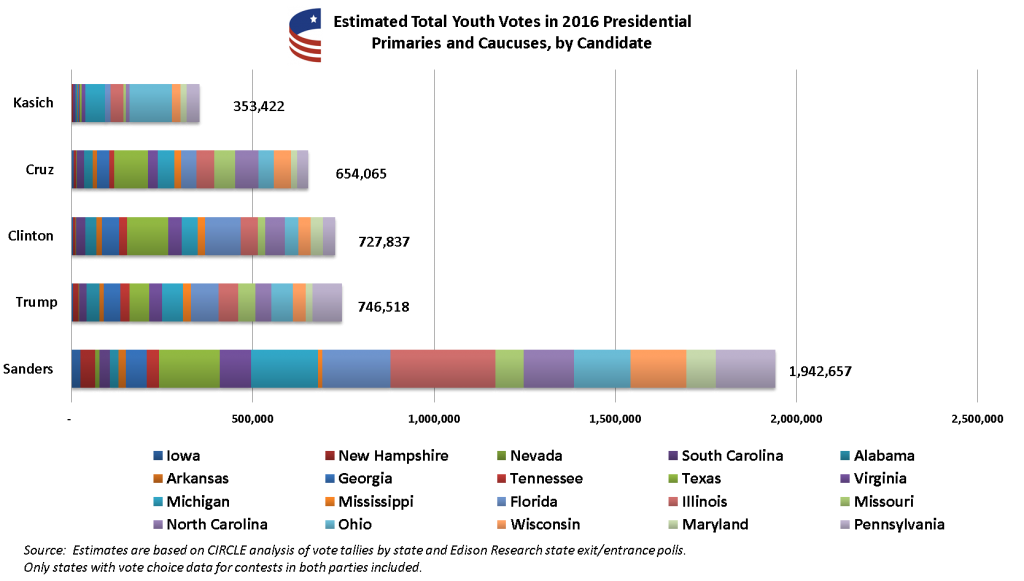
Follow CIRCLE for all the news on young people in the primaries and caucuses. The team reports that about 25% of West Virginia’s young people voted, many for Senator Bernie Sanders. The state’s turnout rate surpassed that of Iowa (11%), Florida (17%), and Virginia (18%), even though the race was considered by many to be over before it reached West Virginia. Youth turnout was also 25% in Indiana, where a majority of young people voted on the GOP side. Trump won a plurality of Indiana’s young Republican voters, but only narrowly edged Sen. Cruz. Finally, this is the latest cumulative youth vote tally:

April26CumulativeVotesGraph

Sen. Sanders has drawn almost three times more youth votes than any other candidate. Donald Trump surpasses Hillary Clinton, even though youth remain his weakest constituency on the GOP side.

tracking change in a group that discusses issues

Colleagues and I just ran a mini-experiment in which students at two very different universities held online discussions of the same controversial current issues. Before and after each discussion, we surveyed them to ascertain their social networks within their own class. We assumed that a group of people who discuss issues exhibit three layers of network ties that can change over time:

  1. Social networks: affective ties among the people, defined by friendship or respect.
  2. Networks of direct address: When person A asks person B a question or endorses B’s view, that creates a tie, and many ties create a network.
  3. Semantic (or epistemic) networks: Ideas connected by explanations. For instance, if A says that racism causes unequal health outcomes, then A has connected two ideas.

I am interested in tracking the relationships among these networks, because some patterns seem more desirable than others, and it would be useful to recognize the differences. For example, if people who are popular in social networks receive most of the direct addresses and determine the group’s epistemic network, then the discussion looks like a popularity contest. But if a new idea causes people to revise their opinions of whose views should be respected, that is evidence of learning.

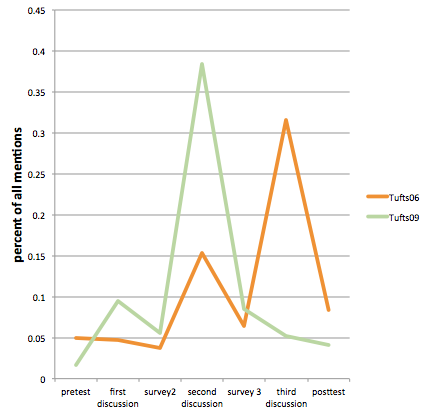
Here is a small illustrative finding from the data so far. Below I show the trajectory of two particular students within the Tufts University discussion thread. Both started off as somewhat less central than average in the class’s social network. At the start of the experiment, Tufts 06 was mentioned by three fellow students as a friend or an influencer, and Tufts09 got one mention. (Below I show the percentage of all mentions, to control for differences in the amount of text at each phase.)

Screen Shot 2016-05-15 at 12.11.56 PM

In the second discussion, which concerned the social determinants of health, Tufts09 posted the very first comment. She wrote, “the presentation given by Dr. [F.] was one of the best presentations given on social determinants of health that I have seen. … As a woman of black decent, I have taken these discussions and this knowledge very seriously, and I now view life with a completely different perspective. … When talking about the Flint, Michigan water crisis, it was shocking to hear that companies … are often built where the majority of the community is minority and low income. This infuriated me.”

Her comment was explicitly referred to by five other students and set the agenda for the whole discussion thread. When next surveyed, four students counted her as someone who had influenced them, up from one at the pretest. The number of mentions fell, however, to two at the end of the experiment.

It appears, then, that by making a forceful comment to start an online discussion—drawing on her own identity—Tufts09 may have gained social capital for a week or so. On the other hand, she did not need social capital before the second discussion to be influential in it.

Tufts 06 was the first to post in the the third conversation, writing: “As someone who has suffered from anxiety and depression, the topic of mental health stigma is incredibly important to me. In my family, nearly everyone on my mother’s side is on medication for anxiety, depression, OCD, or some combination of the three. We have had three suicides in our family (all before I was born) just because the treatments and attitudes toward mental health were not sufficient at the time those family members were suffering through their diseases.”

She received six mentions in the discussion thread, and in the subsequent survey, six students named her as influential (up from 3 at pretest). Again, she seemed to raise her social capital by making an influential point in the online dialog.

These are just two little anecdotes, and much remains to be explored. For instance: How typical is this kind of trajectory? Even in these two cases, did participation in the online discussion really cause social capital to rise? (The effect could be random or driven by some other factor.) And if these students were influential, was it because of what they argued, how they drew on their personal backgrounds, or simply the fact that they each posted first on the discussion thread?