the metaphysics of latent variables in psychology

(Washington, DC) The search for “latent variables” is so common in psychology that I would almost call it definitive of the discipline today. Other disciplines also study people’s thoughts and actions, but the distinctive contribution of psychology seems to be the use of variables that are not directly observed but rather inferred from data. Latent variables have been “so useful … that they pervade … psychology and the social sciences” (Bollen, 2002, p. 606).

But what are they? This is a metaphysical question, in the sense that contemporary, professional, Anglophone philosophers use the word “metaphysics.” It doesn’t mean that latent variables are spooky or illusory, but rather that it’s worth trying to figure out what kinds of things they are and how they relate to other sorts of things, such as beliefs, observations, numbers, mental states, processes, physical brains, etc. (Cf. why social scientists should pay attention to metaphysics.)

It turns out (Mulaik, 1987) that the main tools of psychometrics were invented by early-20th century thinkers who were explicitly interested in philosophical issues. For instance, Karl Pearson, who invented P-values, chi-square tests, and Principal Components Analysis–and who first used a histogram–wrote a book about philosophy of science before he developed these tools in order to implement his philosophy. He sounds like an awful man–an active proponent of racism–but that doesn’t invalidate his contributions to statistics. Their origin in his philosophical thought does, however, reinforce the point that latent factors need a philosophical explanation.

In very general terms, a latent variable is a number derived from several direct observations (the manifest variables) and used to say something meaningful about the subject. A history test provides a simple example. The student’s answers to each question are manifest variables. The student’s grade is derived from them, usually by just calculating the percentage of correct answers, and it is supposed to measure “knowledge of history,” which is latent. Only if the test is designed according to the best statistical principals is the overall grade indeed a valid measure of knowledge.

The same example can be used to illustrate a more sophisticated tool, factor analysis. Suppose that any student’s chance of answering a given question on the history test can be predicted fairly well by a function of several measured variables (the student’s family income, the teacher’s background, the amount of time studying history, etc.) plus X, plus Y. X and Y correlate with the answers, but X and Y are not correlated with each other, and they remain constant for each student.

That much might be a mathematical result: a function that roughly matches the actual data. The question then arises: what do X and Y mean? Suppose that X has a very strong correlation with students’ performance on questions that involve difficult reading assignments, such as original source material. And Y has a very strong correlation with students’ performance on questions that involve concrete factual information, such as the dates of the Civil War. Assuming that X and Y are not correlated, we can conclude that history test scores involve two “factors”: reading ability and memorization of concrete factual information. That interpretation would likely be presented as a meaningful finding, with implications for how educators should teach history.*

I don’t disagree. I am involved in this kind of research myself (albeit usually contributing less than my fair share of the math). But what kind of a thing is “reading ability” or “memorization of concrete factual information” in this example?

They are not exactly causes of the students’ actual answers to questions, for four reasons.

First, it is often (always?) possible to describe any given set of data with multiple functions.

Second, given a mathematical function that well describes a given set of data–such as the kids’ specific answers to Mr. Brown’s AP history test–it doesn’t follow that the same factors would also describe another set of data. The next 10 kids who took Mr. Brown’s test might not fit the function at all. This is an example of the general problem of induction.

Third, we can often switch the direction of the explanatory arrow. Instead of using the student’s latent ability in reading to explain or predict her answers to specific test questions, we could use her answers to those questions to explain or predict her reading ability. If you can switch the direction of an explanation, it doesn’t seem like a causal thesis.

Finally, we don’t usually describe a “cause” as something that is derived mathematically from the effects. A student’s family income might be postulated as a cause of her test scores–although it would require an experiment to assess this hypothesis–but a variable that is derived from the test data itself doesn’t seem to be a cause of it. Mulaik (p. 300) writes, “causes generally are not strictly determinate from effects but rather must be distinct from what they explain.”

If you are a strict inductive empiricist, in the tradition of David Hume, you don’t believe that anything is real except for direct observations. That means there are no causes. But it is possible to generalize based on what you have observed so far. Statistics is just a more refined toolkit for the kind of generalizations that we perform naturally when we observe, for instance, that kids tend to perform better on a test if they study for it. This is one way to make sense of a latent variable. It is a sophisticated version of ordinary induction. However, pure inductivism has been criticized on numerous grounds.

A different view is that some kind of mental process or activity causes people to do things like score well on a given history test question. For instance, memorizing dates increases your odds of correctly answering questions on a history test. We can tell a causal story: the information enters the brain, is stored, and is then retrieved to answer the question. The latent variable that correlates with test scores is an indication of this process. (But see Robert Epstein arguing in Aeon against the storage metaphor for human memory.)

In any case, the mathematics of factor analysis would not explain that this is what’s going on. It would only very roughly suggest a phenomenon that requires causal explanation. And although it is fairly straightforward to infer a causal relationship in this case–you should study in order to do well on a test–it is much less plausible that other factors are causal. For instance, do the Big Five Personality traits “cause” answers to concrete questions about emotions and behavior?  In 1939, Wilson and Worcester (quoted in Mulaik) asked, “Why should there be any particular significance psychologically to that vector of the mind which has the property that the sum of squares of the projections of a set of unit vectors (tests) along it be maximum?”

Another level of challenge is that the data for any latent variable come from observations that someone has designed and selected. For instance, that history test could have included entirely different questions. Or we could give tests on reading but not on history. The resulting factors would look different. Some conception of what’s important underlies the design of the test in the first place.

This is what I’m inclined to propose: latent variables are numbers inferred from data. We give them names that refer to actual things that are very heterogeneous, metaphysically. Sometimes latent variables suggest causal theories, although causation requires other kinds of evidence to test. Sometimes they are descriptions of patterns in the accumulated data that are not causal at all. Sometimes they are just tools that are useful for practical reasons–for instance, a kid needs one grade in history instead of a whole bunch of numbers. Whether that grade is appropriate is partly a question of fairness, partly a question about what is valuable to learn, and partly a question of the pragmatic consequences (e.g. does this kind of test cause kids to learn well?). It is only partly a statistical question.

*The example I am informally describing here involves exploratory factor analysis. You identify factors based on pure math and name them based on a theory. On the other hand, in confirmatory factor analysis, you hypothesize a relationship based on a theory and look for patterns in the data that support or reject it. The math is somewhat different, as is the theoretical framework. I don’t want to go too deeply into that contrast because my topic here is broader than factor analysis. I am interested in uses of all latent variables.

Sources: Bollen, Kenneth A. 2002. Latent Variables in Psychology and the Social Sciences. Annual Review of Psychology, vol. 53, 605-634; Mulaik, Stanley A. “A brief history of the philosophical foundations of exploratory factor analysis.” Multivariate Behavioral Research 22.3 (1987): 267-305.
 

generational differences in attitudes toward racism

(New York City) As the nation grapples with racism and deep divisions over race, it is important to understand trends in opinions on these issues. Here is a small contribution to that topic.

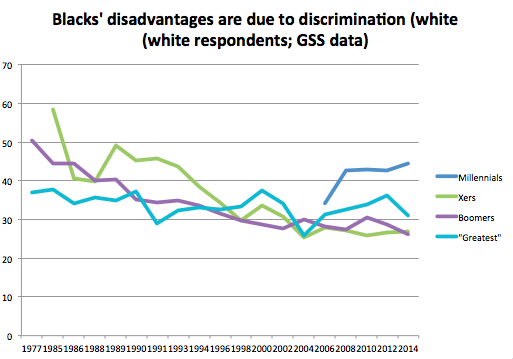
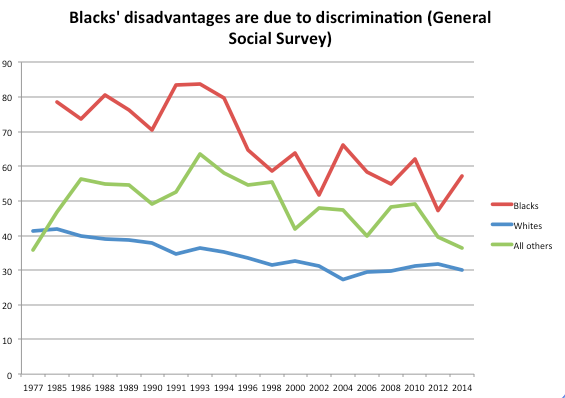
In 1977, and then consistently since 1985, the General Social Survey has asked a representative sample of Americans this question: “On the average [negroes/blacks/African-Americans] have worse jobs, income, and housing than white people. Do you think these differences are mainly due to discrimination?”

This first graph shows the trends for Whites, Blacks, and all others.

GSS racial discrimination measure

Between the early 1990s and 2012, Blacks became less likely to agree that discrimination causes unequal outcomes. In fact, the “yes’s” dipped below 50% for African Americans in 2012. Blacks have become more likely to answer “yes” since then. There hasn’t been a lot of change in the Whites’ responses since 1977, although a moderate decline is evident.

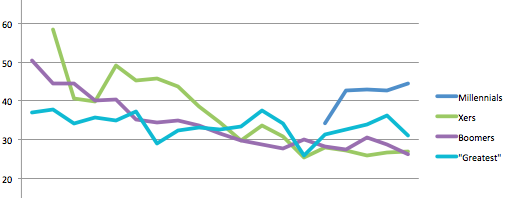
The second graph shows answers by generation. One important complication is that each generation has had a different racial composition from the others. In particular, Latinos and Asian Americans have become much more numerous as the Xers and then the Millennials have arrived. By itself, that demographic change would raise the positive response rate to this question for the youngest generations. To control for that, I show only White respondents in this graph.

GSS racial discrimination

White Millennials are currently more likely to blame inequality on racial discrimination than the older groups are. That reflects a rather rapid change, since only a third of their cohort agreed in 2006. Nevertheless, less than half of them (44.5%) agreed with the statement in 2014. In 2012, according to a different survey, 58% of White Millennials said, “discrimination against whites has become as big a problem as discrimination against blacks and other minorities.”

Xers, by the way, have become substantially less likely to blame anti-Black discrimination over the course of their lives so far. More than half did when they were young, but just 27% did in 2014.

I think that Black Lives Matter reflects and contributes to a substantial increase in concern about racial discrimination since 2012. That concern has by no means captured a majority of White people, or even of White youth. However, the increase has been rapid among White youth and also among African Americans. The result is a movement that has a generational element, and a base in the Black community, but that also faces a lot of backlash.

See also: in what ways are Millennials distinctive?; tolerance and generational change; and the most educated Americans are liberal but not egalitarian (2).

the lack of diversity in philosophy is blocking its progress

I’m on vacation this week and most of next, so I’m not blogging. However, a piece of mine has just appeared in Aeon, entitled “The lack of diversity in philosophy is blocking its progress.” It begins:

Philosophy is a remarkably un-diverse discipline. Compared with other scholars who read, interpret and assign texts, philosophers in the United States typically choose a much higher percentage of their sources (often, 100 per cent) from Europe and countries settled by Europeans. Philosophy teachers, too, look homogeneous: 86 per cent of new PhD researchers in philosophy are white, and 72 per cent are male. In the whole country, only about 30 African-American women work as philosophy professors.

the politics of discontent

We just finished a Frontiers of Democracy session entitled “The politics of discontent: it works in practice, but can it work in theory?” The premise is that we live in an age of discontent. To theorize about that means to ask: what is discontent, what causes it, and how can we use it to build a better society?

I am actually somewhat skeptical that a category called “discontent” is helpful for describing such a range of phenomena as Trump, Sanders, Brexit, etc. An alternative view would be that there’s a political status quo, and people are inevitably more or less contented with it depending on where they stand across a broad political spectrum. At any time, many people are discontented, but they don’t have anything particularly important in common. Some of them have valid grievances and some don’t. What we might call a climate of discontent is just the aggregate of all the variously unhappy people and movements. The aggregate is likely to be worse when economic times are bad, because then the pie is smaller, but discontent is natural.

Here are some other views that emerged in the discussion:

  1. There is a shared basis of discontent, and it’s procedural. People don’t feel heard; they don’t have opportunities for engaging each other. This discontent is valid, and the solution is more and better democracy. (I’d like to believe this thesis because it would validate a lifetime of work in political reform. But I’m not sure I do believe it.)
  2. There isn’t yet–but could be–a shared basis of discontent if we had better ways of talking with each other across partisan and demographic divides.
  3. There is a shared and valid basis of discontent, and it’s social/economic. For instance, Sanders supporters and Trump voters–and even Brexit voters–share a common root grievance: a global financial system that is cozy with governments and receives bailouts from everyone else. Even if these movements express their views in different ways, similar policies might satisfy them all.
  4. Most of the discontent is coming from formerly privileged groups losing their advantages. A better phrase for it is “right-wing ethnonationlism.” That certainly excludes Sanders voters and Black Lives Matters, but it wouldn’t be valuable to categorize them together with the nationalist right under a heading like “discontent.” Let’s acknowledge that we live at a moment of right-wing ethnonationism when there is also some energy on the left.
  5. This is not particularly a time of discontent. Many aggregate measures of well-being and confidence are up. There are some angry voters, but a total of about 25 million people have voted for Sanders and Trump combined so far (in a nation of more than 200 million adults). The ultimate winner of the presidential campaign is likely to be the most “establishment” candidate since George H.W. Bush in 1992. An odd result for year of discontent.

opening remarks at Frontiers of Democracy 2016

We meet at a sobering moment. This conference is a descendent of a meeting organized in 2008 called No Better Time. Today does not seem like “no better time.”

The most thoughtful predictions give a man who has been called a fascist by senior members of his own party a 30% chance of becoming president. If the doctor gave you a 30% chance of succumbing to a deadly disease within the next five months, you wouldn’t draw a lot of comfort from the thought that you’re more likely to survive. Like that patient, our republic is in danger.

Meanwhile, fascist candidate Marianne Le Pen leads French polls for president, drawing twice as much support as the incumbent. Strongly paternalistic and antidemocratic nationalist leaders—all strong men—already dominate most of the nations in an arc from China and Russia to Hungry. Venezuelans are fighting in supermarkets for loaves of bread for their children because of a crisis of governance. The Arab Spring has turned into five consecutive years of repression in the whole region and slaughter in Syria, where 400,000 have died with no end in sight. And here in the United States, a man can murder 49 human beings because they are gay. Some are inspired by the sit-in in Congress, but hardly anyone really expects the government to make changes that will reduce the chances of the same thing happening again.

Bertold Brecht wrote a poem in 1939 entitled “To Future Generations”:

Truly I live in dark times!
A sincere word is folly. A smooth forehead
Indicates insensitivity. If you’re laughing,
You haven’t heard
The bad news yet.
What are these times, when
A conversation about trees is almost a crime
Because it implies silence about so many misdeeds,
When, if you’re calmly crossing the street,
It means your friends can’t reach you
Who are in need?

This we knew:
Even hatred of humiliation
Distorts the features.
Even anger against injustice
Makes the voice hoarse. Oh, we
Who wanted to prepare the ground for friendliness
Could not ourselves be kind.
But you, when
one can help another,
Think of us
Forgivingly.

This is the context in which we gather for Frontiers. Indeed, it could be said that there is no better time to meet

We are hardly alone, of course. We have many allies around the world. In fact, right at this minute, by sheer coincidence, a conference has begun at the Central European University in Budapest entitled “Frontiers of Democracy.” Seeing a photo of their sign, texted by a friend, I thought of another poem written in 1939.

Defenceless under the night
Our world in stupor lies;
Yet, dotted everywhere,
Ironic points of light
Flash out wherever the Just
Exchange their messages …

Perhaps we can send some light in the direction of Budapest and many other places around the world.

I have given a dark picture, albeit with some ironic lights. None of that implies that we can’t have fun. Working together to build a better world is a source of satisfaction, even joy. We can exemplify the pleasure and humor that comes from civic life at its best. I hope you will enjoy every aspect of Frontiers, especially your interactions with one another. If we let civic life turn dreary, few will chose to participate, and politics will be left to the ruthless.

At the same time, we must be profoundly serious. The stakes couldn’t be much higher. We must squarely face unresolved problems, such as how to expand civic values and practices to the scale of nations and the globe, how to tap the power of social movements, and how to define and confront evil.

We must do more and better, and we must change fast. We have a lot to accomplish in the next 48 hours. Let’s get to work.