This summer’s conference will take place June 19 (5:30 pm) to June 21 (12:30 pm), at Tufts University’s campus in Medford, MA.
This year’s special theme is “Listening and Leading.” We recognize that crises of democracy can be caused and fueled by division and polarization,and that listening and dialogue may be part of the solution. We thus anticipate rich discussions and constructive disagreements about how we navigate these frontiers of democracy. There will be sessions on other topics also related to Tisch College’s “North Star”: building robust, inclusive democracy for an increasingly multiracial society.
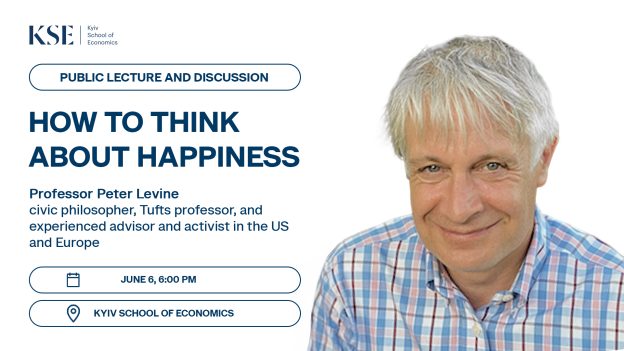
I will visit the Kyiv School of Economics (KSE) in early June primarily to offer a course on civic engagement that will be a short version of the Summer Institute of Civic Studies that colleagues and I have presented regularly since 2009. While I am in Kyiv, I will also offer a public lecture and discussion on the topic: “How to Think About Happiness.”
This is the blurb from my hosts at KSE:
What is happiness, really? And how should we live a good inner life?
This public lecture will explore how major philosophical traditions have approached the question of happiness — from Aristotle’s idea of purpose, to the Buddha’s path of detachment, to the Skeptical embrace of uncertainty and compassion.
Whether you’re curious about ancient wisdom or modern meaning-making, this event will help you rethink how happiness fits into your own life and civic identity.
After a 30-minute lecture, the audience will be invited to take part in an open discussion.
Why you should attend:
Explore timeless and contrasting views on happiness
Rethink your inner life through a philosophical lens
Engage in a meaningful discussion with a world-class thinker
Join either in person or online, wherever you are
Speaker: Professor Peter Levine
Senior Professor at Tufts University, currently visiting at Stanford University
Former fellow at Harvard and Johns Hopkins Universities
Described as “among the leading philosophers of civic life of his generation” (Robert D. Putnam)
Civic activist and advisor with experience across the US and Europe
Date: June 6, 6:00 pm Location: KSE, Rooms 1.08.1 & 1.08.2 and online via Zoom Register here
Contact person: Mariia Yurina, myurina@kse.org.ua Come for the philosophy — leave with a new way to think about happiness.
Thanks to the Kyiv School of Economics (KSE), I have the opportunity to offer a short version of our Summer Institute of Civic Studies in-person in Kyiv on June 3-5. It is open to people in the vicinity as well as KSE students. I will also offer a public talk on the theme of happiness and will post more about that once the promotional materials are ready. Meanwhile, courtesy of KSE, here is information about the civic engagement course:
Do you want to understand how societies can change for the better—and how you can help lead that change?
This exciting, hands-on course is designed for:
Civil society leaders and activists – current and aspiring
Students with a passion for politics, ethics, and making a difference
Why attend?
You’ll dive into real-world examples of civic action and gain practical tools to:
Organize people around a shared goal
Communicate across political divides
Respond to exclusion and injustice
Learn from global success stories of activism and nonviolence
What’s inside the program?
Simulation games like the Prisoner’s Dilemma
Case studies of civic movements
Discussions on propaganda, polarization, and dialogue
Lessons in nonviolent and military resistance
Certificate option with short reading assignments
All participants will receive a certificate upon completing the course.
This is not just a lecture—it’s an invitation to think, act, and engage.
Led by one of the world’s most prominent thinkers in civic philosophy:
Professor Peter Levine – Senior Professor at Tufts University, visiting scholar at Stanford, former fellow at Harvard & Johns Hopkins, renowned expert in civic life and democratic engagement
As a proportion of the economy, total federal spending has been fairly constant since 1962. Entitlements (Social Security, Medicare, Medicaid) and defense keep the whole cost pretty stable. The cost has risen during recessions because bad times increase eligibility for entitlements. This means that the early Reagan years saw a temporary peak in total federal spending (notwithstanding Reagan’s anti-government rhetoric), and the Great Recession and COVID caused big temporary increases.
Meanwhile, federal discretionary spending quite steadily declined from 1965 and 2000. It has fluctuated since then from a lower baseline.
That means that the basket that includes highways and air traffic control, prisons and border control, diplomacy and foreign aid, agricultural subsidies, Food Stamps, etc. represents a smaller percentage of the economy than it did in the 1960s.
Looking more closely at components, we can often find anomalous patterns. For example, total federal spending on education (k12 and college, including financial aid and research) was 1 percent of GDP in 1975 and 1.1 percent in 2024, with spikes during recessions.
Since the economy has grown each decade, a shrinking proportion of GDP could still purchase more goods and services. But that has not really happened during the 21st century. Another telling graph from the same report (below) shows discretionary spending in billions of dollars, adjusted for inflation. It separates defense from non-defense spending. Until COVID hit, neither component had risen (or fallen) in real terms compared to 2005. The Obama stimulus did cause a temporary boost, but that went away. Then COVID spending and the Biden stimulus boosted non-defense spending, which has come down but remains about 25 percent higher than it was in 2019.
These graphs explain why the kinds of public goods that we expect from the national government in the United States often seem to have shrunk or deteriorated, even while the total cost and size of the federal government has remained at least constant.
These data challenge certain assumptions popular among conservatives–that federal spending has risen and that Republican presidents have cut government while in office. (By the way, Elon Musk’s recent rampage will hardly be visible on these graphs when the lines are extended into 2025. Total federal spending rose during the first quarter of 2025.)
These graphs also challenge progressives’ assumptions that government has been shrinking in the era of neoliberalism. Indeed, even discretionary domestic spending is quite a bit higher than it was in 2005 or 2012-19, when adjusted for inflation. What progressives observe is not a shrinking government but a decline in non-defense discretionary spending (as a proportion of the economy) between 1965 and 2000, which has left many national government functions weaker than they were in the mid-1900s.
We write with the good news that the work of EAD very much continues, even in these rapidly changing times.
As of June 1, the Educating for American Democracy Consortium will transition from being housed at iCivics to the Adams Presidential Center, based in Quincy, MA. The Adams Presidential Center works to share the history of a great American family, to promote their ideals of citizenship and selfless public service, and to inspire future generations to serve their communities and our nation. Hosting the EAD Consortium aligns with the Adams Presidential Center’s goal to foster lifelong civic learning.
EAD will continue to be guided by a Steering Committee, currently chaired by Peter Levine of Tufts University. Adams Presidential Center President, Kurt Graham has joined the Steering Committee. EAD is also proud to recognize Thomas Jefferson’s Monticello as a founding partner in the work. Monticello’s President Jane Kamensky also continues to serve on the EAD Steering Committee.
This move to APC comes after six years that iCivics has hosted EAD. We offer our great appreciation to iCivics for playing that role and for the organization’s partnership in creating and stewarding EAD. Louise Dube, CEO of iCivics, will continue to serve on the Steering Committee and fully supports the transition to APC. The Steering Committee’s members unanimously agreed that the transition is important for EAD to continue to thrive. The work will benefit from more focused attention and resources independent of any one provider in the civic education field.
Also, thanks to private philanthropy, the EAD Consortium is now able to search for an Executive Director, and the process is underway. In the meanwhile, questions about EAD can be directed to the EAD Consortium Steering Committee at EAD@adamspc.org.
These are difficult times for all civic educators in and beyond the classroom. Across this great country, countless teachers and civic leaders continue to bring the nation’s K–12 students and its lifelong learners rich lessons in the pluralistic narratives of American history and in the reflective patriotism needed for informed, engaged, and responsible citizenship. We are so proud of the work that you are all doing, and we look forward to celebrating it in March 2026 in Philadelphia at the National Forum of Civic Learning Week, co-hosted by iCivics and the Democratic Knowledge Project. Please save March 9–10, 2026, to join us in the nation’s birthplace.