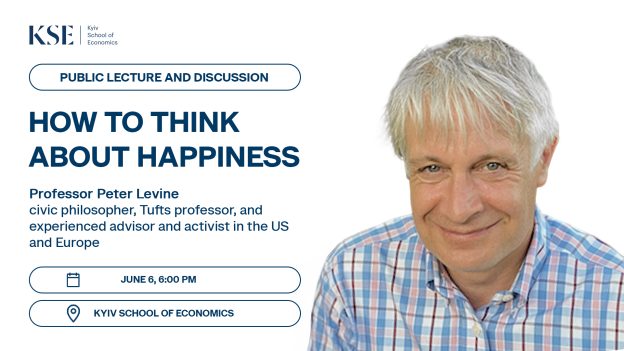
I will visit the Kyiv School of Economics (KSE) in early June primarily to offer a course on civic engagement that will be a short version of the Summer Institute of Civic Studies that colleagues and I have presented regularly since 2009. While I am in Kyiv, I will also offer a public lecture and discussion on the topic: “How to Think About Happiness.”
This is the blurb from my hosts at KSE:
What is happiness, really? And how should we live a good inner life?
This public lecture will explore how major philosophical traditions have approached the question of happiness — from Aristotle’s idea of purpose, to the Buddha’s path of detachment, to the Skeptical embrace of uncertainty and compassion.
Whether you’re curious about ancient wisdom or modern meaning-making, this event will help you rethink how happiness fits into your own life and civic identity.
After a 30-minute lecture, the audience will be invited to take part in an open discussion.
Why you should attend:
- Explore timeless and contrasting views on happiness
- Rethink your inner life through a philosophical lens
- Engage in a meaningful discussion with a world-class thinker
- Join either in person or online, wherever you are
Speaker: Professor Peter Levine
- Senior Professor at Tufts University, currently visiting at Stanford University
- Former fellow at Harvard and Johns Hopkins Universities
- Described as “among the leading philosophers of civic life of his generation” (Robert D. Putnam)
- Civic activist and advisor with experience across the US and Europe
Date: June 6, 6:00 pm
Location: KSE, Rooms 1.08.1 & 1.08.2 and online via Zoom
Register here
Contact person: Mariia Yurina, myurina@kse.org.ua
Come for the philosophy — leave with a new way to think about happiness.