Tufts Political Theory Workshop

(Please contact me if you would like to attend.)

September 28th and 29th at Fung House. 48 Professors Row, Tufts Campus, Medford MA

Thursday Sept. 28

5 pm “(Un)equal Respect and Agents of Justice”
Benedetta Giovanola, Associate Professor of Moral Philosophy
Department of Political Science, Communication, and International Relations, University of Mascerata, Italy Commentator: Dennis Rasmussen, Associate Professor of Political Science

6:15 pm “The Nature and Design of Robust Institutions”
Speaker: Brian Epstein, Associate Professor of Philosophy
Commentator: Peter Levine, Lincoln-Filene Professor of Citizenship and Public Affairs Jonathan M. Tisch College of Civic Life

7:30 pm Dinner for all participants

Friday, Sept. 29th
9:00 am “Justice, Self-Sufficiency, and Commodious Living: Hobbes’ s Commercial Republic”
Speaker: loannis Evrigenis, Professor of Political Science Commentator: Vickie Sullivan, Professor of Political Science

10:15 am “Grounds for Coverage: Considering the Basis for Entitlements of Immigrants to Health Care”
Speaker: Keren Ladin, Assistant Professor of Public Health and Community Medicine and Occupational Therapy
Commentator: Alecia McGregor, Assistant Professor of Community Health

11:30 am “We, the Mediated People: Unconventional Adaptation in post-Cold War South America”
Speaker: Joshua Braver, Jonathan M. Tisch Post-doctoral Fellow in Political Science Commentator: Abiodun Williams, Director, The Institute for Global Leadership

12:30 pm . Lunch

Sponsored by the Tufts Department of Philosophy, the Department of Political Science, and the Jonathan M. Tisch College of Civic Life
new overview of civic education

I’m at Democracy at the Crossroads, a conference on civic education, with speakers who include Justice Sonia Sotomayor, former Secretary of Education John B. King Jr., Senator Bob Graham, Prof. Danielle Allen, and more. At this conference, we are releasing “The Republic is (Still) at Risk–and Civics is Part of the Solution.” Kei Kawashima-Ginsberg and I are the authors of this new overview document, which builds on The Civic Mission of Schools (2003) and Guardians of Democracy (2011). We argue that the main reason to strengthen civics is the perilous condition of our republic, that today’s circumstances require innovation (not your grandparents’ civics), that a wide range of practices are effective when done well, and that state policies can support civics. The paper releases new information on positive changes in Florida and Illinois. It is available for download.

Citation: Peter Levine and Kei Kawashima-Ginsberg, “The Republic is (Still) at Risk—and Civics is Part of the Solution” (Medford, MA: Jonathan M. Tisch College of Civic Life, Tufts University, 2017)

college student voting rose in 2016

Today, my colleagues at Tisch College’s Institute for Democracy and Higher Education have released their national study of college students’ voting, based on the voting records of 9,784,931 students at 1,023 higher education institutions.  The team finds a national college turnout rate of 48.3% in the 2016 presidential election, up from 45.1% in 2012, with significant variations by race, gender, field of study, and institution type. Women voted at rates about seven points above men in both years. (It’s interesting that the dynamics of the 2016 campaign didn’t change that pattern.) Asians and Latinos increased their turnout substantially. African Americans’ turnout slipped from a high baseline in 2012.

  • Here is the full national report.
  • This is an interactive portal where you can explore the data yourself.
  • The team also sent individual reports to 1,005 colleges, with their own turnout data broken down as much as possible by students’ demographics and fields of study.
  • On NPR, Danielle Kurtzleben covers the release in a story headlined, “2016 Voter Turnout Dropped At HBCUs, Climbed At Women’s Colleges, Study Finds.”

becoming adults more slowly

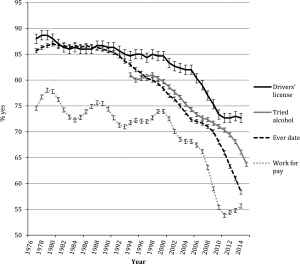
A new paper by Jean Twenge and Heejung Park (2017) is getting a lot of coverage. The main finding is a delay in the onset of certain activities traditionally defined as “adult.” This graph shows the trends in having a driver’s license, drinking alcohol (ever), dating, and working for pay–all down steeply for teenagers.
Twenge and Park find that these trends are parallel for different racial and economic groups. They also find that adolescents simply go outside their homes without their parents much less often than their predecessors did.

These data jibe with my observations teaching college and raising kids (and observing their cohorts) for 25 years. But I would have strongly surmised that my observations had a class bias. I would have explained the delay in adult activities as a result of increasing investments in children by parents who have assets to invest. American parents spend an average of $38,000 per child while their children are between the ages of 18 and 34 (Furstenberg, Rumbaut, Settersten 2005). That statistic conceals huge differences by social class. Some young people are rationally delaying their careers and the formation of their families while they accumulate human capital, thanks to their parents. Other people are on their own at age 15.

This graph, from Kei Kawashima-Ginsberg’s paper on extracurricular activities, shows a widening disparity in the sheer cash invested in organized activities.

Another reason to hypothesize a growing gap in the onset of adulthood by social class is Annette Lareau’s finding (ca. 2003) that middle-class American parents use a strategy of “concerted cultivation”–viewing childhood as an opportunity to develop human capital–while working-class parents prefer “the accomplishment of natural growth,” or letting kids be kids. One reason that middle-class and affluent American teenagers don’t spend much time away from their parents is that their parents are now providing “concerted cultivation” in the form of paid after-school activities, supervised homework, intentional conversations about valuable topics, etc. Meanwhile, the working class are trying to let their kids enjoy some freedom before they have to get jobs.

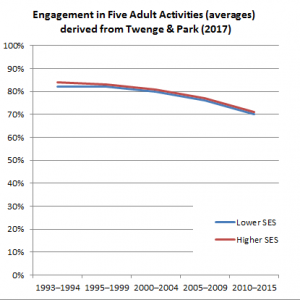
Given these prior assumptions, this is my biggest surprise in the Twenge and Park article: the lack of difference in rates of “adult” activities by social class. Here I graph the data in their Table 2.

Twenge, J. M. and Park, H. (2017), The Decline in Adult Activities Among U.S. Adolescents, 1976–2016. Child Dev. doi:10.1111/cdev.12930.

Furstenberg, F.F,  Rumbaut, R.G. Settersten, R.A. , “On the Frontier of Adulthood,” in Settersten, Furstenberg, and Rumbaut, eds., On the Frontier of Adulthood: Theory, Research, and Public Policy (University of Chicago Press, 2005)

See also: the changing transition to adulthoodcoming of age in your thirtiesGeneration Me?

religion and politics in the US versus many other countries

Here is a thesis that experts can evaluate better than I: The issue of religion in politics is fundamentally different in the US from many other countries. In the US, it is mainly about majority opinions versus minority rights. In countries from Mexico to Myanmar, it is about the social functions of a single organized body, the clergy. This difference matters for everyday politics.

The US has always had a religious majority that has been divided among many Christian denominations, with other faiths also represented. The Constitution gives individuals the right to exercise their religions freely. It also prevents any religion from being “established.”

The classic questions of religion and politics in the US involve majorities versus minorities. Sometimes, a coalition composed of many denominations supports a policy (e.g., banning abortion) for reasons that include religious ones. Then the questions become: 1) Does the desired policy impinge on constitutional rights? and 2) Are religious reasons for the policy acceptable or desirable in the public sphere? At other times, the majority becomes adverse to a particular religion–Mormonism in the 1800s being a clear example. Then the same two questions arise, but now the majority threatens the minority’s free exercise.

In nations with a single dominant religion that is organized in a hierarchical fashion (Catholic countries, but also, perhaps, some Muslim, Orthodox, Buddhist, Lutheran, and Anglican countries, plus in some respects, Israel), the issue is different. These countries have an organized, institutionalized body: the clergy. Typically, the clergy has a history of delivering some public services to the nation as a whole. For example, there may have been a time when the Catholic Church ran and staffed almost all of the state-funded schools in a given country. Sometimes, there is also a history of violent reaction against the clergy as an institution. Priests were executed in the French and Mexican revolutions, for instance.

In these countries, the question is not directly about whether to enact laws consistent with religious values. The question is whether to entrust an organized group of people, the clergy, with particular social functions. At the anti-clerical end of the spectrum, the clergy or priesthood is seen as a bane on society. At the clerical end, it is seen as a bulwark. These positions are, in principle, separate from one’s opinions of theology and of policy issues. A person could agree with the Church on most topics but distrust the clergy, or vice versa.

Here are some practical consequences of the difference:

  1. In the US, when debates over policy have religious components, they are deeply divisive and feel existential. At least some other countries treat such debates as fairly routine. The divisive issues for them concern the prerogatives of the clergy as an institution. An interesting hybrid case is Ireland, where the ballot victory on same-sex marriage was greeted with joy, at least in Dublin. I think voters were pro-equality, they celebrated because they had defeated the Irish clergy, a (currently unpopular) institution.
  2.  In the US, religious involvement in politics is usually mediated by officially secular political parties. The parties strive to assemble majorities by drawing people from several denominations. They typically recruit believers, not churches, into their ranks. In many other countries, each political party has a relationship with the main denomination, ranging from a formal partnership (e.g., for the Christian Democratic parties) to official hostility. Indifference may also be an option, just as a party can be neutral on other issues, but it will face questions about the clergy.
  3. In the US, it doesn’t really make sense to ask a candidate what she thinks of “the clergy.” You can ask her about abortion, God, her own faith, or the First Amendment, but there is no national clergy to have an opinion about.

See also: a typology of denominationsthe political advantages of organized religionreligion and politics in the Muslim world and the USA; and on religion in public debates and specifically in middle school classrooms.