changes in how we talk about cities

At a meeting at a community organization in Boston, we were using various terms to describe local issues and observing that those phrases would not be clear to the people we were talking about–especially new immigrants. That made me wonder about the history of our vocabulary, so I used Google’s Ngram tool to see the frequency of “urban poverty,” “inner city,” “gentrification,” “deindustrialization,” and “urban redevelopment” in published books. This graph shows trends since 1900.


In rough order of when these phrases became popular…

  1. “Urban redevelopment” starts very soon after WWII but declines after 1970. It is a keyword of high-modernist urban planning from the era of big housing projects and highways blasted through downtowns.  It has been notably less popular (at least in books) since ca. 1980.
  2. “Urban poverty” rises in the 1960s and the 1990s, but has–interestingly–fallen in the 2000s.
  3. “Inner city” seems to have become rapidly popular during the Kennedy and Johnson administrations, plateaued at a high level until about 2000, and then fallen off.
  4. “Gentrification” enters the lexicon in 1975. It plateaus in the 1990s and then rises rapidly in our century.
  5. “Deindustrialization” is a new term ca. 1980, describing a phenomenon that started in the 1970s. It peaks in the 1990s.

These changes seem to reflect objective circumstances–cities lose their industrial base but then sometimes attract yuppies who push up housing values–as well as shifts in intellectual fashions, such as the rise, and then fall, of high-modernist design.

the power of the NRA in an age of civic deserts

I can’t recommend too strongly Hahrie Han’s New York Times piece entitled “Want Gun Control? Learn From the N.R.A.” Her argument is important not only for gun-control advocates but for everyone who has a political cause in 21st century America.

Han notes that the NRA does not win because it deploys more money than its opponents do. Funding is substantial on both sides of the issue. I would add that most political scientists doubt that money has much influence on high-salience legislative battles.

Rather, the NRA has “built something that gun-control advocates lack: an organized base of grass-roots power.” Han identifies three characteristics of the NRA that I believe have always been the main ingredients of vibrant civil society in America:

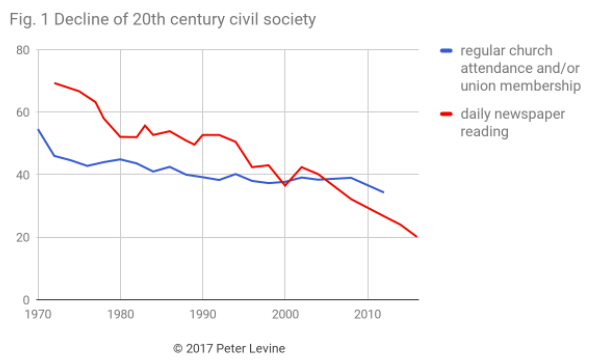
  1. Through gun clubs and gun shops, the NRA offers a wide range of activities and benefits, not merely opportunities to express one’s opinion on a policy issue. In that sense, the NRA is like the traditional bulwarks of 20th-century civil society: religious communities, unions, grassroots political party organizations, and metropolitan daily newspapers. All offered packages of non-political benefits (worship services, employment contracts, social opportunities, comics and box scores) while also steering their members into politics.
  2. The NRA recruits people who do not necessarily agree with its positions but brings them into a community that has strong norms and cultural resonances. Belonging then changes people’s opinions about issues. Again, this was true of religious denominations, unions, 20th-century parties, and newspapers.
  3. The NRA may be centrally run, but it offers lots of opportunities for leadership at the local level.
In contrast, most gun-control groups draw people who already agree about their issue. We join because we want to regulate guns, and only for that reason. Our relationship with the organization is transactional. They ask us to send them money or contact members of Congress, and we take these actions as individuals. Han recalls:

When I joined gun-control groups, I got messages about narrowly defined issues like background checks and safety locks. These messages were a pollster’s dream, tested down to the comma to maximize the likelihood that I would donate or take action. But they never challenged me to rethink who I was or what my relationship to my community was.

A community of people organized around a whole way of life and capable of developing relationships and leadership–that is a fearsome force in politics. A list of people who already vote in a given way and agree to send money or make phone calls–not so much.

One result is that the NRA beats the gun-control groups. The other is that many people lack opportunities to become effective and well-networked citizens because they don’t see organizations around them that offer any opportunities for belonging. They perceive their communities as what my colleagues Kei Kawashima-Ginsberg and Felicia Sullivan named “civic deserts.” (The analogy is to food deserts: places where nutritious food is not for sale.) In an era of civic deserts, a robust membership group like the NRA has awesome power. If you admire their structure but despise their lobbying agenda, then the solution must be to build alternative structures.

See also:  Civic Deserts and our present crisisthe Hollowing Out of US Democracy; we need SPUD (scale, pluralism, unity, depth). And see this new article by CIRCLE: Mitigating the Negative Consequences of Living in Civic Deserts – What Digital Media Can (and have yet to) Do
“Leadership is Female, Is African, Is Muslim Women”

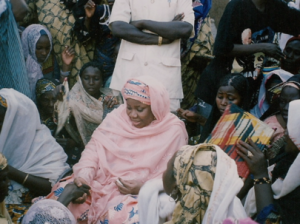
Tisch College is thrilled to host a special event on Wednesday, October 25, entitled “Leadership is Female, Is African, Is Muslim Women” in honor of Saïda Oumulkhairy Niasse, the inaugural recipient of Tisch College’s Global Humanitarian Citizen Award.

Please join us for this celebration, which will take place from 12 – 1:15 p.m. in the Distler Auditorium of the Granoff Music Center on Tufts’ Medford campus. The award ceremony will honor the impact of Mama Kiota’s leadership, feature Tufts Professor Pearl Robinson’s research on Mama Kiota’s movement, and celebrate the Sufi musical and cultural traditions with a live performance.

Known by her followers as Mama Kiota, Saïda Oumoulkhaïry Niasse is the leader of a Sufi Muslim women’s movement with over 200,000 members across West Africa. Trained by scholars in the Niassine Tijaniyya Sufi tradition,  Mama Kiota is a tireless advocate for women’s rights, education, and peace, and she has spent more than 50 years establishing schools, mentoring female leaders, and promoting religious tolerance in a region plagued by Boko Haram. Tisch College is honored to award its inaugural Global Humanitarian Citizen Award to Mama Kiota in recognition of her outstanding leadership and service to the global community in pursuit of a more just, equitable and peaceful society.

For more information and to register online, visit: https://tischcollege.tufts.edu/content/leadership-female-african-muslim-women

the legacy of Elinor Ostrom and the Bloomington School

Many years ago, I met Vincent and Elinor Ostrom in the seminar room of what is now the Ostrom Workshop at Indiana University in Bloomington. I then had several personal interactions with Lin Ostrom, and I’ve been back a few times to Bloomington. (I even wrote a poem about a B&B there once.) I have taught and studied her work and am writing a book in which the tradition that she and Vincent founded–the Bloomington School–is one of three essential components of a theory of citizenship. (The other two are the post-War Frankfurt School and the tradition of political nonviolence: Gandhi/King.) She is, for me, the model scholar.

Today, I was able to speak about Lin Ostrom’s legacy in that same seminar room. I tried to place the Bloomington School in the context of major currents of political theory and civic renewal. A video of my talk is already up on the Workshop’s website. The title is “Elinor Ostrom and the Citizen’s Basic Question: What Should We Do?”

See also: Elinor Ostrom wins the Nobel!Elinor Ostrom speaking at TuftsElinor Ostrom, 1933-2012Ostrom, Habermas, and Gandhi are all we need, and Habermas, Ostrom, Gandhi (II),

Social Ontology 2018: The 11th Biennial Collective Intentionality Conference

On August 22-25, 2018, Tufts University will host the biennial Collective Intentionality conference, with the Tisch College of Civic Life as a co-sponsor. This interdisciplinary and international conference will bring together people who study the nature of the social world and how to improve our models of it.

Topics include:

  • Approaches to the metaphysics of the social world
  • Collective intentionality and group cognition
  • The nature of institutions, firms, and organizations
  • The metaphysics of race and gender
  • The nature of law and legal applications of social ontology
  • Collective responsibility

Interdisciplinary contributions are encouraged.

Keynotes by:

  • Sally Haslanger, Ford Professor of Philosophy, MIT
  • Kit Fine, Silver Professor of Philosophy, NYU
  • Daron Acemoglu, Killian Professor of Economics, MIT
  • Scott Shapiro, Southmayd Professor of Law and Philosophy, Yale
  • Edwin Etieyibo, Associate Professor of Philosophy, Univ. of Witswatersrand
  • Amie Thomasson, Professor of Philosophy, Dartmouth (tentative)

More information about the organizers, how to submit abstracts, and even an essay prize are all here.